Kharkiv WWII UXO Clearance: 43 Legacy Rounds Recovered from Slobozhanska Forest Area
Ukrainian State Emergency Service explosive ordnance disposal teams recovered and destroyed 43 items of World War II-era ammunition (38 mortar shells and 5 artillery shells) from forested terrain in the Slobozhanska territorial community, Kharkiv region. The operation, reported on 12 April 2026, illustrates a continuing WOME baseline burden that is separate from active-conflict UXO and will persist for decades.
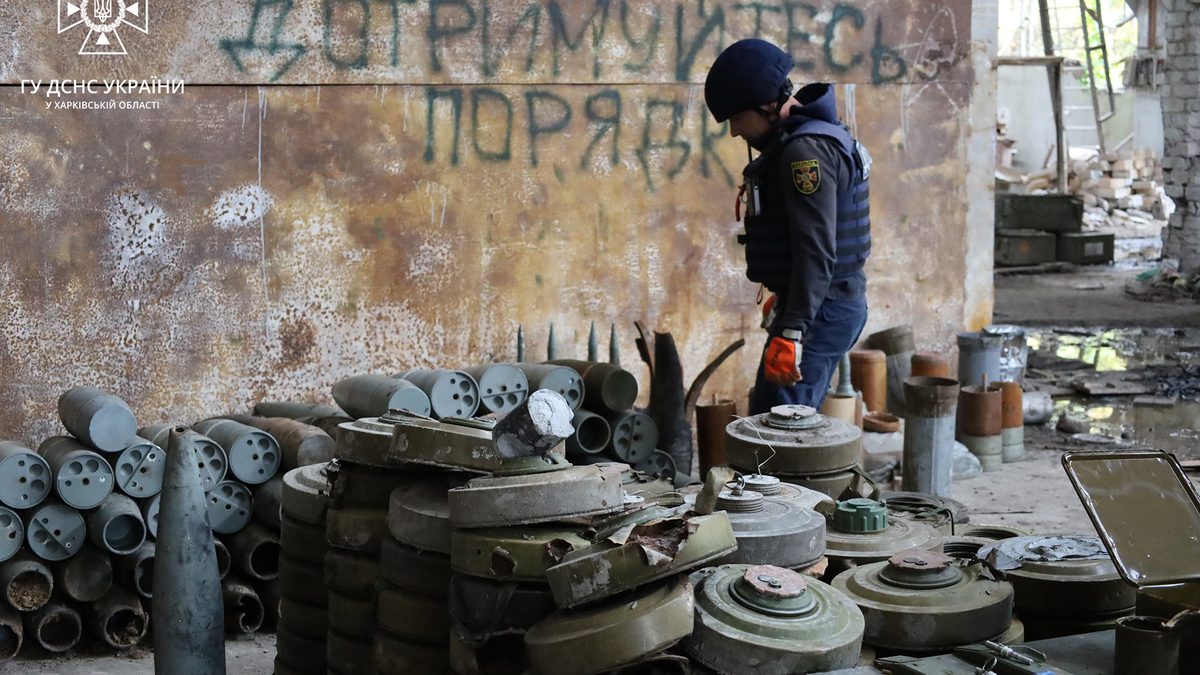
Figure 1. Ammunition assembled for demolition by SES EOD teams in Kharkiv Oblast. Legacy UXO recovered in April 2026 from Slobozhanska forest forms part of the same residual WWII and 2022–2023 conflict baseline. Image: Main Directorate of the State Emergency Service of Ukraine in Kharkiv Oblast (CC BY 4.0), via Wikimedia Commons.
What was recovered and where
Ukrinform reported on 12 April 2026 (19:34 local time) that explosive ordnance disposal (EOD) specialists of the State Emergency Service of Ukraine (SES) in Kharkiv Oblast had recovered and rendered safe a cache of 43 items of legacy ammunition. The cache consisted of 38 mortar shells and 5 artillery shells, identified by SES as dating from the Second World War, discovered in a forested area within the Slobozhanska territorial community [1]. SES confirmed that all items were removed from the discovery site and destroyed; the disposal method was not specified in the public release but SES standard practice is controlled demolition using commercial plastic explosive charges under IMAS 09.30 equivalent procedures.
Slobozhanska is a consolidated territorial community established under Ukraine’s 2020 decentralisation reform, situated in the administrative district north-east of Kharkiv city. The wider region saw sustained ground combat during the German 1941–1942 advance and the Soviet 1943 counter-offensive, and the discovered natures are consistent with Eastern Front mortar and divisional-artillery ammunition of that period.
Nature identification — probable types
SES did not publish calibres. However, the item-count ratio (38 mortar to 5 artillery) and the regional combat history make a confident candidate list possible. WWII-era mortar rounds recovered in Kharkiv Oblast forested terrain are most commonly the Soviet 82mm O-832 series, the Soviet 120mm OF-843A HE-fragmentation round, and the German 8cm Wgr 34 Wurfgranate for the Granatwerfer 34. Artillery rounds are most commonly Soviet 76.2mm OF-350 divisional-gun rounds or the German 10.5cm leFH 18 HE round.
For WOME practitioners the important hazard characteristics are not the calibres themselves but the filling. Soviet WWII-era HE rounds were predominantly filled with TNT or amatol (TNT + ammonium nitrate). German rounds of the period used TNT, Amatol 40/60, or in some later-war stocks Hexogen-based fills (cyclonite / RDX blends). Picric-acid filled ammunition was rarer on the Eastern Front than in Western European recovery sites but cannot be ruled out. All fillings age in the environment, and the practitioner-level risk assessment hinges on the state of the fuze train and the filling body.
Legacy WWII UXO — Key WOME Parameters
Probable mortar natures: Soviet 82mm O-832; Soviet 120mm OF-843A; German 8cm Wgr 34
Probable artillery natures: Soviet 76.2mm OF-350; German 10.5cm leFH 18 HE
Typical fillings: TNT, Amatol, occasional Hexogen blends; picric acid less common on Eastern Front
Fuzing: point-detonation nose fuzes (most) with inertia or clockwork delay elements in some artillery natures
Hazard Division (recovered): 1.1D assumed (HE nature, unproven fuze state) for transport and storage pending technical assessment
Render-safe procedure: in-situ demolition is the preferred option for forest-area caches; manual render-safe is proscribed unless recovery to a licensed disposal site is unavoidable
Reference standard: IMAS 09.30 Explosive Ordnance Disposal; IMAS 04.10 Glossary
Why aged munitions are not safer than fresh UXO
The public perception that decades-old ammunition is “inert” is incorrect and contributes to civilian casualty rates in former combat theatres. Three hazard mechanisms are material to any forest-recovery WOME assessment. First, TNT and amatol fillings undergo slow exudation of solid crystalline products, some of which (particularly from amatol) are more shock-sensitive than the original filling. Second, fuze trains in WWII-era nose fuzes include mechanical safing elements that degrade in the environment; aged fuzes may be armed without external indication. Third, steel cases corrode non-uniformly, and the interface between filling and casing can develop pressure-sensitive voids. For these reasons SES and equivalent national EOD organisations retain in-situ demolition as the preferred render-safe procedure wherever terrain and collateral risk permit [2][3].
Implications for UK and allied WOME practitioners
Two observations warrant attention. First, Kharkiv Oblast remains a live example of the layered UXO burden that formerly occupied territories carry, WWII legacy munitions continue to surface at a steady rate alongside the very large 2022-present UXO caseload. Any post-conflict stabilisation planning for Ukraine will need to retain a permanent legacy-EOD capability regardless of modern-UXO clearance throughput. Second, the SES case illustrates the operational value of national EOD responder training under doctrine equivalent to IMAS 09.30 and CWA 15464 (the European EOD qualification standard). UK engagement through the International Mine Action Coordination Centre (IMACC) and bilateral support to SES has reinforced this capability since 2022; this week’s recovery is an unremarkable but evidentiary data point.
Data gaps are significant. SES did not publish calibres, filling types, fuze state or demolition methodology. Photographic evidence of the recovered items is not in the public domain. These gaps are normal for routine EOD operational reporting and do not affect the WOME takeaway: the legacy burden is sustained, the render-safe procedure is sound, and the casualty-prevention messaging (call 101, do not touch) remains the correct public safety line.
References & Authorities
- [1] Ukrinform (12 April 2026): “In Kharkiv region, bomb disposal experts destroy over 40 WWII-era munitions.” ukrinform.net
- [2] International Mine Action Standards: IMAS 09.30 Explosive Ordnance Disposal. mineactionstandards.org
- [3] Counter-IED Report: “Ukraine: Bomb disposal experts destroy over 40 WWII munitions in Kharkiv region.” counteriedreport.com
- [4] State Emergency Service of Ukraine: Organisational overview. dsns.gov.ua
- [5] CEN Workshop Agreement 15464: Humanitarian Mine Action — EOD Competency Standards. [Available through European Committee for Standardization]