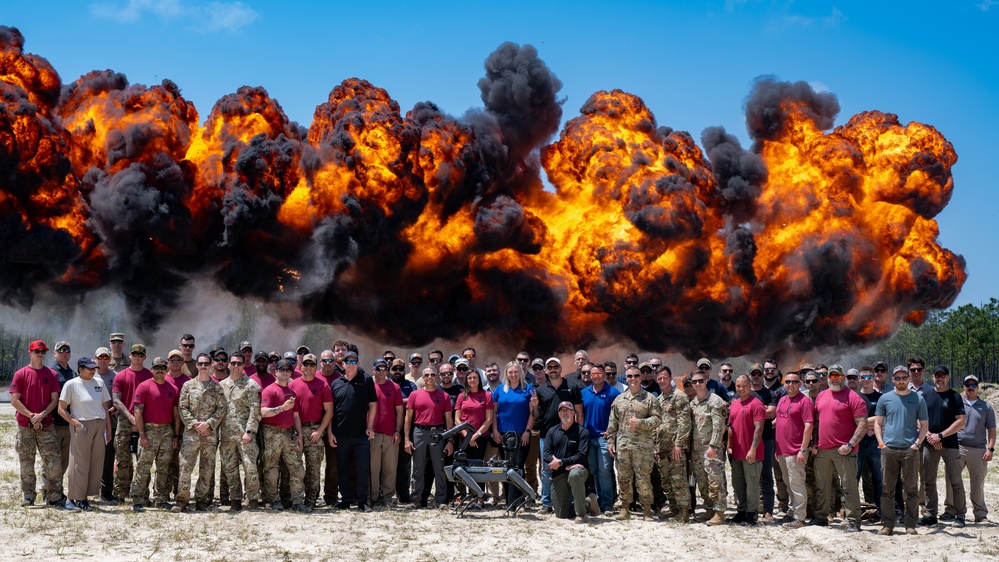
Operation Emerald Coast III (OEC III) is in progress this week at Hurlburt Field, Florida; the third consecutive annual iteration of the United States Bomb Technician Association’s (USBTA) flagship Capability Advancement Training Exercise (CAT-E). The “Opening Day officially underway” announcement published on 27 April 2026 places OEC III in the 27 April–3 May window, consistent with the established USBTA scheduling pattern: OEC I ran 30 April–3 May 2024; OEC II ran 28 April–1 May 2025.
The exercise is hosted in collaboration with the United States Air Force and the Florida Division of Investigative & Forensic Services Bureau of Fire, Arson, and Explosives Investigations, at Building 90621, 272 Red Horse Road, Hurlburt Field, home of Air Force Special Operations Command (AFSOC) and the 1st Special Operations Wing (1 SOW). Attendance is free to qualifying military EOD technicians and credentialled Public Safety Bomb Technicians (PSBTs) under the National Guidelines for Bomb Squads. The USBTA is registered as a 501(c)(3) non-profit (UEI ELXFYJCQ3VZ5, CAGE 81K65, GSA contract 47QSMS24D000Q).
OEC II in Pictures — Hurlburt Field, May 2025
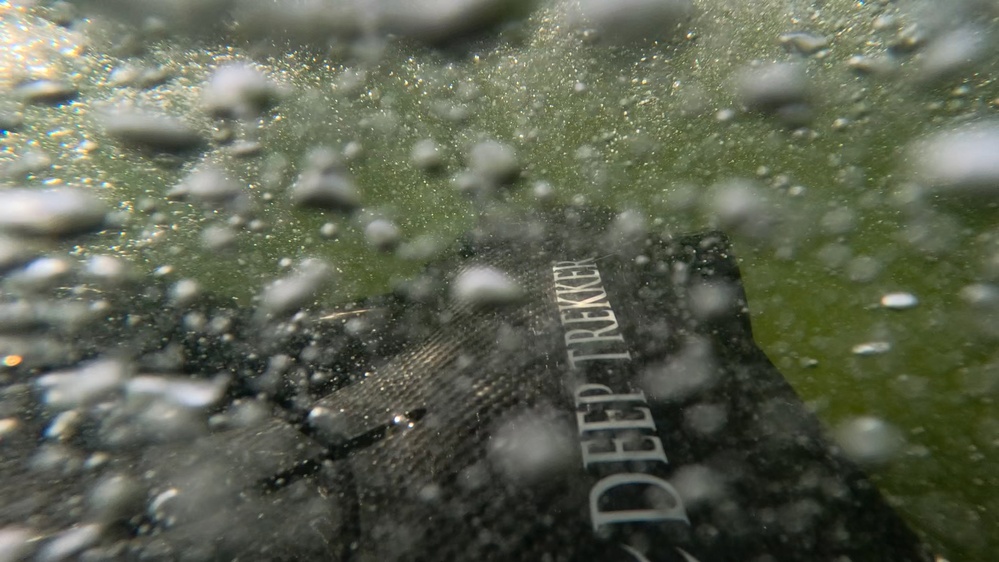
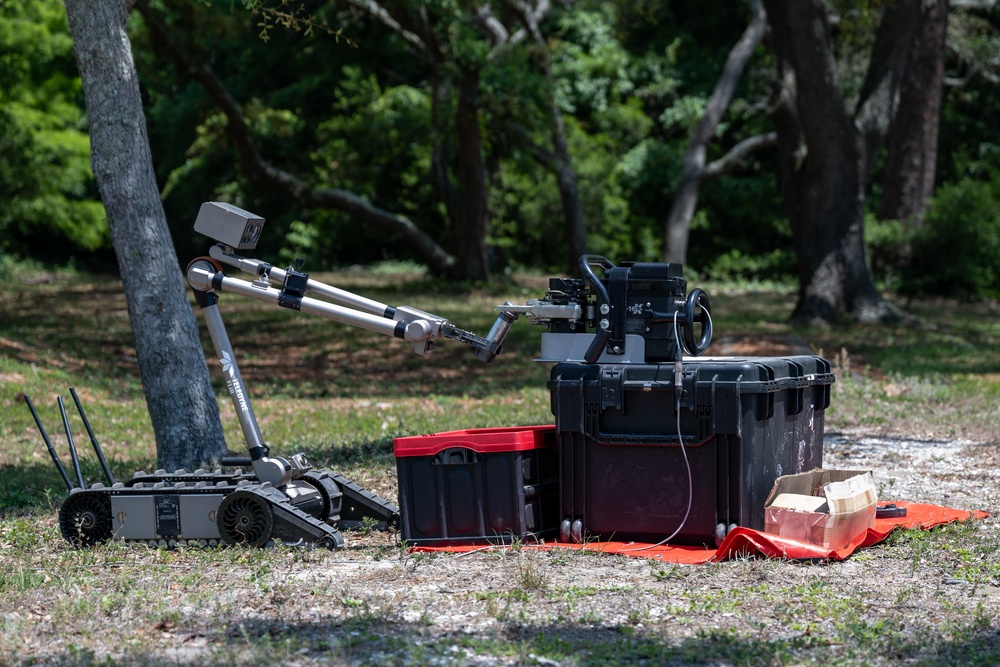
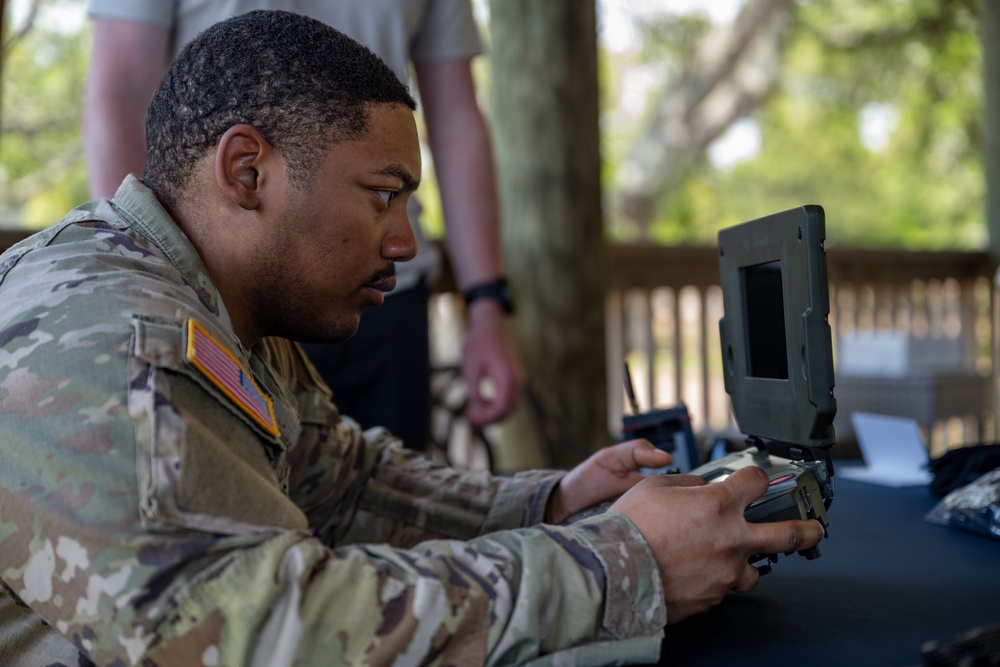
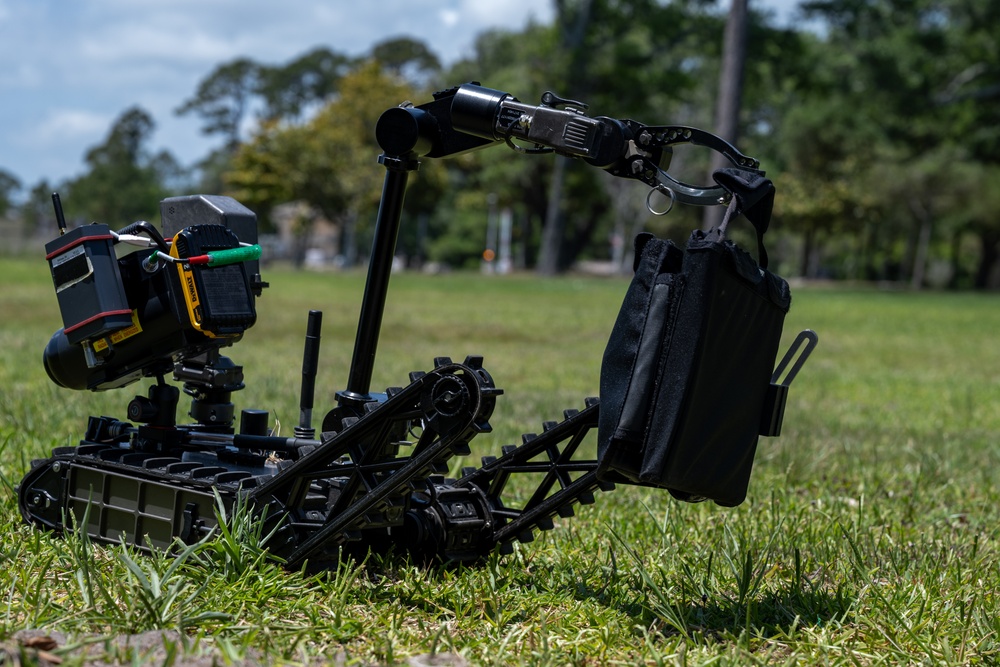
All images: 1st Special Operations Wing Public Affairs / DVIDS (DVIDS Article 497301). US Government works — public domain. Source: dvidshub.net
CAT-E Format and Proficiency Framework
The CAT-E designation carries specific regulatory weight within the US bomb squad ecosystem. Exercises structured under this format satisfy the formal training requirements for Bomb Technician proficiency mandated by the National Guidelines for Bomb Squads. The closest US analogue to the UK’s Explosive Ordnance Disposal and Search (EODS) competence framework. This gives the exercise standing as a counted proficiency event rather than an elective development activity.
Based on the OEC II curriculum, the exercise rotates participants through industry-delivered training stations spanning: homemade explosives (HME) identification, robotics integration, standoff disruption techniques, EOD-specific tool development, rigging procedures, X-ray technique and image interpretation, bomb suit application, uncrewed aerial vehicle (UAV) operations, hand entry procedures, and booby trap and anti-handling device mitigation. Each station is delivered by an industry partner whose equipment is under evaluation by attending technicians; the functional distinction from a conventional exercise is that the instructors are vendors and the instructed are credentialled end-users providing direct capability assessment.
Participating Units: The Operator Ecosystem
OEC II’s verified attendance roster established the breadth of the participant community. Military representation included the 754th and 749th Explosive Ordnance Disposal Companies (US Army), alongside 1 SOW EOD; the highest-readiness conventional EOD formation in the US military, operating in direct support of AFSOC. Federal law enforcement representation included the US Secret Service (USSS) and the Federal Bureau of Investigation (FBI), whose Hazardous Devices School at Redstone Arsenal is the gateway qualification for all federally credentialled PSBTs in the United States.
State and county participation at OEC II included Sanford Police Department, Gwinnett County Bomb Squad, Kane County Bomb Squad, Lake County Sheriff’s Office, and Harvard Homeland Security. The combination of federal intelligence and protection agencies alongside Special Operations EOD and a range of state/county PSBTs creates an exercise population spanning the full spectrum of US bomb squad operating environments, from deliberate high-threat military tasks to time-pressured public safety response.
OEC III — Key Intelligence Parameters
- Host: USBTA (501(c)(3), UEI ELXFYJCQ3VZ5, CAGE 81K65, GSA 47QSMS24D000Q) with USAF and Florida DFIS
- Location: Hurlburt Field, FL — AFSOC / 1st Special Operations Wing
- Format: CAT-E — meets National Guidelines for Bomb Squads proficiency requirements
- Dates: 27 April – 3 May 2026 (in progress; travel days bookend training window)
- Cost: Free to qualifying military EOD and Public Safety Bomb Technicians
- Confirmed partners (prior editions): Vidisco (portable X-ray), NP Aerospace (bomb suit)
- Confirmed units (OEC II): 1 SOW EOD, 754th & 749th EOD Coys (US Army), USSS, FBI, Gwinnett/Kane/Lake Co. Bomb Squads, Sanford PD, Harvard Homeland Security
OEC and the National Robot Rodeo: Two Pillars of US EOD Technology Evaluation
OEC sits in the same institutional niche as the National Robot Rodeo (NRR), both are vendor-rich evaluation exercises where serving bomb technicians assess emerging EOD technologies under realistic scenario conditions. The comparison is instructive because the two exercises have evolved distinct but complementary functions within the US EOD capability development ecosystem.
The NRR, held annually at Kirtland Air Force Base, New Mexico, in partnership with Sandia National Laboratories, is a competitive multi-team event focused specifically on uncrewed systems and robotics. Teams from military EOD formations and civilian bomb squads compete across timed scenarios involving robot manipulation, stair climbing, door operation, and terrain navigation. The NRR is now co-organised through a multi-agency consortium including the Air Force Civil Engineer Center (AFCEC), Sandia National Labs, the Defence Science and Technology Laboratory (Dstl, UK), the Department of Homeland Security (DHS) Cybersecurity and Infrastructure Security Agency Office for Bombing Prevention (OBP), and the EOD Technology Center (EODTECHCEN) at Naval Surface Warfare Center Indian Head (NSWC IHD). The USBTA itself assists in sourcing technologies for the NRR, reinforcing the institutional overlap between the two events. The 2024 NRR ran 26–30 August at Kirtland; 2025 planning is underway with the same agency partnership.
| Parameter | Operation Emerald Coast (OEC) | National Robot Rodeo (NRR) |
|---|---|---|
| Location | Hurlburt Field, FL (AFSOC) | Kirtland AFB, NM (Sandia NL) |
| Format | Collaborative training (CAT-E) | Competitive exercise (timed scenarios) |
| Technology focus | Broad: X-ray, robotics, suits, standoff, HME, UAVs, rigging, hand entry | Narrow: uncrewed systems and robotics exclusively |
| Operator community | Military EOD + PSBTs (federal, state, county) | Military EOD + PSBTs (competitive teams) |
| UK participation | Not confirmed (OEC I–II) | Dstl involved (2025 NRR co-organiser) |
| Annual timing | Late April – early May | August |
The key analytical distinction: OEC surfaces vendor signals across the full counter-IED capability spectrum in a collaborative environment, while the NRR provides a competitive benchmark specifically for robotic systems. For procurement analysts, OEC is the more sensitive leading indicator of “what’s actually getting into operators’ hands” across multiple technology domains simultaneously. For the robotic systems market specifically, NRR competitive results carry additional weight as a ranked performance benchmark.
Video Coverage
No Operation Emerald Coast footage is currently available on YouTube: all official video is hosted via DVIDS, where the 1st SOW Public Affairs office has published B-roll for each prior edition. The OEC I B-roll (DVIDS #922717, April–May 2024) is embeddable below directly from the DVIDS CDN.
National Robot Rodeo — YouTube Archive
While OEC has no YouTube presence, the National Robot Rodeo, the sister exercise at Kirtland/Sandia, has been documented on YouTube across multiple years. These clips show the competitive robot evaluation environment that OEC’s training format is analytically complementary to.

WOME Intelligence Significance: What the Exercise Signals
For WOME analysts and procurement professionals, the OEC series has established itself as a reliable leading indicator of counter-IED capability gaps the US bomb squad community is actively trying to close. The exercise format (free-to-attend for operators, industry-funded for delivery) means vendors self-select based on perceived market timing. A company committing to a training station at OEC is signalling that its product is mature enough for end-user evaluation and close enough to procurement eligibility to warrant the investment.
Three capability domains identified at prior OEC editions warrant specific monitoring at OEC III. First, portable X-ray systems: Vidisco’s confirmed prior participation reflects persistent operator demand for lightweight, high-resolution radiographic capability deployable by a two-person team. The X-ray interpretation station develops PSBT-level radiographic competence, suggesting demand exists not just for equipment but for standardised image-reading protocols. Second, standoff disruption: the recurring inclusion of this domain as a dedicated station reflects limitations in PSBT access to disruptor systems for scenarios where the operator cannot approach within hand-entry parameters. Third, UAV integration: the UAV operations station signals continued interest in operator-deployable uncrewed systems for reconnaissance and potential payload delivery in IEDD contexts.
Attributed & Evaluated References (STANAG 2022)
- DVIDS / 1 SOW PA — “Hurlburt Field Joins Forces in Bomb Training & Technology” (OEC II, May 2025). Reliability A / Accuracy 1. dvidshub.net/news/497301
- DVIDS — Video #922717: “EOD Training: Operation Emerald Coast B-Roll” (OEC I, May 2024). Reliability A / Accuracy 1. dvidshub.net/video/922717
- USBTA — OEC II event page. Reliability A / Accuracy 1. usbta.us
- AFIMSC — “National Robot Rodeo Ropes in Emerging EOD Technologies” (NRR 2024). Reliability A / Accuracy 1. afimsc.af.mil
- USBTA — Call for Technologies, 2025 National Robot Rodeo (NRR 2025 partner list). Reliability A / Accuracy 1. usbta.us/call-for-technologies
- Vidisco — OEC field report, portable X-ray systems. Reliability B / Accuracy 2. vidisco.com
- SAM.gov — USBTA entity record (UEI ELXFYJCQ3VZ5, CAGE 81K65). Reliability A / Accuracy 1. sam.gov
ISC Analysis — Open Source / Unclassified
OEC and the NRR together function as the two primary open-source signals for the direction of US counter-IED technology procurement. OEC surfaces the broad-spectrum vendor evaluation landscape across all capability domains (X-ray, robotics, standoff, suits, HME, UAVs) in a collaborative multi-agency environment; the NRR provides the competitive robotic systems benchmark. Neither event publishes a formal technology assessment, but the vendor participation list and subsequent procurement activity from participating units creates a traceable signal chain.
Two intelligence questions are worth tracking as OEC III’s after-action coverage emerges. First, which vendors not present at OEC II have entered the programme for OEC III; this would indicate new entrants into the US counter-IED supply chain who have achieved sufficient product maturity. Second, whether the UAV operations station has evolved to include payload-capable platforms; at OEC II this was reconnaissance-focused, but the integration of small UAS into IEDD roles is rapidly maturing across NATO EOD formations. The 2025 NRR partnership with Dstl (UK) is worth cross-referencing against any UK-origin vendor appearances at OEC III; this would indicate a transatlantic supply chain connection forming ahead of formal procurement.
Hood’s framing of OEC as a “support group” mechanism rather than a training event is analytically significant. It suggests the USBTA is consciously positioning OEC as a relationship-building infrastructure for the multi-jurisdictional bomb squad community; a community that will be required to cooperate operationally in any domestic mass-casualty IED scenario. The exercise’s value extends beyond technology evaluation into the procedural interoperability domain.