The First Sea Lord opened his Royal United Services Institute (RUSI) address by reaching for Lord Fisher: the Edwardian disruptor whose Dreadnought, submarine and naval-aviation programmes broke a decades-old hardware monopoly so completely that, by 1914, Imperial Germany had given up trying to match them. The choice of patron was deliberate. The speech, delivered on 29 April 2026 to mark the inaugural Lord Fisher lecture, asked its audience to read a Royal Navy approaching its own technological cliff-edge into the same lineage of state-led industrial transformation. It announced a Hybrid Navy of crewed, uncrewed and autonomous platforms; three Atlantic Fleet programmes covering sub-surface defence, integrated air and missile defence, and conventional strike; a Northern Navies coalition headed by the United Kingdom; and a target end-state by 2029.
What the speech did not address (and what cannot honestly be discussed without) is the condition of the conventional fleet underneath the Hybrid layer. The amphibious capability that British naval doctrine has described as central to the force since the 1982 Falklands campaign has, in the eighteen months running up to this address, been hollowed out to a point that has no precedent in the post-war Royal Navy. The arithmetic, set against the speech’s commitments, is the single most important context for what was said.
What the First Sea Lord Committed To
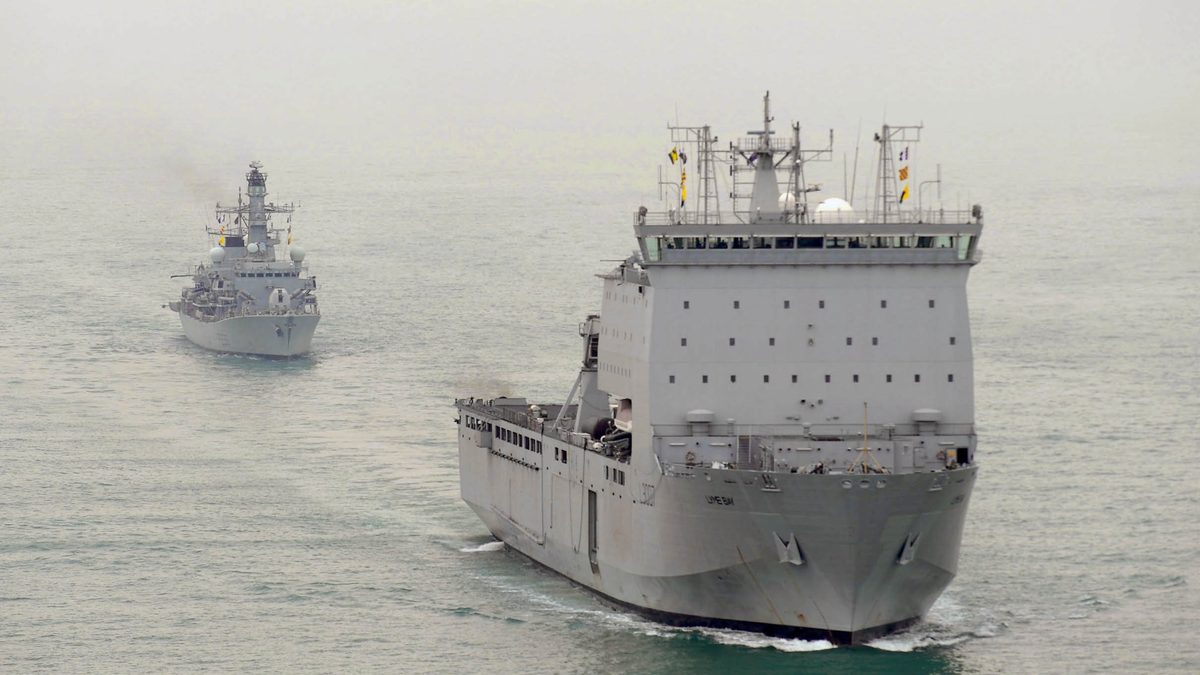
Five concrete announcements were made. First, that the Royal Navy’s first Navy-wide Hybrid wargame, held at Southwick Park in March 2026, returned a three-fold increase in available missile capacity at the formation level, described as “the level necessary to win a contest in the North Atlantic.” Second, that the Royal Marines’ 47 Commando has taken delivery of twenty uncrewed surface vessels (USVs) under Project Beehive, supplied by the British firm Kraken Technology Group. Third, that RFA Lyme Bay, an auxiliary dock landing ship, has been converted into a mothership for autonomous mine countermeasures (MCM) systems for prospective Middle East deployment. Fourth, that a statement of intent was signed last week with naval chiefs from across northern Europe, with a formal declaration on a Northern Navies coalition due by the end of 2026. Fifth, that the first uncrewed gliders for the Atlantic Bastion sub-surface sensor net will be in the water this calendar year, with uncrewed escorts in company with frigates within two years and a jet-powered drone launched from a carrier next year.
The framing was confident. The Royal Navy will, by 2029, be “much stronger than the one I inherited.” A new procurement model would cut decision-to-delivery to as little as three months for certain systems. The North Atlantic and High North are reaffirmed as the geographic priority (consistent with the 2025 Strategic Defence Review (SDR)) with the Joint Expeditionary Force (JEF) construct evolving into a deeper interchangeable maritime force. The Type 26 frigate, eight British and at least five Norwegian under the December 2025 Lunna House Agreement, sits at the structural centre of that coalition. Canada follows.
The Capability That Has Been Removed
The speech is a doctrine of platform integration. To assess it requires looking at the platforms that exist to be integrated. The amphibious lift inventory the First Sea Lord inherited in 2025, and the inventory he is operating with on 29 April 2026, are different fleets.
| Platform | Class | Status | Capability Lost |
|---|---|---|---|
| HMS Albion | Albion-class LPD | Withdrawn Nov 2024; disposal announced | Brigade-scale C2; well-deck for four LCU Mk10; flagship-fitted |
| HMS Bulwark | Albion-class LPD | Withdrawn Nov 2024; disposal announced | As Albion; second hull for refit-rotation continuity |
| HMS Ocean | Landing platform helicopter | Decommissioned 2018; sold to Brazil | Helicopter assault deck; brigade lift; aviation maintenance |
| RFA Sir Galahad / Tristram / Bedivere / Geraint / Lancelot / Percivale | Sir Galahad-class LSL | All retired by mid-2000s | Logistic landing; vehicle deck capacity; ramp-to-shore lift |
| RFA Largs Bay | Bay-class LSD(A) | Sold 2011 to Royal Australian Navy as HMAS Choules | Fourth Bay-class hull; rotation depth |
| RFA Lyme Bay | Bay-class LSD(A) | Reroled March 2026 as MCM mothership | Amphibious well-deck role suspended for current deployment |
| RFA Cardigan Bay | Bay-class LSD(A) | Forward-based Gulf, then UK; LRG(S) | One of two remaining amphibious-tasked hulls |
| RFA Mounts Bay | Bay-class LSD(A) | Forward-based; LRG(N) | One of two remaining amphibious-tasked hulls |
The Albion-class withdrawal, announced by the Defence Secretary on 20 November 2024, was justified to Parliament on the basis of a recurring saving of approximately £9 million per year. Both ships had spent the preceding period in extended readiness; the financial logic turned on avoiding refit costs against a notional Multi-Role Strike Ship (MRSS) replacement window. Neither hull had been fully crewed since 2017. That made the decision politically painless and operationally significant in equal measure: a navy that had been able to put a Landing Platform Dock (LPD) to sea now cannot, and will not be able to until at least the early 2030s.
The Three Bay-Class Calculation
The Royal Fleet Auxiliary’s three remaining Bay-class hulls (Cardigan Bay, Lyme Bay and Mounts Bay) therefore carry the entire UK amphibious lift role. The capacity audit is unforgiving. Each Bay-class displaces approximately 16,160 tonnes, ships one LCU Mk10 and two LCVP Mk5s in the well dock and on davits, can lift 24 Challenger 2-equivalent main battle tanks or 150 light vehicles, and accommodates 356 embarked troops at standard density (rising to 700 on austere benches over short distances). They are good ships. They were not designed to be the only ships.
Three structural problems compound the headcount. First, the Lyme Bay conversion to a mine-countermeasures mothership for the Middle East (announced by the Royal Navy on 29 March 2026) removes one of the three from the amphibious roster for the duration of that mission. Second, the Royal Fleet Auxiliary itself is in a sustained crewing crisis. Public reporting through 2024 and 2025 documented that only six of eleven RFA hulls could be crewed on a regular basis; many vessels operate under a Tailored Scheme of Complement, the safety-floor minimum, often 20–30 per cent below establishment. RMT and Nautilus International members have voted to take strike action over pay in five rounds since late 2024, with a further ballot reported through April 2026. The crewing crisis is not abstract: a hull that cannot be crewed cannot deploy. Third, the LCVP Mk5 ship-to-shore connector entered service in 1996 and is scheduled for retirement in 2027. The Commando Insertion Craft (CIC) replacement programme is still running through industry engagement, with delivery targeted at 2028 at the earliest. The LCU Mk10 is older still.
Available amphibious-tasked hulls capable of generating brigade-or-above lift at NATO Article 5 short-warning timelines: two (RFA Cardigan Bay, RFA Mounts Bay), both Royal Fleet Auxiliary-crewed under industrial-action conditions. No Royal Navy LPD hull. No LPH. The 1982 Falklands landing put approximately 4,600 personnel of 3 Commando Brigade ashore, lifted by HMS Fearless, HMS Intrepid, the Sir Galahad-class LSLs, and a fleet of Ships Taken Up From Trade including SS Canberra, SS Norland and the Atlantic Conveyor. The contemporary independently deployable Commando Force is sized at one Commando battlegroup of approximately 1,800 personnel. The reduction in independent UK amphibious mass over forty-four years is greater than 60 per cent, and the standing UK merchant fleet that supplied the 1982 STUFT ships has itself contracted by over 80 per cent in the same period.
The Bridge That Has Not Been Built
The replacement programme exists on paper. The MRSS (renamed in March 2025 from Multi-Role Support Ship to Multi-Role Strike Ship to align with Atlantic Strike branding) is currently planned for an in-service date of 2033 or 2034. Defence Equipment & Support has committed to up to six hulls, with three firm and three optional. The programme is moving from concept to assessment phase in 2026. No prime contractor has been selected. Babcock, BAE Systems, Cammell Laird and Harland & Wolff are the named candidate yards. Industry assessments, including Shephard Defence Insight, conclude that a contract must be placed by the end of 2026 or early 2027 to avoid a structural capability gap from 2033 onwards.
Read against the speech: the First Sea Lord is committing to a navy “much stronger” by 2029, while the principal hardware bridge to that future (the platform that is supposed to carry the Royal Marines into the High North under Atlantic Strike) will not exist in any form, in any quantity, until four years after he leaves office. The Bay-class will, on current trajectory, still be the operational amphibious fleet in 2029. The MRSS is a 2033 conversation, on the optimistic end.
Why Now? Five Drivers Behind the Pivot
The question Steve’s briefing invited (why has the UK had to undertake this Hybrid pivot at the precise moment its tactical landing-ship capability has been decimated) resolves to five overlapping pressures.
1. The Strait of Hormuz. The First Sea Lord referenced “the shutting of the Strait of Hormuz by Iran” and “the first Iranian missiles” without further elaboration. The implicit context is that the Royal Navy was caught short of a credible MCM capability for a contested chokepoint, having retired the Hunt and Sandown classes faster than the autonomous replacement programme could mature. The Lyme Bay re-role is not a doctrinal innovation; it is a contingency. A Hybrid Navy story makes the contingency look like a design choice.
2. Russian sub-surface reinvestment. The cited 30 per cent uplift in Russian incursions into UK waters, the Defence Secretary’s April 2026 disclosure of disrupted Russian submarine activity, and the “most acute threat” framing of the Russian Yasen-M and Borei-A programmes all point in the same direction: continuous-at-sea deterrent (CASD) protection and critical national infrastructure (CNI) defence have absorbed the surface escort fleet’s spare capacity. Atlantic Bastion is, in part, an attempt to substitute uncrewed sensors for the frigate hulls that no longer exist in number to provide persistent surveillance.
3. The Black Sea proof of concept. The Sea Lord’s most striking statistic (that Ukraine, with no warships, has destroyed or disabled approximately a third of the Russian Black Sea Fleet using maritime drones, uncrewed surface vessels and long-range strike) gives the Hybrid pivot political cover. It also genuinely matters. Magura V5, Sea Baby and the long-range Storm Shadow / Neptune combination have demonstrated that a modest, distributed, expendable sub-fleet can produce strategic effect. The lesson is real. Whether it is the right lesson for amphibious operations in the High North (where weather, ice, and adversary anti-ship capability are categorically different) is a separate question that the speech did not engage.
4. Treasury arithmetic. Uncrewed systems are cheaper per unit, faster to procure under the Strategic Defence Review’s three-month decision-to-delivery target for selected systems, and politically easier to scale than capital ships. Twenty Project Beehive Kraken USVs cost a fraction of one MRSS at preliminary design stage. The pivot to Hybrid permits the visible capability story to run ahead of the Treasury commitment to the platform-replacement bow wave. It also defers the MRSS funding decision into a future spending review, where it can be combined with other large naval programmes (the Type 83 destroyer, the next Astute-replacement nuclear-powered submarine class) for political packaging.
5. NATO and JEF allies pulling forward. The Northern Navies initiative is not solely a UK-led project. Norway has placed a £10 billion order for at least five Type 26 frigates. The Lunna House Agreement establishes interchangeability of crews, parts, ammunition and training between the Royal Navy and the Royal Norwegian Navy. Sweden, Finland and the Baltic states have pulled the JEF deeper into territorial defence framing since the 2022 Russian invasion of Ukraine and the 2024 NATO accession of Sweden. A coalition centred on UK doctrine, Northwood command-and-control and the Fleet Operational Standards and Training framework requires the UK to demonstrate naval credibility now — before MRSS, before the Type 83, with the inventory it has. The Hybrid Navy is the only credible answer the Royal Navy can give in 2026 with the hardware on hand.
“Just maintaining the ‘capable status quo’ is simply not good enough.”
First Sea Lord, RUSI, 29 April 2026The Limits of the Hybrid Answer
The Hybrid Navy is not an empty concept. The wargame at Southwick Park appears, on the limited public reporting, to have been a serious analytical exercise. The three-fold uplift in formation-level missile capacity is consistent with what a frigate-plus-uncrewed-escort grouping can plausibly add in vertical-launch cells and decoy mass. Project Beehive’s Kraken K3-derived USVs are credible insertion-and-resupply platforms for 47 Commando’s small-team operating model. Atlantic Bastion is a coherent response to the under-the-ice threat. Atlantic Shield is consistent with the integrated air and missile defence (IAMD) pivot now underway across NATO. None of this is wrong.
The limit is what uncrewed systems cannot do. They cannot land a Commando battlegroup with vehicles and combat support across a contested beach. They cannot provide the sustained logistic over-the-shore (LOTS) tonnage required to support a brigade ashore for thirty days. They cannot generate the command-and-control, aviation maintenance, and casualty receiving facilities of a 16,000-tonne LSD(A) hull. They cannot substitute for the absent hull in the well dock that the LCU Mk10 was designed to deploy from. They are, at the current state of the art, complementary — not substitutional.
The First Sea Lord’s speech is honest enough to say that Hybrid is an addition, not a replacement: “this paradigm shift is not about replacing existing capabilities. It is about increasing the mass, survivability and lethality of our force.” The unspoken difficulty is that some of the existing capabilities the Hybrid layer was supposed to multiply (specifically, the LPD layer) have already been removed. The multiplier is being applied to a smaller base than the doctrine assumes.
What Comes Next
The next twelve months will determine whether the speech’s logic holds. Three indicators warrant close monitoring. Whether the MRSS contract is awarded by the end of 2026, as Shephard’s programme tracker indicates is necessary; the assessment phase entry alone is not sufficient. Whether RFA crewing is stabilised through a durable pay settlement and a reversal of the Tailored Scheme of Complement regime, or whether industrial action returns through 2026. Whether the Northern Navies declaration in late 2026 carries a hard amphibious-lift commitment from JEF members (Norwegian Skjøld-class corvettes, Dutch LPD HNLMS Johan de Witt, the Karel Doorman-class Joint Logistic Support Ship, the Danish Absalon-class) sufficient to fill the British capability hole at coalition level.
If those three threads hold, the speech will read in retrospect as a successful pivot under fire. If any one of them fails, the gap between Atlantic Strike on paper and the two crewable Bay-class hulls in port will widen until it cannot be reasonably bridged by language.
Sources and References
- First Sea Lord, “First Sea Lord Speech at RUSI — the inaugural Lord Fisher lecture,” Ministry of Defence, 29 April 2026. gov.uk. [Tier 1 — A/1]
- HM Government, “Strategic Defence Review 2025,” published 2 June 2025. House of Commons Library briefing CBP-10408 covering Royal Navy and Royal Fleet Auxiliary implications. commonslibrary.parliament.uk. [Tier 1 — A/1]
- Defence Secretary statement on capability disposals, 20 November 2024 — covered by Naval Technology and UK Defence Journal. Naval Technology. [Tier 2 — B/2]
- Navy Lookout, “What will be the real consequences of axing the Royal Navy’s LPDs?” 2024. navylookout.com. [Tier 3 — B/2]
- Janes, “UK to retire Albion-class amphibious assault ships, one Type 23 frigate, and Wave-class tankers by March 2025.” janes.com. [Tier 2 — A/2]
- Naval Technology, “Royal Navy’s Multi-Role Strike Ship not due until 2033 at the earliest.” naval-technology.com. [Tier 2 — B/2]
- Defence Equipment & Support, “DE&S to order Royal Marines up to six Multi-Role Support Ships,” May 2024. des.mod.uk. [Tier 1 — A/1]
- Shephard Media, “Multi-Role Strike Ship (MRSS) Programme,” programme tracker. plus.shephardmedia.com. [Tier 2 — B/2]
- Navy Lookout, “Royal Fleet Auxiliary sailors seeking fair pay hold fifth round of industrial action.” navylookout.com. [Tier 3 — B/2]
- The News (Portsmouth), “‘Deepening crisis’ within Royal Fleet Auxiliary forces sailors to strike for better pay.” portsmouth.co.uk. [Tier 3 — C/3]
- Royal Navy press release, “New tech added to RFA Lyme Bay so it can act as minehunting mothership,” 29 March 2026. royalnavy.mod.uk. [Tier 1 — A/1]
- Naval News, “UK and Norway ink new Lunna House Agreement,” December 2025. navalnews.com. [Tier 2 — A/2]
- Naval News, “UK plans new Commando Insertion Craft (CIC),” CNE 2023 reporting; updates through 2024 and 2025. navalnews.com. [Tier 2 — B/2]
- Defence Committee written evidence, “Sunset for the Royal Marines? The Royal Marines and UK amphibious capability,” multiple submissions. committees.parliament.uk. [Tier 1 — A/1]
- Royal Navy news, “Royal Navy hosts JEF naval chiefs to reinforce deterrence in North Atlantic and Baltic,” 22 April 2026. royalnavy.mod.uk. [Tier 1 — A/1]
This analysis is AI-assisted and based entirely on open-source materials in the public domain. It does not constitute legal, regulatory, procurement or operational advice. Source evaluation follows NATO STANAG 2022 reliability and accuracy criteria. All classification: Open Source / Unclassified.
The First Sea Lord delivered a serious speech. The Hybrid Navy framing, the three Atlantic programmes, and the Northern Navies coalition are the right responses to the strategic environment described. The wargame data, if accurate, is significant. Project Beehive is real. The Lunna House Agreement is the most consequential Royal Navy export deal in decades. None of that is in dispute.
What is in dispute is whether the speech’s implied promise (that a Royal Navy “much stronger” than the one inherited can be delivered by 2029) is compatible with the hardware reduction the same Royal Navy has accepted in the eighteen months running up to the address. The arithmetic at platform level says no. Two crewable Bay-class hulls, three Atlantic programmes still in early prototyping, an MRSS programme not yet contracted, an LCVP Mk5 retirement two years out with no replacement in service, and a Royal Fleet Auxiliary running on industrial-action ballots do not add up to a stronger force in three years. They add up to a different force, with different doctrine, attempting to do new things because some of the old things can no longer be done.
The honest version of the speech would have included a sixth announcement: that the United Kingdom has, between November 2024 and March 2026, ceased to be a navy capable of independent brigade-scale amphibious operations. The Hybrid Navy is, in part, a coherent response to that fact. But the gap between the speech’s confidence and the inventory beneath it is now wide enough that defence procurement planners, NATO partners and parliamentary scrutiny committees should be reading this address as a flag, not a reassurance. The Lord Fisher framing was apt: Fisher built Dreadnought to maintain a margin he understood to be eroding. The First Sea Lord’s margin is already gone.