Türkiye’s Guided Bomb Ecosystem: Aselsan’s Serial Production Marks a Quiet Shift in NATO Precision Strike Independence
Western defence planners assume that precision-guided munitions flow from American factories to allied air forces — but Türkiye has spent two decades building a parallel ecosystem of GPS/INS guidance kits, winged glide bombs, and laser-guided systems that now rivals JDAM and Paveway in technical capability, and the serial production milestone makes that independence irreversible.
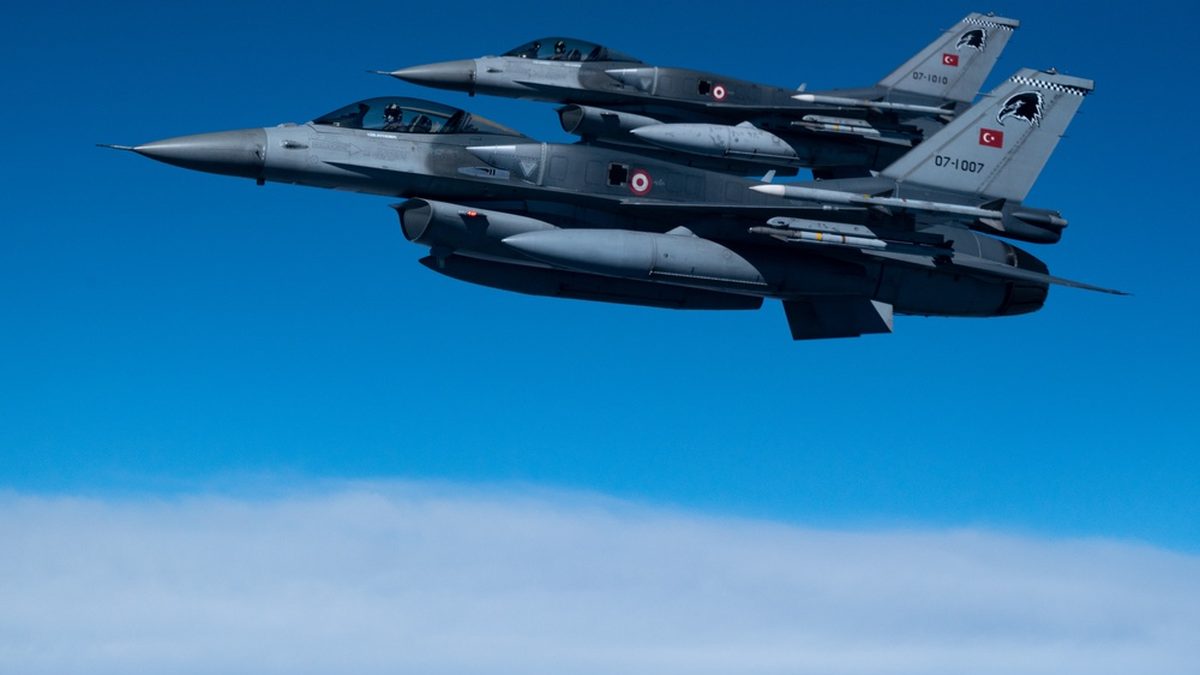
Section 1: The Serial Production Milestone — What It Means for WOME
Aselsan’s transition to serial production of guided bomb kits is not a sudden announcement. It is the culmination of a procurement strategy that Türkiye has pursued since the early 2000s, when the United States proved reluctant to supply Joint Direct Attack Munitions (JDAMs) to the Turkish Air Force (Türk Hava Kuvvetleri, THK) on Türkiye’s preferred terms. That reluctance created a national imperative: build an indigenous precision-guided munitions (PGM) capability that could not be embargoed.
The result is not a single guidance kit. It is a family of at least seven distinct systems spanning GPS/INS direct-attack, winged standoff glide, laser-guided, and dual-mode configurations — all designed to convert standard NATO Mk 80-series bomb bodies into precision weapons. Serial production means Türkiye can now manufacture these kits at industrial scale, equip its own air force without import dependency, and export to third-party customers without US International Traffic in Arms Regulations (ITAR) constraints.
For WOME practitioners, the significance is specific. Every one of these kits fits onto the same Mk 81, Mk 82, Mk 83, or Mk 84 general-purpose bomb bodies used across NATO air forces. Türkiye now produces both the bomb bodies domestically (through Makina ve Kimya Endüstrisi Kurumu, MKE) and the guidance kits to convert them. That is a complete national PGM production chain — explosive fill, casing, fuzing, and guidance — outside the Western supply ecosystem.
Who Builds What
One common error in reporting is attributing all Turkish guidance kits to Aselsan. The development landscape is more distributed. TÜBİTAK SAGE (the Scientific and Technological Research Council’s Defence Industries Research and Development Institute) developed the original HGK and KGK families. Roketsan developed the TEBER laser/GPS dual-mode series. Aselsan developed the LGK laser-guided series and, more recently, entered the guided bomb market directly with systems including contributions to the GÖZDE programme and the Tolun penetrator munition.
Serial production at Aselsan therefore represents a second major Turkish manufacturer entering volume guidance kit production alongside TÜBİTAK SAGE — effectively doubling the national industrial base for this class of munition.
Section 2: The Full Türkiye Precision Munitions Family
Türkiye’s guided bomb ecosystem is wider than most Western analysts appreciate. The following table maps every known production-status guidance kit against its NATO-standard bomb body, guidance type, and published standoff range.
| System | Developer | Bomb Body | Guidance | Range | Status |
|---|---|---|---|---|---|
| HGK-82 | TÜBİTAK SAGE | Mk 82 (500 lb) | GPS/INS | 28 km | Serial production |
| HGK-83 | TÜBİTAK SAGE | Mk 83 (1,000 lb) | GPS/INS | 28 km | Serial production |
| HGK-84 | TÜBİTAK SAGE | Mk 84 (2,000 lb) | GPS/INS | 28 km | Serial production |
| KGK-82 | TÜBİTAK SAGE | Mk 82 (500 lb) | GPS/INS + wings | 110 km | Serial production |
| KGK-83 | TÜBİTAK SAGE | Mk 83 (1,000 lb) | GPS/INS + wings | 110 km | Serial production |
| KGK-84 | TÜBİTAK SAGE / Aselsan | Mk 84 (2,000 lb) | GPS/INS + wings | 100+ km | Testing (F-16 drop test successful) |
| TEBER-81/82 | Roketsan | Mk 81/82 (250/500 lb) | GPS/INS/Laser | 28 km | Serial production |
| GÖZDE | TÜBİTAK SAGE | Mk 82 (500 lb) | GPS/INS/Laser | 28 km | F-16 tested (2025) |
| LGK | Aselsan | Mk 81/82/83/84, NEB, OFAB-250T | Semi-active laser (SAL) | 12 km (6.5 NM) | In service (F-16, F-4, F-15, Su-25) |
| Tolun | Aselsan | Purpose-built penetrator | GPS/INS | Classified | F-16 tested Dec 2025; LRIP expected H2 2026 |
| National SDB | Aselsan / TÜBİTAK SAGE | ~145 kg class | GPS/INS | 55–100 km | Serial production negotiations |
The table reveals a pattern that few Western commentators have mapped in full. Türkiye has at least three independent guidance kit families in serial production (HGK, KGK, TEBER), with a fourth (GÖZDE) completing qualification testing, and two new-build munitions (Tolun penetrator and National SDB) approaching low-rate initial production. Every Mk 80-series weight class from 250 lb to 2,000 lb is covered. Both direct-attack (short-range, GPS/INS) and standoff (winged, 100+ km) roles are addressed. Laser guidance is available through TEBER, GÖZDE, and Aselsan’s own LGK for moving-target engagement.
Aselsan LGK — The Overlooked Workhorse
Aselsan’s Laser Guidance Kit (LGK) warrants separate attention because it is the most versatile single kit in the Turkish inventory — and the one most often underestimated in Western assessments. According to Aselsan’s published specifications, LGK converts all four NATO-standard Mk 80-series bomb bodies (Mk 81, Mk 82, Mk 83, and Mk 84) into laser-guided weapons. It also fits the 2,000 lb Turkish NEB (National Explosive Bomb) and — critically for export markets — the Russian-origin 250 kg OFAB-250T. That last compatibility is not a footnote: it opens a market segment that no Western guidance kit addresses, specifically air forces operating mixed NATO/Soviet-standard munition inventories.
| Parameter | LGK Specification |
|---|---|
| Guidance | Semi-Active Laser (SAL) seeker with canard control |
| Range | 6.5 NM (12 km) |
| Accuracy (CEP) | < 30 ft (~9 m) |
| Altitude envelope | 0 – 40,000 ft MSL |
| Speed envelope | 600 KIAS / Mach 1.2 (carriage/release limit) |
| Seeker FOV | ±15° |
| Aircraft electrical interface | None required |
| Compatible warheads | Mk 81 (250 lb), Mk 82 (500 lb), Mk 83 (1,000 lb), Mk 84 (2,000 lb), NEB (2,000 lb), OFAB-250T (250 kg) |
| Integrated platforms | F-16, F-4, F-15, Su-25 |
| Components | SAL seeker, guidance section, thermal battery, canard control system, rear wing |
| Target types | Stationary and moving (with after-release re-targeting) |
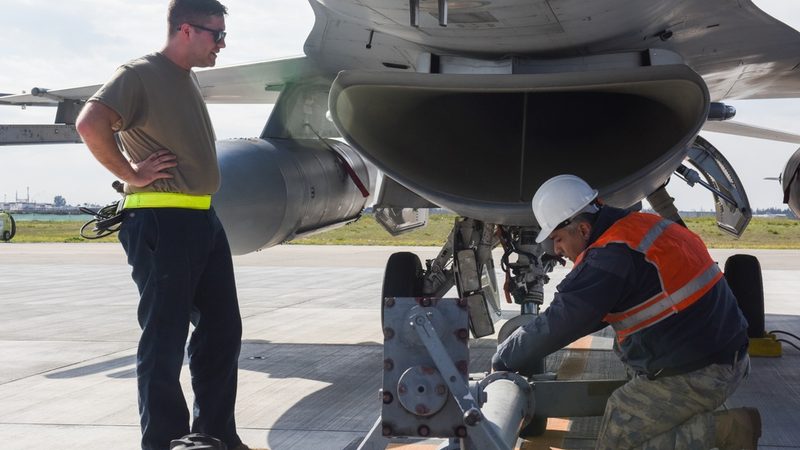
Two details from the specification sheet stand out. First, the “Aircraft Electrical Interface: None” line means LGK requires zero modification to the host aircraft’s wiring or fire-control system. The kit is mechanically attached to the bomb body and operates autonomously once released, homing on laser energy reflected from the target. That makes integration on new platforms trivially simple compared to GPS/INS kits, which typically require a MIL-STD-1760 aircraft-store electrical interconnect for pre-launch GPS initialization and mission data transfer.
Second, the platform list — F-16, F-4, F-15, and Su-25 — spans both NATO and former Soviet aircraft. The Su-25 Frogfoot is operated by multiple post-Soviet and African air forces that Türkiye has cultivated as defence export customers. Pairing an LGK-equipped OFAB-250T with a Su-25 creates a precision strike capability from entirely non-Western components, delivered by a NATO member state. That combination has no equivalent in the US or European export catalogue.
Section 3: How Türkiye’s Kits Compare to JDAM and Paveway
The HGK family is functionally equivalent to the Boeing GBU-31/32/38 JDAM. Both convert unguided Mk 80-series bombs into GPS/INS guided weapons. Both achieve comparable circular error probable (CEP) figures in the 10–13 metre range with GPS, or under 3 metres with differential GPS corrections. Both are all-weather capable and do not require terminal guidance from the launching aircraft. The difference is sovereignty: JDAM procurement requires a US Foreign Military Sales (FMS) case or Direct Commercial Sale with State Department approval, ITAR end-use monitoring, and re-export restrictions. HGK procurement requires a contract with TÜBİTAK SAGE and approval from the Turkish Presidency of Defence Industries (SSB).
The KGK family extends the comparison further. With pop-out wings and a 110 km standoff range, KGK-82 and KGK-83 operate in the same class as the Boeing JDAM-ER (Extended Range), which adds a wing kit to a standard JDAM to achieve glide ranges of approximately 72 km. The KGK-84, with its reported 100+ km range on a 2,000 lb body, appears to exceed JDAM-ER performance — a point noted by Ukrainian defence publication Defence Express when covering the system’s EDEX 2025 debut.
| Parameter | JDAM (GBU-38) | JDAM-ER | HGK-82 | KGK-82 | Paveway IV | TEBER-82 |
|---|---|---|---|---|---|---|
| Bomb body | Mk 82 (500 lb) | Mk 82 (500 lb) | Mk 82 (500 lb) | Mk 82 (500 lb) | Mk 82 (500 lb) | Mk 82 (500 lb) |
| Guidance | GPS/INS | GPS/INS + wings | GPS/INS | GPS/INS + wings | GPS/INS/Laser | GPS/INS/Laser |
| Range | ~28 km | ~72 km | ~28 km | ~110 km | ~28 km | ~28 km |
| Moving targets | No | No | No | No | Yes (laser) | Yes (laser, ≤50 km/h) |
| Origin | United States | United States/Australia | Türkiye | Türkiye | United Kingdom | Türkiye |
| Export control | ITAR | ITAR | SSB | SSB | UK export licence | SSB |
The comparison reveals that Türkiye has not simply replicated JDAM. It has built analogues across the full precision munitions spectrum: HGK matches JDAM for direct attack, KGK exceeds JDAM-ER for standoff range, and TEBER matches Paveway IV for dual-mode laser/GPS capability against moving targets. The National SDB programme, when it enters production, will parallel the Boeing GBU-39/B Small Diameter Bomb — the small-form-factor precision weapon designed for internal carriage on stealth aircraft. That last point matters, because Türkiye’s fifth-generation MMU/TF-X (Kaan) fighter will need an SDB-class weapon for its internal weapons bays.
Section 4: Aselsan — The Company Behind the Production Line
Aselsan Elektronik Sanayi ve Ticaret A.Ş. (Trade & Industry of Electronic Industries) was established in 1975 by the Turkish Armed Forces Foundation (TAFF), which retains a 74.2% ownership stake. The founding impetus was direct: the United States had imposed an arms embargo on Türkiye following the 1974 Cyprus intervention, and the Turkish military concluded that dependence on foreign electronics suppliers was a strategic vulnerability that required a national solution.
That founding rationale — build at home what others will not sell you — has driven five decades of vertical integration. Aselsan now operates across five business sectors: Communications and Information Technologies (HBT), Microelectronics, Guidance and Electro-Optics (MGEO), Radar and Electronic Warfare (REHIS), Defence Systems Technologies (SST), and Transportation, Security, Energy and Automation (UGES).
Financial Scale
Aselsan’s 2025 financial results, published in February 2026, confirm a company operating at a scale that places it among the world’s top 50 defence firms. Revenue reached 180.4 billion Turkish Lira ($4.11 billion), a 15% real-terms increase over 2024. Export contracts surged 104% to exceed $2 billion. Order intake grew 46% to $9.6 billion. The order backlog now stands at $20.4 billion — representing roughly five years of revenue at current rates.
Research and development expenditure hit $1.36 billion, a 40% annual increase. That R&D spend is concentrated in precisely the areas relevant to guided munitions: seekers, inertial navigation units, GPS receivers, electro-optical systems, and guidance algorithms.
Key Recent Contracts
| Contract | Value | Date | Significance |
|---|---|---|---|
| ÇelikKubbe (Steel Dome) air defence | $6.5 billion (joint with Havelsan, Roketsan) | Nov 2025 | Türkiye’s largest-ever defence contract |
| EW systems for Poland | $410 million | 2025 | First major NATO member export in electronic warfare |
| Air defence & radar delivery to THK | $460 million | Aug 2025 | 47 high/medium/low-altitude systems |
The $410 million Polish electronic warfare contract deserves particular attention. Poland is a NATO ally that has historically procured almost exclusively from US and Western European suppliers. Choosing Aselsan for an EW system signals that Turkish defence electronics are now considered competitive at the NATO Tier 1 level — not just in the traditional Turkish export markets of Pakistan, the Gulf states, and sub-Saharan Africa.
The Öğulbey Technology Base
Aselsan’s capacity expansion is physical, not just financial. The Öğulbey Technology Base, a $1.5 billion investment, is under construction and will double the company’s production capacity upon commissioning. Turkish leadership has described it as the largest air defence production facility in Europe. When operational, Öğulbey will absorb guided munition component production alongside radar, EW, and seeker manufacturing — concentrating Türkiye’s precision strike supply chain in a single hardened site.
Section 5: Platform Integration — From F-16 to Kaan
All production-status Turkish guidance kits are currently integrated on the F-16C/D Block 50+, which forms the backbone of the THK’s combat fleet. But the integration roadmap extends across Türkiye’s entire next-generation aerial fleet, including platforms that have no Western analogue for guided munitions certification.
| Platform | Type | Developer | Guidance Kits Planned |
|---|---|---|---|
| F-16C/D Özgür | Modernised 4th-gen fighter | TAI | HGK, KGK, TEBER, GÖZDE, LGK, Tolun, SDB |
| Kaan (MMU/TF-X) | 5th-gen fighter | TAI | HGK, KGK, SDB (internal bay), Tolun |
| Bayraktar Akıncı | HALE UCAV | Baykar | HGK-82, KGK-82, TEBER, MAM-L |
| TAI Aksungur | MALE UCAV | TAI | HGK-82, TEBER, MAM-L |
| TAI Hürjet | Advanced jet trainer / light attack | TAI | HGK-82, TEBER |
| Bayraktar Kızılelma | Unmanned fighter | Baykar | HGK-82/83/84, KGK-82 |
The Kızılelma integration is the most strategically significant item on this list. An unmanned combat aircraft carrying GPS/INS guided bombs eliminates pilot risk entirely from the precision strike mission. If Türkiye achieves operational Kızılelma deployment with HGK-84 integration — a 2,000 lb GPS/INS bomb on an unmanned jet — it will field a capability that no NATO ally currently operates in production.
Section 6: Export Implications and the ITAR-Free Advantage
Every US-origin guided munition carries ITAR obligations: end-use certificates, re-export restrictions, Congressional notification thresholds, and ongoing compliance monitoring. For many nations, these conditions are acceptable. For others — particularly in the Middle East, South and Southeast Asia, and sub-Saharan Africa — they are either politically unacceptable or practically unattainable.
Türkiye’s guided bomb family offers these customers a technically comparable product with simpler export terms. The approval chain runs through SSB (the Presidency of Defence Industries), not the US State Department. There is no ITAR re-export clause. End-use monitoring is bilateral between Türkiye and the customer, not triangulated through Washington.
The Akıncı UCAV has already demonstrated this export pathway. Pakistan, Azerbaijan, and several Gulf and African states have acquired or expressed interest in Bayraktar Akıncı armed with Turkish PGMs. If an Akıncı customer buys HGK or TEBER guidance kits alongside the platform, they acquire a complete ISR-strike package with no US components triggering ITAR jurisdiction — a clean supply chain from airframe to warhead.
That ITAR-free advantage extends to the emerging unmanned combat aircraft market. Kızılelma, if it enters export service with HGK integration, would be the first ITAR-free unmanned precision strike platform available on the international market. The strategic implications for US influence over global munitions flows are considerable.
ISC Commentary
Türkiye’s guided bomb ecosystem did not appear overnight, but the serial production milestone makes the strategic implications unavoidable. A NATO ally now manufactures a complete family of precision-guided munitions — from 250 lb laser-guided to 2,000 lb winged standoff — entirely outside the US and European supply chains that have historically monopolised this capability within the alliance.
The interoperability question cuts both ways. Türkiye uses the same Mk 80-series bomb bodies as every NATO air force, and HGK achieves comparable accuracy to JDAM. But NATO has no standardisation agreement (STANAG) governing guidance kit interchangeability, no mutual recognition of Turkish PGM qualification testing, and no established framework for allied air forces to procure Turkish kits as alternatives to JDAM when US supply chains are constrained. In a conflict where JDAM production cannot keep pace with expenditure rates, Türkiye’s kits represent unused NATO capacity.
For the export market, the absence of ITAR restrictions is the decisive factor. Nations that cannot obtain US FMS approval — or will not accept the end-use monitoring conditions — now have a technically credible alternative from a NATO member state. Aselsan’s $2 billion export surge in 2025 suggests the market has noticed.