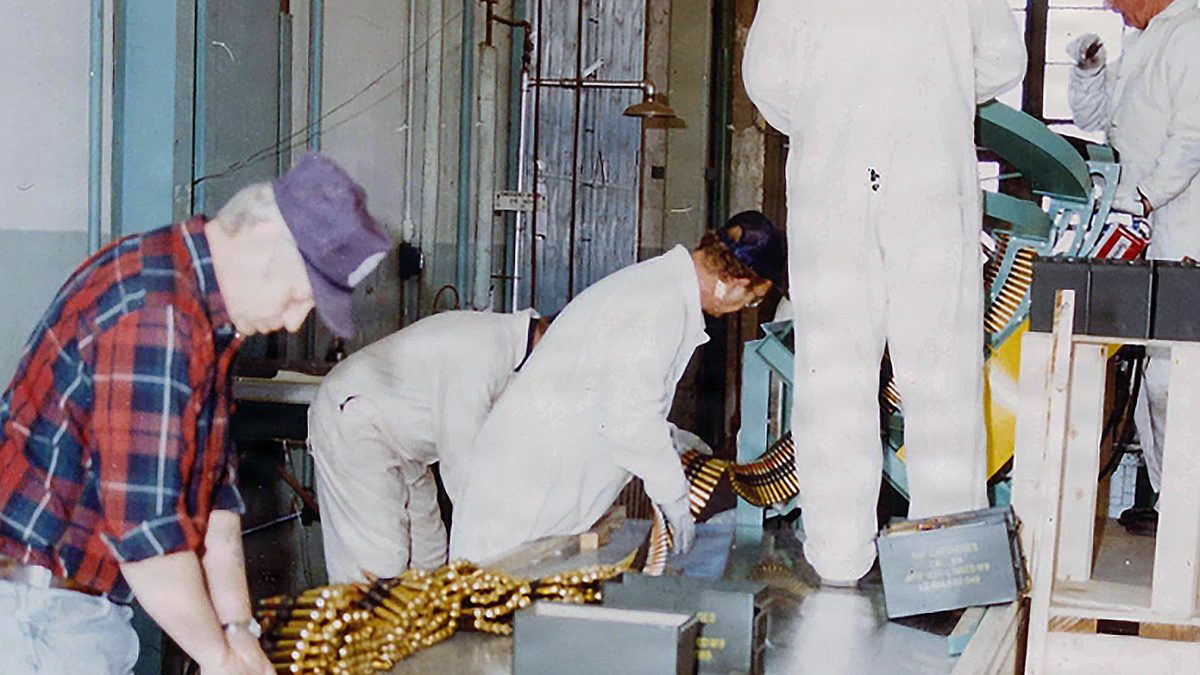
Blue Grass Army Depot employees handling linked small-arms ammunition. Historical US Army photograph, date not stated by the originator, released through the Defense Visual Information Distribution Service (US Government work, public domain). The image is illustrative of the depot's small-arms handling mission and does not show the facility awarded on 18 September 2026.
A 170,000 square foot replacement: Blue Grass moves its small-arms magazine away from the road
The United States Army Corps of Engineers awarded Bristol Group LLC $35,356,272 on 18 September 2026 to design and build a small-arms ammunition magazine at Blue Grass Army Depot, Richmond, Kentucky. The Army's own environmental record describes a 170,000 square foot magazine that replaces deteriorating World War II storage and moves small-arms ammunition further inside the restricted area, away from a major public road.
Technical Summary
The award appears in the United States Department of War daily contract announcement for 18 September 2026. Bristol Group LLC of Lexington, Kentucky takes a design-build construction contract worth $35,356,272, fully obligated at award, for a small-arms ammunition magazine at Blue Grass Army Depot. Bids were solicited over the internet and four were received. Work is at Richmond, Kentucky, with an estimated completion date of 24 June 2029. The contracting activity is the United States Army Corps of Engineers, Louisville District, under contract number W912QR-26-C-A037. The requirement reached the market as solicitation W912QR-26-R-A049, issued on 22 April 2026 with offers due on 22 May 2026.
The bulletin stops at the money, but the Army had already published what the building is for. A Blue Grass Army Depot environmental assessment fact sheet, issued for public comment between 4 May and 3 June 2025, describes a proposed 170,000 square foot small-arms ammunition magazine and states the reason plainly: the existing small-arms magazines were constructed during the Second World War and the design is, in the Army's words, no longer adequate for the storage of large quantities of small-arms ammunition. The same document records the siting decision. The proposed action moves small-arms ammunition storage to a further interior location inside the restricted area, creating a larger safety buffer between the magazine and a major public traffic route. That is a recapitalisation and a separation-distance project, not an expansion of shelf space.
The existing magazines were constructed during World War II and the design is no longer adequate for the storage of large quantities of small arms ammunition. US Army, Blue Grass Army Depot environmental assessment fact sheet, May 2025
What the Army had already published
The project record predates the award by more than a year. These are the figures the Army itself put into the open, set against what the contract announcement adds.
| Item | Open-source position | Source layer |
|---|---|---|
| Proposed floor area | 170,000 square feet | Environmental assessment fact sheet, May 2025 |
| Stated need | Existing small-arms magazines built during the Second World War; design no longer adequate for storing large quantities of small-arms ammunition | Environmental assessment fact sheet, May 2025 |
| Siting change | Storage moves to a further interior location inside the restricted area, widening the safety buffer to a major public traffic route | Environmental assessment fact sheet, May 2025 |
| Environmental finding | No significant environmental impacts; draft Finding of No Significant Impact issued for comment 4 May to 3 June 2025 | Environmental assessment fact sheet, May 2025 |
| Solicitation | W912QR-26-R-A049, issued 22 April 2026, offers due 22 May 2026 | Aggregated federal contract-opportunity record |
| Award | W912QR-26-C-A037, $35,356,272, four bids, completion estimated 24 June 2029 | Department of War daily contract announcement, 18 September 2026 |
Where this award lands
The Joint Munitions Command lists seven storage and distribution facility locations. Those seven sites are the set used below. The test applied to each is narrow and stated deliberately: whether a new small-arms ammunition magazine construction award for that site appears in the open contracting record as at 20 September 2026. The status picture is taken on that date and on that question alone.
| Site | Location | Award in the open record | Status |
|---|---|---|---|
| Blue Grass Army Depot | Richmond, Kentucky | W912QR-26-C-A037, $35,356,272, announced 18 September 2026, Bristol Group LLC | Awarded |
The remaining six sites are listed below against the same test on the same date.
| Site | Location | Small-arms magazine award in the open record |
|---|---|---|
| Anniston Munitions Center | Anniston, Alabama | Not publicly documented |
| Crane Army Ammunition Activity | Crane, Indiana | Not publicly documented |
| Hawthorne Army Depot | Hawthorne, Nevada | Not publicly documented |
| Letterkenny Munitions Center | Chambersburg, Pennsylvania | Not publicly documented |
| McAlester Army Ammunition Plant | McAlester, Oklahoma | Not publicly documented |
| Tooele Army Depot | Tooele, Utah | Not publicly documented |
"Not publicly documented" is a statement about the open record and nothing more. It does not mean no magazine work is under way at those sites, and it does not mean none is programmed. Military construction is announced project by project, there is no consolidated public register of magazine construction across the command, and a project can be authorised, designed and under way without ever producing a line in a daily contracts bulletin that names its purpose. What the table does establish is that Blue Grass Army Depot is the only one of the seven with a new small-arms magazine award visible in that record today.
The production side, for comparison
The rounds a magazine of this kind would hold come from a narrower set again. Two sites carry the small-calibre load in the Fiscal Year 2026 Army ammunition procurement justification.
| Site | Location | Open-source position |
|---|---|---|
| Lake City Army Ammunition Plant | Independence, Missouri | Named in the Fiscal Year 2026 Army ammunition procurement justification as a site whose minimum sustaining rate the budget supports |
| Second source facility | Oxford, Mississippi | Named in the same justification alongside Lake City. Olin Winchester LLC, the 11 September 2026 awardee, is recorded at Oxford, Mississippi in the contract announcement |
Scope note
This article covers a construction award and the storage layer it sits in. It makes no assessment of any ammunition nature, lot, stockpile quantity or operational holding, and no statement about what the awarded facility will hold. Every technical parameter discussed in the safety section is a general classification convention, not a licensed value for this building.
Analysis of Effects
What makes the award worth more than its line in a contracts bulletin is the node it sits on. Blue Grass Army Depot is a 14,596-acre Joint Munitions Command installation in Madison County, Kentucky, established in April 1942 as an ordnance supply depot. Its stated mission is to receive, store, issue, maintain, renovate and demilitarise conventional and non-standard ammunition for every Department of Defense service, and the depot describes itself as a strategic mobility power-projection site and the primary South-East regional distribution point for Department of Defense munitions. A purpose-built small-arms magazine at that address is infrastructure for the wider distribution system, not a local fix for a site that has run out of shelf space.
Two things follow from reading the award and the environmental record together. The first is a correction to the obvious story. Seven days before this award, on 11 September 2026, Army Contracting Command at Rock Island Arsenal awarded Olin Winchester LLC $788,361,894 under contract W519TC-26-D-A024, an indefinite-delivery, indefinite-quantity instrument for 5.56 mm, 7.62 mm and calibre .50 ammunition running to an estimated completion of 10 September 2031. One bid was solicited and one received. It would be easy to read the magazine as somewhere to put the output. Two facts stop that reading: the magazine is funded from Fiscal Year 2025 Military Construction, Army, so it was programmed a full budget cycle earlier, and the Army's stated purpose is replacing life-expired storage rather than adding capacity. The second is about lead time. The construction period itself is about 1,010 days from award to the June 2029 estimate. The long pole is everything in front of it: validating the requirement, clearing the National Environmental Policy Act process, siting against quantity-distance criteria, and appropriating the money. That chain started no later than the May 2025 public comment period and will finish in 2029.
Personnel and Safety Considerations
The siting decision is the part a practitioner should read twice, because it is a quantity-distance decision stated in plain English. Moving the magazine to a further interior location inside the restricted area, in order to widen the buffer between stored ammunition and a major public traffic route, is the textbook response to an inhabited-building or public-traffic-route separation that the original Second World War layout no longer satisfies. Depots built in 1942 were sited against the road network and the explosives safety criteria of 1942, and both have moved since. On classification, packaged small-arms ammunition is conventionally assigned Hazard Division 1.4, most often Compatibility Group S, under the United Nations scheme on which the governing US regulation, the Defense Explosives Safety Regulation DESR 6055.09 Edition 1 Change 2 of 25 November 2025, and its NATO analogue AASTP-1 both build. United Nations number 0012, covering cartridges for weapons with inert projectile and small-arms cartridges of calibre not larger than 19.1 mm, captures most of what such a magazine holds, and that classification drives materially shorter separations than a Hazard Division 1.1 store. None of that is a statement about this building. No licensed hazard division, compatibility group, net explosive quantity (NEQ), magazine type or approved quantity-distance arc for the awarded facility has been disclosed, and the general convention is offered here as context rather than as a licensed parameter.
Data Gaps
The following are recorded as gaps rather than inferred. The awarded facility's licensed hazard division, compatibility group, net explosive quantity limit, magazine type and approved quantity-distance arcs are all undisclosed. The 170,000 square foot figure is the proposed area in the May 2025 environmental record and is a planning figure, not a confirmed as-built area for the contract as awarded. The Fiscal Year 2025 Military Construction project number and its authorised programme amount have not been located in the open budget record, so the relationship between the appropriation and the $35,356,272 award price is unverified. No open-source statement links this magazine to a named ammunition nature, unit or stockpile objective. The Joint Munitions Command does not publish a consolidated register of magazine construction across its installations, so the comparison set above rests on the absence of a public award record rather than on a negative return from a controlled register.
Key Questions
What did the US Army award at Blue Grass Army Depot in September 2026?
On 18 September 2026 the US Army Corps of Engineers, Louisville District, awarded Bristol Group LLC of Lexington, Kentucky $35,356,272 for design-build construction of a small-arms ammunition magazine at Blue Grass Army Depot, Richmond, Kentucky. Four bids were received. The contract is W912QR-26-C-A037 and completion is estimated for 24 June 2029.
Why is the Army replacing the existing small-arms magazines?
Because they are life-expired and badly sited. The Army's May 2025 environmental record states the existing magazines were built during the Second World War and the design is no longer adequate for storing large quantities of small-arms ammunition. The replacement also moves the storage further inside the restricted area to widen the safety buffer to a major public road.
Is the magazine a response to the Winchester small-calibre ammunition contract?
No, on the evidence available. The $788,361,894 Olin Winchester award for 5.56 mm, 7.62 mm and calibre .50 ammunition was announced on 11 September 2026, seven days before the magazine award, but the magazine is funded from Fiscal Year 2025 construction money and the Army's stated purpose is replacing life-expired storage rather than adding capacity.
References
Source-evaluated per NATO source-evaluation doctrine, STANAG 2022 lineage (source reliability A–F / information credibility 1–6). Tier 1 = government primary source; Tier 2 = quality news / specialist defence media; Tier 3 = authoritative aggregator / encyclopaedia.
- T1US Department of War – Contracts for Sept. 18, 2026, 18 September 2026. (Reliability A / Credibility 1)
- T1US Army, Blue Grass Army Depot – FACT SHEET: Environmental Assessment and Draft Finding of No Significant Impact for the Construction of a Small Arms Ammunition Magazine, Public comment 4 May to 3 June 2025. (Reliability A / Credibility 1)
- T2GlobalSecurity.org (verbatim mirror of the Department of War announcement) – Contracts for Sept. 11, 2026, 11 September 2026. (Reliability B / Credibility 1)
- T1US Army Joint Munitions Command – About JMC: purpose, focus and installations, Accessed 20 September 2026. (Reliability A / Credibility 2)
- T1Program Executive Office, Assembled Chemical Weapons Alternatives – Last Chemical Weapon Destroyed at Blue Grass Army Depot, 7 July 2023. (Reliability A / Credibility 1)
- T1US Department of Defense Explosives Safety Board (DENIX) – DESR 6055.09 Edition 1, Defense Explosives Safety Regulation, Change 2, 25 November 2025. (Reliability A / Credibility 1)
- T3HigherGov (aggregated SAM.gov record) – Construction of Small Arms Ammunition Magazine, Blue Grass Army Depot, solicitation W912QR26RA049, Issued 22 April 2026. (Reliability C / Credibility 3)
Editorial responsibility. This analysis is researched, written and published under the editorial responsibility of Steve Sawyers, MIExpE VR. Every technical claim is sourced to named open-source material and rated for reliability and accuracy under NATO STANAG 2022. ISC uses its own domain-trained research and drafting system under human direction; the analysis, the judgements and the accountability for them are ours. Corrections and updates welcome: if you hold open-source data that refines or corrects any parameter here, write to [email protected] citing the specific claim and your source. Verified corrections are incorporated and credited in the revision history. Full editorial and AI policy.