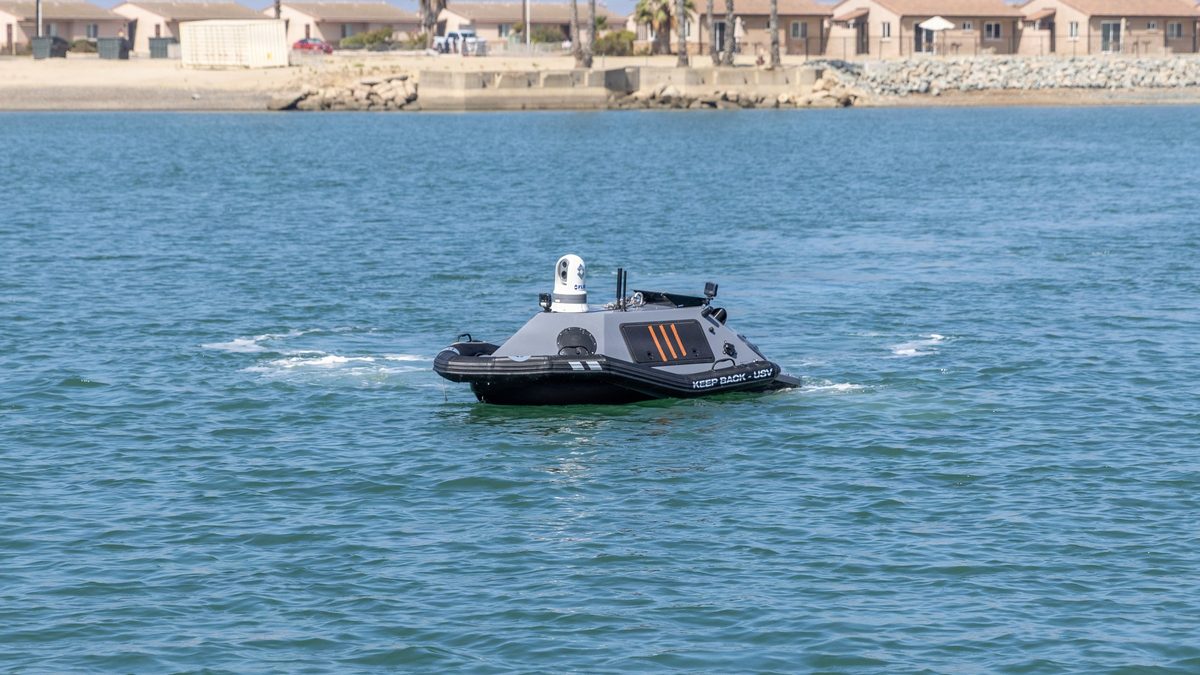
In late August 2026 at Camp Pendleton, California, the PM CSS Explosive Hazard Defeat Team tested an unmanned surface vessel against a littoral capability gap. Photo taken 19 August 2026, released 15 September 2026. PAE Marine Corps photo by Kristiana Gehly. Public domain, US Government work; no endorsement implied.
The Marine Corps Has Validated LEON's Fourth Increment: a Surface Robot That Finds Ordnance and Cannot Neutralise It
Portfolio Acquisition Executive Marine Corps validated an unmanned surface vessel at Camp Pendleton in late August 2026 as the fourth of five Littoral Explosive Ordnance Neutralization increments. Carrying sonar, forward-looking infrared and acoustic communications, it searches very shallow water and relays contacts to the other LEON systems. Fielding to explosive ordnance disposal companies is set for Fiscal Year 2027. It confirms and marks hazards; it does not neutralise them.
Technical Summary
Program Manager Combat Support Systems (PM CSS), under Portfolio Acquisition Executive Marine Corps (PAE MC), ran a two-week Field User Evaluation of an unmanned surface vessel (USV) at Camp Pendleton, California, in late August 2026. The released imagery is dated 19 August and the release itself was issued on 15 September. The PM CSS Explosive Hazard Defeat Team and explosive ordnance disposal (EOD) technicians from 7th Engineer Support Battalion first worked the vehicle in calm water against mock mine targets they had laid themselves, then ran wide-area search in varied sea states off the Pacific coast. The vessel is a commercial hull fitted with autonomous waypoint navigation and a payload comprising sonar, forward-looking infrared (FLIR), line-of-sight (LOS) communications and acoustic communications (AComms).
The Littoral Explosive Ordnance Neutralization (LEON) system of systems runs to five increments: a remotely operated vehicle, diver equipment, an unmanned underwater vehicle, this surface craft as the fourth, and an amphibious unmanned ground vehicle. Its stated task band runs from very shallow water to the beach zone, and its stated function is to confirm and mark hazards and obstacles. Capt Timothy Guinan, project officer on the Explosive Hazard Defeat Team, described the USV as primarily an enabler for the subsurface systems, relaying contacts to the surface in real time, and as carrying a communications capability in the form of a Mobile Gateway Buoy (MGB). Validation sets a fielding path to EOD companies in Fiscal Year 2027, with the wider LEON family to be fielded in the next two years, counted from the September 2026 release.
Unmanned systems allow operations to continue without fatigue. These systems can be launched and left to conduct a mission for upwards of 14 hours covering large areas of the littorals, while it requires minimal manpower to monitor the system. Capt Timothy Guinan, project officer, Explosive Hazard Defeat Team, Program Manager Combat Support Systems
Analysis of Effects
The word neutralization in the programme title is doing more work than this increment delivers. Everything stated about the USV is detection, classification support and communications relay: it finds, and it reports. Confirming and marking a contact leaves the render-safe or disposal task exactly where it has always sat, with an EOD technician, a diver, or a placed demolition charge. The gain is standoff and persistence, not a shortened sequence against an individual mine, and the distinction is worth holding because surf-zone clearance rate is set by how quickly the disposal end of the task can be closed rather than by how quickly contacts can be generated. A search asset that produces more classified contacts per hour than the disposal element can service relocates the bottleneck instead of removing it. That is still a real gain, because the survey leg is where the exposure hours accumulate, but it is a different gain from the one the programme name advertises.
One figure does not quite reconcile. Guinan's reference to upwards of 14 hours of unattended mission time is framed in the release as a general property of unmanned systems, and the platform itself is not officially identified. USNI News attributes the hull to the AEVEX Mako Lite on the basis of released imagery and video: a 2.7 m derivative of the 3.4 m Mako, for which the manufacturer publishes 12.5 hours of endurance, a range of up to 250 nautical miles and a configurable 100 lb payload capacity. If that identification is correct, the official 14-hour statement sits above the published endurance of the candidate hull, which would point either to a lighter payload state, a different duty cycle, or a claim made about the class rather than about this vessel. ISC treats the platform identification as an attributed inference from a reliable outlet rather than as confirmed fact, and treats the endurance difference as unresolved rather than as an error by either party.
Personnel and Safety Considerations
The safety case for LEON is exposure reduction, and on the evidence available it is a sound one. Very shallow water and the surf zone are the worst conditions in which to put a diver against moored or bottom-laid ordnance: degraded visibility, surge loading on the swimmer and the item alike, and an approach that has to be made by hand. Substituting a surface search asset and a subsurface vehicle for a swimmer on the search leg removes human presence from the phase that generates the most exposure hours for the least decisive result. The reduction is consistent with the as low as reasonably practicable principle rather than an elimination of risk, because the disposal phase remains manned and because a mis-marked or unclassified contact transfers risk forward to whoever later crosses that lane. Contact records, positional accuracy and the marking convention therefore become safety-critical data rather than administrative output, and none of those three elements is described in the release.
Data Gaps
No official platform identification, and no contract, quantity or unit cost for the USV. No sonar type, operating frequency, swath width or classification performance, so no detection rate and no false-alarm rate can be assessed. No sea-state limit: the release says different sea states without stating which. No Mobile Gateway Buoy range, data rate or endurance. No endurance figure attributable to the hull as configured, against which the upwards of 14 hours claim could be checked. No identification of the LEON unmanned underwater vehicle, which has remained unpublished since the programme began fielding increments in 2021. No statement of how the neutralisation task is closed once a hazard has been marked, and no description of the marking convention or of positional accuracy. No planned quantity of vessels per EOD company, and no total programme value for the increment.
Key Questions
What is the Marine Corps LEON system?
Littoral Explosive Ordnance Neutralization is a US Marine Corps system of systems in five increments: a remotely operated vehicle, diver equipment, an unmanned underwater vehicle, a surface craft, and an amphibious unmanned ground vehicle. It allows explosive ordnance disposal teams to confirm and mark mines, obstacles and other explosive hazards from very shallow water up to the beach zone.
Can the LEON unmanned surface vessel destroy a mine?
No. Everything the Marine Corps has stated about the fourth increment is search, classification support and communications relay. The vessel carries sonar, forward-looking infrared and acoustic communications, and its task is to find hazards and pass their positions to the other LEON systems. Rendering safe or disposing of the ordnance remains a task for explosive ordnance disposal personnel.
When will the Marine Corps field the LEON unmanned surface vessel?
Portfolio Acquisition Executive Marine Corps says validation of the vessel sets a path to begin fielding it to explosive ordnance disposal companies in Fiscal Year 2027. The same release says integration of the wider LEON family is to be fielded in the next two years, counted from the September 2026 announcement rather than from the start of Fiscal Year 2027. No quantity per company and no contract value have been published.
References
Source-evaluated per NATO source-evaluation doctrine, STANAG 2022 lineage (source reliability A–F / information credibility 1–6). Tier 1 = government or manufacturer primary source; Tier 2 = quality news / specialist defence media; Tier 3 = authoritative aggregator / encyclopaedia.
- T1Portfolio Acquisition Executive Marine Corps (via DVIDS) – The Unmanned Surface Vessel enhances Littoral Explosive Ordnance Neutralization, 15 September 2026. (Reliability A / Credibility 1)
- T2USNI News – Marines Test USV for Littoral Explosive Ordnance Disposal Operations, 17 September 2026. (Reliability B / Credibility 2)
- T2USNI News – New Marine Corps Robot Will Provide Eyes in the Water for Explosive Device Removal Technicians, 22 October 2021. (Reliability B / Credibility 2)
- T2US Naval Institute Proceedings (Lt Cmdr Matthew Hipple) – LEON and LCS Make the Perfect Team, June 2025. (Reliability B / Credibility 2)
- T3AEVEX Aerospace – Mako Lite unmanned surface vessel, product specification page, accessed 18 September 2026. (Reliability C / Credibility 3)
Editorial responsibility. This analysis is researched, written and published under the editorial responsibility of Steve Sawyers, MIExpE VR. Every technical claim is sourced to named open-source material and rated for reliability and accuracy under NATO STANAG 2022. ISC uses its own domain-trained research and drafting system under human direction; the analysis, the judgements and the accountability for them are ours. Corrections and updates welcome: if you hold open-source data that refines or corrects any parameter here, write to [email protected] citing the specific claim and your source. Verified corrections are incorporated and credited in the revision history. Full editorial and AI policy.