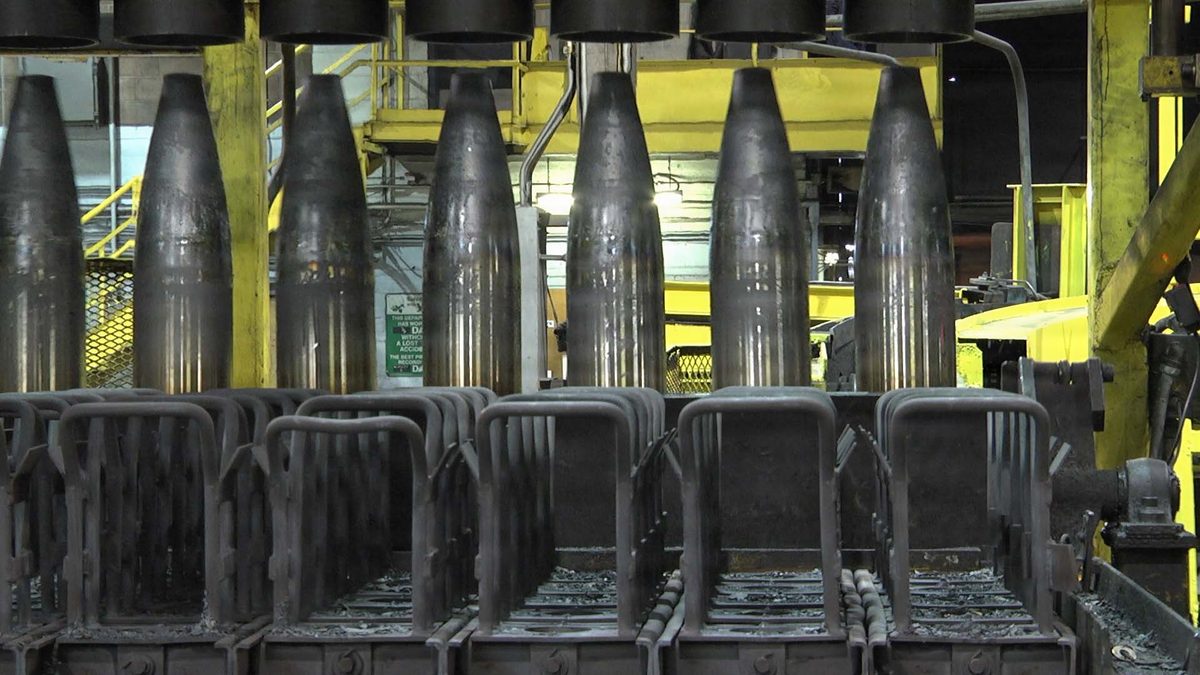
Illustrative: 155mm projectile bodies on the heat-treat line at Scranton Army Ammunition Plant, Pennsylvania, 6 April 2026. Forged bodies before filling; Rheinmetall production is not pictured and the nature in this order has not been identified. US Army photo by Dori Whipple, Scranton Army Ammunition Plant, via DVIDS. Public domain, US Government work; no endorsement implied.
Rheinmetall Books a Three-Figure-Million 155mm Order and Names Neither the Customer nor the Nature
Rheinmetall announced on 14 September 2026 that an unnamed international customer had ordered a low five-figure quantity of 155mm artillery projectiles, at a contract value in the low three-digit millions of euros recognised in the third quarter of 2026. Production has begun and delivery is expected during 2027. No nature designation, filling, fuze or hazard classification was published.
Technical Summary
Rheinmetall AG issued a press release on 14 September 2026 recording an order from an unnamed international customer for a low five-figure quantity of 155mm artillery projectiles. The company puts the contract value in the low three-digit millions of euros, booked in the third quarter of 2026, with production already begun and the order due to complete in 2027. The only technical characterisation offered is that the projectiles are already in service with various NATO member states, can be fired from a wide range of 155mm weapon systems, and offer long range and high effectiveness.
None of that identifies a nature. No designation, no filling, no explosive composition, no net explosive quantity (NEQ), no hazard division (HD) and no compatibility group (CG) appear in the release, and no fuze or propelling charge is named. Hazard classification for a filled high-explosive 155mm projectile is assigned to the packaged configuration under STANAG 4123 (Edition 4) and Allied Ammunition Storage and Transport Publication 3 (AASTP-3, Edition B), and it cannot be asserted for a nature that has not been identified. The phrases long range and high effectiveness are marketing formulations consistent with a base-bleed or velocity-enhanced family, but the release does not say so, and ISC does not infer a nature from adjectives.
Rheinmetall continues to invest heavily in expanding the capacity of existing facilities and establishing new production sites in order to meet the growing demand for modern 155mm projectiles and propellant charges. … The Düsseldorf-based technology group has been expanding its production capacity since 2022 and aims to produce around 1.5 million 155mm artillery shells per year by 2030. Rheinmetall AG, press release, 14 September 2026
Analysis of Effects
The two disclosed quantities cannot be combined into a unit price, and the reason for saying so matters more than an attempt would. A low five-figure quantity and a low three-digit million-euro value bound an implied per-projectile figure whose plausible extremes differ by close to an order of magnitude. Any single number drawn from that band would be an invention wearing the clothes of arithmetic. What the figures do support is a scale comparison. On the ordinary reading of low five figures the quantity sits below 30,000 projectiles, and ISC treats that as a reading of the phrase rather than as a company figure. Set against the 1.5 million shells per year that Rheinmetall targets for 2030, a rate equivalent to roughly 125,000 shells a month, an order of this size is under a quarter of one month of planned output. A headline major order in 2026 amounts to days of capacity at the scale the company is building toward, which is the more informative reading of the announcement.
An order for projectiles is not an order for rounds. A complete 155mm round of ammunition requires a filled projectile body, a propelling charge, a fuze and a primer, and those are four separate qualification and production lines with four separate lead times. Rheinmetall's own release couples projectiles and propellant charges when describing where the capital is going, which is the correct pairing, but the order announced covers projectiles alone. Whether the customer is drawing charges, fuzes and primers from Rheinmetall, from another supplier, or from existing national stock is unstated, and it determines whether this contract adds deliverable fire missions in 2027 or adds inventory that still needs completing. ISC has argued before that fuzing, not the projectile body, is the narrow section of this chain.
Personnel and Safety Considerations
Nothing in the release engages explosive safety, and the omission matters for whoever takes delivery. A low five-figure quantity of filled 155mm high-explosive projectiles is a substantial storage liability. Filled natures in this class are ordinarily classified HD 1.1 in compatibility group D, though as above that cannot be confirmed for an unidentified nature, and the quantity distance obligation then follows from the NEQ aggregated at each potential explosion site under the NATO quantity-distance framework in AASTP-1, not from the number of rounds. Until nature, filling and packaged configuration are known, neither the NEQ per pallet nor the inhabited building distance for a receiving depot can be calculated. A customer taking delivery through 2027 needs licensed magazine capacity in place before the first pallet arrives, and licensing a magazine takes considerably longer than filling a projectile. That sequencing problem is invisible in a value-and-quantity announcement, and it is the part that tends to bind.
Data Gaps
No customer, and therefore no view of whether the recipient is a NATO member, a NATO partner or a third country. No nature designation, and consequently no filling, no explosive composition, no NEQ, no hazard division and no compatibility group. No exact quantity: low five-figure is a formula, not a number. No exact value: low three-digit millions is likewise a band, and no unit price can be derived from the two bands without inventing a figure. No production site named, so no view of whether the order draws on Unterluess, on a newer plant, or on a joint venture. No statement on propelling charges, fuzes or primers. No delivery schedule beyond completion in 2027, and no monthly or quarterly delivery profile. No export licence reference and no corroborating national announcement.
Key Questions
How many 155mm shells did Rheinmetall sell in the September 2026 order?
Rheinmetall says a low five-figure quantity of 155mm artillery projectiles, without giving a number. On the ordinary reading of that phrase the figure sits somewhere between roughly 10,000 and 30,000 projectiles. The contract value is described only as the low three-digit millions of euros, recognised in the third quarter of 2026.
Who is the international customer in Rheinmetall's 155mm order?
Rheinmetall has not said. The release names no country, no armed service and no procurement agency, and no corroborating national announcement has appeared. Customers of this kind usually become identifiable later through the recipient's own budget documentation or parliamentary approval process rather than through the manufacturer.
Does an order for 155mm projectiles deliver complete artillery rounds?
Not by itself. A complete 155mm round needs a filled projectile, a propelling charge, a fuze and a primer, each from its own qualification and production line. Rheinmetall's announcement covers projectiles. Whether the customer sources charges, fuzes and primers from Rheinmetall, from elsewhere, or from national stock is not stated.
References
Source-evaluated per NATO source-evaluation doctrine, STANAG 2022 lineage (source reliability A–F / information credibility 1–6). Tier 1 = government or manufacturer primary source; Tier 2 = quality news / specialist defence media; Tier 3 = authoritative aggregator / encyclopaedia.
- T1Rheinmetall AG – Major order: Rheinmetall supplies artillery ammunition to international customer, contract value in the three-digit millions of euros, 14 September 2026. (Reliability A / Credibility 1)
- T2European Security and Defence – Major order: Rheinmetall supplies artillery ammunition, 15 September 2026. (Reliability B / Credibility 2)
- T2EDR Magazine – Rheinmetall supplies artillery ammunition to international customer, contract value in the three-digit millions of euros, 15 September 2026. (Reliability B / Credibility 2)
- T2Joint Forces News – International Rheinmetall Artillery Ammunition Contract, 15 September 2026. (Reliability B / Credibility 2)
- T3Rheinmetall AG – Rheinmetall Waffe Munition GmbH, company profile (Unterluess), accessed 18 September 2026. (Reliability C / Credibility 3)
Editorial responsibility. This analysis is researched, written and published under the editorial responsibility of Steve Sawyers, MIExpE VR. Every technical claim is sourced to named open-source material and rated for reliability and accuracy under NATO STANAG 2022. ISC uses its own domain-trained research and drafting system under human direction; the analysis, the judgements and the accountability for them are ours. Corrections and updates welcome: if you hold open-source data that refines or corrects any parameter here, write to [email protected] citing the specific claim and your source. Verified corrections are incorporated and credited in the revision history. Full editorial and AI policy.