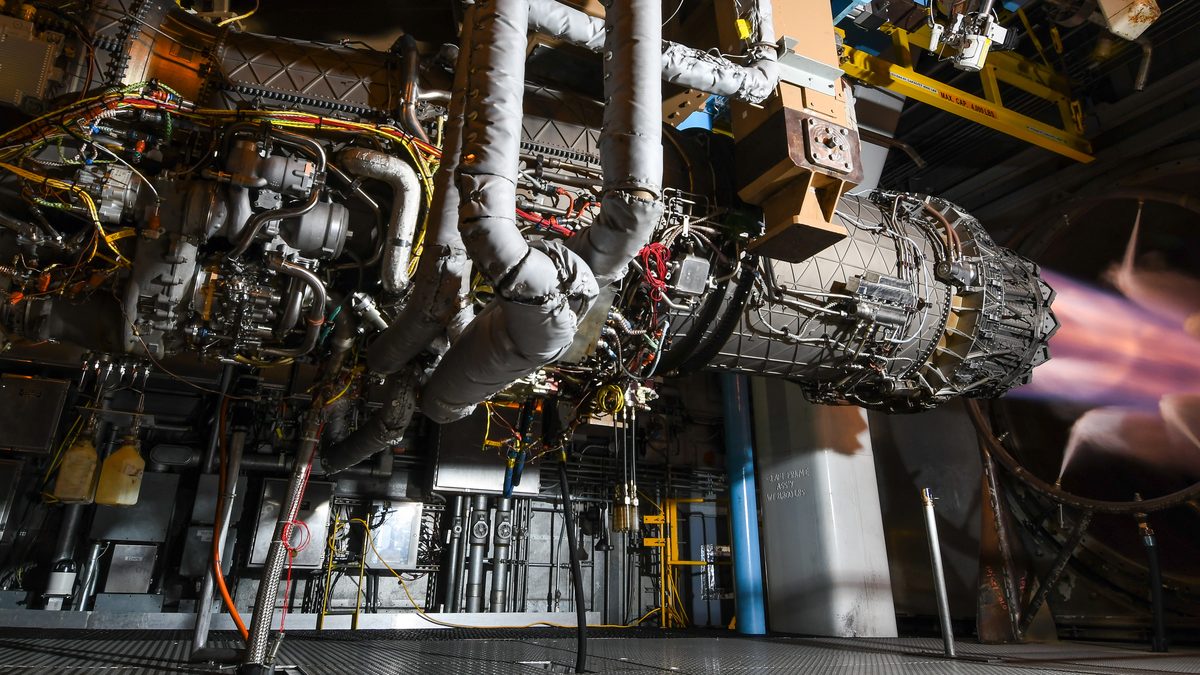
A Pratt & Whitney F135 engine undergoes accelerated mission testing in Sea Level Test Cell 3, Arnold Engineering Development Complex, Arnold Air Force Base, Tennessee, 15 November 2021. U.S. Air Force photo by Jill Pickett. VIRIN 211115-F-KN521-0098, via DVIDS. Public domain. Image predates the Engine Core Upgrade and is illustrative of F135 test activity.
The F-35 Engine Upgrade Passed Its Review. Its Allied Bill Has No Names On It.
Pratt and Whitney announced on 15 September 2026 that the F135 Engine Core Upgrade completed its risk reduction design review. Ground testing is expected from 2027 and production from 2031. A 240.8 million dollar modification awarded on 31 August 2026 includes 39 million dollars of F-35 cooperative programme partner funds, and no national breakdown of that allied share has been published.
Technical Summary
Pratt and Whitney announced on 15 September 2026 that the Engine Core Upgrade for the F-35 Lightning II's F135 powerplant has completed a risk reduction design review. The company statement says the review evaluated detailed design elements, propulsion technologies, integration considerations and risk-reduction activities, and assessed the readiness of the industrial base to support future production and retrofit. It quotes the F-35 propulsion programme manager, United States Navy Captain Mitch Grant. Separately, in an interview with Breaking Defense at the Air and Space Forces Association conference, Jill Albertelli, president of the company's military engines business, characterised the milestone as essentially the same as a critical design review and said about one third of the unique hardware for the first engine to test is in process. That characterisation is hers. Neither the Joint Program Office nor Air Force Life Cycle Management Center has used the term on the record.
The money arrived a fortnight before the announcement. Naval Air Systems Command at Patuxent River awarded a 240.8 million dollar modification on 31 August 2026, running to March 2028, which moves the upgrade from risk reduction design review into engineering and manufacturing development and buys long-lead hardware for a spare test engine. Its funding lines are the interesting part, and they are set out in Table 1. The upgrade itself is a redesign of the engine core rather than a new engine, which is why one modification can serve the F-35A, F-35B and F-35C, and why it is described as a retrofit into aircraft already delivered. Breaking Defense reports that when the plan was first pushed, officials projected service entry by 2028. The schedule now in the public record has ground testing from 2027, flight testing around 2030 and production from 2031.
The review evaluated the detailed design elements, propulsion technologies, integration considerations and risk-reduction activities critical to delivering full engine life. RTX, Pratt & Whitney statement, 15 September 2026
Population and Funding Status
Population definition: the 20 nations that have acquired the F-35 Lightning II, comprising the United States and 19 partner and Foreign Military Sales customers. The roster matches the airframer's own published participant list. Status taken as at 16 September 2026. The measure in the third column is a published, nation-specific funding line for the Engine Core Upgrade. Aggregate partner money is a separate matter and is set out below the tables.
| Funding source | Instrument | Published amount |
|---|---|---|
| United States Air Force | Fiscal year 2025 research, development, test and evaluation funds, 31 August 2026 modification | 87.6 million dollars |
| United States Navy | Fiscal year 2025 research and development funds, same modification | 87.6 million dollars |
| F-35 cooperative programme partners, aggregate | Cooperative programme partner funds, same modification | 39 million dollars, no national breakdown published |
Table 1. The 240.8 million dollar modification of 31 August 2026, awarded by Naval Air Systems Command at Patuxent River and running to March 2028, moves the Engine Core Upgrade from risk reduction design review into engineering and manufacturing development and buys long-lead hardware for a spare test engine.
| Nation | Programme relationship | Published, nation-specific Engine Core Upgrade funding line |
|---|---|---|
| United States | Lead nation, all three variants | Documented. Base contract valued up to 1.3 billion dollars, 30 September 2024; 175.2 million dollars of the August 2026 modification; 317.5 million dollars reported as requested for F-35 propulsion in fiscal year 2027 |
| United Kingdom | Level 1 partner, F-35B | Not publicly documented |
| Italy | Level 2 partner, F-35A and F-35B, final assembly at Cameri | Not publicly documented |
| Netherlands | Level 2 partner, F-35A | Not publicly documented |
| Australia | Level 3 partner, F-35A | Not publicly documented |
| Norway | Level 3 partner, F-35A | Not publicly documented |
| Denmark | Level 3 partner, F-35A | Not publicly documented |
| Canada | Level 3 partner, F-35A | Not publicly documented |
| Israel | Foreign Military Sales, F-35I Adir | Not publicly documented |
| Japan | Foreign Military Sales, F-35A and F-35B | Not publicly documented |
| Republic of Korea | Foreign Military Sales, F-35A | Not publicly documented |
| Belgium | Foreign Military Sales, F-35A | Not publicly documented |
| Poland | Foreign Military Sales, F-35A | Not publicly documented |
| Singapore | Foreign Military Sales, F-35A and F-35B | Not publicly documented |
| Finland | Foreign Military Sales, F-35A | Not publicly documented |
| Switzerland | Foreign Military Sales, F-35A | Not publicly documented |
| Germany | Foreign Military Sales, F-35A | Not publicly documented |
| Greece | Foreign Military Sales, F-35A | Not publicly documented |
| Czech Republic | Foreign Military Sales, F-35A | Not publicly documented |
| Romania | Foreign Military Sales, F-35A | Not publicly documented |
Table 2. Twenty rows. One documented national line, nineteen not publicly documented.
What Not publicly documented does and does not mean here
It does not mean those nations are not paying. The August 2026 modification records 39 million dollars of F-35 cooperative programme partner funds, so on the public record the partners are contributing to this upgrade. What the record does not carry is any split of that 39 million by nation, any national budget line naming the Engine Core Upgrade, and any national commitment to buy retrofit kits for a delivered fleet. Nineteen air forces are inside an aggregate and none of them has published its share. That is the finding: not an absence of money, an absence of names.
Outside the population
Türkiye is not counted in the 20. It was an original Level 3 partner and an industrial participant, and it was removed from the programme in 2019 following its acquisition of the S-400 air defence system. It holds no F-35 and has no engine to retrofit, so a Not publicly documented row against its name would measure nothing. It is recorded here in prose for that reason.
Allied lethality. 🇧🇪 An F-35A Lightning II, assigned to the Belgian Air Force 312th Fighter Squadron, taxis for a weapons validation flight at Luke Air Force Base, Arizona. Multinational training programs foster vital interoperability, validating coalition pilots' capabilities to deploy advanced munitions from the 5th-generation platform.
— F-35 Lightning II Joint Program Office (@theF35JPO) September 16, 2026
Analysis of Effects
The naming of the milestone deserves its own line in the record, and the contract file settles part of it. The August 2026 modification describes its own purpose as moving the programme out of risk reduction design review, so that gate is a real contractual stage and not a piece of press-release branding. What is unresolved is its relationship to the other review. In July 2026 the Air Force said the planned date for the Engine Core Upgrade critical design review had not changed in two years, and placed it in August 2026. What closed on 15 September was branded a risk reduction design review, and only the manufacturer has equated the two. That leaves three readings: one gate under two names, a slip of about two weeks past the August window, or two separate milestones. ISC records the question rather than closing it, because the choice decides whether a programme milestone was met, missed or renamed.
A design review establishes that a design has been judged sound enough to proceed. It does not establish thrust, electrical power or cooling capacity, because the announcement carries no figure for any of them, and it does not establish a fielding date. Production start is not squadron service, and the useful date remains unpublished. That gap matters most for the aircraft already flying. At the same conference, Air Force officers said the F-35 held high mission-capable rates through Operations Epic Fury and Midnight Hammer. Read carefully, that claim is conditional: the qualifier the officers used was when properly resourced, with spare parts allocated as a combat first call. It is a statement about surge priority, and it does not contradict the fleet-wide record. The Government Accountability Office reported on 11 June 2026 that the mission capable rate fell from 67 per cent in fiscal year 2021 to 44 per cent in fiscal year 2025, and the full mission capable rate from 38 per cent to 25 per cent. Those are two different measures and ISC keeps them apart: mission capable counts aircraft able to fly at least one assigned mission, full mission capable counts aircraft able to fly all of them. The honest synthesis is that the aircraft performs when it is first in the queue, and that the same audit priced making that the normal condition at an additional 13.7 billion dollars through fiscal year 2031.
Personnel and Safety Considerations
The Engine Core Upgrade is a propulsion modification and carries no ordnance hazard classification of its own. The handling exposure sits at the depot. A retrofit moves power modules through the same heavy maintenance facilities and test cells that already constrain the return of serviceable engines to the fleet, and the Government Accountability Office named spare parts availability and industry capacity for critical components among the causes of falling availability. The physical network for allied work already exists. Kongsberg Aviation Maintenance Services reached initial depot capability for F135 repair and overhaul at Rygge Air Base in Norway, described at the time as the second fully operational F135 depot outside the United States, and TAE Aerospace reached initial depot capability at Bundamba in Queensland in July 2021, the first in the Asia-Pacific. Both were stood up to serve regional operators under the programme's global support arrangements. Because the upgrade keeps one engine core across all three variants, that existing network is what will set retrofit cost and timing for the other 19 operators, not a second design. Where retrofit and routine overhaul compete for the same cells and the same qualified technicians, the upgrade's schedule and the fleet's availability are drawn against one capacity. ISC has found no published plan separating retrofit throughput from heavy maintenance at any of those sites.
Data Gaps
- The national split of the 39 million dollars of F-35 cooperative programme partner funds recorded in the 31 August 2026 modification. No breakdown is published.
- Whether the risk reduction design review completed on 15 September 2026 is the same gate as the critical design review that the Air Force placed in August 2026, a slip of about two weeks, or a renamed milestone. Neither the Joint Program Office nor Air Force Life Cycle Management Center has addressed the point on the record.
- Thrust, electrical power and thermal management figures for the upgraded engine. The manufacturer statement carries no numerical value for any of them.
- Whether any nation outside the United States has committed to buy retrofit kits for aircraft already delivered, as distinct from contributing to development.
- The size of the retrofit population, expressed in engines or in airframes.
- The date the first upgraded engine is expected to reach squadron service, as distinct from the 2031 production start.
Key Questions
What is the F-35 Engine Core Upgrade?
The Engine Core Upgrade is a modification to the Pratt and Whitney F135 engine that powers every F-35 Lightning II. It is intended to restore expected engine life and to add power and thermal management capacity for the Block 4 upgrade series. It was selected instead of a new adaptive propulsion system, and it is planned as a retrofit into aircraft already delivered.
When will the F-35 engine upgrade actually be fitted?
Not soon. Pratt and Whitney cleared the risk reduction design review on 15 September 2026, and a modification awarded on 31 August 2026 moves the work into engineering and manufacturing development through March 2028. Ground testing is expected from 2027 and flight testing around 2030, with production from 2031. ISC has found no published date for the first upgraded engine reaching squadron service.
Which countries are paying for the F-35 engine upgrade?
Mostly the United States, and the allies in a block. The 240.8 million dollar modification of 31 August 2026 is funded by 87.6 million dollars of Air Force research and development money, an identical 87.6 million dollars from the Navy, and 39 million dollars of F-35 cooperative programme partner funds. The partner share is published only as a single figure. None of the 19 other nations has published its own portion or a national funding line for the retrofit.
References
Source-evaluated per NATO source-evaluation doctrine, STANAG 2022 lineage (source reliability A–F / information credibility 1–6). Tier 1 = government primary source; Tier 2 = quality news / specialist defence media; Tier 3 = authoritative aggregator / encyclopaedia.
- T1RTX, Pratt & Whitney – RTX's Pratt & Whitney completes F135 Engine Core Upgrade Risk Reduction Design Review, 15 September 2026. (Reliability B / Credibility 2, manufacturer primary)
- T1United States Government Accountability Office – GAO-26-108113, F-35 Sustainment: Actions Needed to Ensure Updated Strategy Improves Persistent Readiness Challenges, 11 June 2026. (Reliability A / Credibility 1)
- T2Breaking Defense – F-35 engine upgrade clears key design review, Pratt says, 15 September 2026. (Reliability B / Credibility 2)
- T2Air & Space Forces Magazine – F-35 Engine Core Upgrade to Face Critical Review in August, 28 July 2026. (Reliability B / Credibility 2)
- T2Military Times – F-35 proved combat readiness during Middle East deployments, Air Force officials say, 15 September 2026. (Reliability B / Credibility 2)
- T1F-35 Lightning II Joint Program Office – official account, posts of 10 to 16 September 2026, accessed 16 September 2026. (Reliability A / Credibility 1 for what the office published; the posts are promotional and establish no operational metric)
- T2GovConWire – Pratt & Whitney secures 241 million dollar modification for F135 Engine Core Upgrade, reporting the Department of Defense contract announcement of 31 August 2026. (Reliability B / Credibility 2)
- T1Kongsberg – Norway's F135 engine heavy maintenance facility achieves initial depot capability, 2022. (Reliability B / Credibility 2, operator primary)
- T3Defense Advancement – F135 engine heavy maintenance facility opens in Australia, 27 July 2021. (Reliability C / Credibility 3)
Editorial responsibility. This analysis is researched, written and published under the editorial responsibility of Steve Sawyers, MIExpE VR. Every technical claim is sourced to named open-source material and rated for reliability and accuracy under NATO STANAG 2022. ISC uses its own domain-trained research and drafting system under human direction; the analysis, the judgements and the accountability for them are ours. Corrections and updates welcome: if you hold open-source data that refines or corrects any parameter here, write to [email protected] citing the specific claim and your source. Verified corrections are incorporated and credited in the revision history. Full editorial and AI policy.