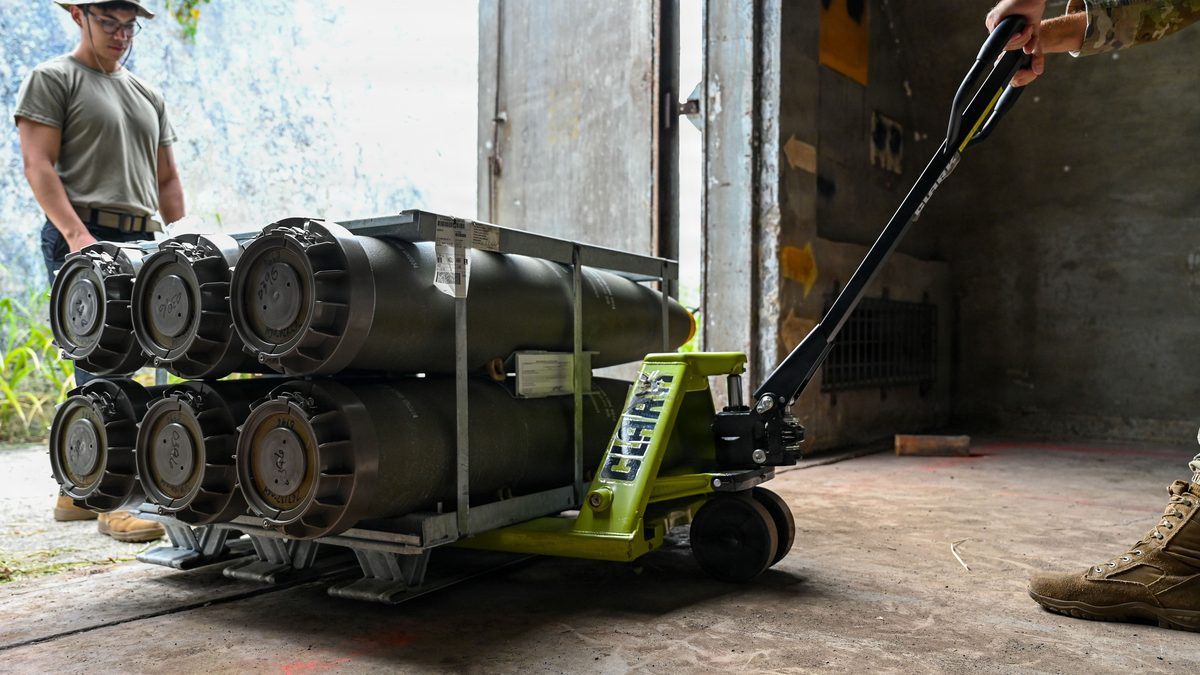
Illustrative image. United States Air Force Airmen of the 346th Expeditionary Air Base Squadron munitions systems flight move a pallet of Guided Bomb Unit 49 bases at Ceiba, Puerto Rico, on 21 May 2026, during operations in the United States Southern Command area of responsibility. The movement shown is a United States operational activity and is not connected to the NATO standardization action described in this article. U.S. Air Force photo by Senior Airman Megan Delaine, VIRIN 260521-F-TJ635-1025, released via the Defense Visual Information Distribution Service. U.S. Government work, public domain. Use does not imply endorsement by the U.S. Department of Defense.
Fifty Pages Where There Were a Hundred and Twelve: NATO Reissues Its Hazard Classification Standard After Thirty-One Years
NATO promulgated STANAG 4123 Edition 4 on 22 June 2026, bringing Allied Ammunition Storage and Transport Publication AASTP-03 Edition B Version 1 into force as the alliance standard for hazard classification of military ammunition and explosives. It displaces AASTP-3 of 1 March 1995. The NATO Standardization Office records the sponsor as CNAD, AC/326 CASG, Sub-Group B.
Technical Summary
The NATO Standardization Office (NSO) record for Standardization Agreement (STANAG) 4123 now reads Edition 4, status PROMULGATED, security classification NON CLASSIFIED, promulgated on 22 June 2026 against a ratification due date of 17 May 2026. Its English title is HAZARD CLASSIFICATION OF MILITARY AMMUNITION AND EXPLOSIVES, AASTP-03 EDITION B. The covered standard is AASTP-03 Edition B Version 1, also promulgated. The tasking authority is recorded as Conference of National Armaments Directors (CNAD), AC/326 CNAD Ammunition Safety Group (CASG), Sub-Group B on Ammunition Systems Design and Assessment. Standards distributor catalogues record the extent of the new publication as 50 pages in English and French, and the extent of the document it replaces, AASTP-3 of 1 March 1995, as 112 pages.
That is the update. What follows is the reference picture, because a hazard classification standard is never read on its own. Almost everything downstream of it starts with two letters and a number assigned under its rules. Quantity distance (QD) under AASTP-01, storage licensing, magazine mixing, transport documentation and net explosive quantity (NEQ) declaration all proceed from a hazard division (HD) and a compatibility group (CG). The manual being displaced had carried that load, unamended in its base edition, since 1995.
AASTP-3 was issued on 1 March 1995 and is catalogued at 112 pages. AASTP-03 Edition B Version 1 was promulgated on 22 June 2026 and is catalogued at 50 pages. NATO Standardization Office record for STANAG 4123 Edition 4, and standards distributor catalogue extents for both editions, accessed 15 September 2026. Catalogue extent is not a clause count
What the Register Records
| Register field | Value as recorded, 15 September 2026 |
|---|---|
| Covering agreement | STANAG 4123, Edition 4 |
| Status | PROMULGATED |
| Security classification | NON CLASSIFIED |
| English title | HAZARD CLASSIFICATION OF MILITARY AMMUNITION AND EXPLOSIVES, AASTP-03 EDITION B |
| French title | CLASSEMENT DES MUNITIONS ET EXPLOSIFS MILITAIRES EN FONCTION DU DANGER, AASTP-03 ÉDITION B |
| Promulgation date | 22 June 2026 |
| Ratification due date | 17 May 2026 |
| Promulgation criteria | 5 |
| NATO Effective Date | Not recorded |
| Reviewed on | Not recorded |
| Tasking authority and working group | CNAD, AC/326 CASG, SG/B, Sub-Group B on Ammunition Systems Design and Assessment |
| Remarks | AC/258(ST) |
| Covered standard | AASTP-03 Edition B Version 1, PROMULGATED |
Three fields in that table repay a second look. The ratification due date of 17 May 2026 falls five weeks before promulgation, which is the ordinary sequence: nations are asked to respond by a date, the sponsor counts the responses, and the Office promulgates once the threshold is met. The promulgation criteria value of five is that threshold, expressed as a number of ratifying nations. The public database publishes the threshold and not the roll call, so which five nations carried it is not open-source information.
The NATO Effective Date field is blank. On an agreement that has already been promulgated this normally means the date has not been set or not been entered rather than that the agreement is inert, and the entry for the covered publication reads PROMULGATED in its own right. Practitioners who need a hard implementation date for a safety case or a licence submission should take it from their national authority and not from the register.
The remarks field carries the string AC/258(ST). ISC records that as a legacy committee reference carried forward from an earlier structure. No open-source document found in this research states its current meaning, so it is logged below as a data gap rather than explained here.
What the open record supports, and what it does not
The register and the distributor catalogues establish designation, edition, version, promulgation date, sponsor, security classification, title and extent. They establish that the title has been shortened from Manual of NATO Safety Principles for the Hazard Classification of Military Ammunition and Explosives to Hazard Classification of Military Ammunition and Explosives, that the designation has been restyled from AASTP-3 to AASTP-03, and that the edition scheme has moved from a plain numeric to the letter and version form now used across the series.
They do not establish the technical delta. AASTP-03 Edition B Version 1 is a sold publication and not an open one, so no clause-level comparison against the 1995 text is possible from open sources, and none is offered here. A reduction from 112 catalogue pages to 50 is consistent with a document that now points at the UN architecture instead of restating it, and that reading is an inference from extent rather than a finding from content. The public database exposes the current edition only, which is a limitation of the view and not an absence of history: the prior covering edition is recoverable from national adoption records, and is given in the next section.
The Edition It Replaces
The covering agreement did not sit still for thirty-one years even though the publication did, and the previous edition is recoverable from national adoption records even though the alliance register shows only the live one. A Ukrainian national military standard, VST 01.052.010-2022, effective 1 August 2022, is an identical adoption of what it names as STANAG 4123 Edition 3 and AASTP-03 Edition 1, under the old title, Manual of NATO Safety Principles for the Hazard Classification of Military Ammunition and Explosives. That is the baseline Edition 4 replaces: the covering agreement moves from Edition 3 to Edition 4, and the publication it covers moves from Edition 1, the 1995 manual, to Edition B Version 1. A Czech national standard settles the same point independently: ČOS 130013, second edition, title page Praha 2021, is recorded as implementing STANAG 4123 Edition 3 and AASTP-3 Edition 1 Change 3.
That change number matters to the thirty-one year framing. The base edition of 1995 was not left untouched for three decades. It ran with amendments, and United Nations guidance cites Change 3 as dated August 2009, the last change ISC has found on the open record. ISC has not inspected the publication’s own record of changes, so that date is offered as the citation given in the United Nations guidelines rather than as the document’s own. What stood still was the edition itself, and with it the structure, the title and the assumptions the document was built on.
Two consequences follow for anyone writing the citation. The thirty-one year clock belongs to the allied publication and not to the standardization agreement, which moved at least once in between. And the designations AASTP-3 and AASTP-03 Edition 1 are the same document, so a reference list carrying both is carrying one item twice.
What a Classification Code Actually Carries
A complete military classification is not a hazard division on its own. It is a classification code, the hazard division followed by the compatibility group, written 1.1D or 1.6N. Everything operational hangs off the pair rather than off either half. The division drives quantity distance and the fire and explosion behaviour assumed in a site plan. The group drives what may be stored or moved alongside what. Thirteen compatibility groups are in use, A to H, J, K, L, N and S, with the letter I omitted to avoid confusion with the Roman numeral.
NATO then goes beyond the United Nations scheme in one specific place, and it is the place where the classification publication and the storage publication meet. Hazard divisions 1.2 and 1.3 are subdivided for storage purposes, because the fragment and debris throw from a 155 mm high explosive projectile and from a small arms cartridge are not the same problem even though the United Nations calls both 1.2. The publicly released edition of AASTP-1, Edition 1 Change 3 of May 2010, sets the split at an individual net explosive quantity of 0.73 kg: storage subdivision 1.2.1 for high explosive projectiles above that figure, storage subdivision 1.2.2 for those at or below it together with cartridges, inert-projectile rounds, pyrotechnics and rocket motors, and storage subdivision 1.2.3 for items whose sympathetic reaction and hazard test behaviour qualifies them. Hazard division 1.3 splits into 1.3.1 for propellant explosives producing mass fire with radiant heat and firebrands, and 1.3.2 for the less hazardous items.
That 0.73 kg figure is quoted from the publicly released 2010 edition, which is the edition available to read. AASTP-01 now stands at Edition D Version 1 and ISC has not verified from open sources whether the threshold or the subdivision structure is carried forward unchanged. The subdivision is assigned by the national competent authority on the evidence of United Nations Test Series 6, and where used on insensitive munitions test evidence, which is precisely why the classification publication and the storage publication have to move together.
One terminology trap sits underneath all of it. The declared quantity is called net explosive quantity in NATO storage practice and net explosive weight in the United States regulatory chain, and test literature uses net explosive mass. The numbers are not always computed on the same basis, packaged against unpacked among them, so a figure lifted from one book into another without checking the counting convention is a licence error waiting to be found at audit.
The Population: the AASTP Series as the Open Register Records It
The population is defined as every Allied Ammunition Storage and Transport Publication returned by the NSO public standardization document database against the search string AASTP, together with the covering agreement that brings each into force. The status picture below was taken on 15 September 2026. The search returns five covering agreements, five allied standards and four standards related documents. Every member is a row. Nothing eligible for a row has been left in the prose.
| Covering agreement | Allied publication | Subject | Sponsor | Status |
|---|---|---|---|---|
| STANAG 4440 Ed. 4 | AASTP-01 Ed. D Ver. 1 | NATO guidelines for the storage of military ammunition and explosives | CNAD, AC/326 CASG, SG/C | PROMULGATED |
| STANAG 4123 Ed. 4 | AASTP-03 Ed. B Ver. 1 | Hazard classification of military ammunition and explosives | CNAD, AC/326 CASG, SG/B | PROMULGATED |
| STANAG 4442 Ed. 2 | AASTP-04 Vol. I Ed. B Ver. 1 | Explosives safety risk analysis: guidelines for risk-based decisions | CNAD, AC/326 CASG, SG/C | PROMULGATED |
| STANAG 4802 Ed. 1 | AASTP-04 Vol. II Ed. B Ver. 2 | Explosives safety risk analysis: technical background | CNAD, AC/326 CASG, SG/C | PROMULGATED |
| STANAG 4657 Ed. 2 | AASTP-05 Ed. B Ver. 1 | NATO guidelines for the storage, maintenance and transport of ammunition on deployed missions or operations | CNAD, AC/326 CASG, SG/C | PROMULGATED |
Four standards related documents hang off that set. They are part of the same population and are listed rather than summarised, for the same reason.
| Standards related document | Subject | Sponsor | Status |
|---|---|---|---|
| AASTP-1.1 Ed. A Ver. 1 | Manual for the development of an explosives safety site plan based on AASTP-1 | CNAD, AC/326 CASG, SG/C | PROMULGATED |
| AASTP-1.2 Ed. A Ver. 2 | Development of NATO debris and fragment distance curves for AASTP-1 | CNAD, AC/326 CASG, SG/C | PROMULGATED |
| AASTP-1.3 Ed. A Ver. 1 | Nationally approved structures for explosives areas | CNAD, AC/326 CASG, SG/C | PROMULGATED |
| AASTP-4.1 Ed. A Ver. 1 | National methods | CNAD, AC/326 CASG, SG/C | PROMULGATED |
The Rest of the Population
Read the same numbering block the other way. AASTP-01 to AASTP-05 is a contiguous series, and one number in it returns nothing.
| Series number | Record in the NSO public database, 15 September 2026 | Position elsewhere on the open record |
|---|---|---|
| AASTP-01 | Present, Edition D Version 1, PROMULGATED | Covered by STANAG 4440 Edition 4 |
| AASTP-02 | Not publicly documented. No record returned against the AASTP search. | Catalogued by standards distributors as the manual of NATO safety principles for the transport of military ammunition and explosives, Edition 1 Change 3, and as a 2005 record. The live transport document sits outside the AASTP numbering: see below |
| AASTP-03 | Present, Edition B Version 1, PROMULGATED | Covered by STANAG 4123 Edition 4 |
| AASTP-04 | Present, Volumes I and II, Edition B, PROMULGATED | Covered by STANAG 4442 Edition 2 and STANAG 4802 Edition 1 |
| AASTP-05 | Present, Edition B Version 1, PROMULGATED | Covered by STANAG 4657 Edition 2 |
Searching the same database for the covering agreement rather than the publication fills that row, and it fills it from a different part of the alliance structure.
| Document | Type | Subject | Sponsor | Status |
|---|---|---|---|---|
| STANAG 4441 Ed. 4 | Covering agreement | Allied multi-modal transportation of dangerous goods directive, AMovP-06 Edition C | MC, MCLSB, TDGG | PROMULGATED |
| AMovP-06 Ed. C Ver. 1 | Allied publication | Allied multi-modal transportation of dangerous goods directive | MC, MCLSB, TDGG | PROMULGATED |
| AMovP-6.1 Ed. A Ver. 1 | Related document | Dangerous goods training | MC, MCLSB, TDGG | PROMULGATED |
| AMovP-6.2 Ed. C Ver. 1 | Related document | Transport by road | MC, MCLSB, TDGG | PROMULGATED |
| AMovP-6.3 Ed. B Ver. 1 | Related document | Transport by rail | MC, MCLSB, TDGG | PROMULGATED |
| AMovP-6.4 Ed. B Ver. 1 | Related document | Transport by sea | MC, MCLSB, TDGG | PROMULGATED |
| AMovP-6.5 Ed. A Ver. 1 | Related document | Transport by inland water way | MC, MCLSB, TDGG | PROMULGATED |
| AMovP-6.6 Ed. D Ver. 1 | Related document | Transport by air | MC, MCLSB, TDGG | PROMULGATED |
| AMovP-6.7 Ed. B Ver. 1 | Related document | Troops in fighting trimm, as the register spells it | MC, MCLSB, TDGG | PROMULGATED |
| AMovP-6.8 Ed. A Ver. 1 | Related document | Terms and definitions | MC, MCLSB, TDGG | PROMULGATED |
That is the whole family as the register carries it: one covering agreement, one allied publication and eight standards related documents, every one promulgated and every one under the same sponsor. STANAG 4441 Edition 4 was promulgated on 23 July 2020 against a ratification due date of 8 May 2020 and an authorized extension date of 31 August 2020. Its promulgation criteria value is 14, against five for the ammunition safety agreements in the table above.
The sharper difference is structural rather than numerical. The alliance publishing scheme has three document types, the covering agreement, the allied standard it brings into force, and standards related documents beneath that. Transport uses all three, with eight related documents carrying the modal detail. Hazard classification uses only two: the register returns no standards related document under AASTP-03 at all, so everything the alliance says about classification sits in a single 50-page book. Storage and risk analysis sit in between, with three related documents under AASTP-01 and one under AASTP-04. Where the detail lives tells a reader where to look, and for classification there is nowhere else to look.
The modal split is the part a licensing or movements officer should notice. Road, rail, sea, inland waterway and air each have their own related document at their own edition, so a transport citation that names only the parent directive is incomplete for the mode actually being used.
The obvious reading of an empty row is that the transport manual is a hole in the series. It is not. STANAG 4441 now stands at Edition 4 and covers AMovP-06 Edition C, the Allied Multi-Modal Transportation of Dangerous Goods Directive, recorded as PROMULGATED with eight supporting documents running from AMovP-6.1 on dangerous goods training through AMovP-6.2 road, AMovP-6.3 rail, AMovP-6.4 sea, AMovP-6.5 inland waterway, AMovP-6.6 air and AMovP-6.7 troops in fighting trim to AMovP-6.8 terms and definitions.
The sponsor line on that entry is the part worth pausing on. Every AASTP publication in the population table is sponsored through the armaments chain, CNAD and AC/326 CASG. STANAG 4441 and the AMovP-06 family are sponsored through the military chain: Military Committee, Military Committee Land Standardization Board, Transport of Dangerous Goods Group. Transport of military dangerous goods has moved out of the ammunition safety series and into the movement and transportation series, under a different committee altogether.
That changes what the empty AASTP-02 row means, and it changes it in a way that matters for citation practice. A safety case or a movement instruction that still cites AASTP-2 as the live transport reference is citing a number that the alliance register no longer carries. The current citation is STANAG 4441 Edition 4 and AMovP-06 Edition C, together with the modal law that actually moves the cargo. ISC does not assert here when the succession happened or which edition of STANAG 4441 carried AASTP-2, because the public register shows the live edition and not the history.
The wider point holds for the whole table. The public database is an open window onto a larger body of work that includes restricted distribution material and national implementing documents. An empty row is a finding about where to look next, and in this case looking next was enough to fill it.
The Sub-Group That Does Not Match
One entry in the population table sits outside the column the rest of it measures, and the exception is the most interesting thing in the record. Four of the five covering agreements name Sub-Group C as sponsor, given in full on the STANAG 4440 record as Sub-Group C on In-Service and Operational Safety Management. STANAG 4123 Edition 4 and AASTP-03 Edition B Version 1 name Sub-Group B, given in full as Sub-Group B on Ammunition Systems Design and Assessment. The two records are otherwise built the same way: both are NON CLASSIFIED, both carry a promulgation criteria value of five, and STANAG 4440 Edition 4 was promulgated on 4 November 2025 against a ratification due date of 8 October 2025, eight months before the classification agreement.
That is not where the hazard classification manual has historically been described as sitting. The Munitions Safety Information Analysis Centre (MSIAC) published an account of the AC/326 sub-group structure, which refers to standards then due for ratification in 2017, placing AASTP-1, AASTP-3, AASTP-4 and AASTP-5 with Sub-Group C under in-service and operational safety management, and placing munition system test standards with Sub-Group B. The register now reads otherwise for one of those four.
ISC does not treat that as a proven transfer of custodianship, because the register records a current sponsor and not a history. What can be stated is the contrast the table creates: as at 15 September 2026 the alliance hazard classification publication is sponsored by a different sub-group from the storage, risk analysis and deployed operations publications that consume its output. If that reflects a deliberate move of classification work towards the group that owns munition design and assessment, it is a sensible one, because hazard classification is decided by what a round does in a test series and not by how a depot is laid out. The register supports that reading in one further place: STANAG 4439 Edition 5 and AOP-39 Edition E Version 1, the alliance insensitive munitions policy, are also sponsored by Sub-Group B, and insensitive munitions evidence is what qualifies an item for the hazard division 1.2.3 storage subdivision. Readers should note that an operator brief circulating with this promulgation attributes it to Sub-Group C. The register says Sub-Group B, and the register is the citable record.
The Sponsor Chains, Decoded
The sponsor column in every table above is a compressed path, and the register publishes the structure it compresses. Its sponsor module carries five levels, Tasking Authority, Delegated Tasking Authority, Group, Sub Group and Sub Sub Group, and each body has an English title recorded against it. Read out in full, the two chains that matter to this article look like this.
| Register level | Hazard classification, storage and risk | Transport of dangerous goods |
|---|---|---|
| Tasking Authority | CNAD, Conference of National Armaments Directors | MC, Military Committee |
| Delegated Tasking Authority | AC/326 CASG, recorded as CNAD Ammunition Safety Group | MCLSB, Military Committee Land Standardization Board |
| Group | SG/B for classification, SG/C for storage, risk analysis and deployed operations | TDGG, Transport of Dangerous Goods Group |
| Sub Group | Not populated for these entries | Not populated for this entry |
| Sub Sub Group | Not populated for these entries | Not populated for this entry |
Two details in that table correct a natural misreading. The bodies called sub-groups sit at the register’s Group level, not at its Sub Group level, which is empty for every entry in this article. That is a fact about the register’s own field names rather than a claim that these bodies are not sub-groups in ordinary usage: sub-group is what they are called, and Group is where the database files them. And the register expands CASG as CNAD Ammunition Safety Group, where a great deal of secondary literature, including material ISC has cited before, renders it Conventional Ammunition Safety Group. Both are in circulation. This article follows the register, because the register is what it cites.
The armaments chain has exactly three groups under AC/326 CASG and the register names them in full: Sub-Group A on Energetic Materials and Initiation Systems, Sub-Group B on Ammunition Systems Design and Assessment, and Sub-Group C on In-Service and Operational Safety Management. Only SG/A carries further bodies beneath it. That three-way split is the whole reason the classification publication and the storage publication can move apart: design and assessment is one group’s work, in-service and operational safety management is another’s, and hazard classification is the output of the first that becomes the input of the second.
The transport chain is not a sub-branch of the armaments one. TDGG is one of thirteen groups under the Military Committee Land Standardization Board, among them explosive ordnance disposal. A movements officer and an ammunition safety officer working the same consignment are reading documents issued under two different tasking authorities, and that is a structural feature of the alliance rather than an oversight.
One warning against reading the two chains as rivals. They are not alternative classification systems. The classification code is a single product used twice: the hazard division and compatibility group assigned under AASTP-03 are the input to quantity distance and licensing under the SG/C publications, and the input to the modal rules under the TDGG publications. Cite AASTP-01 for a distance and AMovP-06 for a shipping document, and cite AASTP-03 for the code that both of them consume.
Where the Obligation Comes From
The obligation behind all of this is the standardization agreement itself. A STANAG does not bind a nation that has not ratified it, and ratification is a national act with national reservations attached. What the agreement produces is a common reference that national regulation then points at, which is why the practical question for a United Kingdom or United States practitioner is not what AASTP-03 says but when the national instrument starts citing Edition B.
Both national chains are public. In the United Kingdom the governing set is the Defence Safety Authority regulatory series, DSA 02.OME for the regulations and DSA 03.OME for the codes of practice, with parts of the Part 1 code reissued at Version 2.0 in February 2026. Joint Service Publication 482, which carried the older UK account of military explosives classification and cited AASTP-3 by name in its Edition 4 of January 2013, is withdrawn and is not a current citation. In the United States the governing instrument is the Defense Explosives Safety Regulation DESR 6055.09, Edition 1 Change 2, and the record of approved classifications is held in the Joint Hazard Classification System (JHCS), a controlled register rather than an open one. A classification an item already holds does not change because a NATO edition changed. It changes when the national authority that issued it says so.
Above both sits the United Nations. Military hazard classification runs on the architecture of the UN Recommendations on the Transport of Dangerous Goods, currently the twenty-fourth revised edition of the Model Regulations, issued in 2025, and the associated Manual of Tests and Criteria. Hazard divisions 1.1 to 1.6 and the thirteen compatibility groups are UN constructs before they are NATO ones. The alliance publication exists to say how a military item is assessed against that architecture, not to replace it.
What Now Cites a Superseded Document
An obvious question follows a supersession, and it is the one a national delegate has to answer first: how many instruments now point at a document that has been replaced. There is no open-source answer to that as a number, and the reason matters. The alliance standardization database publishes the forward link, from a covering agreement to the publication it brings into force. It does not publish the reverse link. Nothing in the public record lists the documents that cite a given standardization agreement, so no count of downstream citations can be produced from open sources, and any figure offered would be invented.
What can be produced is a sample, assembled the slow way, by opening publications and reading their reference lists. The table below records documents found in this research that cite STANAG 4123 or the AASTP-3 publication by name. The status picture is as at 15 September 2026.
| Citing document | Issuing authority | What it cites | Position of the citing document |
|---|---|---|---|
| AASTP-1 Edition 1 Change 3, May 2010, public release copy | NATO, AC/326 CASG | References STANAG 4123 for hazard classification guidance and points to AASTP-3 for the detailed classification information, in the public-release copy read for this article | Superseded: AASTP-01 now stands at Edition D Version 1, promulgated 4 November 2025 |
| AOP-39 Edition 3, March 2010 | NATO International Staff, Defence Investment Division | Scope requires hazard classification “in accordance with the STANAG 4123” | Superseded: the register carries AOP-39 Edition E Version 1 under STANAG 4439 Edition 5 |
| AOP-4382 Edition A Version 1, March 2020 | NATO Standardization Office, sponsored by AC/326 CASG Sub-Group B | Related documents list carries “AASTP-03 Manual of NATO Safety Principles for the Hazard Classification of Military Ammunition and Explosives”, and the scope refers the reader to STANAG 4123 | The register now carries AOP-4382 Edition A Version 2 under STANAG 4382 Edition 3; the wording quoted here is from the Version 1 copy on the open record |
| IATG 01.50, Explosive hazard classification system, third edition, 2021 | United Nations, UN SaferGuard | Cites “NATO AASTP-3, Edition 1, Change 3. Manual of NATO Safety Principles for the Hazard Classification of Military Ammunition and Explosives. August 2009” as the derivation of a hazard division | Current international guidance |
| IATG 02.20, third edition, 2021 | United Nations, UN SaferGuard | Cites the same AASTP-3 Edition 1 Change 3 of August 2009 when describing the hazard division 1.2.3 storage subdivision | Current international guidance |
| ČOS 130013, second edition, title page Praha 2021 | Czech Republic, Office for Defence Standardization, Cataloguing and State Quality Assurance | National standard implementing STANAG 4123 Edition 3 and AASTP-3 Edition 1 Change 3 | Current national standard, adopting the superseded edition |
| VST 01.052.010-2022, effective 1 August 2022 | Ukraine, national military standard | Identical adoption of STANAG 4123 Edition 3 and AASTP-03 Edition 1 | Current national standard, adopting the superseded edition |
| JSP 482 Edition 4, Classification of Military Explosives, January 2013 | United Kingdom Ministry of Defence | States that the explosives sections are repeated in AASTP-3, the manual of NATO principles for the hazard classification of military explosives | Withdrawn; the current United Kingdom set is DSA 02.OME and DSA 03.OME |
This list is not exhaustive, and it is not a count
Eight documents are recorded above because eight were found and read. That is a floor and not a total. The sample is biased towards material that is published openly, which means NATO allied publications with a public release copy, United Nations guidance, and the national standards of nations that publish their defence standards catalogue on the open web. It under-represents exactly the material most likely to carry the citation: restricted-distribution national regulations, service instructions, site explosives licences, safety cases, training syllabuses, contract specifications and manufacturer quality documents. None of those are searchable from outside, and the real population is certainly larger than this table by a wide margin.
ISC therefore publishes this as a starting point for a national check and not as a finding about scale. Anyone quoting a number of affected instruments from this article would be quoting a number that does not exist.
Two checks that came back empty are worth recording, because they show the citation pattern is not uniform. The United States Defense Explosives Safety Regulation DESR 6055.09 Edition 1 Change 2 returned no reference to STANAG 4123 or to any AASTP publication in the text reviewed for this article. Canadian Defence Administrative Order and Directive 3002-2 on insensitive munitions cites STANAG 4439 and the United Nations Model Regulations, and does not cite STANAG 4123. Both national chains run their own classification procedure and record, and both reach the same United Nations architecture without routing through the alliance publication. A nation whose instruments do not name the NATO document has nothing to re-point, which is a useful thing to establish early rather than assume either way.
The practical recommendation is narrow and it belongs with the nations rather than with any analyst. National standardization representatives and armament directors, and the delegates who sit on AC/326 CASG and its sub-groups, are the only people positioned to enumerate their own estate. The work is a citation sweep rather than a technical review: search the national regulatory set, the service instructions beneath it, the current explosives licences and safety cases, the training material and the contract and quality specifications for the strings STANAG 4123, AASTP-3 and AASTP-03, and for AASTP-1 and AASTP-01 in the same pass, because the hyphenation changed with the register and older text uses the short form; list every hit with its edition; and decide for each whether the reference is to the agreement, which has moved to Edition 4, or to the publication, which has moved to Edition B Version 1.
Two sequencing points make that cheaper. A national standard that adopts the superseded edition identically, as the Czech and Ukrainian standards above do, cannot be re-pointed by editing a citation line, because the adopted text is the old text; those need a republication decision and they should be surfaced first. And any document that cites AASTP-3 alongside AASTP-1 should be reviewed once against both, since the storage publication moved on 4 November 2025 and the classification publication on 22 June 2026, and two passes eight months apart is how a reference set ends up half current.
One distinction decides how much work each hit is. An instrument citing the agreement alone, STANAG 4123 with no edition given, points at whichever edition is in force for that nation and needs no more than a currency note. An instrument citing the publication with its edition, AASTP-3 Edition 1 Change 3, is frozen on the old text and needs a decision. The Czech and Ukrainian entries in the table are of the second kind.
The sweep should also be scoped as a package rather than a single supersession. Sub-Group B promulgated two covering agreements on 22 June 2026, not one. STANAG 4123 Edition 4 brought AASTP-03 Edition B Version 1 into force. STANAG 4439 Edition 5 brought AOP-39 Edition E into force as the alliance policy for the introduction and assessment of insensitive munitions, against a ratification due date of 18 May 2026 and the same promulgation criteria value of five. The two publications are used together, because insensitive munitions evidence is what qualifies an item for the hazard division 1.2.3 storage subdivision. A nation that sweeps its estate for one and not the other will do the same work twice.
Analysis of Effects
For the practitioner the immediate effect of this promulgation is a citation change and not a technical one. Hazard divisions already assigned to in-service natures remain the divisions those natures hold, because the authority for an individual classification is national and the record sits in a national or allied register. What moves is the reference at the bottom of the page. Safety cases, explosives storage licences, site plans, transport documentation and training material that cite AASTP-3, the 1995 manual, now cite a superseded document, and any of those artefacts written against the old designation will eventually fail a currency check.
The second-order effect runs through the storage chain. AASTP-01 Edition D Version 1, promulgated on 4 November 2025, sets quantity distances as a function of hazard division, compatibility group and net explosive quantity. A classification standard and a storage standard reissued within eight months of each other, under two different sub-groups, is a combination that rewards a deliberate review rather than a document-by-document one. An organisation that updated its AASTP-1 references last winter and stopped there now has a half-current reference set: the distances are read from the new edition and the divisions that select them are defined in a manual that has since been replaced. If any technical change in Edition B were to touch an existing licence, the two candidates are the storage subdivision rules for hazard divisions 1.2 and 1.3 and the counting convention for net explosive quantity, because those are the outputs a licence actually carries. That is the question to put to a national authority, and not a finding this article makes.
Personnel and Safety Considerations
Nothing in this article changes a hazard division, a compatibility group, a net explosive quantity, a quantity distance or a licensed condition at any site. Classification authority is national. In the United Kingdom that chain runs through the Defence Safety Authority regulatory set; in the United States through DESR 6055.09 and the Joint Hazard Classification System. Practitioners should treat the promulgation as a trigger to ask their national authority two questions, which edition the authority now cites and from what date, rather than as authority to restate a classification locally. Where an item is held under an interim classification, the expiry of that interim is governed by the issuing authority and is unaffected by the NATO edition change. Ammunition technical officers and ammunition technicians should raise any inconsistency between a package marking, a documented division and a storage licence through the established route before the next movement, not after it.
Data Gaps
The clause-level content of AASTP-03 Edition B Version 1 is not in the open record, because the publication is sold rather than published open, so no comparison of technical criteria against the 1995 text is offered. No independent page count for the 2026 text has been found: the 50-page figure is a distributor catalogue extent. Whether Edition B still defines the NATO storage subdivisions of hazard divisions 1.2 and 1.3, or now defers them entirely to AASTP-01 Edition D Version 1, is not established from open sources, and nor is whether the 0.73 kg subdivision threshold published in AASTP-1 Edition 1 Change 3 is carried forward. Per-nation ratification of STANAG 4123 Edition 4 is not published: the register gives a promulgation criteria value of five and no roll call, and any national reservations entered against it are likewise unpublished. The NATO Effective Date and the review date fields are blank in the record. The meaning of the remarks string AC/258(ST) is not stated in any open-source document found in this research. The edition of STANAG 4441 at which the transport publication moved from AASTP-2 to AMovP-06 is not recoverable from the public register, which shows the live edition only. No national implementing authority in the United Kingdom or the United States has been found on the open record announcing a date from which it will cite Edition B, and the absence of such an announcement is a statement about published material rather than about internal staffing action. No reverse-citation index exists for NATO standardization agreements, so the number of instruments worldwide that reference the superseded edition cannot be established, and the sample published here is biased towards openly published material and under-represents restricted national regulations, service instructions, explosives licences, safety cases and contract specifications. The text of DESR 6055.09 was searched in the copy available for this article and the result is a not-found rather than a confirmed absence. The issue date of the second edition of ČOS 130013 is not stated in the document, whose title page carries only Praha 2021, and the date held against that edition in the Czech national register has not been confirmed.
Key Questions
What is STANAG 4123 Edition 4?
STANAG 4123 is the NATO standardization agreement that brings the alliance hazard classification publication into force. Edition 4 was promulgated on 22 June 2026 and covers AASTP-03 Edition B Version 1, titled Hazard Classification of Military Ammunition and Explosives. The NATO Standardization Office records both the agreement and the publication as promulgated, and the sponsor as AC/326 CASG Sub-Group B.
Does AASTP-03 Edition B change the hazard division of ammunition already in service?
No. A hazard division and compatibility group assigned to an in-service nature is issued by a national authority and recorded in a national or allied register, and it changes only when that authority says so. What changes on promulgation is which alliance document safety cases, licences and transport paperwork should cite.
How many national or international regulations still reference the old STANAG 4123?
No count exists. The NATO standardization database publishes which publication an agreement covers, not which documents cite it, so downstream citations cannot be enumerated from open sources. ISC found eight by direct inspection, among them UN SaferGuard guidelines IATG 01.50 and IATG 02.20, Czech standard ČOS 130013 and Ukrainian standard VST 01.052.010-2022. That is a floor and not a total.
References
Source-evaluated per NATO source-evaluation doctrine, STANAG 2022 lineage (source reliability A–F / information credibility 1–6). Tier 1 = government primary source; Tier 2 = quality news / specialist defence media; Tier 3 = authoritative aggregator / encyclopaedia.
- T1NATO Standardization Office – NATO Standardization Document Database record for STANAG 4123 Edition 4 and AASTP-03 Edition B Version 1: status PROMULGATED, promulgated 22 June 2026, ratification due 17 May 2026, promulgation criteria 5, tasking authority CNAD / AC/326 CASG / SG/B, remarks AC/258(ST); and the AASTP series listing used for the population tables, Accessed 15 September 2026. (Reliability A / Credibility 1)
- T1United Nations Economic Commission for Europe – UN Recommendations on the Transport of Dangerous Goods, Model Regulations, twenty-fourth revised edition: the hazard division and compatibility group architecture that military classification is assessed against, 2025. (Reliability A / Credibility 1)
- T1United States Department of Defense, Defense Environment, Safety and Occupational Health Network and Information Exchange – Defense Explosives Safety Regulation DESR 6055.09, Edition 1, Change 2: the United States governing instrument for explosives safety and hazard classification, 25 November 2025. (Reliability A / Credibility 1)
- T1United Kingdom Ministry of Defence, Defence Safety Authority – DSA 02.OME: Defence Ordnance, Munitions and Explosives regulations, the current United Kingdom regulatory set that replaced Joint Service Publication 482, Accessed 15 September 2026. (Reliability A / Credibility 1)
- T1United Kingdom Ministry of Defence – Classification of Military Explosives, Joint Service Publication 482 Edition 4: the withdrawn United Kingdom account that cited AASTP-3 by name, cited here for the historical relationship only, January 2013. (Reliability A / Credibility 2)
- T2Munitions Safety Information Analysis Centre – What is going on in AC/326 and its sub-groups: the published account of sub-group responsibilities placing AASTP-1, AASTP-3, AASTP-4 and AASTP-5 with Sub-Group C, referring to standards then due for ratification in 2017, Accessed 15 September 2026. (Reliability B / Credibility 2)
- T3Intertek Inform standards catalogue – Catalogue records for NATO AASTP-03 Edition B Version 1:2026, 50 pages, dated 22 June 2026, and for AASTP-3:1995, 112 pages, dated 1 March 1995 and recorded as superseded, Accessed 15 September 2026. (Reliability C / Credibility 3)
- T2A. G. Kozyr, V. V. Serhyeyev and K. A. Kulinich, Testing and Certification (Ukraine) – Some issues in creating a hazard classification system of ammunition: quotes the Ukrainian national military standard VST 01.052.010-2022, effective 1 August 2022, as an identical adoption of STANAG 4123 Edition 3 and AASTP-03 Edition 1, the evidence for the previous covering edition, 2025. (Reliability B / Credibility 2)
- T1NATO, released publicly via the Regional Approach to Stockpile Reduction – AASTP-1, Allied Ammunition Storage and Transport Publication 1, Edition 1 Change 3, public release: the storage subdivisions of hazard divisions 1.2 and 1.3 and the 0.73 kg net explosive quantity threshold, May 2010. (Reliability A / Credibility 2)
- T1United Nations, UN SaferGuard – International Ammunition Technical Guideline IATG 01.50, Explosive hazard classification system, third edition: cites NATO AASTP-3, Edition 1, Change 3, August 2009, as the derivation of a hazard division, 2021. (Reliability A / Credibility 1)
- T1United Nations, UN SaferGuard – International Ammunition Technical Guideline IATG 02.20, third edition: cites AASTP-3 Edition 1 Change 3 for the hazard division 1.2.3 storage subdivision, and AASTP-1 Edition B Version 1 of December 2015, 2021. (Reliability A / Credibility 1)
- T1Czech Republic, Office for Defence Standardization, Cataloguing and State Quality Assurance – ČOS 130013, second edition, Klasifikace vojenské munice a výbušnin: the Czech defence standard implementing STANAG 4123 Edition 3 and AASTP-3 Edition 1 Change 3, Title page Praha 2021. (Reliability A / Credibility 1)
- T1NATO International Staff, Defence Investment Division – AOP-39 Edition 3, Guidance on the assessment and development of insensitive munitions: requires hazard classification in accordance with STANAG 4123, March 2010. (Reliability A / Credibility 2)
- T1NATO Standardization Office – AOP-4382 Edition A Version 1, Slow heating test procedures for munitions: related-documents entry for AASTP-03 under the superseded title, and a scope reference to STANAG 4123, March 2020. (Reliability A / Credibility 2)
- T1Canada, Department of National Defence – Defence Administrative Order and Directive 3002-2, Insensitive Munitions: cites STANAG 4439 and the United Nations Model Regulations, and does not cite STANAG 4123, Updated 6 August 2026. (Reliability A / Credibility 1)
- T1Defense Visual Information Distribution Service – 346th Munitions Systems Airmen in action: article hero image, Airmen of the 346th Expeditionary Air Base Squadron munitions systems flight moving a pallet of Guided Bomb Unit 49 bases at Ceiba, Puerto Rico, VIRIN 260521-F-TJ635-1025, Photographed 21 May 2026, published 9 September 2026. (Reliability A / Credibility 1)
Editorial responsibility. This analysis is researched, written and published under the editorial responsibility of Steve Sawyers, MIExpE VR. Every technical claim is sourced to named open-source material and rated for reliability and accuracy under NATO STANAG 2022. ISC uses its own domain-trained research and drafting system under human direction; the analysis, the judgements and the accountability for them are ours. Corrections and updates welcome: if you hold open-source data that refines or corrects any parameter here, write to [email protected] citing the specific claim and your source. Verified corrections are incorporated and credited in the revision history. Full editorial and AI policy.