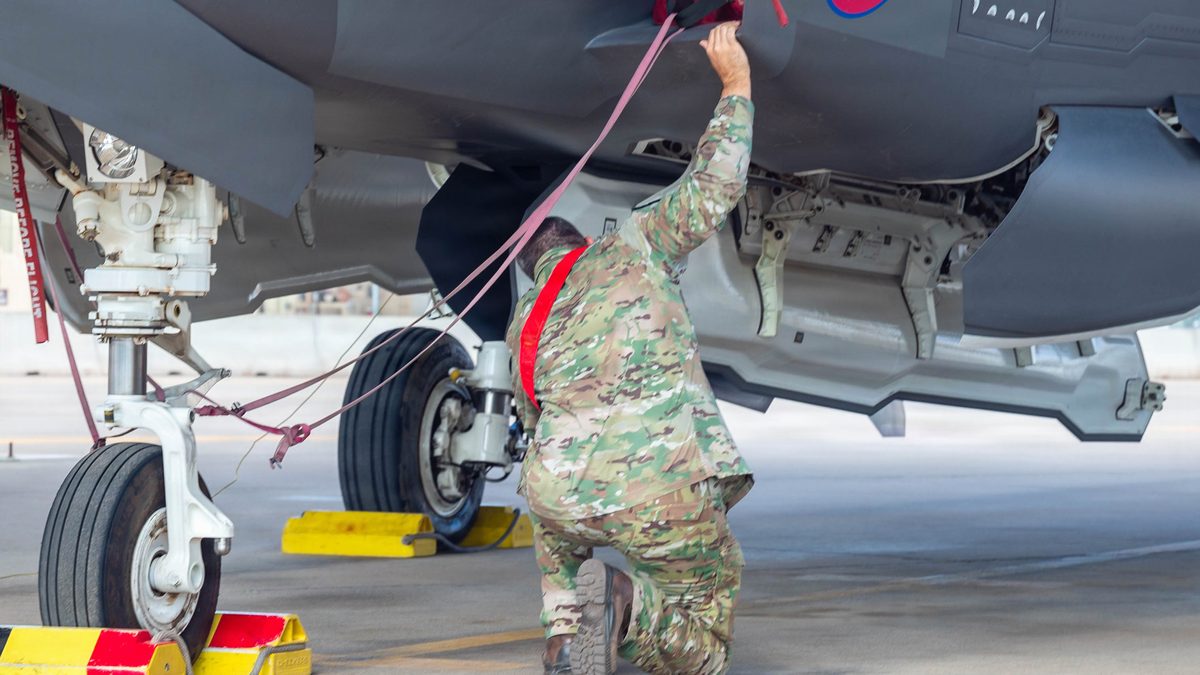
Illustrative image. A Belgian Air Force service member inspects the open weapons bay of an F-35A Lightning II at Luke Air Force Base, Arizona, on 12 August 2026. This is not an Israeli F-35I and no SPICE weapon is shown. U.S. Air Force photo by Airman 1st Class Tekorey Watkins, 56th Fighter Wing, VIRIN 260812-F-QT044-1007, released via the Defense Visual Information Distribution Service. U.S. Government work, public domain. Use does not imply endorsement by the U.S. Department of Defense.
An Israeli Weapon, an American Laboratory: What SPICE 1000 on the F-35I Actually Involves
Rafael Advanced Defense Systems announced on 15 September 2026 that its SPICE 1000 air-to-surface munition is being integrated on the Israeli Air Force F-35I Adir in a joint project with Lockheed Martin, carried out at Lockheed Martin facilities in the United States. Rafael gives a range of more than 120 km and an electro-optical seeker using scene matching.
Technical Summary
Rafael Advanced Defense Systems used the Air and Space Forces Association (AFA) 2026 conference on 15 September 2026 to announce that SPICE 1000 (Smart, Precise Impact, Cost-Effective) is being integrated on the F-35I Adir, the Israeli Air Force derivative of the F-35A. It is the first integration of the SPICE family on any F-35. Rafael describes a 1,000 lb-class weapon for fixed and high-value targets at more than 120 km, homing with an electro-optical seeker and scene-matching algorithms, sold to several countries and used for years from Israeli F-15 and F-16 aircraft, including in recent long-range operations. Israel Hayom, reporting the same announcement, identifies those operations as strikes on Iran and says completion is expected within months.
That is the update. The sentence that carries the most weight is the last one in Rafael’s text: the work is a joint Rafael and Lockheed Martin project, done at Lockheed Martin facilities in the United States. What follows sets out why an Israeli weapon going onto an Israeli aircraft is being integrated in America, what the contract record shows about that work, where SPICE 1000 sits among the other non-United States weapons on the F-35, and what the announcement leaves unsaid.
The integration on the F-35 is being carried out as a joint project between Rafael and Lockheed Martin, at Lockheed Martin facilities in the United States. Rafael Advanced Defense Systems, AFA 2026 announcement, 15 September 2026
What Rafael Said, and What It Did Not
| Claim in the announcement | Evidence class | ISC reading |
|---|---|---|
| SPICE 1000 is being integrated on the F-35I | Manufacturer statement, corroborated by the United States programme record | Consistent with the fiscal year 2027 F-35 Modernized Selected Acquisition Report, which lists a SPICE 1000B item for Israel with no fielding date. |
| Range of more than 120 km | Manufacturer statement | The same text gives the family range as up to 120 km. Rafael’s own SPICE 1000 and 2000 datasheet gives 125 km for SPICE 1000 and 60 km for SPICE 2000, so the SPICE 1000 figure in the announcement agrees and the family figure is the outlier. ISC uses 125 km as the manufacturer’s design figure; no release altitude or speed is given, so it is not a cleared F-35I envelope. |
| Electro-optical seeker with scene matching | Manufacturer statement | Consistent with Lockheed Martin’s own description of SPICE as operating in environments where the Global Positioning System (GPS) is denied. Trade reporting describes GPS and inertial navigation as reference and backup, with image matching providing terminal homing. |
| Used from F-15 and F-16 in recent long-range operations | Manufacturer statement | Israel Hayom reports the operations as strikes on Iran. No sortie or round count is published. |
| Work at Lockheed Martin facilities in the United States | Manufacturer statement | No site is named. See the next section. |
| Completion within months | Secondary reporting only | Not in Rafael’s text; carried by Israel Hayom and Report Difesa. Treated as reported, not confirmed. |
What Rafael’s Own Datasheet Adds
| Parameter | SPICE 1000 | SPICE 2000 |
|---|---|---|
| Stand-off range | 125 km | 60 km |
| Body class | 1,000 lb | 2,000 lb |
| Warhead effect | Blast fragmentation or penetration, on general-purpose or penetration bodies | |
| Wings | Deployable wing set | No wing set indicated |
| Circular error probable (CEP) | 3 m | |
| Terminal guidance | Electro-optical seeker, automatic target acquisition by scene matching, independent of GPS availability | |
| Mission data | Hundreds of missions on a mission cartridge loaded before take-off; each mission holds target imagery, hit angle and azimuth, and fuze delays (the sheet spells it fuse); planning on the ground or on board | |
| Operation | Day, night and adverse weather | |
Rafael’s SPICE 1000 and 2000 datasheet settles the range question and adds detail the announcement omits. The 60 km figure for the larger weapon is the useful contrast: on the datasheet’s own drawing the deployable wing set is drawn on SPICE 1000, and the wing set is the most visible difference between two kits whose reach differs by more than a factor of two. The datasheet does not itself attribute the difference to the wings. Two cautions apply. The datasheet does not mention the F-35, and its issue code (0324) suggests a March 2024 issue even though the copy ISC reviewed was generated in September 2026, so ISC uses it for design figures and not for integration or in-service status. It also gives no mass, dimensions, seeker waveband, specific bomb body, release envelope or datalink, and ISC does not infer them. It is also precise about where GPS independence applies: the weapon flies the midcourse on “its navigation system” and begins scene-matching acquisition as it approaches the target, so the GPS-independent claim is made for acquisition and homing rather than for the whole flight.
Why the Work Is Being Done in the United States
The F-35 is not an aircraft a customer can modify in its own hangar. Every operator flies the same mission-systems software baseline, maintained by Lockheed Martin under the F-35 Joint Program Office, and a new store is a change to that baseline: interface definitions, carriage and release logic, separation clearance and the software load that ties them together. Israel is the one operator that negotiated a measure of national customisation for its jets, and even that customisation is contracted back to the prime. That is the practical meaning of Rafael’s sentence. The weapon is Israeli and the customer is Israeli, but the aircraft software it must be written into is American, and so is the laboratory.
The contract record shows the channel. Israel funds its F-35I work through Foreign Military Sales (FMS) modifications to Lockheed Martin Aeronautics under a line called Israel System Development and Design Phase II, administered by Naval Air Systems Command at Patuxent River, Maryland. Two recent awards set out its shape.
| Announced | Award | Scope | Place of performance | Completion |
|---|---|---|---|---|
| 29 July 2025 | Modification, 33.4 million dollars, of which about 7.7 million dollars Israeli FMS funds | Software development and systems engineering for Israel System Development and Design Phase II, within the Block 4 development effort | Fort Worth, Texas, 80 per cent; outside the continental United States, 20 per cent | July 2026 |
| 7 April 2026 | Modification to N0001921C0040, 11,437,794 dollars, cost-plus-incentive-fee, wholly Israeli FMS funds | Three additional software data loads, described as productionized plus builds off existing enterprise baselines, for Israel System Development and Design Phase II | Fort Worth, Texas, 80 per cent; outside the continental United States, 20 per cent | March 2030 |
Neither award names SPICE, and ISC does not claim that either one funds it. What they establish is narrower and still useful: Israeli-specific F-35I software work is contracted to Lockheed Martin, performed mainly at Fort Worth, with a fifth of the effort outside the continental United States, most plausibly in Israel. A weapon integration running “at Lockheed Martin facilities in the United States” fits that pattern exactly. Rafael does not name Fort Worth, however, and weapons integration is not a single-site activity. F-35 store work has also involved ground and flight test at United States test centres; the Meteor ground vibration and fit checks, for example, were run at Edwards Air Force Base. Fort Worth is therefore the likeliest home of the software work, and an inference rather than a sourced fact.
The joint-project language has its own history. Lockheed Martin and Rafael signed a memorandum of understanding on SPICE in July 2018, a teaming agreement in May 2019 covering development, marketing, manufacture and support of SPICE 1000 and SPICE 2000 guidance kits for United States sale, and an expanded agreement in November 2021 bringing in SPICE 250. The 2019 announcement recorded that more than 60 per cent of SPICE components were already made across eight United States states. The F-35I work is the first time that partnership has touched Lockheed Martin’s own fighter, seven years after it was formed.
The United States programme record carries the same item under a slightly different name. Reporting on the fiscal year 2027 F-35 Modernized Selected Acquisition Report, effective 21 April 2026 and cleared for release on 3 August 2026, lists SPICE 1000B among three F-35I upgrade items, alongside extended-range fuel tanks and an electronic warfare pod. It describes the weapon as moving through an accelerated process called SPICE Lite and gives no fielding date. Whether SPICE 1000B and Rafael’s SPICE 1000 are the same configuration is not stated in either source.
Doing the work inside the enterprise has a consequence beyond Israel. A store model, separation clearance and interface definition written into the common baseline is, in engineering terms, reusable by other F-35 operators, which is the basis for Israel Hayom’s observation that the integration could open the way to other F-35 customers. Whether it does is a release decision rather than an engineering one. It would turn on Israeli export approval for the weapon, United States handling of the integration data generated in American facilities, and the programme’s own policy on sharing partner-funded capability. None of those positions is on the public record.
The Earlier American Link, on Video
The American end of the SPICE supply chain was on the public record well before this week. On 31 October 2023 the United States administration notified Congress of a planned 320 million dollar transfer of SPICE Family Gliding Bomb Assemblies, with associated support, assembly and testing, from Rafael USA, the company’s American subsidiary, to its Israeli parent. CNN reported that the relevant congressional committees had approved the transfer months before 7 October 2023. The Wall Street Journal explained that transfer in the video below, published on 24 February 2024. It predates the F-35I announcement and is reproduced as the publisher released it.

The Population: Non-United States Weapons on the F-35
SPICE 1000 joins a short list. The table below covers every weapon developed outside the United States with a publicly documented F-35 integration or service entry, as at 15 September 2026.
| Nation | Weapon and developer | F-35 variant | Status on the open-source record, 15 September 2026 |
|---|---|---|---|
| United Kingdom | ASRAAM (Advanced Short Range Air-to-Air Missile), MBDA UK | F-35B | In United Kingdom service on the F-35B, per the National Audit Office as reported July 2025. |
| United Kingdom | Paveway IV 500 lb guided bomb, Raytheon UK | F-35B | In United Kingdom service on the F-35B, same source. |
| United Kingdom | SPEAR 3 stand-off missile, MBDA UK | F-35B | In integration. In-service capability given by the Ministry of Defence in May 2025 as early 2030s, low confidence; programme report date September 2032. |
| United Kingdom and Italy (integration sponsors) | Meteor beyond-visual-range missile, MBDA, six-nation programme | F-35B (United Kingdom), F-35A (Italy) | In integration. F-35B flight trials under way; F-35A ground vibration and fit checks completed December 2025; in-service early 2030s; programme report date September 2032. |
| Norway | Joint Strike Missile, Kongsberg | F-35A | In integration. Programme report date September 2027. Japan has received rounds but reported in March 2026 that it cannot yet deploy them because F-35A software integration is incomplete. |
| Israel | SPICE 1000, Rafael | F-35I Adir | In integration at Lockheed Martin facilities in the United States; completion reported as within months; no fielding date in the programme report. |
The Rest of the Population
The same population read the other way: the remaining F-35 partner and customer nations, each with its variant and with a nationally developed weapon integration recorded explicitly as not publicly documented.
| Nation | Variant selected | Nationally developed weapon with documented F-35 integration |
|---|---|---|
| Australia | F-35A | Not publicly documented |
| Belgium | F-35A | Not publicly documented |
| Canada | F-35A | Not publicly documented |
| Czech Republic | F-35A | Not publicly documented |
| Denmark | F-35A | Not publicly documented |
| Finland | F-35A | Not publicly documented |
| Germany | F-35A | Not publicly documented |
| Greece | F-35A | Not publicly documented |
| Japan | F-35A and F-35B | Not publicly documented |
| Netherlands | F-35A | Not publicly documented |
| Poland | F-35A | Not publicly documented |
| Republic of Korea | F-35A | Not publicly documented |
| Romania | F-35A | Not publicly documented |
| Singapore | F-35B and F-35A | Not publicly documented |
| Switzerland | F-35A | Not publicly documented |
On “not publicly documented”. The entry records the open-source record and no more. It does not mean these nations lack a defence industry or an interest in the aircraft’s weapons; several buy and fly weapons from the first table, Japan among them for the Joint Strike Missile. Germany is a partner nation in the six-nation Meteor programme but is not the recorded integration sponsor for either variant, so it sits here rather than above. National integration requests can exist unannounced, and absence from this table is a finding about the record rather than about any ministry’s plans.
One nation sits outside the population and illustrates why the Israeli route matters. Türkiye’s Roketsan signed a follow-on contract with Lockheed Martin in September 2015 to finish SOM-J, a cruise missile designed from the outset for F-35 internal carriage. Türkiye was removed from the F-35 programme in July 2019, and SOM-J went into serial production in March 2026 aimed at the F-16, the KAAN fighter and uncrewed platforms instead. The same prime, the same kind of partnership and the same internal-carriage goal ended without an F-35 because the national relationship with the programme ended. Rafael’s weapon is reaching the aircraft because Israel’s relationship did not.
Population, definition and as-at date
The population is the 20 F-35 partner and customer nations as the airframer defines them: the United States and 19 allies. The first table lists every weapon developed outside the United States with a publicly documented F-35 integration or service entry, by the nation sponsoring it. The second lists the remaining 15 non-United States nations, each recorded explicitly as not publicly documented. The United States is the baseline against which the others integrate and is not tabulated. Türkiye is treated separately above. Status picture taken as at 15 September 2026.
Analysis of Effects
The operational logic is not hard to read. The Israeli Air Force has used SPICE from fourth-generation aircraft for years, and the weapon’s selling point is autonomy: satellite and inertial navigation serve as reference and backup on the way in, and an electro-optical seeker matching the scene against stored reference imagery does not depend on satellite navigation in the terminal phase, which matters in an airspace where jamming of the Global Navigation Satellite System (GNSS) is routine. Rafael’s design figure of 125 km would let an F-35I release well outside the reach of short-range point defences, and would let a squadron that already plans SPICE missions carry the same effect on a newer aircraft. Whether that release can be made from internal stations, and therefore from an aircraft that keeps its low-observable shape, is not in the announcement or the datasheet. The Israeli Air Force is planning for 75 F-35Is in all, and the number of those that can carry the weapon is what will decide how much this matters.
The question the announcement does not answer is where on the aircraft the weapon goes. The F-35A-derived F-35I bay already carries 1,000 lb and 2,000 lb-class direct-attack stores, and SPICE 1000 is built on the same kind of bomb body: a bolt-on guidance kit that converts a 1,000 lb-class bomb such as the Mk 83, with a deployable wing set that gives it its glide range. The wing set is what separates it from a plain guided bomb in the bay, and neither Rafael nor the programme report states whether it will be carried internally or on an external station. The difference is not a detail. External carriage spends the signature advantage that is the reason for using the F-35 at all, while internal carriage limits the load per sortie and requires a bay fit that the public record does not confirm. Until that is published, claims that SPICE 1000 gives the F-35I a stealthy stand-off strike capability are running ahead of the evidence.
Personnel and Safety Considerations
For the people who will handle it, SPICE 1000 on a new platform is a new platform-store pairing, and that carries its own clearance regardless of how long the weapon has been in service elsewhere. The open-source record gives the weapon as 1,000 lb (453 kg) class. Rafael’s datasheet states that the kit is fitted to 1,000 lb or 2,000 lb general-purpose or penetration bodies, blast fragmentation or penetration in effect, and trade reporting names the Mk 83 as a typical 1,000 lb body. Nothing is published on the body actually used for the F-35I: its fill, net explosive quantity (NEQ) and fuze configuration are unknown, so no NEQ in kg TNT-equivalent can be stated here. The hazard division (HD) and compatibility group (CG) of the all-up round are not in the open-source record either; that is a statement about the public record and not about Israeli or United States national classification registers, which are not public. What any such integration requires is well understood even where the specific results are not: carriage environment qualification for the chosen station, including the thermal and vibration environment of an enclosed bay if internal carriage is chosen; safe separation, including the timing of wing deployment after release; mission data handling, since the datasheet describes missions (target imagery, hit angle and azimuth, and fuze delays) held on a mission cartridge loaded onto the weapon before take-off and assigned by the pilot before release, which leaves open who holds planning authority for the F-35I and how the cartridge and aircraft exchange data; assessment of the store against the aircraft’s electromagnetic environment; revised technical publications and loading procedures; and load crew qualification against the new configuration. Israel Hayom’s timeline of months refers to integration; none of these elements is reported as complete.
Data Gaps
The following are recorded as gaps rather than asserted. The specific Lockheed Martin site or sites performing the work are not named; Fort Worth is inferred from the Israeli FMS contract pattern. The contract vehicle funding SPICE 1000 integration is not identified, and neither the July 2025 nor the April 2026 award names it. The relationship between Rafael’s SPICE 1000 and the SPICE 1000B named in the programme report is not stated. Internal or external carriage, and the station, are not published. The announcement gives the family range as up to 120 km against 125 km on Rafael’s datasheet. The warhead body selected for the F-35I and its fill, NEQ, fuze, HD and CG are not published; the datasheet gives only the generic body classes. The datasheet describes an autonomous shot and says nothing about a datalink, so none is assumed. Its issue code suggests March 2024, so it is used here for design figures and not for status. The completion timeline of months comes from secondary reporting, not from Rafael. No round counts are published for the recent operational use. No release policy for other F-35 operators is public.
Key Questions
Where is SPICE 1000 being integrated on the F-35?
Rafael says the work is a joint project with Lockheed Martin at Lockheed Martin facilities in the United States, without naming a site. Israeli-funded F-35I software work under recent contracts is performed 80 per cent at Fort Worth, Texas, so Fort Worth is the likeliest location, but that is an inference rather than a stated fact.
What is SPICE 1000?
SPICE 1000 is a Rafael guidance kit with a deployable wing set that turns a 1,000 lb-class bomb, such as the Mk 83, into a precision glide weapon for fixed and high-value targets. Rafael gives its stand-off range as 125 km and its circular error probable (CEP) as 3 m, with an electro-optical seeker using scene-matching algorithms, which allows operation where GPS is denied. It has been used by the Israeli Air Force from F-15 and F-16 aircraft.
Which non-US weapons are on the F-35?
On the open-source record, the United Kingdom flies ASRAAM and Paveway IV on the F-35B. Meteor, SPEAR 3 and Norway’s Joint Strike Missile are in integration, with programme dates of 2027 for the Joint Strike Missile and 2032 for Meteor and SPEAR 3. Rafael’s SPICE 1000 for the Israeli F-35I Adir is the latest addition, with completion reported as within months.
References
Source-evaluated per NATO source-evaluation doctrine, STANAG 2022 lineage (source reliability A–F / information credibility 1–6). Tier 1 = government primary source; Tier 2 = quality news / specialist defence media; Tier 3 = authoritative aggregator / encyclopaedia.
- T1Rafael Advanced Defense Systems – AFA 2026: for the first time, Rafael’s SPICE 1000 is being integrated on the F-35 (company announcement, official LinkedIn page), 15 September 2026. (Reliability B / Credibility 2)
- T2Report Difesa – AFA 2026: for the first time, Rafael’s SPICE 1000 is being integrated on the F-35, 15 September 2026. (Reliability B / Credibility 2)
- T2Israel Hayom – Israeli SPICE 1000 weapon used in Iran set for F-35 integration: completion expected within months, 15 September 2026. (Reliability B / Credibility 2)
- T3Defence Industry Europe – Israel expands F-35I modernization agenda with SPICE 1000B, extended-range fuel tanks and electronic-warfare pod integration (fiscal year 2027 F-35 Modernized Selected Acquisition Report), 12 September 2026. (Reliability B / Credibility 2)
- T3Defence Blog – Pentagon approves F-35 software upgrade for Israel: modification to N0001921C0040, 11,437,794 dollars, Fort Worth 80 per cent, April 2026. (Reliability B / Credibility 2)
- T3Defence Industry Europe – Lockheed Martin awarded contract to advance software modifications for Israel’s F-35I Adir fleet, 7 April 2026. (Reliability B / Credibility 2)
- T3Defence Industry Europe – Lockheed Martin wins 33.4 million dollar United States contract to advance Israel’s F-35 capabilities, 29 July 2025. (Reliability B / Credibility 2)
- T1Lockheed Martin – Lockheed Martin teams with Rafael to market SPICE air-to-surface guidance kits (SPICE 1000 and SPICE 2000), 16 May 2019. (Reliability B / Credibility 2)
- T1Lockheed Martin – Lockheed Martin signs teaming agreement with Rafael to market SPICE air-to-surface missile kits, 16 July 2018. (Reliability B / Credibility 2)
- T1Lockheed Martin – Lockheed Martin, Rafael partner to develop SPICE 250 weapon system for United States military, 2 November 2021. (Reliability B / Credibility 2)
- T3Defence Industry Europe – United States plans major F-35 weapons expansion with AARGM-ER, LRASM, JSM and StormBreaker in 2027, Meteor and SPEAR 3 in 2032, 6 September 2026. (Reliability B / Credibility 2)
- T2Navy Lookout – National Audit Office report confirms United Kingdom F-35 fleet under-staffed and under-armed (ASRAAM, Paveway IV, AIM-120D in service; Meteor and SPEAR 3 delayed), 11 July 2025. (Reliability B / Credibility 2)
- T2UK Defence Journal – SPEAR 3 missile now looking at early 2030s service entry, 19 May 2025. (Reliability B / Credibility 2)
- T2Breaking Defense – F-35As inch closer to carrying Meteor missiles after pivotal ground tests, December 2025. (Reliability B / Credibility 2)
- T2FlightGlobal – Japan JSM deployment delayed by F-35A software issues, 19 March 2026. (Reliability B / Credibility 2)
- T1Roketsan – Lockheed Martin and Roketsan join forces to develop the SOM-J missile for the F-35 programme, 16 September 2015. (Reliability B / Credibility 2)
- T2The Defense Post – Türkiye launches serial production of SOM-J cruise missile, 26 March 2026. (Reliability B / Credibility 2)
- T1Rafael Advanced Defense Systems – SPICE 1000 and 2000 guidance kits datasheet: SPICE 1000 stand-off range 125 km, SPICE 2000 60 km, CEP 3 m, blast fragmentation or penetration warheads, mission cartridge (issue code UNC.66783/0324), Accessed 15 September 2026. (Reliability B / Credibility 2)
- T2The Wall Street Journal (WSJ Equipped, YouTube) – Why the U.S. is sending Spice bombs to Israel (video embedded in this article), 24 February 2024. (Reliability B / Credibility 2)
- T2The Times of Israel – US set to sign off on 320 million dollar sale of precision-guided bombs to Israel: Rafael USA to Israeli parent, support, assembly and testing, November 2023. (Reliability B / Credibility 2)
- T2CNN – US plans to transfer 320 million dollars in precision bomb equipment to Israel: Rafael USA transfer of SPICE Family Gliding Bomb Assemblies, Congress notified 31 October, 6 November 2023. (Reliability B / Credibility 2)
- T2The Defense Post – US planning to send Rafael munition guidance kits to Israel (citing The Wall Street Journal): Congress notified 31 October 2023; support, assembly and testing included, 8 November 2023. (Reliability B / Credibility 2)
- T3Open Source Munitions Portal – SPICE 1000: bolt-on guidance kit converting 1,000 lb bombs such as the Mk 83, deployable wings, maximum range 125 km, typical miss distance within 3 m, Accessed 15 September 2026. (Reliability C / Credibility 2)
- T2Defense Update – Israel extends SPICE family of air-launched electro-optical guided weapons: deployable wing set, GPS and inertial reference with image-matching terminal homing, 5 May 2013. (Reliability B / Credibility 2)
- T1Defense Visual Information Distribution Service – First Belgian F-35 weapons load strengthens allied air power: a Belgian Air Force service member inspects the weapons bay of an F-35A at Luke Air Force Base, Arizona (VIRIN 260812-F-QT044-1007; article hero image), 12 August 2026. (Reliability A / Credibility 1)
Editorial responsibility. This analysis is researched, written and published under the editorial responsibility of Steve Sawyers, MIExpE VR. Every technical claim is sourced to named open-source material and rated for reliability and accuracy under NATO STANAG 2022. ISC uses its own domain-trained research and drafting system under human direction; the analysis, the judgements and the accountability for them are ours. Corrections and updates welcome: if you hold open-source data that refines or corrects any parameter here, write to [email protected] citing the specific claim and your source. Verified corrections are incorporated and credited in the revision history. Full editorial and AI policy.