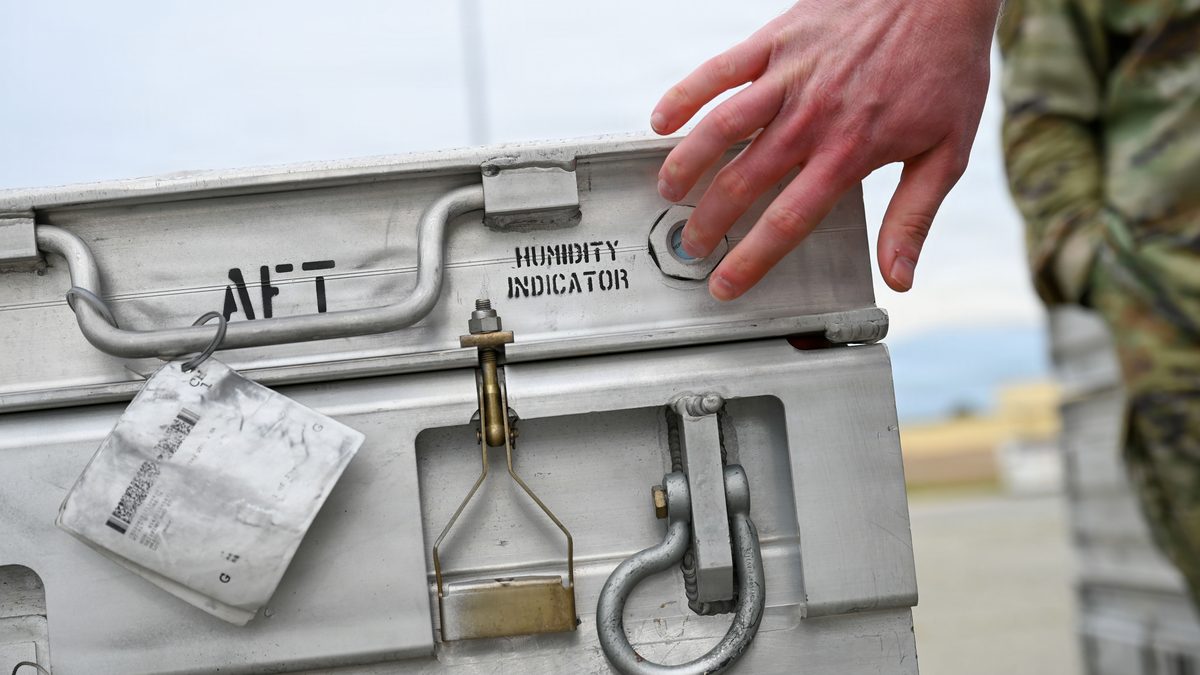
United States Air Force Airmen from the 1st Munitions Squadron inspect munitions pallets during Bamboo Eagle 26-1 at March Air Reserve Base, California, on 16 February 2026. The humidity indicator is checked to confirm moisture levels remain within limits before transport. U.S. Air Force photo by Senior Airman Gerald Ligeralde, VIRIN 260215-F-DA718-1011, released via the Defense Visual Information Distribution Service. U.S. Government work, public domain. Use does not imply endorsement by the U.S. Department of Defense.
The Climate, the Package and the Proof: The Standards That Decide Whether Ammunition Survives the Arctic and the Tropics
Climatic protection of ammunition packaging is set by three kinds of document that are routinely confused. AECTP-230 defines the climate, Edition B promulgated 6 March 2025. DEF STAN 00-088 and MIL-STD-1904C set the package requirement and its tests. AECTP-300, DEF STAN 00-035, MIL-STD-810H and MIL-STD-2073-1E supply the test methods and preservation practice that prove it.
Technical Summary
On 15 January 2026 the Munitions Safety Information Analysis Center (MSIAC) opened a survey of member nations on the certification of munitions packaging as a standalone item: which laws require it, which test standards nations use, and whether ammunition packaging is treated differently from other dangerous goods packaging. The survey names the United Kingdom set as Defence Standard (DEF STAN) 00-088, Packaging for Ammunition and Explosives, DEF STAN 81-41, Packaging of Defence Materiel, and DEF STAN 00-035, Environmental Handbook for Defence Materiel. Its United States list includes Military Standard (MIL-STD) 810, 1660, 1904 and 2073. Since March 2025 the NATO climatic pair has also moved: the Acquisition Streamlining and Standardization Information System (ASSIST) records Allied Environmental Conditions and Test Publication (AECTP) 230, Climatic Conditions, at Edition B and AECTP-300, Climatic Environmental Tests, at Edition E, both promulgated on 6 March 2025. In February 2026 the Defence Safety Authority issued Version 2.0 of its Defence Code of Practice (DCOP) 110 on climatic and mechanical environmental assessment.
That is the update. What follows is the reference picture, because a package is never qualified against one document. Three questions have to be answered in order: what climate the item will meet across its life, what the package must do in that climate, and which test demonstrates that it does. Each question has its own documents, and the most common error in a packaging file is to cite a document written to answer one of them as if it answered another. A claim of MIL-STD-810 compliance, standing alone, answers none of them, because MIL-STD-810H requires every method to be tailored to the service environment of the item under test.
A tarpaulin laid directly over stacked ammunition raises its surface temperature by about 5°C and invites condensation. The same stack under an elevated shade runs up to 23°C cooler than unprotected ammunition. UN SaferGuard, IATG 04.10, Temporary storage, third edition, March 2021, section 8 and Table 12
Three Questions, Five Families of Document
| Question | Governing documents | What they supply |
|---|---|---|
| What climate must the item survive? | AECTP-230; AR 70-38 (US Army); DEF STAN 00-035 Part 4 | Climatic categories, daily cycles of temperature, humidity and solar radiation, and the induced conditions inside shelters and packages |
| What must the package do? | DEF STAN 00-088; DEF STAN 81-41; MIL-STD-1904C; MIL-STD-1660B; IATG 06.40; APP-21 | Performance requirements for the container, the unit load and the materials in contact with the explosive |
| Which test proves it? | AECTP-300; DEF STAN 00-035 Part 3; MIL-STD-810H; DEF STAN 81-41 Part 3; MIL-STD-1904C; AEPP-3 | Laboratory methods, severities and sequences |
| How is the item preserved inside the package? | MIL-STD-2073-1E; TM 38-700 | Preservation methods, barrier materials, desiccant and verification of seals |
| How does the evidence become a safety argument? | AOP-15; AAS3P-20; DSA 03.OME DCOP 110 | The lifecycle environmental profile and the Safety and Suitability for Service assessment that the package evidence feeds |
The Population: Current Status as at 15 September 2026
The population is defined as the NATO, United Kingdom, United States and United Nations documents that a packaging engineer or an ammunition technical officer would cite when demonstrating that a munition package protects its contents against climate: the standards named in the MSIAC packaging certification survey of January 2026 that bear on climate, together with the climatic definition, preservation and assessment documents they depend on. The status picture was taken on 15 September 2026. Every member with a status publicly recorded by its issuing authority or a catalogue of record is a row in the first table. Every member whose current status could not be confirmed from open sources is a row in the second.
| Document | Role | Current position on the open record, 15 September 2026 | Record |
|---|---|---|---|
| AECTP-230, Climatic Conditions | Climate definition | Edition B, promulgated 6 March 2025, 222 pages. Supersedes Edition 1 of 5 July 2009 | ASSIST |
| AECTP-300, Climatic Environmental Tests | Test methods | Edition E, promulgated 6 March 2025, 562 pages. Earlier editions 5 February 1997 and 18 May 2006 | ASSIST |
| MIL-STD-810, Environmental Engineering Considerations and Laboratory Tests | Test methods | Active, Revision H with Change 1, 18 May 2022 | ASSIST |
| MIL-STD-1904, Test Standards for Level A and Level B Packaging for Conventional Ammunition | Package requirement and tests | Active, Revision C of 11 September 2022. Validation Notice 1 dated 3 March 2023 | ASSIST |
| MIL-STD-1660, Ammunition and Ordnance Unit Loads | Unit load requirement | Active, Revision B. Validation Notice 1 dated 23 February 2026 | ASSIST |
| MIL-STD-2073-1, Standard Practice for Military Packaging | Preservation practice | Active, Revision E with Change 4, 22 April 2019. Validation Notice 1 dated 27 June 2024 | ASSIST |
| DEF STAN 00-088, Packaging for Ammunition and Explosives | Package requirement | Issue 4, October 2023, catalogued as active by the Accuris standards store. The Issue 3 text of 14 January 2017 was consulted for this article | Standards distributor catalogue |
| AEPP-3, NATO Standard Packaging Test Procedures | Package tests, NATO | Edition B Version 1, NATO letter of promulgation 12 January 2015, agreement recorded in STANAG 4340. No later edition found | Document and standards distributor catalogue |
| IATG 06.40, Packaging and marking | Package requirement, international guidance | Third edition, March 2021 | UN SaferGuard |
| IATG 04.10, Temporary storage | Storage arrangement | Third edition, March 2021 | UN SaferGuard |
| AR 70-38, Research, Development, Test and Evaluation of Materiel for Worldwide Use | Climate definition, US Army | Dated 26 June 2020, effective 26 July 2020 | Army Publishing Directorate |
| TM 38-700 / AFPAM(I) 24-237, Packaging of Materiel: Preservation | Preservation practice, joint service manual | Dated 27 October 2015 | Department of the Air Force e-Publishing |
| DSA 03.OME Part 1, DCOP 110, Environmental Assessment (Climatic and Mechanical) | Assessment framework, United Kingdom | Version 2.0, February 2026 | GOV.UK |
The Rest of the Population
| Document | Role | Current status | What the open record does show |
|---|---|---|---|
| DEF STAN 00-035, Environmental Handbook for Defence Materiel | Climate definition (Part 4) and test methods (Part 3) | Not publicly documented | Named in the MSIAC survey and cited in DCOP 110 as the source of additional UK-specific guidance. Current issues sit behind Defence Gateway on the UK Defence Standardization extranet |
| DEF STAN 81-41 Part 3, Packaging of Defence Materiel: Environmental Testing | Package tests | Not publicly documented | The test set is described publicly by accredited test laboratories. The current issue has not been confirmed from the UK Defence Standardization register |
| AOP-15, Guidance on the Assessment of the Safety and Suitability for Service of Non-Nuclear Munitions | Assessment framework, NATO | Not publicly documented | MSIAC based its May 2026 Safety and Suitability for Service seminar on Edition D. The promulgation date and the full text were not verified |
| MIL-STD-648, Specialized Shipping Containers | Container requirement | Not publicly documented in this research | MIL-STD-2073-1E, Appendix F, carries a separate paragraph for specialised shipping containers at F.3.5 |
| APP-21, NATO Packaging and Preservation (STANAG 4280) | NATO packaging levels | Not publicly documented | Catalogued with a RESTRICTED marking against Edition B. Its content is not reproduced in this article |
| AAS3P-20, Safety and Suitability for Service Assessment Testing of Large Calibre Ammunition Greater than 40 mm | Munition S3 test programme | Not publicly documented | Edition A Version 1, February 2017, agreement recorded in STANAG 4761, is the edition consulted. Whether it is still the current edition was not confirmed |
“Not publicly documented” is a statement about the open record on the date above. It does not mean that a document is cancelled, unrevised or unavailable to an entitled user. The United Kingdom standards are distributed through the Defence Gateway, and the NATO assessment publication is managed through the alliance standardization system. A project team with access should take the issue it cites from the controlling register, not from this table.
The MSIAC survey also names standards that sit outside this population because they govern marking, electrostatic protection, pallets or mechanical rather than climatic environments: STANAG 4434 and AEPP-2, STANAG 4370, AECTP-400 and AECTP-500, STANAG 2828 and APP-22, ASTM D4169, MIL-STD-1320, MIL-STD-3010 and AFMAN 24-210. They are excluded by definition, not overlooked.
The NATO Packaging Levels
NATO grades military packaging into four levels, and AEPP-3 Edition B, the alliance packaging test procedures, states what each level must survive and which of its procedures to consider. The levels are defined in APP-21 under STANAG 4280. That publication is catalogued with a RESTRICTED marking, so the summary below is drawn from AEPP-3 only.
| NATO level | Storage manner | Climatic zones (AECTP-230) | Duration | Immersion exposure to survive | Maximum vertical drop |
|---|---|---|---|---|---|
| 1 | Outdoor; watertightness and damp heat required | A1 to A3, B1 to B3, C0 to C3, M1 to M3 | 1 year | Partial, 6 days | 1 m |
| 2 | Outdoor; watertightness and damp heat required | A2, A3, B1, B2, C0 to C2 | 3 years | Partial, 6 days | 1 m |
| 3 | Ventilated permanent buildings; watertightness not required | A2, A3, C0 to C2 | 5 years | Not required | 0.75 m |
| 4 | Ventilated buildings; watertightness not required | A2, A3, C0 to C2 | 1 year | Not required | 0.3 m |
Two features matter for this article. No NATO level lists C4, so an extreme cold requirement has to be written into the user requirement rather than inherited from a level. And only Levels 1 and 2 require damp heat and watertightness, so a package qualified to Level 3 for a European depot carries no tropical evidence at all. AEPP-3 also sets Levels 1 and 2 against the storage and transit conditions of their zones, but Levels 3 and 4 against meteorological conditions only.
AEPP-3 does not restate climatic test methods. Its climatic procedures point straight to AECTP-300, which is why the method numbers in a packaging test plan have to be read against the right AECTP-300 edition.
| AEPP-3 procedure | AECTP-300 method |
|---|---|
| A, dry heat | 302, high temperature |
| B, low temperature | 303, low temperature |
| C, dry heat (solar) exposure | 305, solar radiation |
| D, damp heat | 306, humid heat |
| E, water immersion | 307, immersion, with AEPP-3 limitations |
| F, water spray | 310, rain and watertightness |
AEPP-3 also sets the rule that turns climate into a mechanical test. Where temperature affects the package’s resistance, test packages are conditioned to the relevant maximum temperatures referenced to STANAG 4280 for 16 hours or until equilibrium, whichever is less, and if the package has to leave the chamber the test should start within 5 minutes. Its immersion procedure holds a 1.3 m static head of water for 2 hours, and any penetration of moisture is a failure. That 2-hour laboratory test is the proof; the six days of partial immersion in the level table is the service exposure it stands for, and the two should not be quoted as the same thing. Watertight is also not the same as vapour-tight: the MIL-STD-2073-1E distinction between Methods 30, 40 and 50, set out below, still applies to a Level 1 package.
The Climate: Arctic and Tropical Categories
The categories themselves are the starting point for every requirement that follows. The United States Army publishes its design values in AR 70-38, whose Table 3-1 notes that its designations correspond to the climatic categories of AECTP-230, with the exception of A3. The figures below are the daily cycle ambient air values from that regulation. They are reference values for defining exposure. They are not a temperature rating for any package, and they have not been compared against the text of AECTP-230 Edition B. The right-hand column is different in kind: it gives the storage and transit air temperatures of Leaflet 2310/1, Annex A, of the 2009 edition of AECTP-230, which is the condition a stored package actually meets. A test plan should state which table it quotes, because small differences between the two sets, such as the A2 maximum, are easy to carry across by mistake.
| Category | Description | Ambient air, daily cycle | Relative humidity | Storage and transit air, AECTP-230 Edition 1 (2009), not compared with Edition B |
|---|---|---|---|---|
| A1 | Hot dry | +32 to +49°C | 8 to 3% | Peak +71°C |
| A2 | Basic hot | +30 to +43°C | 44 to 14% | Peak +63°C |
| A3 | Intermediate | +28 to +39°C (the correspondence note excepts A3) | Not quoted here | Peak +58°C |
| B1 | Constant high humidity | Nearly constant +24°C | 95 to 100% | +23 to +32°C at 66 to 88% RH; on 7 days a year near-constant +24°C at 100% RH |
| B2 | Variable high humidity | +26 to +35°C | 100 to 74% | Peak +63°C |
| B3 | Hot humid | +31 to +41°C | 88 to 59% | Peak +71°C; RH up to 80% before dawn |
| C0 | Mild cold | −19 to −6°C | Tending toward saturation | −21°C |
| C1 | Basic cold | −32 to −21°C | Tending toward saturation | −33°C |
| C2 | Cold | −46 to −37°C | Tending toward saturation | −46°C |
| C3 | Severe cold | Minimum −51°C | Tending toward saturation | Near-constant −51°C |
| C4 | Extreme cold | −57°C, daily high negligible | Tending toward saturation | Near-constant −57°C |
The ambient column is the wrong number to design a package to, and AR 70-38 says so in its own figures. For hot dry storage it records induced air temperatures of 71°C against an ambient maximum of 49°C, and for basic hot storage 63°C against 43°C. A package that sits in the sun is exposed to its induced condition, not to the weather report.
The 2009 edition makes the same point from both ends. Its hot storage peaks, 71°C for A1 and B3 and 63°C for A2 and B2, sit 20°C or more above the ambient maxima. Its cold storage values sit slightly below the corresponding meteorological minima, because storage shelters often radiate to the night sky better than the air or the ground, and it notes that relative humidity tends to saturation at every cold storage temperature. Its B1 storage cycle, a wet warm regime at 23 to 32°C, is not the same as the AR 70-38 constant high humidity condition, so a test plan should never mix the two.
For the cold end, the United States Army’s own account of Arctic munitions operations, published in Military Review in September 2024, states that the Army in Alaska operates from C1 to C3 and that C4 applies to the coldest areas of Greenland and Siberia. C3 reaches −51°C and C4 −57°C. A European Arctic deployment is therefore normally a C2 or C3 problem, and C4 is the exceptional case rather than the planning default.
Arctic: Cold Exposure and Handling Are One Test
The cold failure of a package is rarely a failure of storage. The low temperature method in the 2006 edition of AECTP-300, Method 303, lists the mechanisms that matter to a container: failure of seals, embrittlement, differential thermal contraction, particularly of non-metallic parts against metallic ones, and stiffening of shock and vibration mounts. The last is the one a packaging engineer should underline, because the cushioning that protects a fuzed round in a drop is the component whose properties move furthest in the cold.
The same method is explicit about its limits. It does not address temperature cycling through 0°C, frost or freeze and thaw, which have their own methods: 304 thermal shock, 311 icing and 315 freeze/thaw. It also states that it may be combined with the shock and vibration tests of AECTP-400 to evaluate dynamic events on cold, embrittled materiel. The practical reading follows directly. A package that survives a cold soak and is then tested for drop at room temperature has not been shown to survive a fork-lift at −40°C. The sequence is part of the evidence. Whether Edition E keeps the same method numbering has not been checked against the 2025 text, so a test plan should cite the method by the edition it was drawn from.
MIL-STD-810H carries the same logic in its own numbering, with separate methods for low temperature, temperature shock, icing and freezing rain, and freeze/thaw, and with a general requirement that each method be tailored to the life cycle of the item. DEF STAN 81-41 Part 3 includes a low temperature test, Test G, in which the chamber is held for 16 hours after the package reaches the test temperature, before mechanical assessment.
The United States ammunition packaging standard writes temperature into the mechanical test itself. MIL-STD-1904C conditions Level A tactical packages at −65°F, +72°F and +160°F (about −54, +22 and +71°C), and Level A non-tactical and Level B packages at −30°F, +72°F and +145°F (about −34, +22 and +63°C). The same standard states its design intent as no degradation after 20 years of protected, controlled storage and 2 years of unprotected, uncontrolled storage in all climatic conditions. Surviving the Arctic, in that sense, is a whole-life requirement and not a one-week cold soak. The upper values also sit close to the induced storage temperatures in AR 70-38, which is the point: the package is proved at the temperature it will actually reach.
The United Kingdom ammunition packaging standard takes the same line. DEF STAN 00-088 Issue 3 requires its drop, vibration and related package tests to be run at both the high and the low temperature extreme, with the packaged store preconditioned and stabilised at the worst temperature it is likely to meet (clause 13.2.4). It requires shock damping components, sealing rings and gaskets to keep their resilience across the specified temperature range (G.3.4), calls for extreme care with polyethylene film used at low temperature and for surplus air to be removed before sealing (F.2.3), and expects fastenings to be operable in the dark while wearing Arctic mitts or NBC clothing. Its statement of packaging requirement offers one example category per climate type, A1, B1, C0 and M1, referenced to DEF STAN 00-035 Part 4, while G.3.1 ties protection to the regions named in the user requirement. A C2 or C3 need therefore has to be stated in that requirement; the form will not supply it.
Tropics: Damp Heat Attacks the Package, Not Just the Contents
In the tropics the package itself degrades. DEF STAN 81-41 Part 3 answers this with Test B, a damp heat test of 4, 21 or 28 cycles of 24 hours, used to assess the effect of a tropical climate on the protective properties of the package, and with dry heat tests: Test C holds the package at +55°C for 48 hours to expose drying effects such as timber shrinkage and loosening of fastenings, and Test N covers hot dry exposure. Solar loading is a separate method again: the 2006 edition of AECTP-300 lists high temperature including radiative heating as Method 302 and solar radiation as Method 305, and a damp heat cycle does not reproduce either. The value of these tests lies in their order. A climatic barrier that has been scuffed or punctured in handling will pass a damp heat test if it is tested undamaged. Applying the mechanical tests first, then the damp heat cycle, is how a test programme finds that failure before a depot does.
Humidity also has to be treated as two different threats. MIL-STD-2073-1E separates them by method. Method 30 is waterproof protection: the item is heat sealed in a waterproof or waterproof-greaseproof bag. Method 40 is watervaporproof protection: the item is heat sealed in a watervaporproof enclosure. Method 50 adds activated desiccant to that enclosure. A package that keeps rain out can still admit water vapour, and in a B1 or B2 climate the vapour is the bigger problem. Appendix G of the same standard sets out how preservation is verified, including leakage tests by vacuum retention, submersion, pneumatic pressure, hot water and squeeze, and strength tests of heat-sealed seams. The joint service manual TM 38-700 describes the same five preservation methods, from Method 10 physical protection to Method 50.
DEF STAN 00-088 Issue 3 carries the same logic into the container. Packaging must be waterproof where water ingress could harm the contents, and must allow for pressure changes caused by temperature or altitude (G.3.2 and G.3.3). A container that has to breathe needs a breather valve and a suitable desiccant (E.4.5). Materials inside the same climatic barrier as the store must be non-hygroscopic: conditioned at 65% relative humidity and 21°C, they may lose no more than 3% of their mass when dried (E.7.4). For the tropics it requires proofing against fungi and insects, timber to ISPM 15, and allowance for warping and shrinking (H.2.7). The current issue is Issue 4, which was not consulted, so these clauses are cited to Issue 3.
The humidity indicator on the container in the photograph above is the field end of that chain. DEF STAN 00-088 Issue 3 requires a visible humidity indicator wherever water or water vapour could affect safety or serviceability, preferably on or close to the closure (E.4.7): a check, before the load moves, that a sealed container is still holding moisture within limits.
Storage Can Defeat a Qualified Package
A package qualified to every document above can still be defeated by the way it is stored. IATG 04.10, the United Nations guideline for temporary storage, records that direct solar radiation can raise the temperature of ammunition by as much as 50°C above ambient air, and gives a Middle East example reaching 101°C, above the melting point of TNT at about 80°C. It identifies the worst condition for temporary storage as large day to night temperature swings combined with high humidity.
Its comparison of protection options, in Table 12, is specific. A tarpaulin laid directly over the stack protects against rain and wind but raises surface temperature by about 5°C and, through poor ventilation, promotes condensation and moisture ingress. The guideline says that option should not be used in hot climates. An elevated shade reduces surface temperature by up to 23°C compared with unprotected ammunition while keeping air moving. The package and its storage arrangement are one protective system, and a qualification that assumes a shaded, ventilated stack says nothing about a tarpaulin in the sun.
IATG 06.40 adds the consequence that most often reaches a licensing officer. Explosives should be held in packaging designed to protect against foreseeable physical damage and environmental deterioration for the whole life of the item. Packaging materials must be chemically compatible with the explosive, including by vapour. And an item not held in its approved packaging may take a different hazard classification code, with effects on storage plans, aggregation and explosive limits. Repacking a nature into a locally sourced container is therefore a classification question as well as a protection question. The United Kingdom code says the same thing in terms: DSA 03.OME DCOP 106, Hazard Classification for Transport and Storage, Version 2.0 of February 2026, states that classification is carried out on the article in its packaging configuration as presented for transport, that the packaging will therefore affect the hazard division and compatibility group assigned, and that the approved Full-Service Standard Package must be used or the article repacked with suitable dunnage. ISC has covered the industrial side of this in British Army artillery ammunition packaging and the SIXPAC small calibre container.
Where the Obligation Comes From
One distinction is routinely lost. IATG 06.40 expects explosive packaging to pass the United Nations Orange Book tests and national requirements, which is the dangerous goods transport case. Military package qualification is a different and usually harder test: MIL-STD-1904C states that its Level A and Level B requirements in general exceed those of Title 49 of the US Code of Federal Regulations. A United Nations performance-oriented package mark is necessary to move the item; it is not evidence that the item will survive a C3 winter or a B2 wet season. The same applies one level up. MIL-STD-1660B tests the complete unit load, and a container that passes MIL-STD-1904C can still fail as a strapped pallet when cold stiffens the restraint or heat and drying slacken it.
The obligation to connect these documents sits in the safety assessment rather than in any single packaging standard. In the United Kingdom, DCOP 110 Version 2.0 requires the anticipated lifecycle of ordnance, munitions and explosives (OME) to be defined so that the climatic and mechanical stimuli can be understood across the Manufacture to Target Disposal Sequence. It points to the NATO AECTPs for suitable tests and to DEF STAN 00-035 for additional UK-specific guidance, and it states that the packaging from which evidence was generated should be suitably similar to the packaging that will enter service. In NATO, AOP-15 frames the Safety and Suitability for Service assessment into which that evidence is fed. The instrument that makes AOP-15 binding on a given nation, and the edition it currently cites, is not fully visible from open sources and is logged below as a data gap.
Package evidence and munition evidence are not the same thing, and the NATO test guidance keeps them apart. AAS3P-20 Edition A, the Safety and Suitability for Service test guidance for large calibre ammunition above 40 mm, applies its aggravated humid heat test to unpackaged munitions, for ten 24-hour cycles under AECTP-300 Method 306. Its low temperature storage test runs at a constant −51°C, the C3 value, for 72 hours in the storage configuration, packaged or unpackaged. Its mould test under Method 308 runs for at least 28 days and may use leftover components or material samples. A munition that passes its S3 humidity test unpackaged has proved its own tolerance, not the package’s barrier, and a safety case needs both.
Analysis of Effects
For a project team the practical sequence is short. Define the lifecycle environmental profile first, including the induced temperatures inside the package and the storage arrangements the item will actually meet. Select the climatic categories from AECTP-230 on that basis. Take the package performance requirement from DEF STAN 00-088 or MIL-STD-1904C as the contract requires, and the unit load requirement from MIL-STD-1660B where the item moves palletised. Choose test methods and severities from AECTP-300, DEF STAN 00-035 Part 3 or MIL-STD-810H, tailored to that profile, and sequence mechanical and climatic tests so that damaged barriers are tested as damaged barriers. Specify the preservation method under MIL-STD-2073-1E by name, because Method 30 and Method 50 are different requirements.
The citation risk is the second-order problem. AECTP-230 and AECTP-300 were both reissued in March 2025, and the widely circulated public copies are the 2009 and 2006 editions. A test report, a safety case or a packaging specification that quotes category values or method numbers from those copies should say so, and should be checked against the current edition before it is relied on. The documents in the first table perform related functions, but their procedures, severities and acceptance criteria are not interchangeable, and a result obtained under one does not transfer to another without an engineering argument.
Personnel and Safety Considerations
Nothing in this article changes a qualification, a hazard classification or a storage licence. Climatic category values here are reference values for defining exposure and are not package temperature ratings. A package that has been damaged, opened, repacked or stored outside its assessed conditions should be treated as outside its evidence until the responsible technical authority says otherwise, and IATG 06.40 is explicit that repacking into unapproved packaging can change the hazard classification code. Where a humidity indicator shows moisture above limits, or a barrier is visibly damaged, the load should be reported through the established route before it moves. In the United Kingdom the governing regulatory set is DSA 02.OME and DSA 03.OME, which replaced the withdrawn JSP 482.
Data Gaps
The text of AECTP-230 Edition B and AECTP-300 Edition E is behind a login in ASSIST and was not read for this article, so no comparison with the 2009 and 2006 editions is offered and the category values shown are taken from AR 70-38. The promulgation date used for both publications is the ASSIST record date; the NATO letter of promulgation was not seen, and its date may differ. The current issues of DEF STAN 00-035 and DEF STAN 81-41 Part 3 were not confirmed, and the DEF STAN 00-088 issue is taken from a distributor catalogue rather than the UK Defence Standardization register. The unit load test conditioning temperatures of MIL-STD-1660B were not read from its text. The promulgation date and national implementation of AOP-15 Edition D were not verified, nor was the current status of MIL-STD-648. The DEF STAN 81-41 Part 3 test descriptions are taken from an accredited laboratory summary rather than the controlled text. No open-source record was found of how the MSIAC packaging certification survey was answered or when its results will be published. The content of APP-21 is not reproduced because the publication is catalogued with a RESTRICTED marking; the maximum conditioning temperatures that AEPP-3 refers to are defined there. The current editions of AEPP-3 and AAS3P-20 were not confirmed against the NATO Standardization Office database, and a later edition of AAS3P-20 may have been issued. DEF STAN 00-088 clauses are cited to Issue 3 of 14 January 2017; Issue 4 was not consulted and the clause numbering or content may differ. The storage and transit values are from AECTP-230 Edition 1 and were not compared with Edition B.
Key Questions
Which standards govern climatic protection of ammunition packaging?
No single document does. AECTP-230 defines the climate the item will meet. DEF STAN 00-088 in the United Kingdom and MIL-STD-1904C in the United States set the packaging requirement and tests, with MIL-STD-1660B for unit loads. AECTP-300, DEF STAN 00-035 and MIL-STD-810H supply test methods, and MIL-STD-2073-1E sets preservation practice. AOP-15 and DCOP 110 connect them into a safety assessment.
What are the NATO climatic categories for Arctic operations?
AECTP-230 defines cold categories C0 to C4. The US Army Military Review account of Arctic munitions operations states that the Army in Alaska operates from C1 to C3, and that C4 applies to the coldest areas of Greenland and Siberia. AR 70-38 gives C2 as minus 46 to minus 37 degrees Celsius and C3 as a minimum of minus 51 degrees Celsius, and C4 as minus 57 degrees Celsius.
Is MIL-STD-810 compliance enough to qualify a munitions package?
No. MIL-STD-810H, current with Change 1 of 18 May 2022, requires its methods to be tailored to the service environment of the item. A bare compliance claim does not say which methods, severities or sequences were applied. Ammunition packaging in the United States is tested against MIL-STD-1904C, which sets container material, performance and environmental tests and states that its requirements generally exceed 49 CFR.
References
Source-evaluated per NATO source-evaluation doctrine, STANAG 2022 lineage (source reliability A–F / information credibility 1–6). Tier 1 = government primary source; Tier 2 = quality news / specialist defence media; Tier 3 = authoritative aggregator / encyclopaedia.
- T2Munitions Safety Information Analysis Center (NATO) – MSIAC survey: Certification of munitions packaging, naming DEF STAN 00-088, DEF STAN 81-41, DEF STAN 00-035, AECTP-300 and MIL-STD-810, 1660, 1904 and 2073, 15 January 2026. (Reliability B / Credibility 2)
- T1US Defense Logistics Agency, ASSIST – AECTP-230, Climatic Conditions: document record, Edition B promulgated 6 March 2025, Accessed 15 September 2026. (Reliability A / Credibility 1)
- T1US Defense Logistics Agency, ASSIST – AECTP-300, Climatic Environmental Tests: document record, Edition E promulgated 6 March 2025, Accessed 15 September 2026. (Reliability A / Credibility 1)
- T1US Defense Logistics Agency, ASSIST – MIL-STD-1904, Test Standards for Level A and Level B Packaging for Conventional Ammunition: document record, Revision C Validation Notice 1, 3 March 2023. (Reliability A / Credibility 1)
- T1US Defense Logistics Agency, ASSIST – MIL-STD-1660, Ammunition and Ordnance Unit Loads: document record, Revision B Validation Notice 1, 23 February 2026. (Reliability A / Credibility 1)
- T1US Defense Logistics Agency, ASSIST – MIL-STD-810, Environmental Engineering Considerations and Laboratory Tests: document record, Revision H Change 1, 18 May 2022. (Reliability A / Credibility 1)
- T1US Army Combat Capabilities Development Command, Armaments Center – MIL-STD-1904C, Test Standards for Level A and Level B Packaging for Conventional Ammunition: scope, relationship to 49 CFR, storage design intent and conditioning temperatures, 11 September 2022. (Reliability A / Credibility 1)
- T1UK Ministry of Defence, Defence Safety Authority – DSA 03.OME Part 1, DCOP 106, Hazard Classification for Transport and Storage, Version 2.0: paragraphs 69 to 74 on the effect of packaging on hazard classification, February 2026. (Reliability A / Credibility 1)
- T1US Department of Defense, Naval Air Systems Command – MIL-STD-2073-1E with Change 4, Standard Practice for Military Packaging: Methods 30, 40 and 50, Appendix F and Appendix G, 22 April 2019. (Reliability A / Credibility 1)
- T1US Department of the Army – AR 70-38, Research, Development, Test and Evaluation of Materiel for Worldwide Use: climatic design types, correspondence to AECTP-230 and induced storage temperatures, 26 June 2020. (Reliability A / Credibility 1)
- T1Army University Press, Military Review – Arctic Munitions Operations, by Chief Warrant Officer 4 Michael Lima: climatic categories C1 to C4 in Arctic operations, September to October 2024. (Reliability A / Credibility 2)
- T3NATO, public reproduction – AECTP-300 Edition 3 (2006), Method 303 Low Temperature: effects on materiel, limitations and combination with AECTP-400 mechanical tests. Historical edition, 18 May 2006. (Reliability C / Credibility 2)
- T3Applus+ Keystone (accredited test laboratory) – DEF STAN 81-41 Part 3, Packaging Testing of Defence Materiel: summary of Tests B, C, G, N and the mechanical tests, Accessed 15 September 2026. (Reliability C / Credibility 2)
- T1United Nations, UN SaferGuard – IATG 06.40, Packaging and marking, third edition: clauses 4.1 to 4.3, March 2021. (Reliability A / Credibility 1)
- T1United Nations, UN SaferGuard – IATG 04.10, Temporary storage, third edition: section 8, climatic effects, and Table 12, protection options, March 2021. (Reliability A / Credibility 1)
- T1US Department of Defense, joint service – TM 38-700 / AFPAM(I) 24-237, Packaging of Materiel: Preservation, chapter 4, methods of preservation, 27 October 2015. (Reliability A / Credibility 1)
- T1UK Ministry of Defence, Defence Safety Authority – DSA 03.OME Part 1, DCOP 110, Environmental Assessment (Climatic and Mechanical), Version 2.0, February 2026. (Reliability A / Credibility 1)
- T2Munitions Safety Information Analysis Center (NATO) – Safety and Suitability for Service (S3) seminar, based on AOP-15 Edition D, 27 to 28 May 2026. (Reliability B / Credibility 2)
- T3Accuris standards store – MODUK DEF STAN 00-088, Packaging for Ammunition and Explosives: catalogue record, Issue 4, October 2023, active, Accessed 15 September 2026. (Reliability C / Credibility 3)
- T1NATO Standardization Office – AEPP-3 Edition B Version 1, NATO Standard Packaging Test Procedures (STANAG 4340): Chapter 2, NATO levels of packaging; Chapter 3, climatic conditioning; Procedures A to F. Document text consulted; catalogue record linked, January 2015. (Reliability A / Credibility 1)
- T1NATO Standardization Agency – AECTP-230 Edition 1, Climatic Conditions: Leaflet 2310/1, Annex A, storage and transit conditions. Historical edition, non-classified; document text consulted; catalogue record linked, July 2009. (Reliability A / Credibility 1)
- T1UK Ministry of Defence, UK Defence Standardization – DEF STAN 00-088 Issue 3, Packaging for Ammunition and Explosives: clauses 13.2.4, C.3.3.6, E.4.5, E.4.7, E.7.4, F.2.3, G.3 and H.2.7. Document text consulted; catalogue record linked, 14 January 2017. (Reliability A / Credibility 1)
- T1NATO Standardization Office – AAS3P-20 Edition A Version 1, Safety and Suitability for Service Assessment Testing of Large Calibre Ammunition Greater than 40 mm (STANAG 4761): Annex C test parameters and Appendix 1 rationale. Document text consulted; catalogue record linked, February 2017. (Reliability A / Credibility 1)
- T3GlobalSpec standards catalogue – STANAG 4280, NATO Packaging and Preservation, APP-21 Edition B: catalogue record showing a RESTRICTED marking, Accessed 16 September 2026. (Reliability C / Credibility 2)
- T1Defense Visual Information Distribution Service – Load, Secure, Deploy: article hero image, Airmen of the 1st Munitions Squadron inspecting a munitions container humidity indicator during Bamboo Eagle 26-1, VIRIN 260215-F-DA718-1011, Published 19 February 2026. (Reliability A / Credibility 1)
Editorial responsibility. This analysis is researched, written and published under the editorial responsibility of Steve Sawyers, MIExpE VR. Every technical claim is sourced to named open-source material and rated for reliability and accuracy under NATO STANAG 2022. ISC uses its own domain-trained research and drafting system under human direction; the analysis, the judgements and the accountability for them are ours. Corrections and updates welcome: if you hold open-source data that refines or corrects any parameter here, write to [email protected] citing the specific claim and your source. Verified corrections are incorporated and credited in the revision history. Full editorial and AI policy.