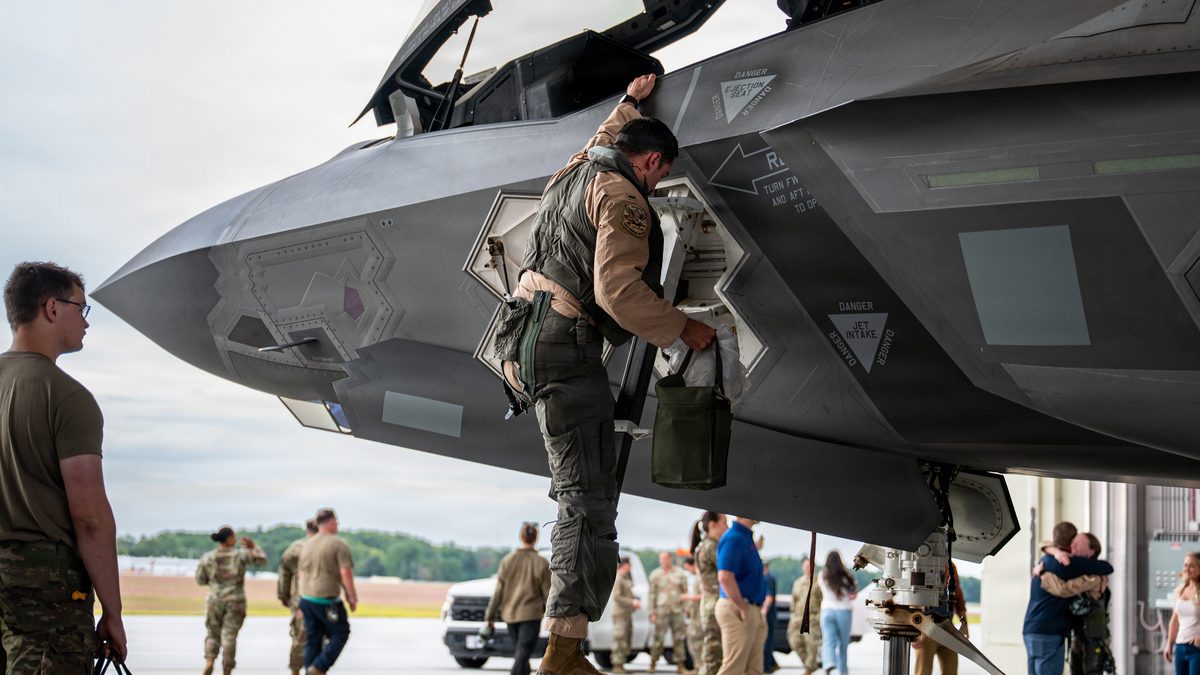
Illustrative image. A United States Air Force pilot steps down from an F-35A Lightning II of the 158th Fighter Wing at the Vermont Air National Guard base, South Burlington, Vermont, on 9 September 2026, on return from a deployment to the United States Central Command area of responsibility. These are not the aircraft, production lots or programme decisions described in this article. U.S. Air National Guard photo by Airman 1st Class Raymond LaChance, VIRIN 260909-Z-CB896-1009, released via the Defense Visual Information Distribution Service. U.S. Government work, public domain. Use does not imply endorsement by the U.S. Department of Defense.
Eleven Per Cent More Per Airframe, Two More Missiles by 2030: The F-35 Programme Reprices Itself
The F-35 Joint Program Office has confirmed higher flyaway costs for production Lots 18 and 19, 296 aircraft in all. In then-year dollars the F-35A rises 11.5 per cent to 92.0 million dollars, the F-35B 11.4 per cent to 121.4 million and the F-35C 8.5 per cent to 110.8 million. Total programme acquisition cost now stands at 536.2 billion dollars.
Technical Summary
Three things moved in the week of 3 to 10 September 2026 and they belong together. The F-35 Joint Program Office confirmed higher unit flyaway costs for production Lots 18 and 19, a block of 296 aircraft contracted at 24.29 billion dollars and finalised on 29 September 2025. Lockheed Martin restated the global fleet position on data current to 27 August 2026: 1,355 deliveries and one million flight hours. The delivery count is the new part of that. The million-hour mark was first passed on 3 March 2025 and this is a restatement of it, not a fresh milestone. Germany’s first F-35A, MG-01, flew from Fort Worth on 8 September 2026, the aircraft that will carry the German share of the alliance nuclear task once Tactical Air Wing 33 at Büchel is ready to receive it.
That is the update. What follows is the reference picture behind it, because the cost line and the carriage line are the same line. The same fiscal year 2027 Modernized Selected Acquisition Report that produced the new unit costs also carries a development item called Six in the Bay, dated September 2030, which would take internal air-to-air missile carriage from four rounds to six without recourse to an external station. Cost growth on this programme is now overwhelmingly a modernisation and weapons-integration story rather than an airframe story, and the magazine is what the money is buying.
Increases internal missile capacity from four to six without relying on external weapon stations. Six in the Bay development item, fiscal year 2027 F-35 Modernized Selected Acquisition Report, effective 21 April 2026, target date September 2030
What Moved This Week
| Item | Date | What is now established |
|---|---|---|
| Lots 18 and 19 unit costs | 4 September 2026 | F-35A 92.0m, F-35B 121.4m, F-35C 110.8m in then-year dollars; 296 aircraft; programme acquisition cost 536.2bn. |
| Six in the Bay | Reported 3 to 6 September 2026 | Development item in the fiscal year 2027 report, four internal rounds to six, target September 2030. |
| United Kingdom funding | 7 September 2026 | A 2.2bn pound programme envelope across four financial years for additional F-35s including, but not limited to, the first F-35As. |
| Germany first flight | 8 September 2026 | MG-01 flew at Fort Worth; first of 35; early aircraft go to the training pipeline at Ebbing, not to Büchel. |
| Fleet milestones | 8 September 2026, data to 27 August | 1,355 deliveries, 55 operating locations, 807,820 sorties. The one million flight hours figure restates a mark first passed on 3 March 2025. |
| Canada | 3 to 6 September 2026 | 16 aircraft firm, 72 still under review; long-lead payments continue to hold production slots. |
| Finland, Patria F135 | 3 to 7 September 2026 | First Finnish-assembled F135 engine completed, for national and regional sustainment. |
What the Lots 18 and 19 Numbers Actually Say
| Variant | Lots 15 to 17 | Lots 18 and 19 | Change | Base-year 2012 dollars, Lots 18 and 19 |
|---|---|---|---|---|
| F-35A | 82.5m | 92.0m | +11.5% | 78.0m (+7.3%) |
| F-35B | 109.0m | 121.4m | +11.4% | 110.3m (+10.5%) |
| F-35C | 102.1m | 110.8m | +8.5% | 93.4m (+6.6%) |
Figures are unit flyaway costs in United States dollars. The first three columns are then-year, that is current, dollars; the last column restates the same lots in constant base-year 2012 dollars, the frame in which the programme reports against its own baseline. The gap between the two columns is the whole argument. In constant dollars the F-35A moves 7.3 per cent and in current dollars it moves 11.5 per cent, so roughly four percentage points of the headline rise is the price level rather than the aeroplane. That is why the programme office and the airframer can both say, without contradiction, that airframe cost is consistent with inflation-adjusted prior years while the number a finance ministry has to find goes up by an eighth.
The drivers the programme office names are inflation and raw material prices, government furnished equipment covering the engine and the radar, Block 4 and Technology Refresh 3 content, and additional spares bought to lift readiness. Reporting on the same document attributes around 900 million dollars of research and development growth to Block 4 scheduling refinements alone, a figure that does not appear in the published extracts of the report itself; production integration of the APG-85 radar and power and thermal management upgrades are named on the record alongside it. Total programme acquisition cost has risen from 485.2 billion dollars, as reported in 2023, to 536.2 billion, an increase of 51 billion. Estimated total lifecycle cost has moved back below the two trillion dollar mark.
One arithmetic trap is worth closing before a reader falls into it. The 24.29 billion dollars definitised on 29 September 2025 buys air vehicles, not complete flyaway aircraft, and it works out at an average of about 82.4 million dollars per airframe across the whole mix of variants and customers. The Lot 18 and 19 engines were settled separately with Pratt & Whitney at a combined 6.6 billion dollars in April 2026. Dividing 24.29 billion by 296 and setting the answer against the 92.0 million dollar F-35A line compares two different things: the first is an airframe average, the second a per-variant flyaway cost that already includes the government furnished engine and radar.
Six in the Bay, and the Magazine Argument
Six in the Bay: what the report says, and what it does not
The primary document is the fiscal year 2027 F-35 Modernized Selected Acquisition Report, effective 21 April 2026 and cleared for publication on 3 August 2026. It lists Six in the Bay as a development item under the aircraft subprogram with a target of September 2030, and describes the effect as raising internal missile capacity from four to six without relying on external weapon stations. That is the extent of what the report states. It does not name the variants, it does not name the missile, and it does not use the word Sidekick.
Widely repeated reporting fills those three gaps from a separate and older public record, and the distinction matters. Lockheed Martin unveiled a company-funded internal rack called Sidekick in 2019, sized to add a third AIM-120 Advanced Medium-Range Air-to-Air Missile to each of the two internal bays of the F-35A and F-35C. The F-35B was excluded then and the reason is geometric rather than programmatic: the lift system occupies the volume forward of the bays and the F-35B bay is shorter, so the rack needs length it does not have. Each main bay on the F-35A and F-35C already carries two AIM-120 rounds, or one 2,000 lb-class store, so Sidekick is a compact rack fitted inside an existing bay rather than a new weapon station. An AIM-120D two-way datalink item sits on the same September 2030 line in the report, which is suggestive but not the same as a stated configuration. ISC treats the four to six figure and the 2030 date as reported by the programme, and the variant applicability and the missile type as inference from the Sidekick record rather than as content of the report.
Read Six in the Bay next to the integration schedule in the same report and the shape of the decade becomes legible. September 2027 carries AARGM-ER, the Advanced Anti-Radiation Guided Missile Extended Range, Long-Range Anti-Ship Missile Capability Increment 1, the Joint Strike Missile and the GBU-53/B StormBreaker. September 2032 carries Meteor, SPEAR 3 and a low-observable pylon for LRASM and the JASSM family, with a further low-observable pylon for AARGM-ER in September 2033. Six in the Bay sits between those two dates and it is the only one of them that adds nothing to the outside of the aeroplane.
That is the point worth holding. Every stand-off weapon on the 2027 and 2032 lines buys reach by hanging mass on a pylon, and every pylon is a radar cross-section decision taken before the sortie. Internal carriage is the only route that adds magazine depth without spending signature, and on a four-round internal load a single additional pair is a 50 per cent increase in shots per sortie. Against a target set where each engagement may need more than one round, sortie count and tanker demand fall in direct proportion. For a European air force sizing an air-to-air war reserve, six rounds per airframe rather than four changes the stockpile arithmetic before a single new missile is bought. Scaled to a formation the difference is stark: a four-ship carrying four internal rounds each puts 16 shots into an engagement, and the same four-ship under Six in the Bay puts up 24.
One caution against a reading this article could invite by covering both subjects at once. Six in the Bay and the nuclear task are not the same magazine. The B61-12 is a large store and it competes for the same internal bay volume that the extra air-to-air rounds would occupy. A nuclear loadout is not a six-shot air-to-air loadout, and no aircraft flies both configurations on the same sortie.
What the Programme Office Put Out This Week
The programme office publishes on X as @theF35JPO, and its output this week was operational rather than programmatic: no post touched the Lot 18 and 19 pricing, the acquisition report or Six in the Bay. That gap is itself the finding, because the three posts below happen to land on the three variants this article has had to keep apart, and each one sits against a point made above. They are reproduced here as the rights holder published them.
Extending the fight. 🥊
— F-35 Lightning II Joint Program Office (@theF35JPO) September 8, 2026
F-35A Lightning II aircraft conduct aerial refueling operations in the U.S. Central Command area of responsibility.
Precision, Power, Readiness 💪
— F-35 Lightning II Joint Program Office (@theF35JPO) September 9, 2026
An F-35C Lightning II, assigned to Marine Fighter Attack Squadron (VMFA) 251, takes off during exercise Red Flag-Alaska 26-3 at Joint Base Elmendorf-Richardson, Alaska.
Utilizing the vast Joint Pacific Alaska Range Complex airspace, Red Flag-Alaska 26-3 provides realistic training environments that prepare service members for full-spectrum combat engagements.
Multilateral training. 🌎
— F-35 Lightning II Joint Program Office (@theF35JPO) September 4, 2026
F-35B Lightning II aircraft, assigned to Marine Fighter Attack Squadron (VMFA) 225, prepare for takeoff during exercise Red Flag-Alaska 26-3 at Eielson Air Force Base, Alaska.
Simulating complex combat scenarios in realistic environments provides unique opportunities to integrate joint and coalition forces, enhancing our ability to project combat power globally.
The Population: Which F-35A Operators Have a Documented Nuclear Task
Two of this week’s items, the German first flight and the British funding line, are the same story at different stages, and neither is legible without the status picture behind it. The table below covers every nation in the F-35 programme with a publicly documented connection between its F-35A and the alliance dual-capable aircraft nuclear mission, as at 10 September 2026.
| Nation | F-35A status, 10 September 2026 | Nuclear-sharing connection on the open-source record |
|---|---|---|
| United States | In service across all three variants | F-35A design and operationally certified for the B61-12 by the Joint Program Office on 12 October 2023, at designated units only. The F-35B and F-35C are not certified. |
| Belgium | F-35A deliveries under way; F-16 replacement | Kleine Brogel is reported in open sources as a United States weapon storage location. The nuclear task passes from the F-16 to the F-35A. |
| Germany | First aircraft MG-01 flew 8 September 2026; 35 on order; early aircraft to the United States training pipeline | The F-35A was selected in 2022 expressly to inherit the Tornado nuclear role at Büchel with the B61-12. Base infrastructure works are in progress and operational deliveries to the wing follow the training tranche. |
| Italy | F-35A in service, assembled at Cameri | Ghedi is reported in open sources as a weapon storage location, with the F-35A replacing the Tornado in the role. |
| Netherlands | F-35A in service; F-16 fully replaced | Volkel is reported in open sources as a weapon storage location. The Netherlands has publicly acknowledged a nuclear task and has moved it to the F-35A. |
| United Kingdom | No F-35A yet; 12 announced 24 June 2025, in service early 2030s | Announced expressly to join the alliance dual-capable aircraft mission, the first British air-delivered nuclear role since 1998. Included within this week’s 2.2 billion pound allocation, which is an envelope covering more than these aircraft. |
The driver behind the first table is a single certification event with a date on it. On 12 October 2023 the F-35 Joint Program Office certified the F-35A, both by design and operationally, to carry the B61-12 guided nuclear gravity bomb, at designated units only. The F-35B and the F-35C were not included and remain outside it. That decision is what makes variant selection a nuclear-policy question rather than a procurement preference: a nation that buys only the F-35B has bought itself out of the delivery role whether it intended to or not, which is precisely why the United Kingdom, an F-35B operator since the programme began, has had to buy a different variant to rejoin the mission.
That is the thread running through this week’s British and German items. The 2.2 billion pounds the United Kingdom allocated across the 2026/27 to 2029/30 financial years funds additional F-35s including the country’s first F-35As, announced in June 2025 as 12 aircraft, entering service in the early 2030s and framed as delivering substantial domestic workshare. Germany selected the F-35A in 2022 for the same reason and is four years further down the same road, with MG-01 flown, eight aircraft heading to Ebbing Air National Guard Base in Arkansas for aircrew and maintainer training, and Tactical Air Wing 33 at Büchel expected to receive its first aircraft around a year after that training tranche rather than on the strength of this week’s first flight. Two nations, one certification, and a decade between the decision and the capability.
The Rest of the Population
The same population read the other way. These are the remaining 14 of the 20 partner and customer nations, each with the variant selected and the nuclear-sharing connection recorded explicitly as not publicly documented.
| Nation | Variant selected | Nuclear-sharing connection on the open-source record |
|---|---|---|
| Australia | F-35A | Not publicly documented |
| Canada | F-35A | Not publicly documented |
| Czech Republic | F-35A | Not publicly documented |
| Denmark | F-35A | Not publicly documented |
| Finland | F-35A | Not publicly documented |
| Greece | F-35A | Not publicly documented |
| Israel | F-35I Adir, an F-35A derivative | Not publicly documented |
| Japan | F-35A and F-35B | Not publicly documented |
| Norway | F-35A | Not publicly documented |
| Poland | F-35A | Not publicly documented |
| Republic of Korea | F-35A | Not publicly documented |
| Romania | F-35A | Not publicly documented |
| Singapore | F-35B and F-35A | Not publicly documented |
| Switzerland | F-35A | Not publicly documented |
On “not publicly documented”. The entry records the state of the open-source record and nothing more. NATO does not confirm the location, custody or national allocation of forward-deployed weapons, and participation in the strike element of the mission is not published as a membership list. Several of the nations in the second table participate in the alliance nuclear mission in support roles that carry no weapon, and nothing in this table speaks to that. Absence of a public entry is a finding about the record, not about the capability, and the reader should not invert it. Israel is a further special case: the dual-capable aircraft mission is a NATO arrangement and Israel is not a NATO member, so its entry records a nation outside the framework rather than a nation inside it with nothing on the record.
One nation sits outside the population and is the more instructive for it. Türkiye was a Level 3 partner in the programme, built F-35 components, and was removed in 2019 following its acquisition of the S-400 air defence system. It is also, on the open-source record, a longstanding host of United States weapons in Europe. That combination is unusual: a NATO member reported as hosting the weapon with no current route to the only fifth-generation aircraft certified to deliver it. Whatever else the alliance dual-capable aircraft recapitalisation is, it is not uniform, and the Türkiye case is where the seam shows. ISC has covered the sanctions and airframe position in detail in our July analysis of the six aircraft Türkiye owns and cannot collect.
Population, definition and as-at date
The population is the complete set of F-35 partner and customer nations as the airframer defines it: 20 countries, the United States and 19 allies. The first table lists every nation with a publicly documented connection between its F-35A and the alliance dual-capable aircraft nuclear mission. The second lists the remaining 14, each with the variant selected and the connection recorded explicitly as not publicly documented. The two tables together account for all 20. Türkiye is deliberately outside both, and is treated separately below. Status picture taken as at 10 September 2026.
Analysis of Effects
Take the cost rise apart before deciding what it means, because two different questions are being answered by one number. The first is whether the aeroplane is getting more expensive to build. On the programme's own constant-dollar frame the F-35A moves 7.3 per cent, the F-35C 6.6 per cent and the F-35B 10.5 per cent, and the F-35B outlier is consistent with the variant that carries the most complexity per airframe. The second question is what a customer actually pays, and that is the then-year column, where the same three aircraft move 11.5, 8.5 and 11.4 per cent. A defence ministry budgets in the second frame and a programme reports against the first, which is how a programme office and a treasury can look at identical data and reach opposite conclusions about whether anything has gone wrong. Nothing has gone wrong in the sense of a cost breach on the airframe. Something has changed in the sense that the buying power of a fixed national line has fallen by around an eighth in two lots.
The more consequential figure is the 51 billion dollar rise in total programme acquisition cost, from 485.2 billion to 536.2 billion, because of where it comes from. This is not the classic story of a fighter that costs more to build than promised. The named contributors are Block 4 content, Technology Refresh 3, radar production integration and thermal management, which is to say the modernisation programme rather than the production programme. On a fleet that has now passed 1,355 airframes and one million flight hours, the marginal dollar has shifted decisively from building aircraft to arming and upgrading the ones already built. Set that beside the readiness picture and the tension is obvious. The United States Government Accountability Office reported on 11 June 2026 that the fleet ran a 44 per cent mission capable rate and a 25 per cent full mission capable rate in fiscal year 2025, against programme office targets of 80 and 65 per cent by 2030, with spares shortfalls, depot repair throughput and software delays named as root causes. Extra spares are one of the stated drivers of the Lot 18 and 19 increase, so part of what looks like inflation on the sticker is in fact the programme paying retrospectively for a sustainment tail it under-bought a decade ago. A magazine upgrade that lifts internal carriage by 50 per cent delivers nothing at all on an airframe that cannot fly, and 44 per cent is the number that decides how much of the 2030 capability is real.
Personnel and Safety Considerations
The weapons-handling consequences of internal carriage are worth stating plainly for the people who will actually do the work, because Six in the Bay is a loading problem before it is a tactical one. An AIM-120 Advanced Medium-Range Air-to-Air Missile is a rocket motor, a warhead and an active radar seeker in a package of roughly 152 kg, and it is loaded into a confined internal bay from a lift truck rather than winched onto an open pylon with clear access on three sides. Adding a third round per bay reduces clearance, adds a rack, and lengthens the time an armed weapon spends being manoeuvred in a space where the loader cannot stand upright. Every one of those is a hazard-analysis input, and none of it is difficult, but it is different work from the work the current load crews are qualified against. Load crew qualification, technical publications, the munitions lift equipment itself and the tie-down and safing sequence would all need revision against the new configuration before the first operational load, and none of that appears in a report that records a September 2030 fielding date. The honest position is that the report gives a capability date and says nothing about the qualification path to it. On the nuclear side the discipline is stricter still and the certification language should not be loosened in the retelling. The Joint Program Office statement of 12 October 2023 covers United States Air Force F-35A aircraft at designated units, both design certified and operationally certified, for the B61-12. Design certification, operational certification and national release are three separate determinations, and an allied air force acquiring the same variant does not inherit any of them automatically. Nuclear weapon surety, weapon storage and security systems, and the national and alliance procedures that sit around them are held in records that are not open, and no part of this article should be read as reporting the status of any of those.
Data Gaps
The following are recorded as gaps rather than asserted either way. The fiscal year 2027 report does not name the variants to which Six in the Bay applies, does not name the missile, and does not refer to the Sidekick rack; the F-35A and F-35C attribution used in reporting derives from the separate 2019 Sidekick record and is treated here as inference. No unit cost, development cost or qualification schedule for Six in the Bay is published. The exact split of the 296 aircraft between Lot 18 and Lot 19 by variant and customer is only partly published. Germany's delivery date for MG-01 was described as imminent at the time of the first flight and had not been confirmed as having occurred. The number of additional F-35s the United Kingdom's 2.2 billion pound allocation buys, beyond the 12 F-35As announced in June 2025, has not been broken out. Canada has published no decision date for the remaining 72 aircraft and no figure for long-lead payments made to date. Nuclear weapon locations, national allocations and dual-capable aircraft mission participation are not published by the alliance, so the second table records the open-source record and not the underlying position.
Key Questions
Why did the F-35 get more expensive in Lots 18 and 19?
The Joint Program Office attributes the rise to inflation and raw material prices, government furnished equipment covering the engine and radar, Block 4 and Technology Refresh 3 upgrade content, and additional spare parts bought to improve readiness. In then-year dollars the F-35A rose 11.5 per cent to 92.0 million dollars. In constant 2012 dollars the same aircraft rose 7.3 per cent.
What is Six in the Bay on the F-35?
It is a development item in the fiscal year 2027 F-35 Modernized Selected Acquisition Report, targeted for September 2030, which would raise internal air-to-air missile carriage from four rounds to six without using external weapon stations. The report does not name the variants or the missile. The concept derives from Lockheed Martin's company-funded Sidekick rack, unveiled in 2019 for the F-35A and F-35C.
Why is the United Kingdom buying F-35As when it already flies the F-35B?
Only the F-35A is certified to carry the B61-12 nuclear gravity bomb. The Joint Program Office certified that variant on 12 October 2023 and did not include the F-35B or F-35C. Britain announced 12 F-35As in June 2025 to join NATO's dual-capable aircraft mission, with entry to service expected in the early 2030s.
References
Source-evaluated per NATO source-evaluation doctrine, STANAG 2022 lineage (source reliability A–F / information credibility 1–6). Tier 1 = government primary source; Tier 2 = quality news / specialist defence media; Tier 3 = authoritative aggregator / encyclopaedia.
- T1United States Government Accountability Office – F-35 Sustainment: Actions Needed to Ensure Updated Strategy Improves Persistent Readiness Challenges (GAO-26-108113): fiscal year 2025 mission capable rate 44 per cent, full mission capable 25 per cent, against 2030 targets of 80 and 65 per cent, 11 June 2026. (Reliability A / Credibility 1)
- T1Lockheed Martin – F-35 global fleet dominates the sky, surpasses 1 million flight hours: the company announcement recording the first crossing of the one million flight hour mark, 3 March 2025. (Reliability B / Credibility 2)
- T1Lockheed Martin – F-35 Lightning II global enterprise: the United States and 19 allied partner and customer nations, Accessed 10 September 2026. (Reliability B / Credibility 2)
- T2Air & Space Forces Magazine – What each F-35 variant really costs right now: then-year unit flyaway costs for Lots 18 and 19 against Lots 15 to 17, 3 September 2026. (Reliability B / Credibility 2)
- T2Air & Space Forces Magazine – F-35 price rising due to new upgrades, inflation and more: base-year 2012 dollar figures and total acquisition cost growth to 536.2 billion dollars, 28 August 2026. (Reliability B / Credibility 2)
- T2Air & Space Forces Magazine – F-35 deal for Lots 18 and 19 covers 296 fighters at 24.3 billion dollars, Accessed 10 September 2026. (Reliability B / Credibility 2)
- T2Breaking Defense – F-35 costs jump in latest production lots, 4 September 2026. (Reliability B / Credibility 2)
- T2Breaking Defense – F-35A officially certified to carry nuclear bomb: Joint Program Office certification of the B61-12 on 12 October 2023, F-35A only, at designated units, March 2024. (Reliability B / Credibility 2)
- T2The Aviationist – Germany’s first F-35 has flown: MG-01 maiden flight at Fort Worth, 35 aircraft on order, Ebbing Air National Guard Base training, Tactical Air Wing 33 at Büchel, 8 September 2026. (Reliability B / Credibility 2)
- T3Defence Industry Europe – Lockheed Martin says F-35 global fleet surpasses 1,355 deliveries and one million flight hours, data current to 27 August 2026, 8 September 2026. (Reliability B / Credibility 2)
- T3Defence Industry Europe – Britain to buy more F-35 fighters in a 2.2 billion pound push across the 2026/27 to 2029/30 financial years, adding the first F-35As, 7 September 2026. (Reliability B / Credibility 2)
- T3Defence Industry Europe – United States plans major F-35 weapons expansion with AARGM-ER, LRASM, JSM and StormBreaker in 2027, Meteor and SPEAR 3 in 2032 (fiscal year 2027 Modernized Selected Acquisition Report, effective 21 April 2026, cleared 3 August 2026), 6 September 2026. (Reliability B / Credibility 2)
- T2Army Recognition – United States F-35 to carry six internal missiles under the Six in the Bay upgrade by 2030: what the Modernized Selected Acquisition Report does and does not state, 4 September 2026. (Reliability C / Credibility 3)
- T3Arms Control Association – United Kingdom to purchase F-35As and join the NATO nuclear mission: 12 aircraft announced 24 June 2025, July 2025. (Reliability B / Credibility 2)
- T2CP24 / The Canadian Press – Canada will not rush its decision on the F-35 deal amid United States trade tensions, defence minister says, 3 September 2026. (Reliability B / Credibility 2)
- T2Airforce Technology – Patria completes local assembly of Finland’s first F135 engine, September 2026. (Reliability B / Credibility 2)
- T1Defense Visual Information Distribution Service – 58th Aircraft Maintenance Unit weapons load crew guide an AIM-120 AMRAAM into the weapons bay of an F-35A Lightning II, Eglin Air Force Base, Florida: four AIM-120 rounds loaded internally, round mass given as about 335 lb (VIRIN 251118-F-WL511-1063), 18 November 2025. (Reliability A / Credibility 1)
- T1F-35 Lightning II Joint Program Office (@theF35JPO), official United States Department of Defense account – Programme office posts of 4, 8 and 9 September 2026 embedded in this article (F-35A aerial refuelling in the United States Central Command area of responsibility; F-35C and F-35B at Red Flag-Alaska 26-3), Accessed 10 September 2026. (Reliability A / Credibility 1)
- T1Defense Visual Information Distribution Service – Back in Vermont: pilots and F-35s return. 158th Fighter Wing F-35A Lightning II aircraft and aircrew return to the Vermont Air National Guard from a United States Central Command deployment (VIRIN 260909-Z-CB896-1009; article hero image), 9 September 2026. (Reliability A / Credibility 1)
Editorial responsibility. This analysis is researched, written and published under the editorial responsibility of Steve Sawyers, MIExpE VR. Every technical claim is sourced to named open-source material and rated for reliability and accuracy under NATO STANAG 2022. ISC uses its own domain-trained research and drafting system under human direction; the analysis, the judgements and the accountability for them are ours. Corrections and updates welcome: if you hold open-source data that refines or corrects any parameter here, write to [email protected] citing the specific claim and your source. Verified corrections are incorporated and credited in the revision history. Full editorial and AI policy.