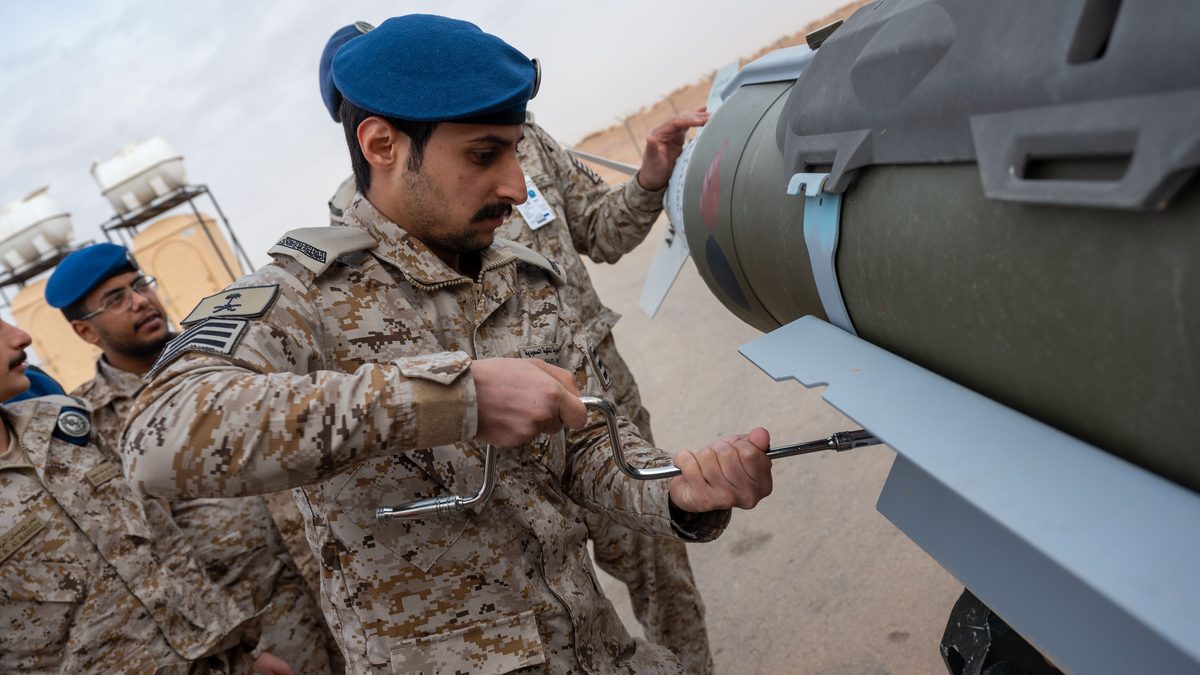
Illustrative: host nation partners work on a GBU-31(V)3 Joint Direct Attack Munition during an ammunition build in the US Central Command area of responsibility, 6 February 2025. The notification analysed here covers the GBU-31(V)1 and GBU-38 pairings rather than the (V)3 penetrator shown. US Air Force photo by Staff Sgt. Jovante Johnson, US Air Forces Central, via DVIDS; US Government work in the public domain. Appearance of US Department of Defense visual information does not imply or constitute DoD endorsement.
Saudi JDAM-ER Case Buys 10,004 Complete Weapons, and Not One Wing Kit
The US State Department cleared a $5.0 billion Foreign Military Sale to Saudi Arabia on 4 September 2026 under Transmittal 26-35. It covers 5,004 KMU-572 and 5,000 KMU-556 Joint Direct Attack Munition guidance kits, matched one for one against 5,004 BLU-111 500-pound and 5,000 BLU-117 2,000-pound general purpose bomb bodies, with FMU-139 fuze systems.
Technical Summary
Transmittal 26-35, released by the Bureau of Political-Military Affairs on 4 September 2026, enumerates four major defence equipment lines. Two are guidance kits: 5,004 KMU-572 tail kits, the 500-pound class Joint Direct Attack Munition (JDAM) kit that produces the GBU-38 configuration, and 5,000 KMU-556 tail kits, the 2,000-pound class kit that pairs with the BLU-117 to produce the GBU-31(V)1 configuration. The penetrator pairing, BLU-109 with the KMU-557 tail kit to make GBU-31(V)3, does not appear in this case, which makes it a blast and fragmentation buy rather than a hardened target buy. Two are bomb bodies: 5,004 BLU-111 general purpose bombs of 500-pound class and 5,000 BLU-117 general purpose bombs of 2,000-pound class. Non-major defence equipment covers FMU-139 fuze systems, DSU-38 and DSU-40 target detectors, containers, support equipment and spares. Boeing of Arlington, Virginia is named principal contractor.
The BLU-111 and BLU-117 are the thermally protected members of the Mk 82 and Mk 84 body families, filled with the aluminised, RDX-based, HTPB-bound plastic-bonded explosive PBXN-109 rather than legacy Tritonal. That fill choice is an insensitive munitions decision taken at the body level, not a guidance decision. Open sources place the BLU-111 fill at roughly 89 kg and the BLU-117 fill at roughly 429 kg; neither figure is stated in the notification, and both should be treated as indicative rather than contractual. On those published figures the aggregate explosive fill across 10,004 bodies is on the order of 2,590 tonnes. That is fill mass, not a TNT equivalence calculation: PBXN-109 is an aluminised RDX composition and its blast equivalence against TNT is neither unity nor a single number, being dependent on charge confinement and the range at which the comparison is drawn. The figure is an order-of-magnitude planning quantity from open-source body data, of moderate confidence, and it is not contractual.
The notification is titled Extend Range. The itemised major defence equipment contains 10,004 tail kits and 10,004 bomb bodies, and no wing kits of any description. ISC assessment of Transmittal 26-35, 4 September 2026
Analysis of Effects
The kit-to-body ratio is the most informative number in the document. Both pairings match exactly, 5,004 against 5,004 and 5,000 against 5,000, which makes this a complete-round purchase rather than a kit-only top-up against bomb bodies already held. Kit-only cases are common where a customer has a deep inventory of unguided iron and wants to convert it. Saudi Arabia is buying the whole weapon. One caution follows from that. Dividing the $5.0 billion ceiling by 10,004 complete rounds gives about $500,000 each, which is not a unit price for a bomb body and a tail kit. The estimated value covers bodies, kits, fuzes, target detectors, containers, spares, repair and return, and government and contractor support services, and the notification publishes no split between them. Per-round arithmetic off the headline figure will mislead. That points to replenishment of expended stock or to a genuine capacity increase, and it carries a heavier logistics burden than a conversion buy because bodies, kits and fuzes all have to be shipped, stored and married up.
A discrepancy sits in the title. JDAM-ER conventionally denotes a wing kit fitted in addition to the tail kit, extending glide range well beyond the baseline weapon. No wing kit appears anywhere in the enumerated hardware. Either the extended-range element sits inside the non-major defence equipment line and is not separately itemised, which would be unusual for a range-defining component, or the case title reflects a programme name rather than the configuration actually being cleared. A second small inconsistency is worth logging, and it is specific to one of the two items. This notification groups the DSU-38 and the DSU-40 together as target detectors, while the Canada transmittal published two days earlier in the Federal Register describes the DSU-38 as a Precision Laser Guidance Set. The label is loose in one of the two documents, and the Canada wording is the more useful one, because the DSU-38 is not a passive detector in the fuzing sense. Department of Defense notifications describe it as a laser spot tracker with the cabling, tail kit door and flight software changes needed to fly both laser and standard missions, and it is the fitting of that sensor which turns a GBU-38 into a GBU-54 Laser JDAM. Quantities of DSU-38 and DSU-40 are unpublished here, so the laser-capable fraction of the 10,004 rounds cannot be derived.
Winged and Unwinged: What the Extended-Range Kit Actually Changes
The difference between a baseline Joint Direct Attack Munition and the extended-range weapon is aerodynamic. It is not explosive and it is not guidance. Both use the same tail kit, the same inertial navigation system aided by the Global Positioning System, the same movable fins, the same bomb body and fill, and the same aircraft interface. The extended-range version adds a pop-out wing set that deploys after release. That raises the lift-to-drag ratio of the store. It adds no thrust whatsoever. Every published range figure below is envelope dependent and should be read as a high-altitude, high-speed maximum rather than a guaranteed combat range.
| Baseline JDAM (no wing) | JDAM-ER (wing kit) | |
|---|---|---|
| Mechanism | Tail kit plus body strakes; short glide | Same tail kit plus deployable wing |
| Published maximum standoff | About 13 to 15 nautical miles, 24 to 28 km, from high altitude | About 40 to 45 nautical miles, 72 to 80 km, from high altitude; Boeing and Royal Australian Air Force language is "triple" |
| Propulsion | None | None |
| What actually sets range | Release height, speed, heading relative to the target, and density altitude | The same, plus wing lift-to-drag after deployment |
The United States Air Force lists baseline JDAM at up to 15 miles. Air & Space Forces Magazine cites 15 nautical miles for the GBU-38 and 45 nautical miles for JDAM-ER. Royal Australian Air Force and Boeing work at the Woomera Test Range quoted 24 km rising to 72 km, and Boeing's 2009 announcement of the 2,000-pound class wing used 80 km, or 50 miles, for the same accuracy. All of those are high-release figures. A low-level or pop-up loft cuts the winged range sharply: open reporting on the Australian Kerkanya precursor, the Defence Science and Technology Organisation programme from which Boeing Hawker de Havilland derived the wing kit, put range at roughly one third when the weapon was released from about 600 m in a climb. Ukrainian combat use of JDAM-ER has been lofted from low level for the same reason.
Guidance and accuracy
Guidance mode does not change. Both weapons fly a Global Positioning System aided inertial navigation solution to a coordinate, with an optional DSU-38 laser guidance set on the 500-pound class producing the GBU-54. Official baseline circular error probable is 5 m or better with the Global Positioning System available, and 30 m or better in inertial-only mode for free-flight times up to 100 seconds. Boeing has cited production test circular error probable under 1.7 m against a 3.3 m requirement. Industry statements for the extended-range weapon claim the same accuracy at the longer range, and that claim is only as good as satellite navigation holds through a longer time of flight. A glide beyond 70 km lasts well past the 100-second qualifier in the baseline specification, so an inertial-only or heavily jammed extended-range shot should be expected to degrade further than a short baseline shot would. That is a physical consequence of flight time, not a published extended-range accuracy table. No such table exists in the open literature.
Terminal kinematics
The warhead does not change. The BLU-111 still carries roughly 89 kg of PBXN-109 and the BLU-117 roughly 429 kg. Blast, fragmentation and case break-up are properties of the body, not of the wing. What does change is the arrival condition, and that is the part that matters for weaponeering.
A baseline weapon is flown to a planned impact angle and azimuth, with the final second used to zero angle of attack so the case strikes along the velocity vector. That is what penetration demands and what prevents case fracture on impact. A wing holds the weapon on a shallow glide for most of its flight instead. Shallow arrival suits area targets, soft vertical faces, and staying outside the reach of short-range ground-based air defence. It is a poor match for a steep, high-velocity strike on a hardened roof. Boeing has tested a BLU-109 penetrator paired with the extended-range wing, and open analysis notes that a winged trajectory can be used deliberately to drive a near-horizontal attack against a bunker face. That is a different weaponeering problem from a GBU-31(V)3 dive profile. Impact velocity, fuze delay and case integrity all have to be re-established for it, because none of them is inherited from the unwinged weapon.
Carriage, release and logistics
Folded, the wing is a strap-on store. It adds mass, it adds length, and once deployed it adds span. It uses the existing MIL-STD-1760 aircraft-store electrical interface and the established JDAM operational flight program path, which is precisely why Boeing marketed it as a cheap integration. It remains a new store for clearance purposes: safe separation, flutter and load-out density all have to be re-proven. An aircraft cleared to carry four GBU-38 rounds may not carry four winged rounds on the same stations. The build sequence becomes body, then tail kit, then optional wing, then fuze and laser guidance set, which makes the wing a separate line item, a separate magazine problem and a separate compatibility-group question. Historic quoted unit cost for the wing alone has been given at around 10,000 dollars against a tail kit in the low tens of thousands, though published JDAM tail-kit unit costs range widely with buy quantity, from about 18,000 dollars in Fiscal Year 1999 to between 25,000 and 84,000 dollars in recent years. Cheap relative to a cruise missile such as the Joint Air-to-Surface Standoff Missile. Not free.
What the wing does not buy
It does not turn a bomb into a cruise missile. The powered follow-on is JDAM Long Range, the GBU-75, which pairs a 500-pound class JDAM with the BSU-111/B Payload Delivery Unit carrying a wing kit and a Kratos TDI-J85 turbojet rated at about 200 pounds of thrust. Air Force and Boeing figures put that at more than 300 nautical miles against 15 nautical miles baseline and 45 nautical miles for the extended-range wing, and the Air Force awarded Boeing a first production contract on 5 August 2026. The wing buys only the middle step of those three. It also does no work on the insensitive munitions properties of the fill, it does not by itself alter hazard division or compatibility group, and it is no substitute for laser guidance or an M-code satellite navigation receiver where either of those is the actual requirement.
What this means for the Saudi pairings
If the 5,004 KMU-572 and BLU-111 rounds and the 5,000 KMU-556 and BLU-117 rounds are fielded without wings, the Royal Saudi Air Force receives GBU-38 and GBU-31(V)1 performance: precision inside roughly 15 nautical miles of a medium or high release, a steep impact profile available when the target needs one, and the same magazine footprint as the JDAM stock already held. Fit wings later and the same bodies become standoff weapons at roughly two and a half to three times the reach, paid for with a shallower arrival, a longer satellite-navigation-exposed flight, fresh store certification on the F-15SA, and a second kit to store and marry. The notification as written funds the first of those two weapons. It does not fund a demonstrated example of the second.
Fitting the Wing: What an F-15SA Would Actually Need
A Saudi aircraft that already employs baseline JDAM does not need a new data bus or a new pylon type simply because a wing is bolted on. It does need a platform clearance, updated launch-envelope software and fresh mission-planning data. Those three are not optional if the wing is to be used as an extended-range weapon rather than carried as dead weight.
What does not have to change
The wing is a mechanical add-on. Power, transfer alignment, target coordinates and release consent all still pass through the existing MIL-STD-1760 aircraft-station interface that JDAM already uses. Boeing designed it that way deliberately: the company's own description is that the kit takes advantage of the conventional JDAM aircraft interface and Small Diameter Bomb glide technology, precisely to avoid a new aircraft integration. On a type that already talks to JDAM, the umbilical protocol does not change.
Royal Saudi Air Force F-15S and F-15SA sit in that category. The Royal Saudi Air Force first requested JDAM conversion kits in 2008 for the F-15S, with Defense Security Cooperation Agency cases following in 2010, 2015 and 2024, and a technology-transfer request in 2017 covering integration onto the F-15SA. The F-15SA is a 1760-wired, fly-by-wire strike aircraft with an active electronically scanned array radar. For those jets the electrical path for the KMU-572 and KMU-556 already exists.
What does have to change
| Item | Where it lives | Why the wing forces it |
|---|---|---|
| Launch Acceptable Region tables | Aircraft operational flight program and stores-management system | The jet computes the release polygon from the weapon's aerodynamic model and tells the crew when it is in zone. A winged round flies roughly three times farther on a different path. Baseline GBU-38 and GBU-31(V)1 tables will either inhibit a valid long-range release or authorise one the store cannot fly. |
| Weapon operational flight software | The tail kit's own mission computer | A winged airframe needs different guidance gains and impact-angle logic than a strake-only weapon. The software sits in the kit, but the aircraft must recognise the variant and load the correct mission block. A kit that is electrically a KMU-572 is not an extended-range weapon until that load is present and identified. |
| Carriage and release clearance | Per aircraft type, per station, per weight class | Folded-wing length and span, adjacent-store clash, flutter, maximum-g carriage, safe separation and jettison all have to be re-proven. A 2,000-pound winged BLU-117 is a different store from a 500-pound winged BLU-111, and one clearance does not cover both. |
| Mission planning and weaponeering | Ground planning systems | Extended-range tables for range, time of flight and impact angle, revised weapon danger areas, and fuze arming times matched to a far longer flight. Coordinate hand-off procedure stays JDAM-like; the numbers fed into it do not. |
| Ground and support systems | Build-up, loading, test and technical publications | Build sequence, loading procedure, Common Munitions Built-In-Test and Reprogramming Equipment use, and technical orders all change once a wing is in the stack. |
Australia is the worked example. The Royal Australian Air Force flew a dedicated extended-range certification trial on the F/A-18 at Woomera in 2013, carrying two winged 500-pound stores alongside two time-space-position-information pods, and released from altitudes between 40,000 ft and 10,000 ft. Those Hornets already employed baseline JDAM. The clearance was still required, and the weapon, designated GBU-62, entered Australian service only in the middle of that decade. The same class of work applies to F-15SA stations.
Transmittal 26-35 does include United States Government and contractor engineering, technical and logistics support services, which is the usual Foreign Military Sales bucket for exactly this kind of effort. That funding is not a substitute for an aircraft operational flight program drop, and the notification does not say one is coming.
Other Royal Saudi Air Force types
Eurofighter Typhoon and Tornado IDS are not United States JDAM aircraft in Saudi service in any published sense; they carry European Paveway and Storm Shadow class stores. Putting a KMU-572 or KMU-556 and a wing onto either would be a new national integration covering wiring, operational flight program and pylons, not a bolt-on, and the Tornado has no native 1760 JDAM fit unless one was added and never disclosed. Treat both fleets as out of scope for this case unless a separate integration programme surfaces. The F-15C and F-15D are air-defence aircraft and are not the intended carriers. The Ukrainian MiG-29 and Su-27 route is the opposite problem, an aircraft with no 1760 bus at all, requiring custom pylons and interface boxes; the F-15SA does not have that difficulty.
The planning consequence
If the wings are never issued, existing F-15SA clearances and load crews are sufficient for GBU-38 and GBU-31(V)1 employment. If the wings are issued, the aircraft needs no new bus, but it does need an extended-range launch-envelope load, an extended-range weapon software identity, and a signed carriage-and-release clearance for each weight class and station. Until those three exist, a winged kit hanging on an F-15SA is not an authorised extended-range weapon. The 5.0 billion dollar notification funds hardware and support. It does not by itself certify the winged configuration on Saudi aircraft.
Personnel and Safety Considerations
The storage consequence is the part that does not appear in any reporting of this case. Roughly 2,590 tonnes of explosive fill entering a national inventory is a magazine siting problem before it is an air-delivery capability. Licensed net explosive quantity per potential explosion site, inhabited building distance and inter-magazine distance all scale from that figure under NATO AASTP-1 Edition D and its national equivalents. No single licensed quantity follows from the tonnage alone. The distances turn on the assigned hazard division, the packaging configuration, whether the site is barricaded or earth-covered, and whether kits, fuzes and bodies are held married or broken down. The PBXN-109 fill improves the reaction of these bodies to fast and slow cook-off and to fragment impact compared with Tritonal, but hazard division and compatibility group are assigned to a specific packaging configuration, not to a fill in isolation. Neither the hazard division nor the compatibility group for the delivered configuration is disclosed. Guidance kits, fuzes and bodies are also separate storage problems: the FMU-139 is the Joint Programmable Fuze, an electronic multi-delay design with its own compatibility group and its own separation rules from the bodies it will eventually arm. Its dash number is not given, so the exact variant cannot be identified.
Data Gaps
Hazard division and compatibility group for the delivered packaging configuration are not stated. Actual PBXN-109 fill masses for the BLU-111 and BLU-117 lots are not published, so the aggregate net explosive quantity figure above rests on open-source body data. The FMU-139 variant is not specified. Quantities of DSU-38 and DSU-40 units are not given, so the proportion of the buy that will be laser-capable cannot be derived. No delivery schedule, no offset arrangement and no breakdown between major and non-major defence equipment value are published. Whether an extended-range wing kit forms part of the case at all remains unresolved on the primary text. No extended-range circular error probable figure exists in the open literature, so the industry claim of unchanged accuracy at triple the range cannot be checked. The frequently quoted wing-kit unit cost of about 10,000 dollars could not be confirmed against a primary budget document during this review and is carried as an historic trade figure only. Whether current Royal Saudi Air Force F-15SA operational flight program suites already contain an extended-range Launch Acceptable Region is not published, and should be assumed absent until a clearance says otherwise. No carriage-and-release clearance for a winged BLU-111 or BLU-117 on any F-15 variant has been identified in open sources.
Key Questions
What exactly did the United States approve for Saudi Arabia?
On 4 September 2026 the State Department cleared a possible Foreign Military Sale worth $5.0 billion under Transmittal 26-35. It covers 5,004 KMU-572 and 5,000 KMU-556 JDAM guidance kits, 5,004 BLU-111 and 5,000 BLU-117 general purpose bombs, plus FMU-139 fuze systems, DSU-38 and DSU-40 target detectors, containers, spares and support.
Does the sale actually include extended-range JDAM hardware?
Not on the face of the notification. JDAM-ER normally means a wing kit fitted alongside the tail kit, and no wing kit is listed among the major defence equipment. The enumerated items are baseline JDAM tail kits and bomb bodies. The extended-range element is either unitemised or the case title reflects a programme name rather than the cleared configuration.
How much explosive does a buy of this size actually represent?
On published open-source fill masses of roughly 89 kg for the BLU-111 and roughly 429 kg for the BLU-117, 10,004 bodies carry on the order of 2,590 tonnes of explosive fill. That is fill mass rather than a TNT equivalence figure. That figure drives magazine siting, licensed storage capacity and quantity distance long before it drives sortie planning.
References
Source-evaluated per NATO source-evaluation doctrine, STANAG 2022 lineage (source reliability A–F / information credibility 1–6). Tier 1 = government primary source; Tier 2 = quality news / specialist defence media; Tier 3 = authoritative aggregator / encyclopaedia.
- T1US Department of State, Bureau of Political-Military Affairs – Kingdom of Saudi Arabia: Joint Direct Attack Munitions, Extend Range (Transmittal 26-35), 4 September 2026. (Reliability A / Credibility 1)
- T1US Department of Defense, Defense Security Cooperation Agency, Federal Register 91 FR 56433 – Arms Sales Notification, Transmittal 0D-26 (Canada), describing the DSU-38 as a Precision Laser Guidance Set, 2 September 2026. (Reliability A / Credibility 1)
- T1US Department of Defense, Defense Security Cooperation Agency, Federal Register 90 FR (document 2025-19372) – Arms Sales Notification, describing the DSU-38 laser spot tracker and its role in converting a GBU-38 to a GBU-54 Laser JDAM, 2 October 2025. (Reliability A / Credibility 1)
- T2FlightGlobal – US clears massive Saudi JDAM-ER deal, September 2026. (Reliability B / Credibility 2)
- T2Calibre Defence – Saudi Arabia approved for JDAM-ER as tensions with Yemen grow, September 2026. (Reliability B / Credibility 2)
- T3GlobalSecurity.org – Kingdom of Saudi Arabia: Joint Direct Attack Munitions, Extend Range (full notification text), 4 September 2026. (Reliability C / Credibility 2)
- T2Air & Space Forces Magazine – Long-Range JDAM Deal Gives Air Force New Standoff Strike Option (15, 45 and 300-plus nautical mile comparison; BSU-111/B Payload Delivery Unit; Kratos TDI-J85), August 2026. (Reliability B / Credibility 2)
- T2Boeing – JDAM Extended Range Wing Kit product card, undated. (Reliability B / Credibility 3)
- T3Australian Government Defence Science and Technology – Joint Direct Attack Munition, Extended Range (Kerkanya lineage and Woomera trials), undated. (Reliability B / Credibility 3)
- T2FlightGlobal – Wing kit gives JDAM triple the range, Australian air force shows (Boeing on the conventional JDAM aircraft interface and Small Diameter Bomb glide technology), February 2015. (Reliability B / Credibility 2)
- T3Airforce Technology – Joint Direct Attack Munition Extended Range (2013 Woomera certification trials, two 500-pound stores and two time-space-position-information pods, 40,000 ft to 10,000 ft releases), undated. (Reliability B / Credibility 3)
Editorial responsibility. This analysis is researched, written and published under the editorial responsibility of Steve Sawyers, MIExpE VR. Every technical claim is sourced to named open-source material and rated for reliability and accuracy under NATO STANAG 2022. ISC uses its own domain-trained research and drafting system under human direction; the analysis, the judgements and the accountability for them are ours. Corrections and updates welcome: if you hold open-source data that refines or corrects any parameter here, write to [email protected] citing the specific claim and your source. Verified corrections are incorporated and credited in the revision history. Full editorial and AI policy.