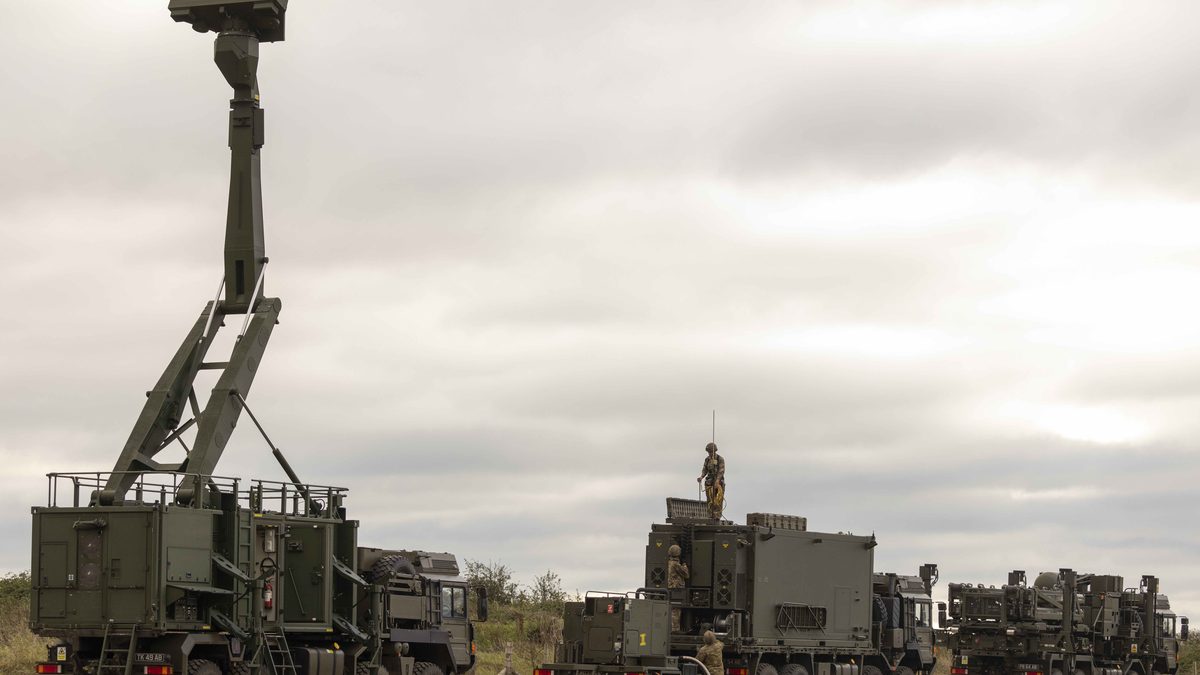
Illustrative: soldiers of 16th Regiment, Royal Regiment of Artillery demonstrate the British Sky Sabre system, left to right the Giraffe radar vehicle, the command and control vehicle and the launcher vehicle carrying CAMM. This is the United Kingdom system, not the Polish PILICA plus iLauncher configuration at Czosnów, and is shown because it is the same effector on the same class of canister launcher. UK MOD Crown Copyright 2021, Open Government Licence v1.0, via Wikimedia Commons.
MBDA Opens at Czosnów, but Poland Still Cannot Service Its Own CAMM Rounds
MBDA opened its first industrial facility in Poland at Czosnów on 7 September 2026, a service and technology centre for the PILICA plus programme. The announced scope is launcher maintenance, technical assistance and training. Neither MBDA nor the UK Ministry of Defence claims explosives-licensed work on the Common Anti-air Modular Missile round itself.
Technical Summary
The Czosnów site was opened by UK defence readiness and industry minister Luke Pollard alongside Polish deputy defence minister Paweł Zalewski. It supports PILICA plus, the inner tier of the Polish integrated air defence system, which sits below the NAREW and WISLA tiers and combines Common Anti-air Modular Missile (CAMM) effectors with Polish guns, very short range infrared guided missiles, radars and command and control. MBDA valued its missile and launcher contribution at GBP 1.9 billion in April 2023, covering 22 PILICA plus batteries. First CAMM rounds and series production launchers reached Poland in September 2025.
CAMM is a soft vertical launch effector. A gas generator ejects the round from its sealed canister before main motor ignition, which is why the launcher can be a simple canister frame rather than a hot-launch structure with efflux management. The operational consequence for sustainment is that the round arrives, lives and is fired as a certified all-up round inside that canister. Through-life work on it is canister integrity, environmental and shock monitoring, and periodic surveillance against a defined storage life. It is not field strip, and it cannot be done on a workshop bench alongside vehicle integration.
Launcher maintenance, technical assistance and training are announced for Czosnów. Rocket motor surveillance, life extension and warhead work are not, and those need an explosives licence, not a workshop. ISC assessment, 9 September 2026
Analysis of Effects
Both official statements are precise about scope, and the precision is the story. The UK Ministry of Defence wording is maintenance, support and training for the programme; MBDA describes a service and technology centre and points to future collaboration with the Polish Armaments Group and research bodies. Polish industry already performs vehicle integration, camouflage painting and national radio installation on delivered launchers. Every one of those tasks sits on the launcher and platform side of the line. None of them touches an energetic component.
The effector side is a different infrastructure problem entirely. Rocket motor surveillance, propellant ageing assessment, warhead work and any life extension decision require a licensed explosives facility with quantity distance separation, a compliant storage licence, and an authority willing to underwrite the disposition of a round that has been opened. That is a national regulatory undertaking, not a commercial fit-out. Poland has been building maintenance depth alongside equipment purchases in other domains, including a planned Abrams engine service centre at Dęblin, but engines and effectors are not the same class of problem. The gap matters at scale: 22 batteries and, across the wider NAREW programme, more than 1,000 missiles and over 100 launchers at a stated value above GBP 4 billion.
That gap is being closed, but on a different programme and a different site. Under NAREW, Poland signed an investment agreement at Wojskowe Zakłady Elektroniczne in Zielonka on 30 March 2026 for a service and production centre for CAMM Extended Range (CAMM-ER) rounds, with construction targeted for completion by 2028. Two days later, on 1 April 2026, a further agreement was signed at MESKO in Skarżysko-Kamienna to establish Polish production of CAMM-ER rocket motors and fragmentation warheads, funded at PLN 304,440,000 against a total project value of PLN 360,300,000 and running to 2030. Both sit inside the recapitalisation of the PGZ-NAREW consortium approved on 29 December 2025. The Polish deputy defence minister Paweł Bejda described the object explicitly as technology transfer for rocket motor production and the development of a new warhead.
The distinction that survives is the one that matters for the rounds already in Poland. MESKO and Zielonka are being built for CAMM-ER under NAREW, a longer round with a different motor and a different warhead. Neither confers the right or the tooling to open a sealed PILICA plus CAMM canister already accepted into Polish service, and neither is a declared surveillance or disposition authority for that stock. Poland is acquiring an energetic industrial base for the CAMM family. It has not yet been shown to have a through-life route for the CAMM rounds it already holds.
Personnel and Safety Considerations
Certified all-up rounds carry a storage life and a surveillance obligation from the day of acceptance. Where the surveillance authority and the physical capability sit outside the operating nation, the practical result is that rounds approaching a life decision must be returned to the supplier state or accepted on paper against foreign data. Both routes have a cost in readiness. Hazard division and compatibility group for the CAMM canister as delivered are not published and will be configuration dependent, so no storage arithmetic can be run from open sources. What can be said is that the announcement contains no repair throughput figure and no target turnaround time, which are the two numbers that would show whether Czosnów is a support capability or a support address.
Floor area is now on the record even though throughput is not. Małgorzata Kobylarczyk, general manager of MBDA Poland, described two buildings at the site, one of about 900 square metres and one of about 3,000 square metres, holding office space, laboratory facilities, a warehouse and a storage hall adapted to the PILICA launcher and sized to take several launchers at once with their spares. Eleven Polish staff were employed there at opening, with expansion planned for late 2026 and early 2027, partly so that the United Kingdom technicians responsible for the launcher have a working base when they travel. That is a credible launcher shop. It is not, on any published description, an explosives estate.
Data Gaps
No repair throughput figure and no target turnaround time were published by MBDA or the UK Ministry of Defence. The scope of work at Czosnów is not broken down between launcher, radar, command and control, and training. Hazard division, compatibility group and storage life for the delivered CAMM canister configuration are not disclosed. It is not stated where CAMM rounds held in Poland undergo periodic surveillance, nor which authority holds the disposition decision at end of storage life. The number of PILICA plus batteries accepted into service to date is not given in either statement. The handover most often cited, the first serial system delivered to the 34th Air Defence Missile Squadron at Bytom on 21 November 2025 as the first of sixteen under the Armament Agency and PGZ-PILICA plus consortium agreement, was a PSR-A Pilica anti-aircraft missile and artillery system, the gun and short range infrared guided missile fire unit. It is not a CAMM-equipped battery and it does not answer the question. Whether the announced Polish Armaments Group collaboration extends to energetic work is unstated.
Key Questions
What does the new MBDA facility in Poland actually do?
The Czosnów service and technology centre, opened on 7 September 2026, provides maintenance, technical assistance and training for the PILICA plus air defence programme. British and Polish personnel work together on site. The published scope covers launcher equipment and training rather than work on the CAMM missile round itself.
Can Poland now maintain its own CAMM missiles?
Not on the basis of what has been announced. CAMM is delivered as a certified all-up round in a sealed canister. Work on the round means rocket motor surveillance, propellant ageing assessment and warhead handling, all of which require a licensed explosives facility. Neither statement claims that capability exists at Czosnów.
How large is the Polish air defence programme this supports?
MBDA valued its missile and launcher contribution to PILICA plus at GBP 1.9 billion in April 2023, covering 22 batteries. The wider British and Polish NAREW programme is stated at more than GBP 4 billion and is intended to supply over 1,000 air defence missiles and more than 100 launchers.
References
Source-evaluated per NATO source-evaluation doctrine, STANAG 2022 lineage (source reliability A–F / information credibility 1–6). Tier 1 = government primary source; Tier 2 = quality news / specialist defence media; Tier 3 = authoritative aggregator / encyclopaedia.
- T1UK Ministry of Defence – UK expertise to bolster Polish air defences in boost to NATO security, 7 September 2026. (Reliability A / Credibility 1)
- T1MBDA – MBDA expands support to Poland with first industrial facility, September 2026. (Reliability A / Credibility 2)
- T2MBDA Newsroom – MBDA wins major Polish air defence contract, April 2023. (Reliability B / Credibility 2)
- T2MBDA – MBDA delivers first CAMM missiles and launchers to Poland for PILICA+, September 2025. (Reliability B / Credibility 2)
- T2Breaking Defense – European missile-maker MBDA opens first industrial facility in Poland, September 2026. (Reliability B / Credibility 2)
- T1Ministry of National Defence, Republic of Poland – Umowa inwestycyjna w programie NAREW podpisana, 1 April 2026. (Reliability A / Credibility 1)
- T2MILMAG – Mesko to produce CAMM-ER missile components under the Narew program, April 2026. (Reliability B / Credibility 2)
- T2MILMAG – State-of-the-art CAMM-ER missile service and production center to be built in Zielonka, March 2026. (Reliability B / Credibility 2)
- T2Defence Matters – MBDA opens Polish hub for air-defence maintenance and support, 8 September 2026. (Reliability B / Credibility 2)
Editorial responsibility. This analysis is researched, written and published under the editorial responsibility of Steve Sawyers, MIExpE VR. Every technical claim is sourced to named open-source material and rated for reliability and accuracy under NATO STANAG 2022. ISC uses its own domain-trained research and drafting system under human direction; the analysis, the judgements and the accountability for them are ours. Corrections and updates welcome: if you hold open-source data that refines or corrects any parameter here, write to [email protected] citing the specific claim and your source. Verified corrections are incorporated and credited in the revision history. Full editorial and AI policy.