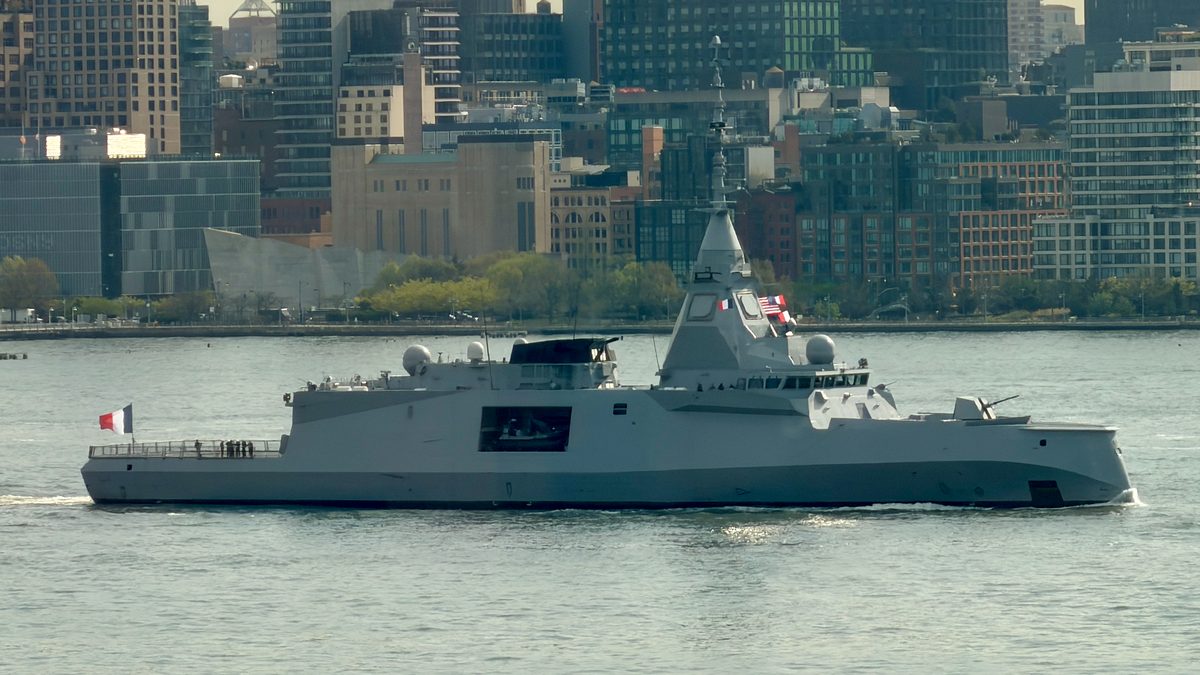
Amiral Ronarc’h, lead ship of the French FDI class and the type Sweden ordered on 31 August 2026, pictured in New York in April 2026. Photo: Oleg Yunakov, CC BY-SA 4.0, via Wikimedia Commons.
France’s DGA Plan B Would Turn an EU Budget Fight into a Coalition of Buyers
BLUF: La Lettre reports that the Élysée is preparing a DGA-led fallback if the 2028 to 2034 EU budget does not preserve a strict European preference for defence procurement. The machinery and the Swedish model are public; the decision to activate them is not. This is a credible contingency, not yet a declared French policy.
What the Scoop Actually Says
Matthieu Fauroux reported for La Lettre on 9 September 2026 that Berlin's efforts to weaken European-preference conditions in defence contracts are pushing the Élysée to prepare a Plan B. The public teaser describes a strategy led by the Direction générale de l'armement, the DGA, under which France would rely on a smaller group of allied states if negotiations over the European Union's next multiannual budget fail.
That distinction matters. The report does not say France has left a European programme, rejected the Union's budget, or signed a replacement treaty. It says the French executive is preparing an alternative route. The reported contingency would transfer the centre of gravity from a Commission-administered funding instrument to procurement arrangements made directly by governments. Those arrangements can still be European in membership, supply chain and strategic purpose. What changes is who sets the conditions and who awards the contracts.
Three layers of the story can be tested against the public record. The money is real: the Commission proposed almost €2 trillion for the 2028 to 2034 Multiannual Financial Framework, including €131 billion for defence, security and space inside the European Competitiveness Fund. The eligibility argument is real: the adopted European Defence Industry Programme, EDIP, caps the cost of components originating outside the Union and its associated countries, or where relevant Ukraine, at 35% of the estimated component cost of the end product, and applies a design-authority test. The French instrument is real: the DGA has stood up a plateau Europe, a Europe desk it describes as the focal point for European opportunities, and its Délégué général said in June 2026 that a team of about fifteen people would coordinate DGA engagement at European level, both part of the 2026 transformation into a "DGA de combat".
The three numbers defining the dispute
| €131 billion | Commission proposal for defence, security and space in the 2028 to 2034 European Competitiveness Fund |
| 35% | Maximum non-associated component-cost share permitted under both the adopted EDIP regulation and the SAFE loan instrument |
| 15 people | Approximate size of the team the Délégué général said in June 2026 would coordinate DGA engagement at European level |
The Argument Is About Control, Not Geography
"Made in Europe" can describe several different industrial realities. A system may be assembled in Europe while a non-European company retains design authority, export licensing, software control, restricted components or the right to approve modification and use. It may employ European workers and add European manufacturing capacity while still leaving the buyer dependent on decisions made outside Europe. France's position treats that distinction as strategic. Berlin's position gives more weight to speed, available production and the military value of systems already in service.
EDIP's final structure captures the fault line. Regulation (EU) 2025/2643 was adopted by the Council on 8 December 2025 and entered into force on 30 December 2025, carrying €1.5 billion for 2025 to 2027 with €300 million ring-fenced for the Ukraine Support Instrument. The content rule limits the non-associated share to 35%, but the design-authority test is the sharper provision. The regulation seeks to ensure that a funded recipient is not prevented by a non-associated third country from defining, adapting or evolving the product. Two details matter to anyone costing a bid. Raw materials are not counted as components, so the 35% ceiling bites on subsystems, seekers, software and high-value electronics rather than on steel. And for the production of ammunition and missiles specifically, Article 12 requires the recipient or the relevant national authority to hold the ability to decide the definition, adaptation and evolution of the design, including the legal authority to substitute or remove restricted components. Where that ability does not yet exist, the regulation accepts a legally binding commitment from the non-associated third country that it will be obtained, and sets a long stop of 31 December 2033. That is the sharpest provision in the text and also the one most likely to be argued case by case, because the control tests, the guarantees available to third-country-controlled entities and the derogation route are all administered rather than automatic.
Germany has practical reasons to resist a definition that excludes licensed American designs. COMLOG, the Raytheon and MBDA Deutschland joint venture at Schrobenhausen, moved from Patriot sustainment into GEM-T missile production under a NATO Support and Procurement Agency contract placed in January 2024. On 7 July 2026 Rheinmetall and Lockheed Martin signed a memorandum to co-produce the Army Tactical Missile System, ATACMS, at Unterlüß, the first time that missile would be built outside the United States. Two days later Chancellor Merz confirmed a Tomahawk and Typhon purchase, presented in Berlin as a bridge while the European Long-Range Strike Approach, ELSA, matures. From Berlin's perspective, these arrangements deliver capacity on European soil. From Paris's perspective, they risk using European public money to deepen dependence on American design authority. The argument is not new. France declined to join the German-led European Sky Shield Initiative in 2023 on the same reasoning, objecting to an air-defence architecture assembled around American and Israeli designs rather than European ones. The budget fight is that dispute moved from one capability to the whole procurement rulebook.
This is why the row is larger than a procurement preference. A €131 billion budget window can shape factories, skills, standards and supply chains for a decade. If licensed US systems qualify on the same terms as systems controlled in Europe, the programme can expand European manufacturing without necessarily expanding European freedom of action. If the rules exclude those systems too rigidly, Europe may delay rearmament while waiting for alternatives to mature. Both sides are arguing about risk, but they are pricing different risks.
Which EU Instruments Actually Carry a European-Content Rule
The argument is easier to judge against the instruments that already exist. The population for this status picture is every European Union level defence-industrial funding instrument in force or formally proposed as at 9 September 2026. Two of them publish a component-cost threshold. The rest do not.
| Instrument | Legal basis | Value | Published European-content rule | Status at 9 Sep 2026 |
|---|---|---|---|---|
| EDIP | Regulation (EU) 2025/2643 | €1.5bn for 2025 to 2027, including €300m ring-fenced for the Ukraine Support Instrument | Cost of components originating outside the Union and associated countries, or where relevant Ukraine, capped at 35% of the estimated component cost of the end product. Raw materials are not counted as components. Design-authority requirement under Article 12, with a derogation route for ammunition and missiles | In force 30 December 2025 |
| SAFE | Council regulation under Article 122 TFEU, adopted 27 May 2025 | Up to €150bn in loans | Components from outside the EU, the EEA-EFTA states and Ukraine capped at 35% of estimated end-product cost. Category 2 products additionally require the contractor to be able to decide the definition, adaptation and evolution of the design | In force 29 May 2025, national plans submitted |
That second row deserves attention. The design-authority condition France is arguing for is not a French invention waiting on a budget fight. It is already written into the largest instrument the Union has created, and it already binds the member states drawing SAFE loans. What Paris wants from the next budget is that test applied to grants at scale, not invented from nothing. How hard it bites is a separate question, and one that will be settled in individual eligibility decisions rather than in the regulation itself.
The complement matters as much as the table above. Every remaining instrument in the population is listed below with its European-content rule recorded as it stands in the open-source record.
| Instrument | Legal basis | Value | Published European-content rule | Status at 9 Sep 2026 |
|---|---|---|---|---|
| EDF | Regulation (EU) 2021/697 | About €7.3bn for 2021 to 2027 | Not publicly documented as a percentage. Eligibility is structural: recipients established in the EU or an associated country, executive management in the Union, and no control by a non-associated third country, subject to case-by-case guarantees | Active, annual work programmes running |
| EDIRPA | Regulation (EU) 2023/2418 | €310m | Not publicly documented | Short-term instrument scoped to the 2024 to 2025 window. Operational status today is a data gap |
| ASAP | Regulation (EU) 2023/1525 | €500m | Not publicly documented | Time-boxed to 2023 to 2025, funded projects due to complete by the end of 2025 |
| ECF defence, security and space window | MFF 2028 to 2034 proposal, not adopted | About €131bn, given by the Commission as €130.704bn | Not publicly documented. The window is a proposal and carries no adopted eligibility text | Proposal, under Council and Parliament negotiation |
| EIB security and defence financing | No dedicated instrument, Board-approved lending policy | €4.5bn earmarked for 2026 | Not publicly documented | Active |
Not publicly documented means the open-source record holds no published percentage threshold for that instrument. It does not mean the instrument is open to any supplier. Nor does it mean a threshold is absent from a work programme or an individual call text. Where eligibility is set structurally rather than numerically, as the European Defence Fund does it, the effect on a non-European bidder can still be decisive. The absence is recorded here as a finding about the public record rather than left out of the picture.
The instruments share a driver but not a rulebook. Each was legislated separately, under different legal bases and against different emergencies, so a supplier that qualifies under one may fail under another. That fragmentation is part of what France is arguing about. A single window worth €131 billion would settle the question for a decade, which is why the eligibility text carries more weight than the headline figure.
Data gaps
ISC could not independently retrieve the La Lettre report beyond its public headline and standfirst. The outlet blocks automated access and the piece sits behind subscription, so the contingency is recorded here as reported rather than as confirmed by any government. No public source states the staffing of the DGA plateau Europe; the figure of about fifteen people comes from the Délégué général’s June 2026 interview and describes a team to coordinate European engagement, which may or may not be the same body. No Commission source reviewed states EDIRPA’s operational status as at today’s date. No EU instrument in the population publishes a numerical design-authority metric, so the design-control tests above are qualitative and will be judged case by case.
Why Berlin Has Become the Test Case
The industrial relationship between France and Germany entered this budget negotiation with less trust than its official communiqués suggest. The joint Future Combat Air System fighter programme was abandoned on 8 June 2026 after Dassault and Airbus failed to resolve leadership, workshare and intellectual-property disputes. A month later, the Franco-German Defence and Security Council reframed MGCS around research and a proof of concept for collaborative armoured combat rather than promising an immediate common replacement platform.
Those outcomes do not amount to a complete rupture. France and Germany continue to cooperate through KNDS, the Franco-German Armament and Innovation Committee, nuclear consultations and several capability projects. Yet they show that the old assumption of a single Franco-German industrial engine cannot carry every strategic programme. When the two governments disagree on design authority, they do not merely disagree about a clause in Brussels. They disagree about who owns the next generation of European combat systems.
The American force-posture signal increases the cost of getting that answer wrong. The Pentagon announced on 2 May 2026 that about 5,000 troops would leave Germany over six to twelve months, roughly a seventh of the force stationed there. Around 80,000 US personnel remained across Europe, and on 19 May 2026 the Supreme Allied Commander Europe, General Alexus Grynkewich, said the reductions did not represent a major change to overall US posture in Europe. The evidence therefore supports a drawdown, not an American departure. Even so, Paris can reasonably point to the episode as proof that a European procurement decision should be robust against a future US licensing or prioritisation decision.
What a DGA Route Would Change
Defence procurement remains primarily a national competence. The DGA already acts as a contracting authority, manages multinational programmes, places orders for partner states and uses bilateral or small-group arrangements where a larger EU mechanism is not the right vehicle. Its public 2026 reform adds speed, production depth and European partnership capacity. That makes Fauroux's reported Plan B institutionally credible without making it confirmed.
A DGA-led coalition would probably be narrower than the Commission route and easier to discipline around design authority. Participating states could agree a common requirement, select a European-controlled design, allocate industrial work and let one national authority contract on behalf of the group. The trade-off is scale. A coalition of willing buyers cannot automatically reproduce the financing power, market reach or policy leverage of a €131 billion Union window. It can prove a model, accelerate a priority and create facts on the ground. It cannot replace the whole budget.
| Route | What it offers | What it cannot guarantee |
|---|---|---|
| Commission and ECF | Large common funding envelope, open calls and EU-wide industrial reach | A French definition of design control if the co-legislators choose broader eligibility |
| DGA-led coalition | Buyer control, tighter eligibility and faster agreement among willing states | The financing scale or participation breadth of the EU budget |
| Bilateral exchange | Reciprocal orders and a balanced political bargain | A common European market or a solution for every capability |
Sweden Shows the Model in Working Order
The strongest public support for the Swedish part of the scoop arrived only nine days before publication. On 31 August 2026, Emmanuel Macron went to Stockholm for Sweden's signature of a €4.3 billion contract for four French FDI frigates, first delivery planned for 2030 and the remaining three by 2034. France had already ordered two Saab GlobalEye airborne early-warning aircraft on 30 December 2025 for about €1.1 billion. The ministers also signed a framework to deepen operational, capability and industrial cooperation.
This was not a simple offset. The June 2025 Franco-Swedish armaments roadmap covered air surveillance, anti-tank weapons, Meteor, Aster, short-range air defence, the FDI, innovation and the security of ammunition and explosives supply. It linked major purchases in both directions to a broader government-to-government relationship. France bought a mature Swedish capability rather than insisting on a French platform. Sweden bought a French surface combatant and its associated missile architecture. Each side acquired something it needed and gave the other an industrial stake.
That reciprocity is the political technology behind the reported Plan B. It allows France to insist on European control without defining European preference as "buy French". It also offers smaller partners a bargain they can explain at home: sovereignty is pooled through reciprocal capability choices rather than transferred to the Commission. The model is easier to assemble with states that possess complementary industries and similar views on operational control. It becomes harder where urgency points to an American system with no mature European substitute.
What the Scoop Proves, and What It Does Not
The article's central claim remains a report from La Lettre, attributed to sources the publication does not identify in its public teaser. No Élysée, DGA, German government or Commission statement reviewed by ISC confirms a formal French decision to abandon the Commission route. The correct evidential label is therefore a reported contingency plan.
The surrounding facts make the contingency coherent. The budget and eligibility fight exists. France has argued for strict European preference. Germany has invested in licensed US production. The DGA has the legal and organisational capacity to build procurement groups. The France-Sweden exchange provides a current example of reciprocal, state-led industrial cooperation. FCAS and MGCS show why Paris cannot assume Berlin will accept French control preferences inside every programme.
The unresolved question is leverage. France can threaten to build elsewhere, and because the Multiannual Financial Framework requires unanimity in the Council it holds meaningful negotiating power. But a French veto or walkout would not by itself redirect the Commission's proposed €131 billion. The practical Plan B is less dramatic than the headline and more consequential than a protest: select capabilities would move first, contracts would create new coalitions, and Brussels would be asked to follow an industrial map drawn by buyers.
Key Questions
Has France decided to leave the EU defence budget?
No public decision says that. La Lettre reported on 9 September 2026 that the Élysée is preparing a fallback if negotiations on the 2028 to 2034 EU budget fail. The reported option would move selected procurement into DGA-led agreements among willing states, not withdraw France from the European Union or end all Commission programmes.
Why is Germany central to the dispute?
Germany combines rapid rearmament with large purchases of US-designed systems and licensed production in Europe, including Patriot and a planned ATACMS line. France argues that European money should build European design authority, while Berlin treats licensed production as a way to add capacity quickly and retain the transatlantic link.
Why is Sweden the model for France's alternative?
France and Sweden have paired major purchases with a wider state-to-state framework. France ordered two Saab GlobalEye aircraft in December 2025; Sweden signed for four French FDI frigates worth €4.3 billion on 31 August 2026. The exchange spreads industrial benefit without waiting for a Commission eligibility settlement.
Which EU defence funding rules already require European design authority?
SAFE and EDIP both do. SAFE caps components from outside the EU, the EEA-EFTA states and Ukraine at 35% of end-product cost and, for Category 2 products, requires the contractor to be able to decide the design’s definition, adaptation and evolution. EDIP applies the same 35% cap with its own design-authority test. No other EU defence instrument publishes a percentage threshold.
References
Source-evaluated per NATO source-evaluation doctrine, STANAG 2022 lineage (source reliability A–F / information credibility 1–6). Tier 1 = government or legislative primary source; Tier 2 = quality news or specialist defence media.
- T2La Lettre – Paris ready to slam the door in Berlin's face over the defence budget, 9 September 2026. Public headline and standfirst; the contingency itself remains the publication's sourced reporting. (Reliability B / Credibility 2)
- T1European Commission – An ambitious budget for a stronger Europe: 2028-2034, 16 July 2025. (Reliability A / Credibility 1)
- T1Council of the European Union – European Defence Industry Programme, reviewed 8 December 2025. (Reliability A / Credibility 1)
- T1Official Journal of the European Union – Regulation (EU) 2025/2643 establishing EDIP. Act dated 16 December 2025, published in OJ L of 29 December 2025, in force 30 December 2025. Primary source for the 35% component rule (Recital 27, Article 12(3)), the raw-materials exclusion (Recital 27) and the ammunition and missile design-authority derogation with its 31 December 2033 long stop (Article 12(4)). (Reliability A / Credibility 1)
- T1French Ministry of the Armed Forces – DGA de combat: gagner en masse et en rapidité, 18 June 2026. (Reliability A / Credibility 1)
- T1Élysée – Déplacement en Suède, 31 August 2026. (Reliability A / Credibility 1)
- T1French DGA – La DGA commande deux avions de surveillance et de commandement aéroporté GlobalEye, 6 January 2026. (Reliability A / Credibility 1)
- T1French Ministry of the Armed Forces – France and Sweden strengthen armaments cooperation, 18 June 2025. (Reliability A / Credibility 1)
- T1Élysée – Conclusion of the Franco-German Defence and Security Council, 17 July 2026. (Reliability A / Credibility 1)
- T2Defense News – Germany set to become first international site for ATACMS missile production, 7 July 2026. (Reliability B / Credibility 2)
- T2Associated Press – US to withdraw 5,000 troops from Germany, 1 May 2026. (Reliability B / Credibility 1)
- T2Reuters via Onvista – FCAS fighter project stopped, 8 June 2026. (Reliability B / Credibility 1)
- T1Council of the European Union – SAFE: Council adopts €150 billion boost for joint procurement on European security and defence, 27 May 2025. (Reliability A / Credibility 1)
- T1Council of the European Union – What is Security Action for Europe (SAFE)?, policy page reviewed 2026. (Reliability A / Credibility 1)
- T1European Commission – European Defence Fund (EDF), Regulation (EU) 2021/697, official programme page. (Reliability A / Credibility 1)
- T1European Commission – EDIRPA: addressing capability gaps, Regulation (EU) 2023/2418. (Reliability A / Credibility 1)
- T1European Commission – ASAP: boosting defence production, Regulation (EU) 2023/1525. (Reliability A / Credibility 1)
- T1European Commission – EU budget 2028-2034, official budget page. (Reliability A / Credibility 1)
- T1French Ministry of the Armed Forces – Accélération, coopération, production: une DGA de combat, 3 July 2026. Source for the plateau Europe. (Reliability A / Credibility 1)
- T1European Investment Bank – EIB Group renews record-high financing target of €100 billion, 11 December 2025. Source for the €4.5bn security and defence earmark. (Reliability A / Credibility 1)
- T2Rheinmetall – Rheinmetall and Lockheed Martin plan to produce ATACMS, 7 July 2026. (Reliability B / Credibility 1)
- T2RTX – NSPA awards COMLOG a contract for Patriot missiles, 3 January 2024. (Reliability B / Credibility 1)
- T2Stars and Stripes – NATO commander on EUCOM troop cuts, 19 May 2026. (Reliability B / Credibility 2)
- T3OSW Centre for Eastern Studies – France against Germany’s European Sky Shield Initiative, 22 June 2023. (Reliability B / Credibility 2)
- T2Naval News – Sweden inks contract with France for four FDI frigates, 31 August 2026. (Reliability B / Credibility 1)
Editorial responsibility. This analysis is researched, written and published under the editorial responsibility of Steve Sawyers, MIExpE VR. Every technical claim is sourced to named open-source material and rated for reliability and accuracy under NATO STANAG 2022. ISC uses its own domain-trained research and drafting system under human direction; the analysis, the judgements and the accountability for them are ours. Corrections and updates welcome: if you hold open-source data that refines or corrects any parameter here, write to [email protected] citing the specific claim and your source. Verified corrections are incorporated and credited in the revision history. Full editorial and AI policy.