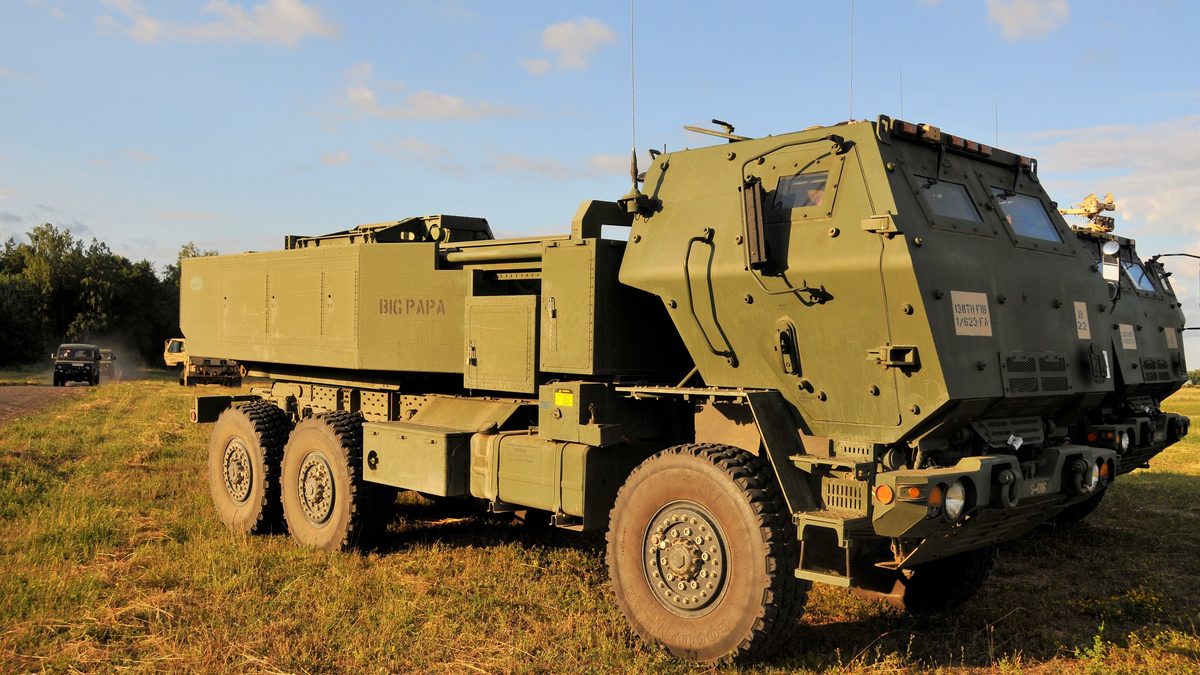
M142 High Mobility Artillery Rocket System of the 1st Battalion, 623rd Field Artillery Regiment, Kentucky Army National Guard, executing a fire mission during Saber Strike 18. Photo: Charles Rosemond / US Army, public domain, via Wikimedia Commons.
Sweden Buys Rocket Artillery for the First Time, and Inherits a Magazine It Has Never Had to Fill
On 7 September 2026 the Swedish Government authorised the Swedish Armed Forces to procure the M142 High Mobility Artillery Rocket System from Lockheed Martin, with first deliveries in 2027 and procurement costs of around SEK 7 billion. Sweden has never fielded rocket artillery. The launcher is the visible part of that decision; the ammunition holding behind it is the harder half.
Technical Summary
The Government Offices of Sweden announced on 7 September 2026 that the Government is authorising the Swedish Armed Forces to procure the M142 High Mobility Artillery Rocket System (HIMARS), built by Lockheed Martin. First deliveries are set for 2027. Procurement costs are stated at around SEK 7 billion, financed through the Swedish Armed Forces regular investment plan and treated as an opportune purchase within the Total Defence Bill 2025 to 2030. In parallel, Sweden's Minister for Defence Pål Jonson and Finland's Minister of Defence Antti Häkkänen signed a Joint Declaration covering training, education, capability development, maintenance, security of supply and cooperation on production of the two countries' rocket artillery.
HIMARS is a wheeled launcher that carries a single launch pod container. It is not a weapon in itself: its capability is defined entirely by the natures loaded into that pod. The MLRS Family of Munitions spans 227mm guided rockets, principally the M31 series Guided Multiple Launch Rocket System (GMLRS) unitary round and its extended range development, and the larger single round pods holding the Army Tactical Missile System (ATACMS) or the Precision Strike Missile (PrSM). Open sources place baseline GMLRS at roughly 70km and the extended range variant at roughly 150km, with ATACMS beyond 300km. None of these figures is confirmed for the Swedish buy, because the Government release names no nature and no quantity.
The September authorisation sits inside a larger notified ceiling. On 10 March 2026 the United States State Department approved a possible Foreign Military Sale to Sweden, congressional transmittal 26-27, at an estimated total of USD 930 million. That request covered 20 M142 launchers; 35 pods each of the M31A2 GMLRS unitary, M30A2 GMLRS alternative warhead, M403 extended range GMLRS alternative warhead and M404 extended range GMLRS unitary natures, every one of them specified with an Insensitive Munitions Propulsion System (IMPS); 20 M57 ATACMS pods; and 24 International Field Artillery Tactical Data Systems. At roughly USD 730 million, the SEK 7 billion authorised in September is a first tranche drawn against that ceiling rather than the whole of it. A congressional notification authorises a possible sale and sets its upper bound; it is not itself a contract, and the natures actually placed on order may differ.
Finland has the Multiple Launch Rocket System (MLRS), which uses the same munitions and components as HIMARS. Government Offices of Sweden, press release, 7 September 2026
Analysis of Effects
The published figure buys launchers, munitions and support materiel together, and the Government release does not break that total down. This matters more than it looks. A launcher is a durable asset bought once; rockets are a consumable bought continuously, and the ratio between the two is the whole of the capability question. Without a unit price or a nature breakdown, the SEK 7 billion headline cannot be converted into rounds, sustained rates of fire, or days of combat. Any figure circulating for Swedish rocket holdings is inference, not disclosure.
The Finnish dimension is the most substantive interoperability claim in the announcement, and it operates at the ammunition level rather than the platform level. Finland's tracked M270 MLRS carries two pods to the wheeled M142's one, but the pod itself is the common item. Two neighbouring states drawing on a single pod inventory can cross-load, hold combined war reserve, and share a maintenance and surveillance regime for the same natures. That is a materially stronger form of commonality than shared vehicles. Infrastructure already sits behind the declaration: on 25 June 2026 Lockheed Martin and the Finnish company Insta agreed with the Finnish Defence Forces to establish the first European sustainment centre for the MLRS Common Fire Control System at Tampere, covering both M270A2 and HIMARS. Sweden can draw on a Nordic fire control depot rather than raise one from nothing. The separate Lockheed Martin and Saab declaration, covering potential integration of the Ground Launched Small Diameter Bomb and production of munitions for HIMARS and for the Patriot air defence system, points the same way: the scarce commodity in European long range fires is not launchers but qualified rounds.
Personnel and Safety Considerations
Introducing rocket artillery as a first of type carries an ordnance safety workload that no procurement headline captures. A complete 227mm guided rocket in its pod combines a solid propellant motor with a high explosive warhead, so the packaged configuration must be assigned a hazard division and compatibility group by the national authority, and stored against the resulting quantity distances under the NATO storage guidelines at AASTP-1. The propulsion specification bears directly on that outcome. Every GMLRS pod type in the March 2026 request is specified with an Insensitive Munitions Propulsion System, a design intended to reduce the violence of reaction to fire, impact and shock stimuli, and the reaction demonstrated in qualification testing is what decides which hazard division a packaged configuration attracts. That does not remove the licensing workload. It changes the quantity distance a given tonnage demands, and it is decided by test evidence rather than by the procurement decision. Sweden's existing magazine estate is sized for Archer 155mm natures and mortar ammunition, not for pod stacks of this volume. Explosives storage licensing, transport classification under ADR and RID, ammunition process and surveillance procedures, and an explosive ordnance disposal render safe capability for an unfamiliar guided nature all have to exist before the first operational round is held. Deliveries begin in 2027, which sets the clock on that infrastructure now.
Data Gaps
The Government release states no launcher quantity, no nature selection, and no split between launchers, munitions and support within the SEK 7 billion. A launcher count did reach the public record, but orally rather than in the release: at the announcement event at Ärna air base the Minister for Defence said Sweden would field just over ten launchers together with a substantial quantity of ammunition. That is ministerial oral disclosure, reported by several outlets, and it is carried here on that basis rather than as a contracted line item. Hazard division, compatibility group and net explosive quantity per pod for the Swedish configuration are not in open source, nor is the magazine or storage site plan. The Saab Ground Launched Small Diameter Bomb integration is described as potential rather than contracted, and the munitions production element of the Lockheed Martin and Saab declaration carries no value, site or date. The nature mix for this tranche is unstated, although the March 2026 request did carry ATACMS pods within the approved ceiling. Precision Strike Missile employment has been raised by the Minister for Defence as a future possibility and does not appear in the notified package.
Key Questions
What did Sweden actually approve on 7 September 2026?
The Swedish Government authorised the Swedish Armed Forces to procure Lockheed Martin's M142 HIMARS rocket artillery system at around SEK 7 billion, with first deliveries in 2027. Defence ministers of Sweden and Finland separately signed a Joint Declaration on rocket artillery cooperation covering training, maintenance, security of supply and production.
Why does Finland's MLRS matter to Sweden's HIMARS purchase?
The Swedish Government states that Finland's M270 MLRS uses the same munitions and components as HIMARS. Because the launch pod is the common item, the two states can cross-load rounds, hold combined reserves and share one surveillance and maintenance regime, which is deeper interoperability than shared vehicles would give.
Does SEK 7 billion tell us how many rockets Sweden is buying?
No. The figure covers launchers, munitions and support materiel as a single total, and the Government published no unit price, nature selection or quantity. Without a breakdown the total cannot be converted into rounds or into any estimate of sustained rates of fire.
References
Source-evaluated per NATO source-evaluation doctrine, STANAG 2022 lineage (source reliability A–F / information credibility 1–6). Tier 1 = government primary source; Tier 2 = quality news / specialist defence media; Tier 3 = authoritative aggregator / encyclopaedia.
- T1Government Offices of Sweden – Sweden to buy US artillery rocket system and enter Sweden-Finland cooperation on rocket artillery, 7 September 2026. (Reliability A / Credibility 1)
- T1Government Offices of Sweden – Military defence: Government policy, Accessed 8 September 2026. (Reliability A / Credibility 2)
- T2Defence Industry Europe – Sweden approves HIMARS purchase and expands Finnish long-range artillery partnership to strengthen NATO's northern defences, 7 September 2026. (Reliability B / Credibility 2)
- T2Lockheed Martin – High Mobility Artillery Rocket System (HIMARS), Accessed 8 September 2026. (Reliability B / Credibility 2)
- T1United States Department of State – Sweden – M142 High Mobility Artillery Rocket Systems, congressional transmittal 26-27, 10 March 2026. (Reliability A / Credibility 1)
- T1Lockheed Martin – Lockheed Martin and Insta advance Europe's first MLRS Common Fire Control System sustainment centre, 25 June 2026. (Reliability B / Credibility 1)
- T2Breaking Defense – Sweden signs HIMARS deal, forges rocket artillery pact with Finland, 7 September 2026. (Reliability B / Credibility 2)
- T3Wikipedia – M142 HIMARS, Accessed 8 September 2026. (Reliability C / Credibility 3)
Editorial responsibility. This analysis is researched, written and published under the editorial responsibility of Steve Sawyers, MIExpE VR. Every technical claim is sourced to named open-source material and rated for reliability and accuracy under NATO STANAG 2022. ISC uses its own domain-trained research and drafting system under human direction; the analysis, the judgements and the accountability for them are ours. Corrections and updates welcome: if you hold open-source data that refines or corrects any parameter here, write to [email protected] citing the specific claim and your source. Verified corrections are incorporated and credited in the revision history. Full editorial and AI policy.