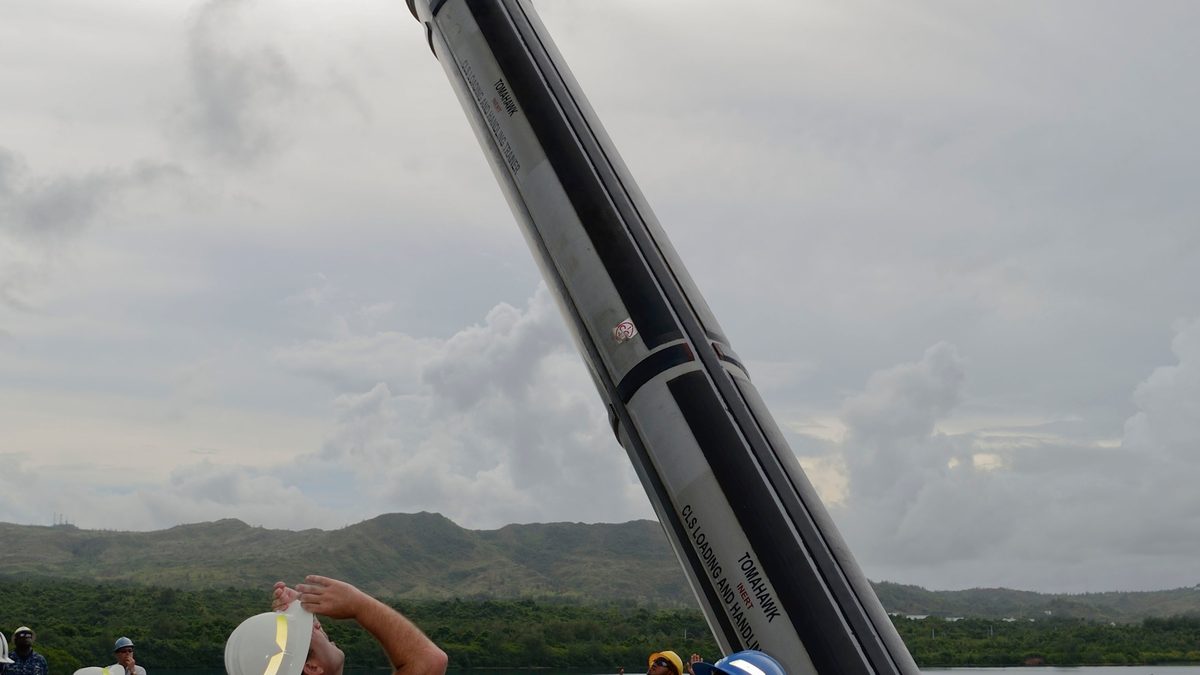
U.S. Navy photograph by Mass Communication Specialist 1st Class Jason C. Swink, released via DVIDS (image 892842), Polaris Point, Guam, 6 November 2012. Public domain. Illustrative: shows civilian mariners and sailors of the submarine tender USS Frank Cable (AS 40) lifting a submarine capsule launch system Tomahawk practice shape during a site certification. It is the retired analogue rather than the current one. The capsule launch system is how the earlier nuclear armed Tomahawk was handled; the announced design interface for this programme is the Virginia Payload Tube.
The Bill Arrives for the Trigger: A Nuclear Cruise Missile Fire Control Job Moves Off an Unpriced Letter Contract
General Dynamics Mission Systems Inc. of Pittsfield, Massachusetts was awarded a 194,139,485 dollar cost plus fixed fee modification, PZ0002, to a previously awarded unpriced letter contract, N0003026C7000, on 3 September 2026. The value includes optional line items. The effort provides technical and engineering support for the Fire Control Subsystem of the Nuclear Armed Sea Launched Cruise Missile programme, known as SLCM-N. Work is split between Pittsfield, Massachusetts at 75 per cent and Manassas, Virginia at 25 per cent, and is expected to be complete on 30 September 2028. Fiscal 2025 reconciliation research, development, test and evaluation, Navy funding of 135,303,302 dollars is obligated. The award was made sole source under 10 U.S. Code 3204(a)(1), was previously synopsised on the System for Award Management portal, and Strategic Systems Programs, Washington, D.C. is the contracting activity.
Technical Summary
Fire control is the least glamorous line in a nuclear weapon programme and the one that carries the most of its safety architecture. It is the equipment and software between a national decision and a launch: the receipt and authentication of a release order, the enabling of the weapon, the targeting and initialisation data passed to the missile, and the interlocks that hold the whole sequence inert until every condition is met. For a submarine launched weapon it also holds the tactical layer, the launcher interface and the sequencing that separates a live round from a training evolution. In a nuclear context these are not conveniences. They are the use control and surety boundary, and they are the reason this subsystem is contracted, funded and reviewed separately from the missile itself.
The contracting activity explains the vendor. Strategic Systems Programs is the Navy organisation that owns the sea based strategic deterrent, and General Dynamics Mission Systems at Pittsfield, Massachusetts is the long standing fire control house for the Trident submarine launched ballistic missile. Placing SLCM-N fire control there rather than with a cruise missile airframe prime is a deliberate choice to keep the nuclear command, control and use control lineage inside the organisation and the supplier that already carries it. The Manassas, Virginia share at 25 per cent is consistent with the company's mission systems and undersea electronics work. The instrument is cost plus fixed fee, which is what a buyer uses when the technical content is real but the scope is still moving. Fire control is also only one of several parallel first phase workstreams, and reading this award as a prime contract for the missile would be a mistake. In August 2025 Strategic Systems Programs placed missile and technology prototype agreements with Leidos, Raytheon, Lockheed Martin, Northrop Grumman and Florida Turbine Technologies, a Kratos subsidiary, through the Strategic and Spectrum Missions Advanced Resilient Trusted Systems consortium. In September 2025 the launcher and canister work went the same route, to Northrop Grumman Mission Systems and to Pacific Engineering. General Dynamics Mission Systems holds the fire control lane alongside those, not above them.
An unpriced letter contract means the work began before the price was agreed. A 194 million dollar modification against it is the moment the government finds out what it has already been buying. ISC reading of modification PZ0002 to contract N0003026C7000, 3 September 2026
Analysis of Effects
The instrument is the story. A letter contract is an authorisation to begin work immediately, issued when schedule pressure will not wait for negotiation, and it is undefinitised until a price is settled. Its use signals urgency and it transfers risk toward the government, because the contractor is performing before terms are fixed. PZ0002 is the priced action taken against that letter, and it carries a stated value of 194,139,485 dollars including optional line items, with 135,303,302 dollars obligated. The announcement does not say whether this definitises the letter contract in whole or in part, which matters, because the difference between those two readings is the difference between a programme that has now bounded its fire control cost and one that has bounded some of it. The completion date of 30 September 2028 is a technical and engineering support horizon, not a fielding date.
The second point is where this sits in the wider programme, and here the public record is firmer than the strategic debate around it suggests. Congress, not the Navy, set the schedule. Section 1640 of the Fiscal Year 2024 National Defense Authorization Act directed the Department to run SLCM-N as a major defence acquisition programme, to begin altering the W80-4 warhead for delivery by it, and to reach initial operational capability no later than 30 September 2034; section 1633 of the Fiscal Year 2026 Act then required a limited number of assets to enable limited operational deployment by September 2032. The launch interface is equally specific. Strategic Systems Programs has told industry that the launcher subsystem integrates with a Virginia Payload Tube and connects the missile to the submarine's shipboard systems, and the programme is being developed for Virginia class boats in the 2030s. Reporting that a future large surface combatant will also carry the weapon exists, but nothing in the public record makes it the fire control design baseline. The warhead is the one genuinely unsettled item: the statute names the W80-4, the National Nuclear Security Administration has since described the choice as the W80 family, and 2026 reporting names a W80-5. ISC does not treat any dash number as established. Against all that, the 30 September 2028 date on this modification is an engineering support horizon and not a fielding date.
Personnel and Safety Considerations
Nothing here describes an incident, and the safety content is structural rather than event driven. Returning a nuclear armed cruise missile to a submarine or a surface combatant reintroduces a certification and handling burden that the United States Navy largely retired from its general purpose fleet in the early 1990s. Three strands of it belong to this contract's subject matter. The first is use control: nuclear weapon system safety rules require that the weapon cannot be armed or released absent authenticated authorisation, and fire control is where that requirement is physically and logically enforced, alongside human procedural controls such as two person handling. The second is the weapon system safety review process itself, under which a nuclear weapon system is assessed and certified as a whole rather than component by component, so a fire control change is a nuclear certification event and not simply a software drop. The third is conventional and mundane and is usually what actually injures people: a nuclear armed cruise missile is still an item of ordnance that has to be transported, stored, canisterised and loaded, under hazard division and compatibility group segregation, net explosive quantity limits and quantity distance siting like any other store. The shape of that burden has moved. The earlier nuclear armed Tomahawk was a capsule launch system problem handled at a waterfront or alongside a tender; a Virginia Payload Tube weapon is a canister and tube load out problem, with the magazine certification that goes with it. There is also a control problem that did not arise on a ballistic missile submarine. A boat whose payload tubes also carry conventional land attack rounds needs positive physical and logical separation between the nuclear and conventional load outs, so that a conventional mission cannot at any point present an enabled nuclear path. None of the specific safety rules, hazard classifications or handling arrangements for SLCM-N are in open sources.
Data Gaps
Whether PZ0002 fully definitises letter contract N0003026C7000 or only part of it, and what unpriced value remains. The value and date of the original letter contract. The scope boundary between the fire control subsystem and the missile prototype vendors' own guidance and control work. Whether any surface platform sits in the fire control design baseline alongside the Virginia Payload Tube, or whether the surface option remains commentary. The warhead variant, which the statute, the National Nuclear Security Administration and 2026 reporting describe inconsistently within the W80 family. The nuclear certification and weapon system safety review milestones and their sequencing against the 30 September 2028 support horizon and the September 2032 limited deployment date. How nuclear and conventional load outs are to be segregated aboard a boat carrying both. Which of the 2025 prototype vendors, if any, the fire control subsystem is being designed to interface with.
Key Questions
What is SLCM-N and who is building its fire control?
SLCM-N is the United States Navy programme for a nuclear armed sea launched cruise missile. On 3 September 2026 General Dynamics Mission Systems of Pittsfield, Massachusetts received a 194,139,485 dollar cost plus fixed fee modification for technical and engineering support to the programme's Fire Control Subsystem, awarded sole source by Strategic Systems Programs and running to 30 September 2028.
What is an unpriced letter contract and why does it matter here?
It is an authorisation to start work before the price and terms have been negotiated, used when schedule will not wait. Until it is definitised the government carries more of the cost risk. This modification is the priced action taken against that letter, and that makes it a programme milestone rather than a routine award.
Why does fire control matter more on a nuclear weapon than on a conventional one?
Because it is where use control lives. Fire control authenticates the release order, enables the weapon, passes initialisation data and holds the interlocks that keep the sequence inert until every condition is satisfied. A change to it is a nuclear certification event assessed against weapon system safety rules, not simply an engineering update.
References
Source-evaluated per NATO source-evaluation doctrine, STANAG 2022 lineage (source reliability A–F / information credibility 1–6). Tier 1 = government primary source; Tier 2 = quality news / specialist defence media; Tier 3 = authoritative aggregator / encyclopaedia.
- T1U.S. Department of War – Contracts for Sept. 3, 2026, 3 September 2026. (Reliability A / Credibility 1)
- T1Congressional Research Service – Nuclear-Armed Sea-Launched Cruise Missile (SLCM-N), IF12084, undated, in force 2026. (Reliability A / Credibility 1)
- T1U.S. Navy / DVIDS – Submarine capsule launch system, USS Frank Cable (AS 40), Polaris Point, Guam, 6 November 2012. (Reliability A / Credibility 1)
- T2Congress.gov – Nuclear-Armed Sea-Launched Cruise Missile (SLCM-N), CRS product landing page, undated. (Reliability A / Credibility 2)
- T2USNI News – Report to Congress on Nuclear Sea-Launched Cruise Missile, 24 September 2025. (Reliability B / Credibility 2)
- T2National Security Technology Accelerator (NSTXL) – U.S. Navy Awards SLCM-N Launcher and Canister prototype agreements to Northrop Grumman Mission Systems and Pacific Engineering, September 2025. (Reliability B / Credibility 2)
- T2Military Aerospace Electronics – Navy eyes open-systems, modular, and affordable nuclear cruise missile for Virginia-class attack submarines, 2025. (Reliability B / Credibility 2)
Editorial responsibility. This analysis is researched, written and published under the editorial responsibility of Steve Sawyers, MIExpE VR. Every technical claim is sourced to named open-source material and rated for reliability and accuracy under NATO STANAG 2022. ISC uses its own domain-trained research and drafting system under human direction; the analysis, the judgements and the accountability for them are ours. Corrections and updates welcome: if you hold open-source data that refines or corrects any parameter here, write to [email protected] citing the specific claim and your source. Verified corrections are incorporated and credited in the revision history. Full editorial and AI policy.