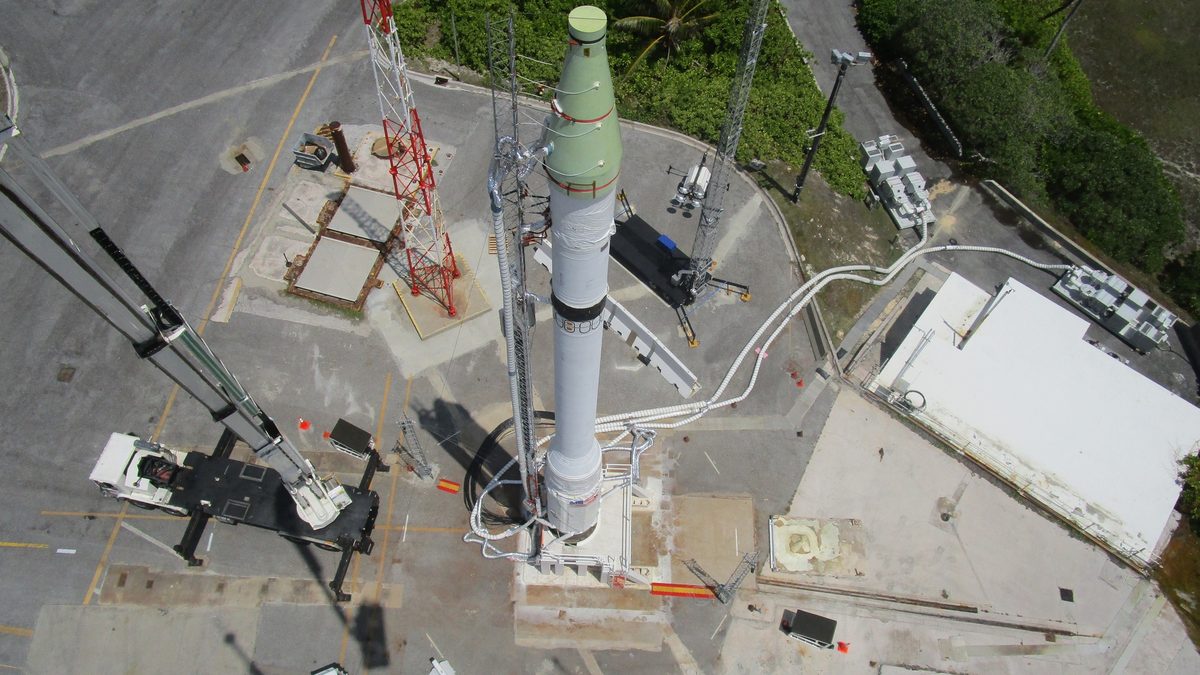
U.S. Missile Defense Agency courtesy photograph released via DVIDS (image 3433730), FTG-15 Flight Test, 30 May 2017. Public domain. Shows an Intercontinental Ballistic Missile class target vehicle on its pad at the Reagan Test Site, Kwajalein Atoll, Republic of the Marshall Islands, before the first live fire intercept test of the Ground based Midcourse Defense system against an ICBM class target. The vehicle is of the class covered by the contract reported here, photographed at one of the fixed sites the Intercontinental Ballistic Missile target flies from.
Half a Billion Dollars to Be Shot At: The Missile Defence Target Fleet Is a Single Source Business Until 2035
The Missile Defense Agency awarded Northrop Grumman Systems Corp. of Chandler, Arizona a noncompetitive contract valued at 508,490,719 dollars on 4 September 2026. Under the follow on award the contractor provides flight test support for the remaining Intermediate Range Ballistic Missile and Intercontinental Ballistic Missile targets, and integrated logistics support for all government furnished equipment, in support of Missile Defense System testing. Work runs from September 2026 through August 2035 at Chandler, Arizona; Corinne, Utah; and Elkton, Maryland. One offer was solicited and one was received. Fiscal 2026 research, development, test and evaluation funds of 8,786,477 dollars were obligated at award. The contracting activity is the Missile Defense Agency, Huntsville, Alabama, under HQ0855-26-C-E001. It follows contract HQ0147-11-C-0006, awarded to the same company in March 2011 with a potential value of about 1.9 billion dollars and a period of performance extended through September 2026.
Technical Summary
A ballistic missile target is a live rocket built to be destroyed. It is a suborbital launch vehicle carrying a representative front end, flown on a programmed trajectory so that an interceptor, a radar and a fire control chain can be tested against something that behaves like the threat. The two classes named in this award are not the same vehicle and they are not launched the same way. Northrop Grumman states that the Intermediate Range Ballistic Missile target draws on its Pegasus space launch vehicle technology and is dropped by parachute from a C-17 transport, then ignited in the air, which frees the trajectory from the geometry of any fixed launch site. The Intercontinental Ballistic Missile target, by the company's account, expands on that platform by adding a further SR119 downstage motor to give ground launch capability and to simulate long range threats, and it flies from fixed sites including Meck Island in the Republic of the Marshall Islands and Kodiak, Alaska. Between them the two classes are used to test Ground based Midcourse Defense, Aegis Ballistic Missile Defense, Terminal High Altitude Area Defense and Patriot.
The three work locations name the industrial content rather than describe it. Chandler, Arizona is the company's target vehicle and interceptor site. Elkton, Maryland and the Utah operations near Corinne are solid rocket motor plants. What the Missile Defense Agency has bought, in energetics terms, is a nine year call on multi stage solid propellant motors, their loading and their integration, drawn from the same narrow set of production lines that supplies interceptors and tactical rocket motors. The instrument reflects that. It is a hybrid of cost plus fixed fee, cost reimbursable and fixed price incentive elements, which is how a buyer prices work whose content is understood but whose quantity and timing are not. Of the total, 8,786,477 dollars was obligated at award, so the announcement commits about 1.7 per cent of its own headline value.
One offer was solicited and one offer was received. That sentence appears in the announcement without comment, because at this tier of the industrial base there is nobody else to ask. ISC reading of contract HQ0855-26-C-E001, 4 September 2026
We successfully launched our Intercontinental Ballistic Missile target vehicle, redesigned in a digital ecosystem providing enhanced capability, optimized processes and streamlined field operations for ICBM flight test missions and national missile defeat capabilities. Learn more…
— Northrop Grumman (@NGCNews) January 8, 2026
Analysis of Effects
The word to hold on to is remaining. The Missile Defense Agency has not bought a new target fleet. It has bought the flight test support needed to expend the Intermediate Range Ballistic Missile and Intercontinental Ballistic Missile targets it already owns, plus the logistics to keep the government furnished equipment behind them serviceable, and it has bought nine years of it. That is a sustainment posture, not a growth one, and it sets a hard boundary on the test programme: the number of full range intercept tests the system can attempt before 2035 is bounded by an inventory that this contract manages rather than replenishes. Neither the announcement nor the agency states how many targets remain, which is precisely the figure that would let anyone outside the programme judge whether the test schedule is affordable in hardware terms. Nor is this the moment the work became single source. The predecessor vehicle, HQ0147-11-C-0006, went to the same company in March 2011 with a potential value of about 1.9 billion dollars and was extended by modification until it ran out this September. What has just happened is the renewal of a fifteen year incumbency, not its creation, and the unit costs of building the vehicles sat on that earlier contract rather than on this one.
The second finding is the ageing of the stock, and it is an energetics problem rather than an accounting one. A target held in storage is a loaded solid rocket motor under surveillance. Composite propellant grains age: the binder cures further, mechanical properties drift, bond lines between grain, liner and insulation are the usual first failure surface, and the service life of a motor is set by a surveillance programme rather than by a manufacturer's warranty. Managing a fixed pool of motors across nine years therefore means managing an ageing curve, and the phrase integrated logistics support for all government furnished equipment is where that work sits. The risk it carries is asymmetric in an unhelpful direction: a target that fails on the way up produces a no test, which consumes a range window, an interceptor and a year of schedule while proving nothing about the interceptor at all.
Personnel and Safety Considerations
The explosives safety content of this contract is easy to miss because the hazard is written as a test event rather than as a store. A target vehicle is a multi stage assembly of loaded solid rocket motors, ordnance initiated stage separation devices and a flight termination system. Class 1.3 mass fire hazards and class 1.1 mass detonating items commonly sit in the same stack depending on the motor and the ordnance items fitted, so hazard division and compatibility group assignment is made for the configuration in each storage, transport and processing state rather than once for the vehicle. Storage siting, net explosive quantity limits and quantity distance follow from that assignment under the Defense Explosives Safety Regulation DESR 6055.09. The air launched class adds a hazard the ground launched one does not have, and the distinction matters. The Intercontinental Ballistic Missile target flies from a prepared site at Meck Island or Kodiak, where the controls are the ones any range uses. The Intermediate Range Ballistic Missile target does not. Extracting a live motor stack from a transport aircraft under parachute and igniting it in flight places the initiation sequence outside any prepared launch site, which makes the flight termination system, the safe and arm devices and the aircraft escape geometry the controlling safety features rather than range layout, while storage and transport of the stacked vehicle before load out remain governed by the ordinary regime. None of the specific hazard divisions, compatibility groups, net explosive quantities or flight termination arrangements for these vehicles are published, so none of this can be quantified from open sources.
Data Gaps
How many Intermediate Range Ballistic Missile and Intercontinental Ballistic Missile targets remain in inventory, and the split between the two classes. Which front ends remain, since a serviceable booster carrying an obsolete reentry vehicle is not a threat representative target and the manufacturer advertises the platform only as compatible with future front ends. The stated basis for the noncompetitive award and the exception relied on. The split of the 508,490,719 dollars between flight test support and integrated logistics support. The motor stages and their production sources at Elkton and in Utah, and whether the SR119 downstage motors used by the Intercontinental Ballistic Missile target are drawn from a finite pool of residual motors rather than from production. Hazard divisions, compatibility groups and net explosive quantities for the vehicles in storage and in transport. The surveillance and service life extension regime applied to stored motors, and any life limits already reached. The planned number of flight tests to 2035 against which the inventory is being managed. Whether any replenishment buy of target vehicles is programmed separately.
Key Questions
What did the Missile Defense Agency buy for 508 million dollars?
Flight test support for its remaining Intermediate Range Ballistic Missile and Intercontinental Ballistic Missile targets, and integrated logistics support for the government furnished equipment behind them, from September 2026 through August 2035. The award to Northrop Grumman Systems Corp. was announced on 4 September 2026 under HQ0855-26-C-E001. It is a noncompetitive follow on to HQ0147-11-C-0006, held by the same company since March 2011; one offer was solicited and one was received. It does not buy new target vehicles.
What is a ballistic missile target and why does it cost this much?
It is a suborbital rocket flown to imitate an incoming missile so that interceptors, radars and fire control can be tested against realistic behaviour. Each one is a multi stage solid rocket motor stack with a representative front end, built to be expended. The cost sits in the motors, the instrumentation, the range operations and the logistics of holding energetic hardware in a serviceable state for years before it is fired.
Why is an intermediate range target dropped from an aircraft?
Northrop Grumman states that the Intermediate Range Ballistic Missile target is dropped by parachute from a C-17 and ignited in the air, which allows a launch from any point on any bearing rather than from a fixed site. That freedom is the reason for the design. It also moves the ignition of a live motor stack away from a prepared range, which places the burden on the flight termination and safe and arm arrangements instead. The Intercontinental Ballistic Missile target is different: it adds an SR119 downstage for ground launch and flies from fixed sites including Meck Island and Kodiak.
References
Source-evaluated per NATO source-evaluation doctrine, STANAG 2022 lineage (source reliability A–F / information credibility 1–6). Tier 1 = government primary source; Tier 2 = quality news / specialist defence media; Tier 3 = authoritative aggregator / encyclopaedia.
- T1U.S. Department of War – Contracts for Sept. 4, 2026, 4 September 2026. (Reliability A / Credibility 1)
- T1Northrop Grumman – Strengthening Missile Defense through Suborbital Target Vehicles, undated, last modified May 2026. (Reliability B / Credibility 2)
- T1U.S. Missile Defense Agency / DVIDS – FTG-15 Flight Test, ICBM class target on the pad at the Reagan Test Site, 30 May 2017. (Reliability A / Credibility 1)
- T2Northrop Grumman – Testing Advanced Missile Defense Technologies with High Performance Target Vehicles, undated. (Reliability B / Credibility 2)
- T2Northrop Grumman – Type 4 Subscale Targets, short and medium range target vehicle family, undated. (Reliability B / Credibility 2)
- T2Northrop Grumman – Target Vehicles capability overview, undated. (Reliability B / Credibility 2)
- T2Northrop Grumman – Northrop Grumman Launches Digitally Redesigned Intercontinental Ballistic Missile Target To Simulate Advanced Threats, undated. (Reliability B / Credibility 2)
- T2HigherGov – Intermediate Range Ballistic Missile (IRBM) Targets, contract HQ0147-11-C-0006 record, awarded 7 March 2011, extended through September 2026. (Reliability B / Credibility 2)
- T2ClearanceJobs – Northrop Grumman Wins $508.5M Missile Defense Agency Ballistic Missile Target Contract, 6 September 2026. (Reliability C / Credibility 2)
Editorial responsibility. This analysis is researched, written and published under the editorial responsibility of Steve Sawyers, MIExpE VR. Every technical claim is sourced to named open-source material and rated for reliability and accuracy under NATO STANAG 2022. ISC uses its own domain-trained research and drafting system under human direction; the analysis, the judgements and the accountability for them are ours. Corrections and updates welcome: if you hold open-source data that refines or corrects any parameter here, write to [email protected] citing the specific claim and your source. Verified corrections are incorporated and credited in the revision history. Full editorial and AI policy.