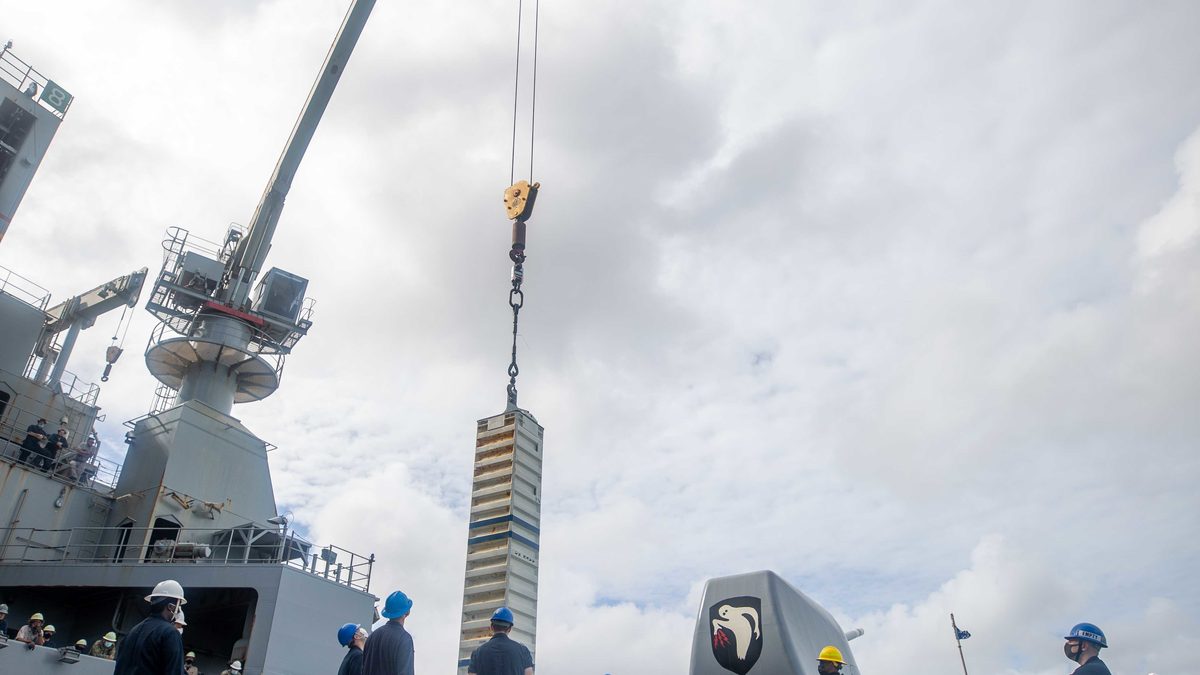
U.S. Navy photograph by Petty Officer 2nd Class Ryre Arciaga, released via DVIDS (image 7119780), 30 March 2022. Public domain. Illustrative: a crane aboard the dry cargo and ammunition ship USNS Cesar Chavez (T-AKE 14) transfers an inert shape canister into the forward vertical launch system of the destroyer USS Milius (DDG 69) during an ordnance handling evolution at Naval Base Guam. It shows the class of lifting gear and container handling this contract covers, not equipment supplied under it.
Seven Bidders, Seven Winners: The Navy Buys the Gear That Moves Its Ordnance
Seven small businesses were awarded a combined 31,000,000 dollar firm fixed price multiple award indefinite delivery, indefinite quantity contract on 3 September 2026 for the manufacture, assembly, testing and spare parts of ordnance handling equipment. The awardees are ATAP Inc., Brooks and Perkins Inc., Central Metal Fabricators Inc., Cardinal Scientific Inc., Greene Machine and Manufacturing Co., BK Manufacturing Co. trading as BK Aerospace, and Bent River Machine. Seven offers were received and seven awards were made. Work runs to August 2031 under Naval Surface Warfare Center Indian Head Division, contracts N00174-26-D-1016 through N00174-26-D-1022. The underlying solicitation names the MK 3 MOD 2 strongback lifting beam as the item, plus undefined further handling equipment and spares for moving and storing naval weapons containers.
Technical Summary
Ordnance handling equipment is the layer of the weapons enterprise that never gets written about and that determines whether the rest of it can be worked safely. It is the physical interface between a human being and a filled store: the beams, skids, cradles, adapters, slings, hoists, dollies and stowage fittings by which a weapon is moved from a magazine to an assembly space to a launcher. In the United States Navy this sits within packaging, handling, storage and transportation, and Naval Surface Warfare Center Indian Head Division leads the research, development and acquisition of those systems for all naval ordnance, alongside its role as the Department of War energetics centre and the lead for explosive ordnance disposal technology. One distinction is worth drawing inside that: the award is written at Indian Head in Maryland, but the packaging, handling, storage and transportation work for this class of equipment sits with the division's Picatinny detachment in New Jersey. Indian Head is the energetics centre; the detachment holds the technical authority for the beams. The contracting activity is therefore the correct one, and the requirement is a sustainment requirement rather than a development one.
The underlying solicitation is narrower than the award line suggests, and the difference matters. N0017426R1011, issued in April 2026, called for the manufacture and assembly of the MK 3 MOD 2 strongback lifting beam, other undefined ordnance handling equipment, and spare parts, required for the movement, transportation and storage of naval storage containers. A strongback is a lifting beam that spreads a crane or hoist load across the approved pick points of a weapons container so the container is not side loaded. That places this buy in the container handling family, gear that interfaces between lifting machinery and the packaged store, rather than in the flight deck and aviation ordnance shop equipment that the phrase ordnance handling equipment often calls to mind. The two families sit under different configuration control regimes, and conflating them produces the wrong picture of what has been bought.
The instrument is a multiple award, firm fixed price indefinite delivery, indefinite quantity vehicle with a combined ceiling of 31,000,000 dollars, running to August 2031. Every awardee is flagged as a small business. Each received 500 dollars at award as the minimum contract guarantee, so the total obligation on the day was 3,500 dollars against fiscal 2026 Navy weapons procurement funds, with all remaining funding to be made available at delivery order level. The scope is stated as manufacture, assembly, testing and spare parts, which is the language of build to print fabrication against government furnished drawings rather than design authority. That reading is consistent with Indian Head retaining the in service engineering and qualification role and buying production capacity from the market. The notice also names the seven places the work will be done, which are the awardees' own plants: Eastaboga and Arab in Alabama, Clarkdale in Arizona, Cadillac in Michigan, Waldorf in Maryland, Farmingdale in New Jersey, and Macon in Georgia.
Seven offers were received and seven awards were made. The competition has not been resolved by this contract, it has been deferred to the order level, where it will be fought out one item at a time for the next five years. ISC reading of contracts N00174-26-D-1016 through N00174-26-D-1022, 3 September 2026
Analysis of Effects
The award ratio is the finding. A multiple award solicitation that attracts seven offers and produces seven awards has selected nobody. That is a deliberate acquisition choice rather than an accident, and it has a clear logic: for a catalogue of dissimilar mechanical items with intermittent demand, a wide pool of qualified fabricators gives the government a bidder for each item and avoids the situation where a single seat holder has no incentive to price a difficult one. The cost of that choice is that no offeror was screened out at the vehicle stage, so whatever filter remains has to operate order by order. For a product line whose failure mode is a dropped store, that filter matters more than it would for office furniture. One qualification belongs here: a hundred per cent award rate is a count, not a verdict on quality. The notice does not state what was evaluated at the vehicle stage, so whether all seven cleared a genuine technical bar or no bar was set cannot be read from the public record. What can be read is that the discriminating decisions have been pushed downstream.
The scale is the second finding, and it cuts against the first. A 31,000,000 dollar ceiling shared seven ways across roughly five years is a small requirement by the standards of the daily contracts page, and the 3,500 dollars actually obligated tells the awardees plainly that the government has committed to nothing. A vendor holding a seat with a 500 dollar guarantee and no visible pipeline will not invest in tooling, in qualification of a second source of material, or in retaining the specialist welding and proof loading capability that this work needs. That is the structural risk in the model. Set that against the pattern ISC has traced through the artillery fuzing tier this month, where single bid awards of several hundred million dollars showed a supplier base too thin to compete. Here the base is broad and the money is thin, which is the opposite failure and produces the same end state, a capability nobody can afford to sustain.
Personnel and Safety Considerations
Handling equipment is a safety article, and it is easy to forget that because it contains no energetic material of its own. The hazard it governs is the dropped or struck store. Filled ordnance is qualified against defined shock and drop criteria, and a hoist, sling or cradle that fails outside those criteria presents the item with a stimulus its safety case does not cover. That is why this class of equipment is subject to proof load testing, periodic re-certification and formal condemnation criteria rather than ordinary maintenance, and why manufacture to print with witnessed testing is the appropriate acquisition model. The announcement covers testing within scope but does not state the standard, the proof factor or the certification authority. The announcement's silence is not the same as an absence of public standards, and the distinction is worth drawing. MIL-STD-1365, General Design Criteria for Handling Equipment Associated with Weapons and Related Items, currently at revision D of 20 October 2020, is the design criteria parent for exactly this class, naming beams, bands, strongbacks, cradles, assembly stands, slings, dollies, loaders, trailers and hoists, and it is administered from Indian Head Division itself; its Table I carries the static safety factors and design proof loads. The standard says of itself that it is not to be used directly to acquire equipment: it is the basis on which a development specification is written, and the equipment is then designed and bought against that specification. For a build to print buy such as this one, the binding document is therefore the government's technical data package, with MIL-STD-1365 sitting behind it. NAVSEA OP 2173, dual designated NAVAIR 19-100-1, is the approved handling equipment list, and the rule it states is that only approved equipment may be used. The public stack is therefore identifiable; what the award text does not say is which revision applies, who witnesses the proof test, and which activity certifies each delivery order. A related distinction saves confusion in the other direction. Ordnance handling equipment of this kind is purpose designed gear for weapons and their containers, and it is a separate family from the industrial materials handling equipment that moves pallets around a depot, from the ship and shore cranes that lift the load in the first place, and from the aviation weapons support equipment used on a flight deck. Each carries its own approval list and its own maintenance publications, and only equipment approved through the relevant route may be used on ammunition and explosives at all. Two further points are practical rather than contractual. First, handling gear used inside a magazine or an explosives workshop is subject to the same electrical, spark and material compatibility controls as everything else brought into that space, and non conforming equipment defeats those controls without any obvious sign. Second, an item that carries the wrong adapter, the wrong sling angle or the wrong lifting point for the nature actually being moved is a hazard even when it is fully serviceable, which makes configuration control of adapters and spares as important as the mechanical integrity of the equipment. Above the equipment standards sits the wider regime: Navy ordnance publications afloat and ashore, and at Department level the Defense Explosives Safety Regulation DESR 6055.09, which governs quantity distance and magazine siting rather than proof factors.
Data Gaps
The remainder of the catalogue beyond the named MK 3 MOD 2 strongback, since the solicitation's own phrase for the rest is other undefined ordnance handling equipment. Which revision of MIL-STD-1365 is invoked, which proof factors apply to each item class, who witnesses first article testing and which activity certifies the equipment for issue. Which containers and which weapon programmes the supported set actually covers. Whether government furnished drawings define the whole catalogue or only part of it. The expected annual order volume, which the 3,500 dollar obligation gives no basis for estimating. Whether the seven seat holders are qualified across the whole catalogue or each against a subset. The parent requirement driving the buy, whether recapitalisation of ageing gear or new natures entering service. In service engineering and configuration control arrangements for adapters and spares.
Key Questions
Who makes ordnance handling equipment for the US Navy?
From 3 September 2026, seven small businesses share a combined 31,000,000 dollar multiple award indefinite delivery, indefinite quantity contract for manufacture, assembly, testing and spare parts. They are ATAP Inc., Brooks and Perkins Inc., Central Metal Fabricators Inc., Cardinal Scientific Inc., Greene Machine and Manufacturing Co., BK Manufacturing Co. trading as BK Aerospace, and Bent River Machine. Naval Surface Warfare Center Indian Head Division is the contracting activity.
What counts as ordnance handling equipment?
The mechanical gear that moves and supports filled weapons and their containers without initiating them: strongback lifting beams, skids, cradles, adapters, slings, hoists, dollies and stowage fittings. It contains no energetic material itself, but it governs the shock and drop environment a store experiences, which is why it is proof load tested to MIL-STD-1365 criteria and periodically re-certified rather than simply maintained.
Why does it matter that seven offers produced seven awards?
Because no offeror was screened out at the vehicle stage, so the discriminating decisions are deferred to individual delivery orders over the next five years. That keeps a bidder available for every item in a dissimilar catalogue, but it moves the filter to the order level for a product line whose failure mode is a dropped store. The notice does not state what was evaluated at the vehicle stage.
References
Source-evaluated per NATO source-evaluation doctrine, STANAG 2022 lineage (source reliability A–F / information credibility 1–6). Tier 1 = government primary source; Tier 2 = quality news / specialist defence media; Tier 3 = authoritative aggregator / encyclopaedia.
- T1U.S. Department of War – Contracts for Sept. 3, 2026, 3 September 2026. (Reliability A / Credibility 1)
- T1Naval Surface Warfare Center Indian Head Explosive Ordnance Disposal Technology Division – Division overview and mission, Maryland Department of Commerce briefing sheet, undated. (Reliability A / Credibility 1)
- T1U.S. Navy / DVIDS – USS Milius (DDG 69) Ordnance Handling Evolution, 30 March 2022. (Reliability A / Credibility 1)
- T1U.S. Army / Picatinny Arsenal – Naval Surface Warfare Center Picatinny Detachment, packaging, handling, storage and transportation mission, undated. (Reliability A / Credibility 1)
- T1U.S. Naval Sea Systems Command – MIL-STD-1365, General Design Criteria for Handling Equipment Associated with Weapons and Related Items, revision D of 20 October 2020 is the current issue (superseding revision C of 17 May 2010, linked); administered by Indian Head Division, Naval Surface Warfare Center. (Reliability A / Credibility 1)
- T1U.S. Naval Sea Systems Command – NAVSEA OP 2173 Volume 2 / NAVAIR 19-100-1.2, Approved Handling Equipment for Weapons and Explosives. (Reliability A / Credibility 1)
- T2TechLink – Naval Surface Warfare Center Indian Head Division laboratory profile, undated. (Reliability B / Credibility 2)
- T2dcmilitary.com – Naval Surface Warfare Center Indian Head Explosive Ordnance Disposal Technology Division, undated. (Reliability B / Credibility 2)
Editorial responsibility. This analysis is researched, written and published under the editorial responsibility of Steve Sawyers, MIExpE VR. Every technical claim is sourced to named open-source material and rated for reliability and accuracy under NATO STANAG 2022. ISC uses its own domain-trained research and drafting system under human direction; the analysis, the judgements and the accountability for them are ours. Corrections and updates welcome: if you hold open-source data that refines or corrects any parameter here, write to [email protected] citing the specific claim and your source. Verified corrections are incorporated and credited in the revision history. Full editorial and AI policy.