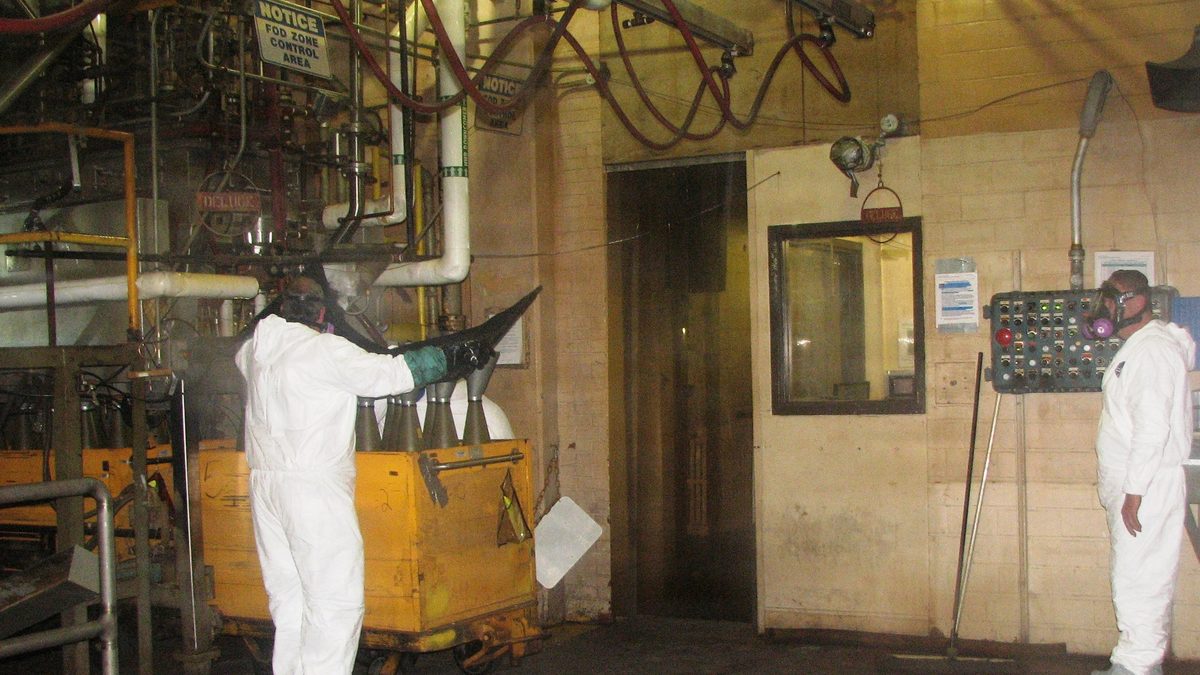
U.S. Army photograph by Dori Whipple, Iowa Army Ammunition Plant, released via DVIDS (image 9757733). Taken 19 November 2024; published 17 June 2026. Public domain. Illustrative: shows contractor employees preparing 155mm M795 projectile cases for the final steps of the load, assemble and pack process at the plant, not the contract action reported here.
Twelve Point Six Million Dollars for Ammunition That Was Not Made: The Iowa Plant Shutdown Bill Comes Due
American Ordnance LLC of Middletown, Iowa was awarded a 12,643,367 dollar firm fixed price indefinite delivery, indefinite quantity contract on 4 September 2026 for an equitable adjustment covering costs sustained during a shutdown. One bid was solicited and one was received. The estimated completion date is 30 October 2026. Army Contracting Command, Rock Island, Illinois is the contracting activity under W519TC-26-F-A552. American Ordnance is the operating contractor of the Iowa Army Ammunition Plant, the Army's principal load, assemble and pack facility for 155mm high explosive projectiles. The announcement names no dates, but the plant's only documented stoppage in the period was the government ordered safety pause of 12 to 30 March 2026 over stored lead azide.
Technical Summary
The announcement is four lines long and it is the most revealing ammunition item published this week. American Ordnance LLC operates the Iowa Army Ammunition Plant at Middletown under a government owned, contractor operated arrangement. The plant does not make steel shell bodies and it does not make propellant. It performs load, assemble and pack, the stage at which inert components, bulk energetic fill, primer and fuze are brought together into a certified round. Its principal loaded nature is the 155mm high explosive projectile of the M795 family; M107 capability is residual rather than the current surge line. Its published capability list is wider than that: the 40mm high velocity family, 120mm tank ammunition, 60mm, 81mm and 120mm mortar propelling charges, M112 demolition charge and the mine clearing line charge, detonators, and the warheads for TOW, Hellfire, Javelin, Stinger and Sidewinder. The site runs to 19,011 acres and 271 earth covered magazines. An equitable adjustment paid to that contractor is therefore a bill for the cost of a load, assemble and pack line not running, and the line in question is not only the artillery one.
The instrument matters as much as the money. An equitable adjustment is a contractual mechanism for restoring a contractor to the financial position it would have occupied had a government caused event not intervened. It is not a purchase of ammunition and it does not add a round to the stockpile. The order number W519TC-26-F-A552 carries the F segment that United States defence contract numbering uses for orders placed against an existing vehicle rather than a new standalone award, which is consistent with a settlement executed under a parent operating contract. The estimated completion date of 30 October 2026, under two months from award, is far too short for any production activity and is consistent with an administrative settlement rather than a delivery schedule. One bid was solicited and one was received, which is the expected pattern when the only party capable of performing is the incumbent operator of the facility in question. The clause family that produces a payment of this kind is well established, covering changes to a fixed price contract, suspension of work, stop work orders and government caused delay, but the announcement does not say which of them was invoked, or whether the amount was negotiated as a request for equitable adjustment or certified as a claim.
An equitable adjustment buys no ammunition. It records the price of an ammunition plant standing still, and at a government owned, contractor operated energetics facility that price is not proportional to the days lost. ISC reading of contract W519TC-26-F-A552, 4 September 2026
Analysis of Effects
The announcement does not say what the shutdown was. The open record does. Iowa Army Ammunition Plant stopped work on 12 March 2026 and resumed on Monday 30 March, eighteen calendar days, after the government ordered what the Joint Munitions Command described as a proactive safety review of lead azide held on the site. Lieutenant Colonel Daniel Nosse, the plant commander, said the Army would implement a multi step plan to neutralise and dispose of the material and that there was no immediate danger to the public. The material sat in earth covered magazines throughout, and the Army subsequently obtained an Environmental Protection Agency permit to manage it as a hazardous waste while a disposal route was developed. That is the second of the three categories a reader might otherwise guess at, an ordered stand down following a safety judgement, and not the first, an appropriations lapse, or the third, a scheduled outage that overran.
Two cautions attach to that identification. The contract announcement states no dates, so the March pause is the leading candidate for the period covered rather than a proven one; it is simply the only publicly documented interruption at Middletown in the window a September settlement would plausibly close. And nothing in the public record describes a detonation, an injury or a line failure. The official language stayed within review, storage and disposal throughout. Anyone reading the figure as evidence of an accident at Middletown is reading something the record does not contain. What the record does contain is that the Army ordered the stoppage, and then accepted a claim of this size as reasonable and settled it inside a two month administrative window.
Set against eighteen calendar days, the settlement works out at roughly 702,000 dollars a day, or about 1.05 million dollars for each of the twelve working days in that window. Those are arithmetic on the announced figure and the documented dates rather than an audited rate, and they are useful mainly for what they rule out: a number of that shape is a bundle of standing costs, not lost rounds priced at unit cost. The reason a figure of this size is credible for an idle plant is that energetics production does not pause cheaply. A melt pour line running a high explosive fill holds material at temperature in kettles and transfer systems; taking it down is a controlled process with disposal consequences for whatever is in process, and bringing it back is not a matter of restarting a machine. The workforce is the larger item. Explosive operators at a load, assemble and pack facility work to certified procedures with currency requirements, and a licensed workforce that is retained through an idle period is a direct cost while a workforce that is released is a far more expensive one to rebuild. Underneath both sits the fixed obligation that does not stop for a shutdown at all: the magazines still hold explosives, and the storage, surveillance and safety regime under the Defense Explosives Safety Regulation DESR 6055.09 continues to apply on day one of an outage exactly as it did on the day before. Lot acceptance is the tail. Where a fill or an assembly process has been interrupted, restoring the evidence chain that a lot conforms is a testing burden, not a paperwork one.
Personnel and Safety Considerations
The stoppage was a precautionary review of stored material, not an accident, and nothing in the record describes an occurrence. The explosive safety point the episode raises is structural. A load, assemble and pack facility in an idle state is not a dormant site: it holds bulk energetic material, part processed articles and packaged rounds in magazines that remain subject to quantity distance siting, compatibility group segregation and net explosive quantity limits throughout. Explosives safety obligations under DESR 6055.09 are continuous, and the surveillance regime that establishes whether stored natures remain serviceable is time based rather than production based, so it accrues fastest precisely when nothing is being produced. Where in process energetic material is held through an unplanned interruption, its disposition is a technical judgement about the material's condition and not an inventory decision, because thermal history and hold time bear on the stability of a fill. The workforce dimension is the one that most often goes unmanaged: explosive operator currency is a safety control, and a return to production after an extended outage carries a higher error rate at exactly the point where the articles being handled contain their full net explosive quantity. Neither the hazard divisions nor the compatibility groups nor the net explosive quantities held at Middletown during the period in question are published, so none of this can be quantified from open sources.
The material that triggered the stoppage illustrates the point better than any general argument. Lead azide, Pb(N3)2, is a primary explosive used in detonators and other initiating devices. It is sensitive to impact, friction and electrostatic discharge by design, since that sensitivity is what makes it work as an initiator, and stored quantities are conventionally assigned to Hazard Division 1.1 and Compatibility Group A. Group A is segregated from every other compatibility group, which is why a storage question about an initiating explosive can stop an entire site even when the melt pour line itself has not failed. What happened next is on the public record and is more instructive than the pause. Once the material was no longer needed for production it was reclassified as a hazardous waste, and the Environmental Protection Agency issued an emergency permit in April 2026 allowing it to be stored where it stood, a location the plant's existing permit did not cover. The waste was recorded as exhibiting both the characteristic of reactivity, being energetic, and the characteristic of toxicity for lead. In July 2026 that emergency permit was extended because a permanent disposal route had still not been settled. Disposition of an initiating explosive is a technical judgement about the material's condition taken by people qualified to make it, and in this instance the judgement has taken longer than the production stoppage it caused by a wide margin.
Data Gaps
Whether the 12 to 30 March 2026 pause is in fact the period the settlement covers, since the announcement states no dates. Which production lines and which natures were affected, the site running several beyond the artillery one. The basis on which 12,643,367 dollars was computed, and the split between standing labour, facility charges and material disposition. Whether the action was a request for equitable adjustment settled by negotiation or a certified claim under the Contract Disputes Act. The parent contract against which W519TC-26-F-A552 was placed. Whether 155mm output against the Army's monthly production targets was reduced, and by how much. The quantity and condition of the lead azide holding, and whether a permanent disposal route has been agreed since the emergency storage permit was extended in July 2026. Whether any in process energetic material or part processed articles were dispositioned as a result. Whether comparable adjustments have been paid to operators of the other government owned, contractor operated ammunition facilities for the same period.
Key Questions
Why did the Army pay American Ordnance 12.6 million dollars?
The Department of War announced on 4 September 2026 a 12,643,367 dollar firm fixed price indefinite delivery, indefinite quantity contract to American Ordnance LLC for an equitable adjustment for costs sustained during a shutdown. Army Contracting Command Rock Island is the contracting activity under W519TC-26-F-A552. The announcement itself names no dates or cause, but the only documented stoppage at the plant in the relevant window is the government ordered safety pause of 12 to 30 March 2026 over stored lead azide.
What is an equitable adjustment, and does it buy any ammunition?
It does not. An equitable adjustment restores a contractor to the financial position it would have held had a government caused event not intervened. It settles cost, not supply. No round enters the stockpile as a result of this action, and the estimated completion date of 30 October 2026 is an administrative closure date rather than a delivery schedule.
What does the Iowa Army Ammunition Plant actually produce?
It is a government owned, contractor operated load, assemble and pack facility. It brings together components made elsewhere, the shell body, the bulk energetic fill, the propellant, the primer and the fuze, into finished rounds. Its principal loaded nature is the 155mm M795 high explosive projectile, alongside the 40mm high velocity family, 120mm tank ammunition, mortar propelling charges, demolition charges and mine clearing line charges, detonators, and warheads for TOW, Hellfire, Javelin, Stinger and Sidewinder.
References
Source-evaluated per NATO source-evaluation doctrine, STANAG 2022 lineage (source reliability A–F / information credibility 1–6). Tier 1 = government primary source; Tier 2 = quality news / specialist defence media; Tier 3 = authoritative aggregator / encyclopaedia.
- T1U.S. Department of War – Contracts for Sept. 4, 2026, 4 September 2026. (Reliability A / Credibility 1)
- T1U.S. Army Joint Munitions Command – Iowa Army Ammunition Plant fact sheet, undated. (Reliability A / Credibility 1)
- T1U.S. Army / DVIDS – Iowa Army Ammunition Plant 155 Production, image gallery, taken 19 November 2024, published 17 June 2026. (Reliability A / Credibility 1)
- T1Assistant Secretary of the Army (Financial Management and Comptroller) – FY 2026 Procurement of Ammunition, Army justification book, 2025. (Reliability A / Credibility 1)
- T1U.S. Environmental Protection Agency Region 7 – Public Notice: Iowa Army Ammunition Plant, Middletown, Iowa, emergency permit for storage of lead azide hazardous waste, 2026. (Reliability A / Credibility 1)
- T2KCRG – Iowa Army Ammunition Plant gets extension to store hazardous waste, 13 July 2026. (Reliability B / Credibility 2)
- T2KWQC – Iowa Army Ammunitions Plant pause continues, 19 March 2026, carrying the Joint Munitions Command statement and the plant commander's remarks on lead azide. (Reliability B / Credibility 2)
- T2Breaking Defense – Army well short of 155mm ammo production goal, Texas facility in the spotlight, July 2026, reporting the Department of War Inspector General evaluation. (Reliability B / Credibility 2)
- T2American Ordnance LLC – Artillery, 155mm capability statement, undated. (Reliability B / Credibility 2)
- T2CBS News – Defense watchdog finds new 155mm artillery plant failed to produce parts in 2 years since it was built, hindering production goals, 2026. (Reliability B / Credibility 2)
Editorial responsibility. This analysis is researched, written and published under the editorial responsibility of Steve Sawyers, MIExpE VR. Every technical claim is sourced to named open-source material and rated for reliability and accuracy under NATO STANAG 2022. ISC uses its own domain-trained research and drafting system under human direction; the analysis, the judgements and the accountability for them are ours. Corrections and updates welcome: if you hold open-source data that refines or corrects any parameter here, write to [email protected] citing the specific claim and your source. Verified corrections are incorporated and credited in the revision history. Full editorial and AI policy.