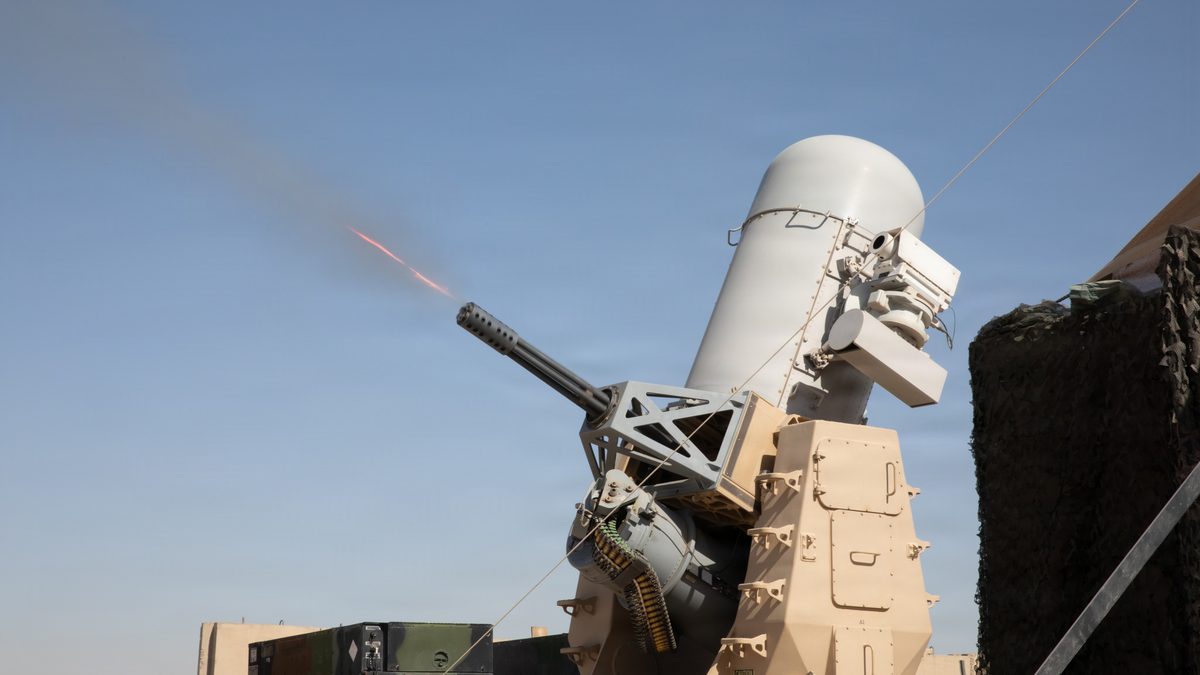
Illustrative image. A U.S. Army Centurion Counter-Rocket, Artillery and Mortar system fires 20mm rounds during a practice live fire in the U.S. Central Command area of operations, October 2025. This is a U.S. Army system and is not a candidate for the U.S. Air Force requirement described here. U.S. Army photo by Sgt. Anthony Till, VIRIN 251011-A-FC759-4228, released via DVIDS. U.S. Government work, public domain. Use does not imply endorsement by the U.S. Department of Defense.
Fifteen Parameters: What the Air Force Is Really Asking of an Air Base Defence Gun
On 3 September 2026 the Air Force Life Cycle Management Center posted a sources sought notice for a Ground-Based, Medium-Caliber Gun Weapon System to defend United States Air Force assets against subsonic cruise missiles and Unmanned Aircraft Systems in Groups 1 to 5. Responses close at 1700 Eastern on 9 October 2026. The Air Force fields no organic gun based ground air defence today.
Technical Summary
The notice went up on SAM.gov on 3 September 2026. It comes from the Air Force Life Cycle Management Center, C3BM Directorate, at Wright-Patterson Air Force Base, Ohio, is typed on the portal as a sources sought, and describes itself in its own text as a Request for Information. The stated object is market research into a Ground-Based, Medium-Caliber Gun Weapon System that fires affordable munitions and provides persistent defence of United States Air Force assets, with an initial focus on subsonic cruise missiles and Unmanned Aircraft Systems (UAS) in Groups 1 to 5. The anticipated North American Industry Classification System code is 332994, Small Arms, Ordnance, and Ordnance Accessories Manufacturing, a code that fits the gun and mount rather than the ammunition, which is manufactured under separate codes. The acquisition strategy, in the notice's own words, is still in development.
Two features of the document matter more than the headline. The first is a silence: the notice never defines medium calibre. The United States Army product listing for medium calibre ammunition tops out at 40mm, but Army contracting has already moved past it. Delivery order W519TC24D0009 under Medium Caliber Cartridges Family Buy 3, placed with General Dynamics Ordnance and Tactical Systems on 29 April 2024, covers 20mm, 25mm, 30x113mm, 30x173mm and 50mm natures inside one medium calibre vehicle. So the band a bidder inherits depends on which Army document you read, and the Air Force has declined to settle it. The second feature is the evaluation frame. Fifteen baseline operational and technical parameters are to be analysed in unison, alongside three trade space attributes. Read together, those fifteen describe a sustainment problem at least as much as a lethality problem.
The Government is conducting market research to identify potential industry sources capable of providing solutions for a Ground-Based, Medium-Caliber Gun Weapon System that fires affordable munitions. Air Force Life Cycle Management Center, sources sought notice, 3 September 2026
The Fifteen Baseline Parameters
These are the fifteen, in the order the notice gives them. They are to be analysed in unison, not traded off one at a time.
| Baseline parameter | What it measures | Class |
|---|---|---|
| Salvo probability of kill against cruise missiles | At maximum range and altitude | Lethality |
| Salvo probability of kill against UAS Groups 1 to 5 | At maximum range and altitude | Lethality |
| Effective slant range | Outer edge of the engagement envelope | Coverage |
| Elevation coverage | Vertical extent of the envelope | Coverage |
| Magazine depth | Rounds available before replenishment | Endurance |
| Raid handling | Behaviour against a saturating attack | Endurance |
| Integrated sensor capability | Organic acquisition and tracking | Integration |
| Command and control system integration | Fit to an existing battle management chain | Integration |
| System interoperability | Function across joint networks | Integration |
| Cost per engagement | Economic sustainability of firing | Sustainment |
| Manpower | Crew burden to operate and maintain | Sustainment |
| Built-in test (BIT) | Diagnostics without a depot | Sustainment |
| Transportability | Movement into an austere theatre | Deployability |
| Weapon safety | Safe employment of the system | Safety |
| Multi-domain engagement capability | Effect across operating environments | Breadth |
What counts as medium calibre
The notice does not say, and the Army answers the question twice. The published medium calibre product listing runs to 20mm, 25mm, 30x113mm, 30x173mm and 40mm. Army contracting goes further: delivery order W519TC24D0009 under Medium Caliber Cartridges Family Buy 3, placed on 29 April 2024, covers 20mm, 25mm, 30x113mm, 30x173mm and 50mm natures together. A 50mm candidate is therefore not outside medium calibre as the Army now buys it. Because the Air Force sets no bound of its own, the question stays open, and it is the question that decides which industrial base the requirement lands on.
Who Already Holds This Capability
Ground-based air defence of air bases has largely been a United States Army responsibility. The table below covers every United States armed service and records, for each, what gun-based ground air defence is on the open record.
| Service | Ground-based gun air defence | Principal calibre | Position | Open-source basis |
|---|---|---|---|---|
| United States Army | Centurion Counter-Rocket, Artillery and Mortar (C-RAM); Sgt Stout (Stryker M-SHORAD), a mixed gun and missile turret carrying the cannon alongside Stinger launchers and a 7.62mm machine gun | 20mm; 30mm XM914 | In service | C-RAM photographed firing 20mm in the U.S. Central Command area of operations, October 2025 (Ref 6). Sgt Stout turret and XM914 reported in service (Ref 5). |
| United States Marine Corps | Marine Air Defense Integrated System (MADIS) | 30mm XM914 | In service | Live fire with 12th Littoral Anti-Air Battalion at Camp Schwab, Okinawa, July 2026 (Ref 6). |
| United States Air Force | No gun publicly documented; a missile and electronic warfare layer is being fielded (Air Base Air Defense Systems, Small Unmanned Air Defense Systems) | Not applicable to guns | Seeking | Sources sought notice published 3 September 2026 (Ref 1). Missile and electronic warfare character of the fielded programmes recorded in the Fiscal Year 2027 posture statement (Ref 3). |
| United States Navy | Not publicly documented in the ground-based role | Not applicable | None recorded | The Phalanx Close-In Weapon System is a shipboard mount; Centurion is the land derivative operated by the Army (Ref 5). |
| United States Space Force | Not publicly documented | Not applicable | None recorded | No open-source record of an organic ground-based gun air defence capability. |
The Candidate Field, and What Is Not on the Record
| System | Origin | Calibre | Publicly documented anti-UAS or anti-cruise-missile role | U.S. Air Force status |
|---|---|---|---|---|
| Raid Hunter | Northrop Grumman, United States | 50mm | Manufacturer states cruise missiles, UAS and other advanced threats; guided 50mm ammunition; palletised, C-130 transportable | Not publicly documented |
| Skyranger 35 | Rheinmetall, Germany | 35x228mm | Manufacturer states KDG 35/1000 revolver cannon, 1,000 rounds per minute, effective range up to 4,000m, AHEAD airburst capable | Not publicly documented |
| Skyshield | Rheinmetall, Germany | 35mm | Fixed-site member of the same gun family, in service with several states | Not publicly documented |
| Gepard | German origin, Ukrainian operation | 35mm | Twin radar-directed cannon; engagements against one-way attack drones reported from Ukraine. A 1970s design, listed here as a combat data point on radar-directed 35mm rather than as a candidate | Not a candidate; no U.S. programme documented |
| Centurion C-RAM | United States | 20mm | Fielded gun-based base defence; fires the M940 self-destructing nature | In U.S. Army service; not publicly documented as a U.S. Air Force programme |
On “not publicly documented”. That entry records the state of the open-source record and nothing more. It does not mean a system has been rejected, has not been offered, or has not been evaluated. Vendor engagement with a sources sought notice is not published, and a United States hazard classification for a foreign nature would sit in a register that is not open to the public. Absence of a public entry is a finding about the record, not about the programme.
Population, definition and as-at date
The first table covers the whole population of the fifteen baseline parameters named in the notice. The second covers the whole population of the United States armed services and their organic ground-based gun air defence. The third lists medium and large calibre gun systems with a publicly documented counter-UAS or counter-cruise-missile role. Status picture taken as at 5 September 2026.
Where the Requirement Comes From
The driver is stated in the service’s own budget documents rather than inferred. The Department of the Air Force Fiscal Year 2027 posture statement to Congress records that the Air Force is developing organic air and missile defence capabilities, including counter-small Unmanned Aircraft Systems, to defend its air bases in all theatres, and that fielding the Air Base Air Defense Systems missile defence capability at overseas main operating bases contributes to joint layered defence but does not reduce the need for increased joint investment. Read that carefully, because it cuts against a lazy summary: the Air Force is not undefended. It holds a missile and electronic warfare layer and is funding more of it. What it does not hold is a gun.
Nor is this notice a standalone. The same C3BM directorate issued a Ground-Based Launcher Request for Information in July 2026, against the same threat set of cruise missiles and Unmanned Aircraft Systems, framed around eleven technical attributes with responses due on 7 August 2026. The September gun notice is the kinetic gun counterpart to that July launcher notice. Taken together they read as one office assembling a layered organic base defence rather than as a single acquisitive impulse.
The notice’s own reference list points to a 31 October 2023 Office of the Secretary of Defense memorandum on the use of Unmanned Aircraft Systems in the United States National Airspace, and to Joint Publication 3-01 dated 23 March 2012. A later edition of Joint Publication 3-01, dated 21 April 2017, is on the open record.
Analysis of Effects
The economic argument for a gun layer is the one that travels furthest, so it deserves stating precisely rather than as a slogan. The Centurion Counter-Rocket, Artillery and Mortar system fires the M940 self destructing 20mm round, priced at 80.70 US dollars in the United States Army Fiscal Year 2025 budget request as read by The War Zone. At a cyclic rate of 4,500 rounds per minute, a two second burst is 150 rounds. That is roughly 12,100 US dollars of ammunition, an ISC arithmetic derivation from those two published figures rather than a quoted unit cost. Set against a Patriot Advanced Capability 3 interceptor at around 5 million US dollars on the same reporting, the ratio is roughly 400 to 1, which sits between two and three orders of magnitude rather than at either end. The comparison is not like for like, because a gun cannot hold the outer ring, and nobody in the requirement is pretending otherwise. What it does buy is permission to stop spending scarce interceptors on cheap airframes.
The more revealing content is the parameter list. Salvo probability of kill and effective slant range are the lethality entries anyone would expect. Magazine depth, raid handling, cost per engagement, manpower, built in test and transportability are not lethality entries at all. They are the questions a base commander asks on the fourth night of a sustained raid series, when the interesting number is no longer how good the first shot was but how many more the crew can take. Two further entries, command and control system integration and system interoperability, say the Air Force does not want a standalone gun. It wants a shooter that can be cued by somebody else's sensor picture. Layer on the rapidly deployable trade space attribute, which calls for a lightweight, modular and transportable footprint projectable into austere theatres, and the shape of the thing becomes clear: protection sized to move with expeditionary airpower rather than to be built into a fixed site.
Personnel and Safety Considerations
A gun layer inside an operating air base creates weapons effects problems that a missile layer does not. Rounds fired at low elevation across an airfield have to fall somewhere, which is why the fielded 20mm base defence round is a self destructing nature. Fuzing, not calibre, is what makes a gun tolerable over an airfield, and the fielded and developmental options divide into four families: self destruct tracer, as on the 20mm M940; programmable airburst set at the muzzle, the European answer used on 35mm systems; proximity or multi mode fuzing, of which the United States example is the 30x113mm XM1223 Multi-Mode Proximity Airburst, developed for the XM914 chain gun on Maneuver Short Range Air Defense and on the Mobile Low, Slow, Small Unmanned Aircraft Integrated Defeat System, and whose programmable modes include proximity airburst and self destruct; and the guided projectile, which trades rounds per kill for cost. Surface danger zones and weapon danger areas have to be reconciled with the airfield traffic pattern, with dispersal and with the aircraft servicing areas the system is there to protect, under airfield geometry criteria such as Unified Facilities Criteria 3-260-01, and that reconciliation is a siting decision taken once and lived with. The magazine depth the notice asks for lands directly on explosives safety: deep magazines mean licensed storage at the operating base, and the storage licence follows the hazard division and compatibility group of the nature selected, assessed under the Defense Explosives Safety Regulation DESR 6055.09 for United States sites and under AASTP-1 where NATO quantity distance criteria apply. The notice names Weapon Safety as one of its fifteen parameters but publishes no threshold, and it names no ammunition nature, so net explosive quantity per round, hazard division and compatibility group all remain unstated at this stage.
Data Gaps
The notice does not define the medium calibre band, so the eligible calibres are not fixed. No ammunition nature is named, which means hazard division, compatibility group and net explosive quantity per round cannot be stated for any candidate. No threshold or objective value is published for any of the fifteen baseline parameters, so the notice establishes what will be measured without establishing what will pass. No acquisition strategy, schedule or funding line is attached. On doctrine, the notice's reference list cites Joint Publication 3-01 dated 23 March 2012, while a later edition dated 21 April 2017 sits on the open record; whether that 2017 edition is itself current cannot be confirmed, because the public Joint Chiefs of Staff listing does not publish the full joint publication index outside JEL+, which requires a Common Access Card. Finally, whether any candidate system holds a United States hazard classification is not something the open record can settle: the Joint Hazard Classification System is not a public register, so the absence of a public entry is not evidence that no classification exists.
Key Questions
What is the US Air Force asking for in the medium-calibre gun RFI?
A ground based medium calibre gun weapon system firing affordable munitions, able to defeat subsonic cruise missiles and Unmanned Aircraft Systems in Groups 1 to 5, and able to deploy quickly into austere theatres. The Air Force Life Cycle Management Center published the notice on 3 September 2026 and set fifteen baseline parameters against which candidates will be compared.
Why does the Air Force want guns when it already buys missiles?
Because engagement cost and magazine depth decide how long a defence lasts. Firing a multi million dollar interceptor at a drone costing tens of thousands is unsustainable across a long raid series. A gun with cheap ammunition can absorb the low end of a mixed raid and leave interceptors for targets that genuinely need them.
Does the US Air Force have its own ground-based air defence guns today?
No gun based ground air defence is publicly documented in United States Air Force service, and ground based air defence of air bases has largely been a United States Army task. The Air Force is not undefended: its Air Base Air Defense Systems and Small Unmanned Air Defense Systems programmes are being fielded. Both are missile and electronic warfare capabilities rather than guns.
References
Source-evaluated per NATO source-evaluation doctrine, STANAG 2022 lineage (source reliability A–F / information credibility 1–6). Tier 1 = government primary source; Tier 2 = quality news / specialist defence media; Tier 3 = authoritative aggregator / encyclopaedia.
- T1SAM.gov (Air Force Life Cycle Management Center) – Ground-Based, Medium-Caliber Gun Weapon System (sources sought / Request for Information), Office FA8612 AFLCMC C3BM C3, 3 September 2026. (Reliability A / Credibility 1)
- T1Joint Chiefs of Staff – Joint Publication 3-01, Countering Air and Missile Threats (21 April 2017 edition, archived copy), 21 April 2017. (Reliability A / Credibility 1)
- T1U.S. House Armed Services Committee – Department of the Air Force Posture Statement, Fiscal Year 2027 (joint testimony), 20 May 2026. (Reliability A / Credibility 1)
- T1Congressional Research Service – Defense Primer: Categories of Uncrewed Aircraft Systems (IF12797), Accessed 5 September 2026. (Reliability A / Credibility 1)
- T2The War Zone – U.S. Air Force Seeks Anti-Aircraft Guns To Protect Its Overseas Bases, 4 September 2026. (Reliability B / Credibility 2)
- T1SAM.gov (U.S. Army Joint Munitions Command) – Medium Caliber Cartridges Family Buy 3 (indefinite-delivery vehicle covering 20mm, 25mm, 30x113mm, 30x173mm and 50mm natures; delivery order W519TC24D0009), Delivery order placed 29 April 2024. (Reliability A / Credibility 2)
- T2Air & Space Forces Magazine – Air Force Wants New Ground-Based Launcher for Air Base Defense (July 2026 C3BM launcher RFI, eleven attributes, responses due 7 August 2026), July 2026. (Reliability B / Credibility 2)
- T2Janes – US Army developing new smart munition for M-SHORAD chain gun (30x113mm XM1223 Multi-Mode Proximity Airburst), Accessed 5 September 2026. (Reliability B / Credibility 2)
- T1Whole Building Design Guide (U.S. Department of Defense) – Unified Facilities Criteria 3-260-01, Airfield and Heliport Planning and Design, Accessed 5 September 2026. (Reliability A / Credibility 1)
- T1Defense Visual Information Distribution Service – C-RAM Practice Live Fire Exercise (VIRIN 251011-A-FC759-4228); 12th Littoral Anti-Air Battalion Conducts a Live-Fire MADIS Range (VIRIN 260728-M-BR391-1027), Published 25 November 2025 and 6 August 2026. (Reliability A / Credibility 1)
- T3Northrop Grumman – Northrop Grumman Introduces Raid Hunter for Next Generation Gun-Based Air Defense System (manufacturer statement), 11 August 2026. (Reliability C / Credibility 3)
- T3Rheinmetall – Skyranger 35 mobile air defence (manufacturer product statement), Accessed 5 September 2026. (Reliability C / Credibility 3)
Editorial responsibility. This analysis is researched, written and published under the editorial responsibility of Steve Sawyers, MIExpE VR. Every technical claim is sourced to named open-source material and rated for reliability and accuracy under NATO STANAG 2022. ISC uses its own domain-trained research and drafting system under human direction; the analysis, the judgements and the accountability for them are ours. Corrections and updates welcome: if you hold open-source data that refines or corrects any parameter here, write to [email protected] citing the specific claim and your source. Verified corrections are incorporated and credited in the revision history. Full editorial and AI policy.