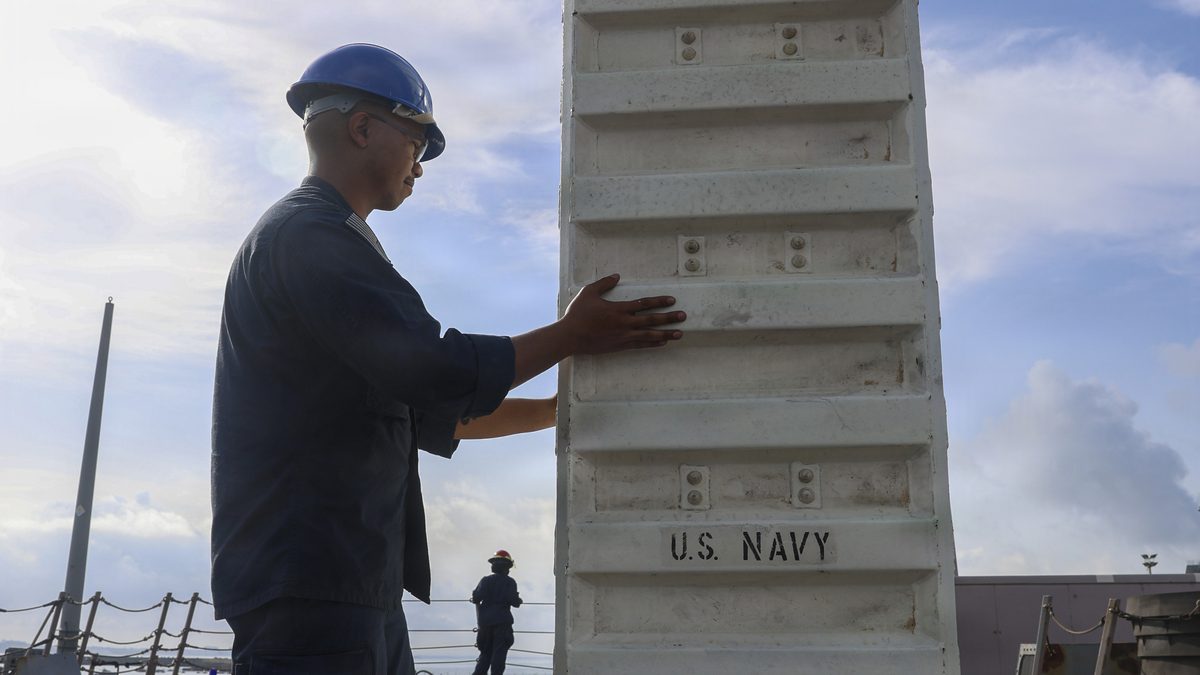
Gunner's Mate Seaman Elijah Wortham guides a missile canister into a Vertical Launch System cell aboard USS Oscar Austin (DDG 79) at Naval Station Rota, Spain, 19 August 2026. U.S. Navy photo by Petty Officer 2nd Class Jackson Wanous, via DVIDS. Public domain. Illustrative of the ordnance handling step discussed here; the ship is American and unconnected to the Turkish programme.
Both Launchers Measure 6.7 Metres: The Turkish Frigate Bid Turns on Certification, Not Steel
Not on the published evidence. Roketsan's MIDLAS and Lockheed Martin's Mk 41 both use an eight cell module and a tactical cell of about 6.7 metres, so module lengths are close, but that is not interchangeability. The United States Navy assessment ordered by Acting Secretary Hung Cao and due on 12 November 2026 is exploratory, and approval would rest on the whole launcher, weapon, combat system and ship configuration.
Technical Summary
Acting Secretary of the Navy Hung Cao has ordered an assessment of foreign built combatants and support ships, run by the Assistant Secretary of the Navy for Research, Development and Acquisition, William Mahan, and reporting on 12 November 2026. USNI News reported on 1 September, citing industry sources, that three allied frigate designs sit under consideration within it: the Japanese Mogami, the South Korean Chungnam and the Turkish Istanbul class. No formal competition has been established publicly. None of the three is named in the memorandum and no bid has been admitted. Commentary has nonetheless settled quickly on the Turkish launcher as the disqualifying fact. The scepticism is aimed at the wrong component.
Roketsan publishes MIDLAS as an eight cell module holding one canister per cell and compatible with quad pack canisters, in a tactical version measuring 2 by 3 by 6.7 metres at 15,000 kg and a strike version measuring 2 by 3 by 8 metres at 18,000 kg. Lockheed Martin publishes the Mk 41 as an eight cell module in a self defence length of just over 5.2 metres, a tactical length of about 6.7 metres and a strike length of about 7.6 metres. The published module counts and lengths are close, and the Turkish strike cell is the deeper of the two. That is where the comparison ends. Neither brochure establishes a common footprint, a common canister envelope or a common interface. Turkiye does already operate Mk 41: Lockheed Martin lists the tactical module as currently installed in Turkish vessels, and open sources record eight cell modules aboard the Barbaros and Salih Reis frigates firing the Evolved Sea Sparrow Missile. That is operational familiarity, not evidence that one launcher drops into the other's foundations.
The Turkish strike cell is 8 metres deep. The American strike cell is about 7.6 metres. Comparable published lengths are not interchangeability, and the country that would have to make the change already operates Mk 41 on four frigates. ISC assessment, open sources, 3 September 2026
The Two Launchers, Side by Side
| Parameter | MIDLAS (Roketsan) | Mk 41 (Lockheed Martin) |
|---|---|---|
| Module size | 8 cells, one canister per cell | 8 cells, building block of the system |
| Quad pack | Compatible | Compatible |
| Tactical length | 6.7 m (2 x 3 x 6.7 m, 15,000 kg) | about 6.7 m |
| Strike length | 8 m (2 x 3 x 8 m, 18,000 kg) | about 7.6 m |
| Self defence length | Not offered | just over 5.2 m |
| Electrical interface | Roketsan cites MIL-STD-1399 Section 300B, cancelled 25 September 2018, and STANAG 1008 | Current standard is MIL-STD-1399 Section 300 Part 1 |
| Fire protection | Gas management plus integrated 24 hour deluge and sprinkler | Cell uptake and plenum venting plus its own deluge system |
| Integration status (manufacturer) | HISAR-D RF and SIPER 1D reported complete by Roketsan, 21 August 2026; SIPER 1D fired from MIDLAS 27 September 2025 | Tomahawk and midcourse defence natures need strike length, tactical length takes the rest of the inventory |
WOME scope note
This assessment concerns launcher interfaces and ordnance certification only. It does not address hull, propulsion or combat system integration, and it takes no position on the merits of the three candidate designs as warships. Every figure in the table is drawn from published manufacturer documentation and is cited in the references.
Analysis of Effects
What does not transfer automatically is approval, and three things that are routinely merged need separating. Hazard classification, assigned under NATO STANAG 4123 and the joint United States procedure, governs transport and storage. Insensitive munitions assessment, under STANAG 4439 and Allied Ordnance Publication 39, measures how a munition responds to defined threats: fast and slow cook off, bullet impact, fragment impact, shaped charge jet attack and sympathetic reaction. Weapon System Explosives Safety Review Board approval covers the fielded system entire, hardware, software, procedures and ship integration together, and it applies to any configuration whatever its national origin. It is also worth saying that this is not a Turkish problem in isolation. Of the three designs reported under consideration, the Japanese entry already uses the Mk 41, the South Korean entry uses a national Korean launcher, and the Turkish entry uses a national Turkish one. Two of the three therefore raise a foreign launcher question, and they raise different ones. Which gate bites here depends on a choice nobody has announced. Fit a Turkish hull with Mk 41 and American rounds and the Turkish natures never enter an American magazine at all. Embark HISAR-D RF, SIPER 1D, ATMACA or GEZGIN and each needs its own classification and assessment. No open source records that work for any of them. The Joint Hazard Classification System is not a public document, so absence from open sources cannot establish absence from the American system.
Statute sits behind the safety case, though less absolutely than it is usually described. Section 2389 of Title 10 of the United States Code, enacted by Public Law 107-107 in December 2001, directs the Secretary of Defense to ensure, so far as practicable, that insensitive munitions under development or procurement are safe throughout development and fielding when subject to unplanned stimuli. Practicability qualifies the duty. It sets no pass or fail procurement bar and prescribes no particular NATO route. There is an irony buried in the file. MIDLAS exists because Washington refused to sell the alternative. Alper Kose, who leads naval platforms at Turkiye's defence procurement authority, told Defense News in July 2021 that the foreign military sale was not approved for the Mk 41 on the fifth MILGEM ship, and that Roketsan was contracted in consequence. Sanctions produced the national launcher. The national launcher is now offered as the reason that sanctions relief cannot produce a frigate.
Personnel and Safety Considerations
For ammunition technicians and afloat explosives safety staff the live question is the magazine safety case, not the procurement politics. Both launchers combine gas management with active suppression rather than choosing between them. Roketsan advertises integrated 24 hour deluge and sprinkler systems, which denotes continuous availability rather than continuous discharge; the detection and initiation logic is not published. The Mk 41 vents a burning motor overboard through cell uptakes and a plenum, and it carries its own deluge system, for which the Naval Sea Systems Command publishes water treatment and maintenance guidance. There is a sharper difference underneath the fire fighting. The Mk 41 is a hot launch system: the motor lights inside the cell and the exhaust has to be managed there. Roketsan states that MIDLAS can launch different missile types by hot or cold method on command from the ship combat management system. Cold launch ejects the round and ignites it clear of the cell, which lowers the in cell thermal and overpressure load but moves the risk to hatch timing, misfire and hangfire drills, and heating of adjacent cells from a late ignition. Those are different magazine safety cases, not different brochures. The design question is therefore not venting against water. It is whether a given arrangement keeps a reacting round from confinement, pressure rise and a transition from deflagration to detonation in a space ringed by manned compartments, and what test evidence supports the claim. That evidence is not public for the Turkish system. A fleet adopting a second launcher standard would also carry a second stowage and segregation regime, a second handling equipment set and a second training pipeline, for the life of the class.
Data Gaps
Internal cell dimensions, allowable canister mass and the mechanical interface for MIDLAS are unpublished, so nothing beyond module count and approximate length can be compared. Comparable lengths do not establish a common footprint: foundations, high impact shock, exhaust loading, electromagnetic compatibility, power quality, canister envelope and topside weight and moment would each need design authority substantiation. Lockheed Martin publishes no module mass or plan dimensions for the Mk 41 in its factsheet, so the mass and deck footprint of the two systems cannot be compared directly: Roketsan gives 15,000 kg and a 2 by 3 metre plan for the tactical MIDLAS module, and there is no published counterpart figure to set against it. The platform used for the SIPER 1D firing of 27 September 2025 is not stated in the cited reporting, so whether it was a ship or a ground facility shot is unresolved, and that distinction matters to a magazine safety case. No hazard division or compatibility group is published for HISAR-D RF, SIPER 1D, ATMACA or GEZGIN, and because the Joint Hazard Classification System is not public their status in the American system cannot be settled either way from open sources. No insensitive munitions assessment result has been located for any of them, though such reports are often classified or proprietary. Insensitive munitions policy addresses munitions rather than launchers, so no equivalent result should be expected for MIDLAS itself. The strike length fit reported by specialist naval media aboard TCG Izmir in August 2026 rests on imagery rather than a builder or agency statement. Whether the American requirement mandates Mk 41 at all is not public, and that one question governs the whole assessment. Roketsan gives the strike module as 8 metres while 2021 reporting gave the developmental system as roughly 8.3 metres, and the discrepancy is unexplained.
Key Questions
Can a Turkish frigate carry American missiles?
Not on published evidence. Module lengths are close, since MIDLAS and the Mk 41 both use eight cell modules with a tactical cell of about 6.7 metres, but that is not interchangeability. Approval would rest on the whole launcher, weapon, combat system and ship configuration, which needs Weapon System Explosives Safety Review Board review whatever the design's national origin.
Why did Turkiye build its own vertical launching system?
Because the United States would not sell it one. Alper Kose of Turkiye's defence procurement authority told Defense News in July 2021 that the foreign military sale of the Mk 41 for the fifth MILGEM ship was not approved, following sanctions over the S-400 purchase, and that Roketsan was contracted to develop a national system instead.
When does the US Navy decide on a foreign frigate design?
The assessment directed by Acting Secretary of the Navy Hung Cao is due on 12 November 2026. It covers the Japanese Mogami, South Korean Chungnam and Turkish Istanbul designs. It follows the presidential memorandum of 13 August 2026, which permits foreign construction under a national security waiver subject to 30 days notice to Congress.
References
Source-evaluated per NATO source-evaluation doctrine, STANAG 2022 lineage (source reliability A–F / information credibility 1–6). Tier 1 = government primary source; Tier 2 = quality news / specialist defence media; Tier 3 = authoritative aggregator / encyclopaedia.
- T1Office of the Law Revision Counsel, U.S. House of Representatives – 10 U.S.C. 2389: Ensuring safety regarding insensitive munitions, current through the 2024 main edition. (Reliability A / Credibility 1)
- T1The White House – Rebuilding the United States Navy and America's Shipbuilding Industrial Base, 13 August 2026. (Reliability A / Credibility 1)
- T2USNI News – Japanese, South Korean, Turkish Warships Under Consideration for New U.S. Frigate Competition, 1 September 2026. (Reliability B / Credibility 2)
- T2Roketsan (design authority, manufacturer copy) – MIDLAS National Vertical Launcher System, product catalogue, 2024. (Reliability B / Credibility 2)
- T2Lockheed Martin (manufacturer copy) – MK 41 Vertical Launching System factsheet, accessed 3 September 2026. (Reliability B / Credibility 2)
- T2Defense News – Turkey to make its own maritime missile-launching system after sanctions interrupt Lockheed plans, 2 July 2021. (Reliability B / Credibility 2)
- T2Navy Lookout – US Navy considers overseas-built frigates in major policy shift, August 2026. (Reliability B / Credibility 2)
- T3Wikipedia – Barbaros-class frigate, accessed 3 September 2026. (Reliability C / Credibility 3)
- T2Naval News – Turkiye successfully test-fires SIPER-1D long range SAM from indigenous VLS, 27 September 2025. (Reliability B / Credibility 2)
- T2Anadolu Agency – Roketsan chief executive Murat Ikinci on MIDLAS integration, 21 August 2026. (Reliability B / Credibility 2)
- T1Defense Logistics Agency, ASSIST – MIL-STD-1399 Section 300B, cancellation record, cancelled 25 September 2018. (Reliability A / Credibility 1)
Editorial responsibility. This analysis is researched, written and published under the editorial responsibility of Steve Sawyers, MIExpE VR. Every technical claim is sourced to named open-source material and rated for reliability and accuracy under NATO STANAG 2022. ISC uses its own domain-trained research and drafting system under human direction; the analysis, the judgements and the accountability for them are ours. Corrections and updates welcome: if you hold open-source data that refines or corrects any parameter here, write to [email protected] citing the specific claim and your source. Verified corrections are incorporated and credited in the revision history. Full editorial and AI policy.