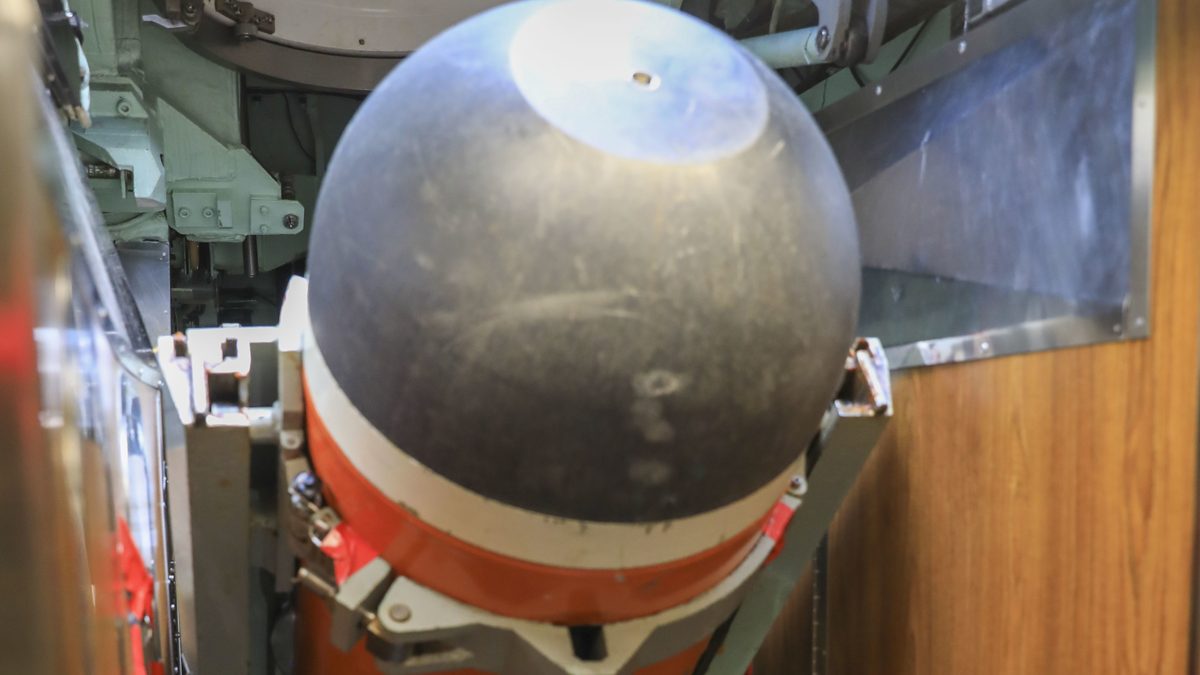
Illustrative: a MK 67 submarine launched mobile mine (SLMM) being loaded aboard the Los Angeles class fast attack submarine USS Annapolis (SSN 760) at Apra Harbor, Guam, 4 May 2022. The Mk 67 is the legacy weapon MEDUSA is intended to succeed; it is not a MEDUSA vehicle. U.S. Navy photo by Mass Communication Specialist 2nd Class Zachary Grooman, via DVIDS. Public domain. Use does not imply endorsement by the U.S. Department of Defense.
Offensive mining comes back: the Navy exercises its MEDUSA option for a torpedo tube delivered minefield
On 2 September 2026 Naval Sea Systems Command exercised a 15,147,625 dollar option on General Dynamics Mission Systems contract N00024-24-C-6315 for the Mining Expendable Delivery Unmanned Submarine Asset, MEDUSA. The system is a torpedo tube launched unmanned underwater vehicle that carries a mine payload to a laydown position remote from the launching submarine. Work runs to February 2028.
Technical Summary
The Department of War contract announcement of 2 September 2026 records a 15,147,625 dollar cost plus incentive fee and firm fixed price modification to previously awarded contract N00024-24-C-6315, exercising options for the Mining Expendable Delivery Unmanned Submarine Asset (MEDUSA). The awardee is General Dynamics Mission Systems of Quincy, Massachusetts. Work is performed at Quincy and is expected to be completed by February 2028. Fiscal year 2025 research, development, test and evaluation (Navy) funds of 15,147,625 dollars were obligated at the time of award and do not expire at the end of the current fiscal year. Naval Sea Systems Command, Washington Navy Yard, is the contracting activity.
MEDUSA is a medium class unmanned underwater vehicle (UUV) sized to eject from a standard 533mm submarine torpedo tube. It is not itself a mine. It is a delivery vehicle that transits submerged to a designated laydown point and releases its mine payload, allowing the launching submarine to remain well outside the mined water. General Dynamics Mission Systems took the original prototype award in late 2024, valued at approximately 15.9 million dollars with priced options that could carry the effort to about 58.1 million dollars, covering design, systems engineering, fabrication, test and integration. This is not the first option to be exercised against it. On 6 July 2026 the Navy exercised an option worth approximately 14.3 million dollars for prototype systems, software development, ashore support equipment and engineering services, with work running to July 2028. Counting the base award and both public option exercises, the announced total stands at roughly 45 million dollars against the 58.1 million dollar priced ceiling. Open sources place at sea prototype trials off Massachusetts in early 2026. The mine natures MEDUSA is qualified to carry, their Hazard Division and Compatibility Group, and the Net Explosive Quantity per vehicle are not stated in any open source located for this assessment.
Fiscal year 2025 research, development, test and evaluation funds of 15,147,625 dollars were obligated at award, carrying MEDUSA to February 2028 against an original prototype effort of about 15.9 million dollars and priced options to roughly 58.1 million dollars. ISC assessment, from the Department of War contract announcement, 2 September 2026
Analysis of Effects
The significance here is programmatic rather than technical. The United States has not retired submarine laid mining, but it has let it wither. The Mk 67 Submarine Launched Mobile Mine, a modified Mk 37 torpedo body carrying a Mk 13 explosive section, remains the only mine in the inventory that can be delivered clandestinely from standoff range, and it is 1980s equipment held in small numbers and launchable only from improved Los Angeles class boats. It is not a museum piece: US Sixth Fleet published imagery of an expeditionary ordnance on load of a Mk 67 into USS Montpelier at Souda Bay in June 2021. Alongside that residual capability sits the Quickstrike family, general purpose aircraft bombs fitted with target detecting devices, which requires an aircraft to fly to the minefield and survive doing so. MEDUSA is best read as the intended replacement path for a shrinking, platform constrained legacy weapon rather than a capability conjured from nothing, and a torpedo tube launched delivery vehicle widens the clandestine option to boats that cannot carry the Mk 67 at all. The planning consequence for an opponent is broader than the number of mines involved: any water within transit range of a submarine patrol box has to be treated as potentially mined, and mine countermeasures effort has to be spent proving otherwise.
For the ordnance community the interesting problems sit at the interfaces. A mine carried inside a UUV is stowed, transported and handled as an assembled explosive store with its own Hazard Division and Compatibility Group, while the vehicle adds a high energy propulsion battery and, probably, pyrotechnic or gas generator ejection devices to the same package. Mixing rules for storage turn on those compatibility groups, so the packaged configuration decides what a weapons handling facility or a submarine tender may hold alongside it and at what Net Explosive Quantity. Whether MEDUSA is certified as a single assembled store or as separable components that ship and stow apart is not addressed anywhere in the open record, and the two answers imply very different storage footprints.
Personnel and Safety Considerations
Weapons handling personnel should note that an expendable delivery vehicle changes the failure modes an armament supply department has to plan for. A conventional mine is inert in stow and arms after laying. A delivery vehicle carrying a mine adds propulsion, control surfaces and a release mechanism, any of which can fail with the payload still aboard, which creates a recovery and render safe problem for a store that has left the tube but has not laid. Explosive ordnance disposal planning for any asset of this class should start from the assumption that a recovered vehicle may hold its payload in an unknown arming state. No open source describes the MEDUSA arming sequence, its safety and arming device architecture, or its abort and recovery procedure, and nothing in this assessment should be read as describing them.
Data Gaps
Open sources do not state the mine natures carried or their Hazard Division and Compatibility Group; the Net Explosive Quantity per vehicle; vehicle length, mass, endurance or transit range; how many options this modification exercised and what each covers; the safety and arming architecture; whether MEDUSA has entered a formal weapon safety certification programme; and whether the February 2028 completion reflects prototype testing alone or an initial production quantity. The contract announcement names neither a delivery quantity nor a fielding date, and ISC has located no Navy release tied specifically to this September 2026 modification.
Key Questions
What is MEDUSA?
MEDUSA, the Mining Expendable Delivery Unmanned Submarine Asset, is a United States Navy unmanned underwater vehicle sized for launch from a submarine torpedo tube. It carries a mine payload to a laydown position remote from the launching submarine and is then expended. General Dynamics Mission Systems holds the development contract.
How much has the US Navy spent on MEDUSA so far?
The late 2024 base award was about 15.9 million dollars, with priced options to roughly 58.1 million. The Navy exercised about 14.3 million dollars in July 2026 and a further 15,147,625 dollars on 2 September 2026, funded from fiscal year 2025 research and development money. Announced total: roughly 45 million dollars.
Why does a submarine launched mine delivery vehicle matter?
It separates the launching platform from the minefield. Mass United States offensive mining leans on Quickstrike, an air delivered bomb conversion needing an aircraft over the target water, while the submarine laid Mk 67 is residual and fits only some boats. An expendable delivery vehicle widens clandestine mining without exposing a manned platform.
References
Source-evaluated per NATO source-evaluation doctrine, STANAG 2022 lineage (source reliability A–F / information credibility 1–6). Tier 1 = government primary source; Tier 2 = quality news / specialist defence media; Tier 3 = authoritative aggregator / encyclopaedia.
- T1U.S. Department of War – Contracts for Sept. 2, 2026, 2 September 2026. (Reliability A / Credibility 1)
- T1Naval Sea Systems Command – U.S. Navy Awards MEDUSA Contract to Advance Innovative Unmanned Technology, 2024. (Reliability A / Credibility 1)
- T2General Dynamics Mission Systems – General Dynamics Mission Systems Awarded Contract to Advance MEDUSA Prototype Systems and Engineering Services, 22 July 2026. (Reliability B / Credibility 2)
- T2The War Zone – Navy Offers Glimpse Of Its Submarine-Launched Mine Capabilities In The Mediterranean, June 2021. (Reliability B / Credibility 2)
- T2General Dynamics Mission Systems – MEDUSA Unmanned Underwater Vehicle, accessed 3 September 2026. (Reliability B / Credibility 2)
- T2Naval News – General Dynamics Testing MEDUSA Submarine Launched Mine Warfare Drone, February 2026. (Reliability B / Credibility 2)
- T2The Defense Post – General Dynamics to Develop MEDUSA Mining System for US Navy, 1 November 2024. (Reliability B / Credibility 2)
Editorial responsibility. This analysis is researched, written and published under the editorial responsibility of Steve Sawyers, MIExpE VR. Every technical claim is sourced to named open-source material and rated for reliability and accuracy under NATO STANAG 2022. ISC uses its own domain-trained research and drafting system under human direction; the analysis, the judgements and the accountability for them are ours. Corrections and updates welcome: if you hold open-source data that refines or corrects any parameter here, write to [email protected] citing the specific claim and your source. Verified corrections are incorporated and credited in the revision history. Full editorial and AI policy.