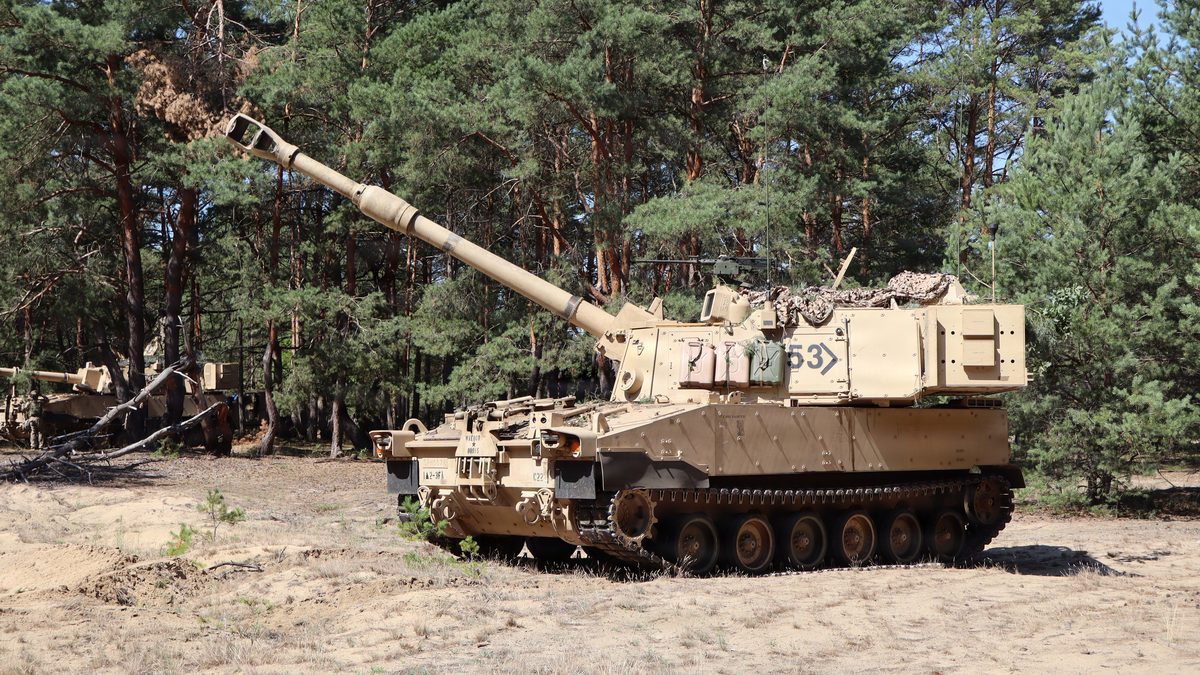
An M109A7 Paladin of 2nd Platoon, Charlie Battery, 2nd Battalion, 3rd Field Artillery Regiment during Artillery Table XI at Forward Operating Site Torun, Poland, July 2026. Photo: 1st Lt. Bryan Kott, 1st Armored Division. US Department of Defense imagery via DVIDS, public domain. Illustrative: the M109A7 is the in-service tracked system the request for information seeks to supplement, not a candidate offered against it.
After the Wheeled Award, the US Army Asks Industry for a Tracked 155mm Howitzer and the Vehicle That Feeds It
The US Army has issued a request for information for a tracked 155 mm self-propelled howitzer and a matching ammunition resupply vehicle, with responses due on 11 September 2026 and an industry day to follow. It comes two weeks after Hanwha Defense USA won the wheeled Mobile Tactical Cannon award for K9 Mobile Howitzer prototypes, and it asks vendors to demonstrate on American ammunition.
Technical Summary
The request for information asks interested parties to offer a tracked self-propelled 155 mm howitzer, a coinciding resupply vehicle and ground support personnel to support demonstration and safety testing events, and to state production lead times. Responses are due on 11 September 2026 and the service intends to hold an industry day. Reporting of the notice records that the Army recently reassessed its modernisation objectives, progressed to replacing the M777 towed howitzer with a wheeled self-propelled system under the Mobile Tactical Cannon programme, and is treating the tracked requirement as an additional capability for employment within armoured formations. The two lines are best kept distinct by name: the wheeled effort is the wheeled variant of Mobile Tactical Cannon, and the tracked requirement is a separate enquiry rather than a revision of it.
The sequencing matters. On 19 August 2026 Hanwha Defense USA announced that it had been selected to deliver wheeled K9 Mobile Howitzer prototypes for the Army's Mobile Tactical Cannon programme, covering six prototype systems with an option for a further twelve. Reported values differ and both should be read: Breaking Defense put the deal at up to $233 million, while the other transaction agreement has been reported with an initial action of $100.3 million against a cumulative face value of $262.9 million. Hanwha's own announcement states the prototype quantities and the Opelika, Alabama integration site but does not state a value. The new tracked notice does not displace that decision; it opens a separate line of enquiry for a platform to serve formations whose mobility and protection requirements the wheeled solution was not selected to meet. Quantities, funding line and any prototype vehicle count for the tracked requirement are not stated in the notice as reported.
That the tracked enquiry followed the wheeled award by two weeks was signalled in the award announcement itself. Hanwha's president of land systems described the wheeled vehicle as the wheeled variant of the K9 and said it provides, in his words, an expansion path towards a tracked capability. An incumbent stating a tracked ambition a fortnight before the customer advertises a tracked requirement does not tell us who will win, and the notice names no vendor. It does tell us the tracked line was not a surprise to at least one participant.
The Army is not only asking for a gun. It is asking for the vehicle that feeds it, the crews that operate both, and a demonstration fired on American ammunition. That is a request about a logistic chain, not a chassis. ISC assessment of the US Army tracked howitzer request for information
Analysis of Effects
The instruction to demonstrate on American ammunition is the technically load bearing line in the notice. Any candidate offered from a non US production base will have been proved on its home nature of projectile and, more importantly, on its home propelling charge. Chamber volume, ordnance profile and pressure limits are harmonised across most NATO 155 mm systems through the Joint Ballistics Memorandum of Understanding, but harmonisation is not equivalence: the ordnance has to be cleared against the US Modular Artillery Charge System zones, against the pressure and temperature envelope those charges produce, and against the specific projectile natures the Army intends to issue. That clearance is a safety case activity with instrumented firing behind it, and it is why the notice pairs the demonstration with safety testing rather than a mobility trial.
Asking for the resupply vehicle in the same notice is the second signal. Sustained rate of fire in an armoured formation is set by the rate at which projectiles and charges can be moved from the resupply vehicle into the gun, not by the gun's burst capability. A resupply vehicle also concentrates a magazine of complete rounds and separately packaged propelling charges in one hull, which drives the internal stowage arrangement, the separation between the projectile and charge magazines, fire suppression provision and the crew handling task. Buying the gun without settling the resupply architecture is how armies end up with a high burst rate and an unchanged sustained rate.
Personnel and Safety Considerations
A tracked self-propelled 155 mm system and its resupply vehicle carry a mixed load with distinct hazard characteristics: high explosive projectiles, propelling charges, primers and, depending on the natures issued, fuzes held separately. Propelling charges and complete rounds do not share a hazard division or a compatibility group in every packaging configuration, so the internal stowage design has to satisfy the mixing rules that apply to the load carried rather than to the heaviest single item. For the demonstration and safety testing events, the practical controls are the ones that always apply to a foreign origin ordnance firing US natures: an approved firing safety case for each charge zone and projectile combination, instrumented pressure measurement, a defined temperature conditioning regime, and clearly stated abort criteria. Personnel handling drills for the resupply task should be assessed for manual handling load as well as for ordnance safety.
Data Gaps
The following are unresolved in open source: the quantity of tracked systems and resupply vehicles the Army intends to procure; the funding line and programme milestones; the barrel length in calibres and chamber standard required; which projectile natures and charge zones will be used in the safety testing events; whether the resupply vehicle is to be a purpose designed platform or a variant of an existing carrier; the required sustained and burst rates of fire; the relationship between this requirement and the existing tracked self-propelled artillery fleet; and the extent to which candidates already hold US safety clearance for the Modular Artillery Charge System.
Key Questions
What is the US Army asking for in the tracked howitzer RFI?
The Army asked industry to offer a tracked 155 mm self-propelled howitzer, a coinciding ammunition resupply vehicle and ground support personnel for demonstration and safety testing events, and to state production lead times. Responses were due on 11 September 2026, with an industry day planned. Quantities and funding are not stated in the notice as reported.
Does this replace the Hanwha K9 wheeled howitzer award?
No. On 19 August 2026 Hanwha Defense USA announced selection for wheeled K9 Mobile Howitzer prototypes under the Mobile Tactical Cannon programme, aimed at replacing the towed M777 in lighter formations. Six prototypes are covered with an option for twelve more; reported values range from $233 million to a cumulative face value of $262.9 million on an initial $100.3 million action. The tracked request is presented as an additional capability for armoured formations and runs alongside that decision rather than superseding it.
Why does the Army want candidates tested with American ammunition?
Because clearance is specific to the ammunition, not just the calibre. A foreign origin ordnance must be proved against US projectile natures and the Modular Artillery Charge System zones, with instrumented pressure measurement across the temperature envelope, before it can be issued. Shared 155 mm calibre does not by itself establish that a gun is safe on another nation's charges.
References
Source-evaluated per NATO source-evaluation doctrine, STANAG 2022 lineage (source reliability A–F / information credibility 1–6). Tier 1 = government primary source; Tier 2 = quality news / specialist defence media; Tier 3 = authoritative aggregator / encyclopaedia.
- T1Assistant Secretary of the Army (Financial Management and Comptroller) – FY 2026 Procurement of Ammunition, Army justification book, 2025. (Reliability A / Credibility 1)
- T2Breaking Defense – Army seeks tracked howitzer candidates following award for wheeled platforms, 1 September 2026. (Reliability B / Credibility 2)
- T2Breaking Defense – Army picks Hanwha's wheeled K9 for self-propelled howitzer prototypes, August 2026. (Reliability B / Credibility 2)
- T2The War Zone – South Korea's Highly Mobile 155mm Artillery System Wins U.S. Army Howitzer Contract, August 2026. (Reliability B / Credibility 2)
- T2Hanwha Defense USA – Hanwha wins US Army Mobile Tactical Cannon contract, 19 August 2026. Company announcement: six prototypes with an option for twelve, Opelika integration site, and the quoted expansion path towards a tracked capability. No contract value stated. (Reliability B / Credibility 2)
- T3The Defense Post – US Army Picks Hanwha K9 Wheeled Howitzer for M777 Replacement Program, 20 August 2026. (Reliability C / Credibility 3)
Editorial responsibility. This analysis is researched, written and published under the editorial responsibility of Steve Sawyers, MIExpE VR. Every technical claim is sourced to named open-source material and rated for reliability and accuracy under NATO STANAG 2022. ISC uses its own domain-trained research and drafting system under human direction; the analysis, the judgements and the accountability for them are ours. Corrections and updates welcome: if you hold open-source data that refines or corrects any parameter here, write to [email protected] citing the specific claim and your source. Verified corrections are incorporated and credited in the revision history. Full editorial and AI policy.