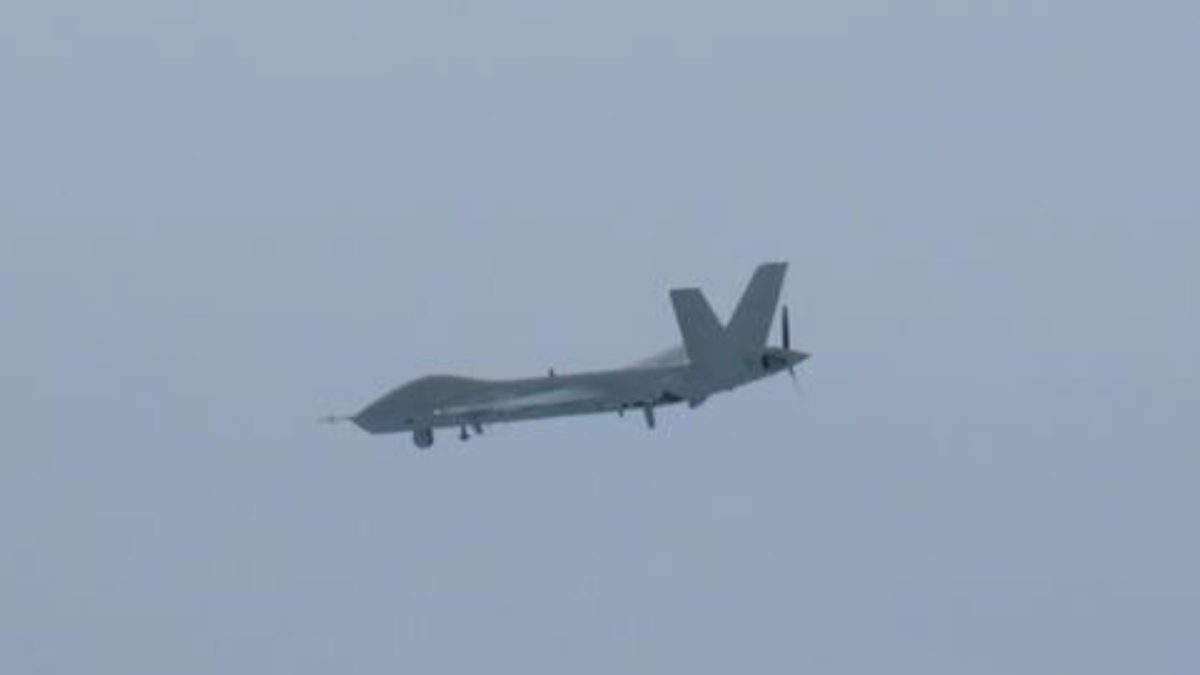
A People’s Liberation Army GJ-2 (Wing Loong II) photographed on 26 February 2025. Image: Japan Ministry of Defense / Japan Air Self-Defense Force, via Wikimedia Commons, licensed CC BY 4.0. Cropped to 16:9 by ISC.
The 480-Kilogram Ceiling: What a Wing Loong II Drops, and What the Fragments Give Away
The Wing Loong II, designated GJ-2 in Chinese service, carries up to 480 kg of stores across six underwing hardpoints. That is roughly 28 per cent of the 1,701 kg payload the United States Air Force quotes for an MQ-9 Reaper. The ceiling fixes the target set at soft, unhardened aim points, and it explains both the aircraft’s export record and the day that record runs out.
Technical Summary
Côte d’Ivoire became the newest confirmed operator this month. The Armed Forces of Côte d’Ivoire released video on 10 August 2026 showing two Wing Loong II airframes at Bouaké Air Base, three days after a parade commentator let the acquisition slip on air. The aircraft trace to a June 2024 contract with the China National Aero-Technology Import and Export Corporation (CATIC), the trading arm of the Aviation Industry Corporation of China (AVIC). One airframe in the footage carries what analysts read as a communications intelligence (COMINT) pod, which points at a surveillance fit rather than a strike fit. Côte d’Ivoire is the second West African operator after Nigeria, which took at least five aircraft in 2023. It joins a user list that already runs to Pakistan, Egypt, Serbia, Kazakhstan, Algeria, Morocco, Saudi Arabia and the United Arab Emirates, with China flying its own aircraft as the GJ-2.
Set the export story aside and one number governs everything the aircraft can do to a target. Maximum takeoff weight is 4,200 kg. External stores are capped at 480 kg across six underwing hardpoints, three per wing. The United States Air Force fact sheet puts total MQ-9 Reaper payload at 3,750 lb, or 1,701 kg, on a maximum takeoff weight of 10,500 lb. The comparison is not exact, since the American figure covers payload rather than external stores alone, and it flatters the Reaper slightly for that reason. It is still the right order of magnitude: the Wing Loong II carries a little over a quarter as much, behind a WJ-9 turboprop of roughly 500 to 600 shaft horsepower against the Reaper’s Honeywell TPE331 at a commonly quoted 900. Cruise sits near 200 km/h at a ceiling of 9,000 m. Endurance is the figure the marketing leads with, at 31 to 32 hours clean, but endurance is not what lands on the target.
A 480 kg ceiling across six pylons is not a smaller version of a Reaper’s magazine. It is a different target set: soft, unhardened, and inside airspace nobody is defending. ISC assessment, 29 August 2026
Analysis of Effects
What 480 kg buys is a spread of small guided stores rather than one heavy one. Reported fits centre on the Blue Arrow LJ-7, a semi-active laser homing weapon from the Norinco AKD-10 anti-armour family, and on Luoyang FT-series satellite-guided bombs. That distinction matters to anyone working the ground afterwards. An anti-armour missile delivers a shaped-charge effect and a guided bomb delivers blast and fragmentation, so the two leave different residues and pose different problems on recovery. With multiple ejector racks the six pylons build up to roughly a dozen small items. Nothing in the documented export loadout penetrates a hardened aircraft shelter, a buried facility, or reinforced concrete of any real depth. The effect on offer is a small high-explosive warhead placed accurately on a vehicle, a compound, a mortar team or a boat. Against the Baloch separatist camps in Sistan and Baluchestan that Pakistan, a Wing Loong II operator, struck on 18 January 2024 under Operation Marg Bar Sarmachar, that is a matched requirement. Islamabad’s own foreign ministry described the operation only as coordinated precision strikes on terrorist hideouts and named no platform, so the Wing Loong II attribution, alongside JF-17 and J-10CE fighters, rests on defence reporting rather than on the Pakistani statement. Against a functioning air defence network the requirement does not arise at all, because the aircraft does not survive to release.
Iran demonstrated the second half of that on 2 April 2026, when a Wing Loong II came down over Shiraz, well inside Iranian airspace and close to ballistic missile production sites. Foreign ministry spokesman Esmail Baqaei published wreckage images two days later and demanded clarification from what he called the two states of the region that operate the type, a reference widely read as Saudi Arabia and the United Arab Emirates. Iran’s Tasnim news agency had first reported the wreck as an American MQ-9 Reaper before the debris was reidentified. Neither Riyadh nor Abu Dhabi has acknowledged the airframe. The error is instructive. Recent survey work describes the Wing Loong II as bearing a strong external resemblance to the Reaper, sharing a similar wingspan, tail configuration and nose-mounted sensor turret, and the report of the shootdown itself called the two types similar in size and appearance. A burnt centre section is therefore a weak identifier on its own. The ordnance is not.
Personnel and Safety Considerations
For explosive ordnance disposal (EOD) teams and post-strike investigators the evidence and the hazard arrive as the same object. Amnesty International reported in May 2025 that fragments recovered from a strike near al-Malha in North Darfur on 9 March 2025 came from a Norinco GB50A guided aerial bomb manufactured in 2024, the first documented combat use of that store anywhere. The GB50A is releasable from the Wing Loong II and the FeiHong-95, both operated in Sudan only by the Rapid Support Forces, and Amnesty assessed the transfer route as running through the United Arab Emirates in breach of the arms embargo. Those fragments were the evidence. At the point of recovery they were also a hazard of unknown extent, because a guided store that has functioned low order, or failed to function at all, leaves a fuze train in an unknown arming state. ISC has not confirmed the filled weight or net explosive quantity (NEQ) of the GB50A against primary documentation, and the Norinco GB family numbering that would place it in the 50 kg class is a naming convention rather than a specification, so no fragmentation distance is offered here. Applicable doctrine differs by jurisdiction, with United Kingdom forces working to Defence Safety Authority regulation DSA 03.OME and humanitarian clearance organisations to the International Mine Action Standards, but the first action is common to both: cordon, record, and pass to a qualified operator. Attribution work and render safe procedure compete for the same ground, and the investigative value of a fragment does not lower its hazard.
Data Gaps
Filled weight and NEQ for the GB50A and for the Blue Arrow LJ-7 warhead are not established from primary documentation, so no fragmentation or safety distance is calculated in this assessment. Armed endurance is reported inconsistently, at about 26 hours in the Côte d’Ivoire reporting and at roughly 20 hours in other open sources, and ISC has not reconciled the two against a manufacturer figure. WJ-9 output is quoted between 500 and 670 shaft horsepower depending on the source. Fuze types, arming logic and functioning reliability for the Chinese export stores are absent from open literature, which is the largest single gap for anyone planning post-strike clearance. Whether the Côte d’Ivoire aircraft are configured for strike at all is unconfirmed, since the released footage shows a sensor fit. Unit price is commonly cited between one and two million United States dollars for the air vehicle, a figure with no primary sourcing that in any case excludes ground stations, spares and support.
Key Questions
How much ordnance can a Wing Loong II carry?
Up to 480 kg of external stores across six underwing hardpoints, three under each wing. Multiple ejector racks allow roughly a dozen small stores. That is about 28 per cent of the 1,701 kg payload the United States Air Force quotes for the MQ-9 Reaper, and it confines the aircraft to small guided munitions against unhardened targets.
Who operates the Wing Loong II?
China flies it as the GJ-2. Confirmed or reported export operators include Pakistan, Egypt, Nigeria, Serbia, Kazakhstan, Algeria, Morocco, Saudi Arabia and the United Arab Emirates. Cote d'Ivoire became the newest confirmed user on 10 August 2026, when its armed forces released video of two aircraft at Bouake Air Base.
How are Wing Loong II strikes attributed to a specific state?
Rarely from the airframe. Attribution normally comes from munition remnants, which carry manufacture and lot markings. Amnesty International identified a Norinco GB50A bomb built in 2024 from fragments at a March 2025 strike in North Darfur, and used that finding to trace the supply route in breach of the Sudan arms embargo.
References
Source-evaluated per NATO source-evaluation doctrine, STANAG 2022 lineage (source reliability A–F / information credibility 1–6). Tier 1 = government primary source; Tier 2 = quality news / specialist defence media; Tier 3 = authoritative aggregator / encyclopaedia.
- T1United States Air Force – MQ-9 Reaper Unmanned Aircraft System fact sheet (archived by the US Government Publishing Office), accessed 29 August 2026. (Reliability A / Credibility 1)
- T2Amnesty International – Sudan: Advanced Chinese weaponry provided by UAE identified in breach of arms embargo, May 2025. (Reliability A / Credibility 2)
- T2South China Morning Post – Iran demands explanations from Saudis and UAE after Chinese-made drone was shot down, 4 April 2026. (Reliability B / Credibility 2)
- T2Armada International – Wing Loong II: Market Success and a Tougher Test in the Field, 27 August 2026. (Reliability B / Credibility 2)
- T2Military Africa – Ivory Coast confirms newly acquired Chinese Wing Loong II drones, 21 August 2026. (Reliability B / Credibility 2)
- T2The Defence Blog – Pakistani fighter jets strike targets in Iran, 18 January 2024. (Reliability B / Credibility 2)
Editorial responsibility. This analysis is researched, written and published under the editorial responsibility of Steve Sawyers, MIExpE VR. Every technical claim is sourced to named open-source material and rated for reliability and accuracy under NATO STANAG 2022. ISC uses its own domain-trained research and drafting system under human direction; the analysis, the judgements and the accountability for them are ours. Corrections and updates welcome: if you hold open-source data that refines or corrects any parameter here, write to [email protected] citing the specific claim and your source. Verified corrections are incorporated and credited in the revision history. Full editorial and AI policy.