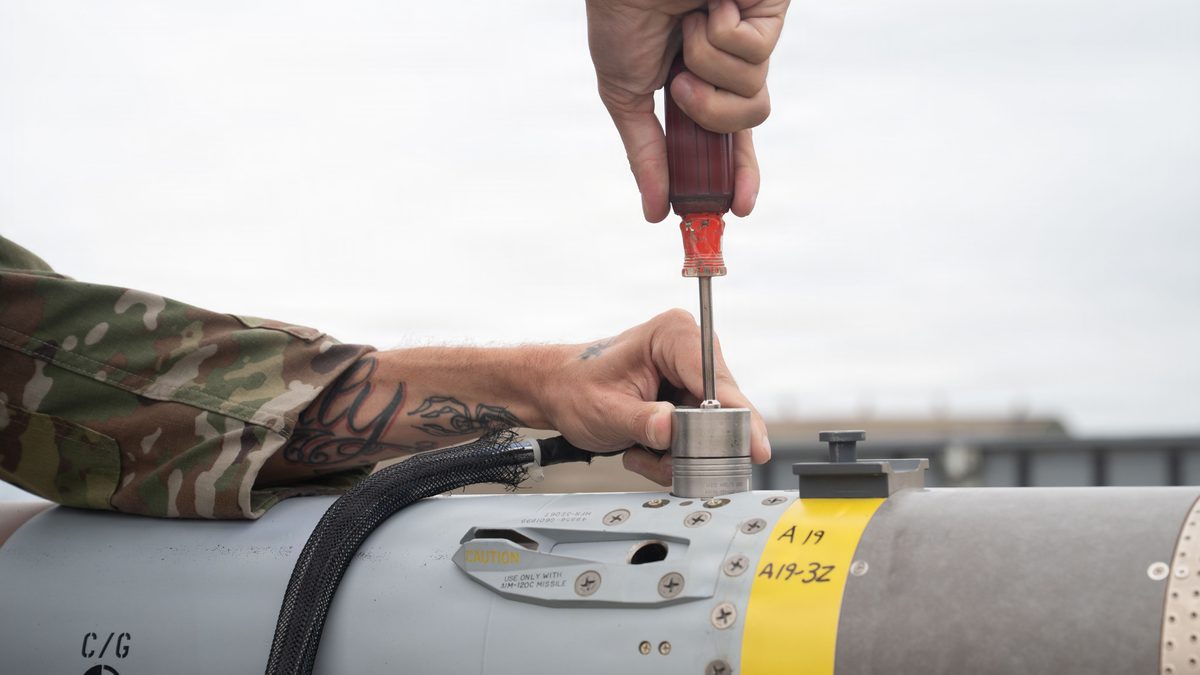
A U.S. Air Force precision guided munitions inspector prepares an AIM-120 AMRAAM during Combat Archer-UK 26 at RAF Lakenheath, England, 22 July 2026. U.S. Air Force photo by Staff Sgt. Ashley Talley, 48th Fighter Wing. Public domain, via DVIDS.
AMRAAM Wing and Fin Replenishment Goes Sole-Source to One Alabama Small Business Until 2031
The wings and fins the United States Air Force buys to replenish its AIM-120X and CATM-120X Advanced Medium-Range Air-to-Air Missiles come from BK Manufacturing Co. Inc. of Arab, Alabama. On 28 August 2026 the Air Force Life Cycle Management Center at Robins Air Force Base awarded the firm a sole-source, firm-fixed-price requirements contract, FA8556-26-D-B001, with a ceiling of $28,000,000 running to 27 August 2031.
Technical Summary
The Department of War contract announcement of 28 August 2026 records BK Manufacturing Co. Inc. of Arab, Alabama, flagged as a small business, receiving a maximum $28,000,000 firm-fixed-price, requirements, indefinite-delivery/indefinite-quantity contract for wings and fins for the AIM-120X and CATM-120X series of Advanced Medium-Range Air-to-Air Missiles (AMRAAM). Work is performed at Arab, Alabama. Completion is expected by 27 August 2031. The award was a sole source acquisition and no funds were obligated at the time of award. The contracting activity is the Air Force Life Cycle Management Center (AFLCMC) at Robins Air Force Base, Georgia, under contract number FA8556-26-D-B001. The scope is replenishment of specific catalogued items rather than the production line that builds new rounds, a distinction that matters and is returned to below.
Wings and fins are not generic airframe hardware on this weapon, and the two words are not interchangeable. The wings are the fixed mid-body lifting surfaces. The fins are the four movable tail surfaces that the control section drives to steer the round in flight; the Directory of U.S. Military Rockets and Missiles records the AMRAAM WCU-11/B control section as controlling the missile through those four movable tail fins, with the later WCU-28/B fitted to the AIM-120C-5. Both sets are variant-keyed. The AIM-120C introduced clipped wings and fins specifically to allow carriage inside the weapons bays of the F-22, taking the AIM-120A/B wingspan of 53.3 cm (21 in) and finspan of 63.5 cm (25 in) down to 44.7 cm (17.6 in) for both on the AIM-120C-5. A wing and fin set is therefore a qualified, configuration-controlled item tied to a variant, not a commodity part that any competent machine shop can substitute at short notice.
Dimensional tolerances as tight as plus or minus 0.0004 inch, surface finish to 25 micro-inches, titanium and nickel-based alloys and honeycomb, and a First Article test the Air Force justifies on the grounds that failure in service could cause catastrophic failure on the wing of an aircraft. AFLCMC sources-sought notice FA8556-24-R-000X, Wings and Fins Subassemblies, AMRAAM
Contract parameters (open sources)
| Contract number | FA8556-26-D-B001 |
| Contractor | BK Manufacturing Co. Inc., Arab, Alabama (small business) |
| Item | Wings and fins, AIM-120X and CATM-120X series |
| Contract type | Firm-fixed-price, requirements, indefinite-delivery/indefinite-quantity |
| Ceiling | $28,000,000 maximum; no funds obligated at award |
| Competition | Sole source acquisition; statutory exception not stated in the announcement |
| Place of performance | Arab, Alabama |
| Contracting activity | AFLCMC, Robins Air Force Base, Georgia |
| Period | Announced 28 August 2026; completion expected 27 August 2031 (60 months) |
| Predecessor | FA8556-24-C-B001, ceiling $5,662,749, awarded 16 July 2024, one bid received |
| Live-round stock numbers (federal supply class 1420, guided missile components) | Wing assembly 3820402-101 (Department of Defense identification code PG64); fin 3820431-101 (PG61); wing assembly G601897 (PT44); fin assembly G601895 (PT45) |
| Training stock numbers (federal supply class 6920, armament training devices) | Fin, missile LT/CCM 7038180 (PY96); fin assembly, CATM P3I 7006031-1 (XY59) |
Analysis of Effects
The contract type carries more information than the headline figure. A requirements contract, defined at Federal Acquisition Regulation 16.503, provides for filling all actual purchase requirements of designated activities for the supplies covered during a specified period, with deliveries made by placing orders against it. Applied here, the Air Force has not bought a quantity of wing and fin sets. It has undertaken to source its replenishment requirement for those items from this one supplier for five years, and set a spending ceiling of $28,000,000 against that undertaking. Nothing has been obligated yet. The instrument reserves a supplier and a ceiling, not a delivery.
Why no competition is the more interesting question, and AFLCMC has already published most of the answer. A sources-sought notice issued at Robins in August 2023, followed by a virtual industry day on 12 September that year, sought market research on the same six national stock numbers (NSNs), described the work as a possible build-to-print effort against Level III drawings, and set out what a new entrant would have to clear. Dimensional tolerances run as tight as plus or minus 0.0004 inch, surface finish requirements as low as 25 micro-inches, and the materials are titanium, nickel-based alloys and honeycomb, worked by machining, brazing and welding to aerospace standards. The notice states plainly that these items are designed for military application and have no commercial use. First Article testing is waived only for an offeror that has already supplied the same or a similar article to the prime for delivery to the Air Force, or is currently producing it under another Air Force contract, and then only if no more than 36 months have passed. The Air Force explains why in one sentence: failure of these items in operation could cause catastrophic failure on the wing of an aircraft. That is a qualification barrier written down in advance, and it goes a long way to explaining how a competitive pre-solicitation in 2024 produced a single bid and how the follow-on in 2026 arrived sole-source.
Scaled against the predecessor, the reserved headroom has grown, though the raw ratio flatters it. Federal contract records for FA8556-24-C-B001 show a $5,662,749 ceiling awarded on 16 July 2024, of which roughly $3.7m had been obligated by January 2026, about eighteen months in. The new ceiling of $28,000,000 is 4.9 times that figure but runs for five years rather than three, so on an annual basis the increase is closer to threefold than fivefold. Both numbers are ceilings rather than purchases, and no quantity has been published, so the honest reading is an order-of-magnitude one: the Air Force has roughly tripled the annual headroom it holds against this supplier. For context on the pace of the wider programme, Air Force budget justification quoted by Air and Space Forces Magazine put the industrial lead time between ordering AMRAAM all-up rounds and taking delivery at 40 months. That figure belongs to the round, not to these spares, but it indicates the planning horizon the sustainment shop is working to.
Personnel and Safety Considerations
The items in this contract hold no energetic material. Wings and fins as delivered have no net explosive quantity, and no hazard division or compatibility group attaches to them. They move as inert structural hardware outside the Class 1 regime of the European agreements on the international carriage of dangerous goods by road and by rail (ADR and RID) and of the International Maritime Dangerous Goods (IMDG) Code, and they sit outside the quantity-distance rules that govern storage of the assembled round. The federal supply classification captures the split cleanly: the four live-round items sit in FSC 1420, guided missile components, while the two training items sit in FSC 6920, armament training devices. The exposure these parts do carry is configuration control rather than explosives risk. Because the clipped surfaces are not interchangeable across variants, a mis-issued or mis-marked set is an airworthiness and fit problem caught by lot traceability and part-number discipline, not by any explosives safety control, and the Air Force has stated that failure in service could cause catastrophic failure on the wing of an aircraft. One distinction is worth holding onto because reporting regularly blurs it: the CATM-120 is a captive air training missile, carried aloft on the aircraft for aircrew and seeker training, while ground-handling and loading training uses the separate DATM-120. Both are inert, and both need control surfaces that match the live round.
Data Gaps
Quantity is not published: AFLCMC has stated no number of wing and fin sets and no delivery schedule accompanies the award. The statutory exception relied on for the sole-source award is not cited in the announcement, and ISC has not assumed one. Whether BK Manufacturing is the only qualified source or simply the only willing bidder is not stated for the 2026 award, though the 2024 predecessor drew a single bid and federal records classify it as other than full and open competition. No public information indicates whether a second source is being qualified now. The variant question is partly closed and partly open: the Air Force uses the X suffix as a series wildcard rather than as a missile designation, its own 2023 notice covering the AIM-120X, CATM-120X and MSV-120X series together, but no public breakdown says which build standards the six stock numbers actually support. Finally, this contract covers an AFLCMC replenishment requirement; nothing in it describes the supplier arrangements behind the Raytheon all-up-round production line, and ISC has seen no open source that does.
Key Questions
Who makes the wings and fins for the AIM-120 AMRAAM?
BK Manufacturing Co. Inc. of Arab, Alabama holds the United States Air Force replenishment contract for wings and fins for the AIM-120X and CATM-120X series. The Air Force Life Cycle Management Center at Robins Air Force Base awarded contract FA8556-26-D-B001 on 28 August 2026, with a ceiling of $28,000,000 and completion expected by 27 August 2031.
What is the difference between a CATM-120 and a DATM-120?
The CATM-120 is a captive air training missile, an inert round carried aloft on the aircraft so aircrew can train against a realistic store. The DATM-120 is the ground-handling training round used for loading and handling drills. Both are inert and both use control surfaces matching the live missile, which is why the same contract covers them.
Why did the Air Force not compete this AMRAAM parts contract?
The announcement records a sole source acquisition without stating the statutory exception. The Air Force had run market research in 2023, including an industry day, and set out a stiff qualification barrier: tolerances to 0.0004 inch, titanium and nickel alloys, and First Article testing waived only for established suppliers. The 2024 predecessor solicitation drew one bid.
References
Source-evaluated per NATO source-evaluation doctrine, STANAG 2022 lineage (source reliability A–F / information credibility 1–6). Tier 1 = government primary source; Tier 2 = quality news / specialist defence media; Tier 3 = authoritative aggregator / encyclopaedia.
- T1U.S. Department of War – Contracts for Aug. 28, 2026 (BK Manufacturing Co. Inc., FA8556-26-D-B001), 28 August 2026. (Reliability A / Credibility 1)
- T1AFLCMC Robins AFB, via SAM.gov – Sources Sought FA8556-24-R-000X, Wings and Fins Subassemblies, AMRAAM (NSNs, tolerances, First Article criteria), 25 August 2023, updated 14 September 2023. (Reliability A / Credibility 1)
- T1Acquisition.gov – Federal Acquisition Regulation 16.503, Requirements contracts, accessed 29 August 2026. (Reliability A / Credibility 1)
- T2The Defence Blog – U.S. Air Force taps small Alabama firm for AIM-120X missile parts deal, 29 August 2026. (Reliability B / Credibility 2)
- T2Air & Space Forces Magazine – Latest AMRAAM Cleared for Deployment; Multiyear Buy Bridges the Gap to JATM, 21 April 2023. (Reliability B / Credibility 2)
- T3Directory of U.S. Military Rockets and Missiles – Raytheon (Hughes) AIM-120 AMRAAM: control section, clipped wings and fins, span data, accessed 29 August 2026. (Reliability C / Credibility 2)
- T3HigherGov – Contract record FA855624CB001, Purchase of Wings and Fins for AIM-120X and CATM-120X Missiles, accessed 29 August 2026. (Reliability C / Credibility 3)
Editorial responsibility. This analysis is researched, written and published under the editorial responsibility of Steve Sawyers, MIExpE VR. Every technical claim is sourced to named open-source material and rated for reliability and accuracy under NATO STANAG 2022. ISC uses its own domain-trained research and drafting system under human direction; the analysis, the judgements and the accountability for them are ours. Corrections and updates welcome: if you hold open-source data that refines or corrects any parameter here, write to [email protected] citing the specific claim and your source. Verified corrections are incorporated and credited in the revision history. Full editorial and AI policy.