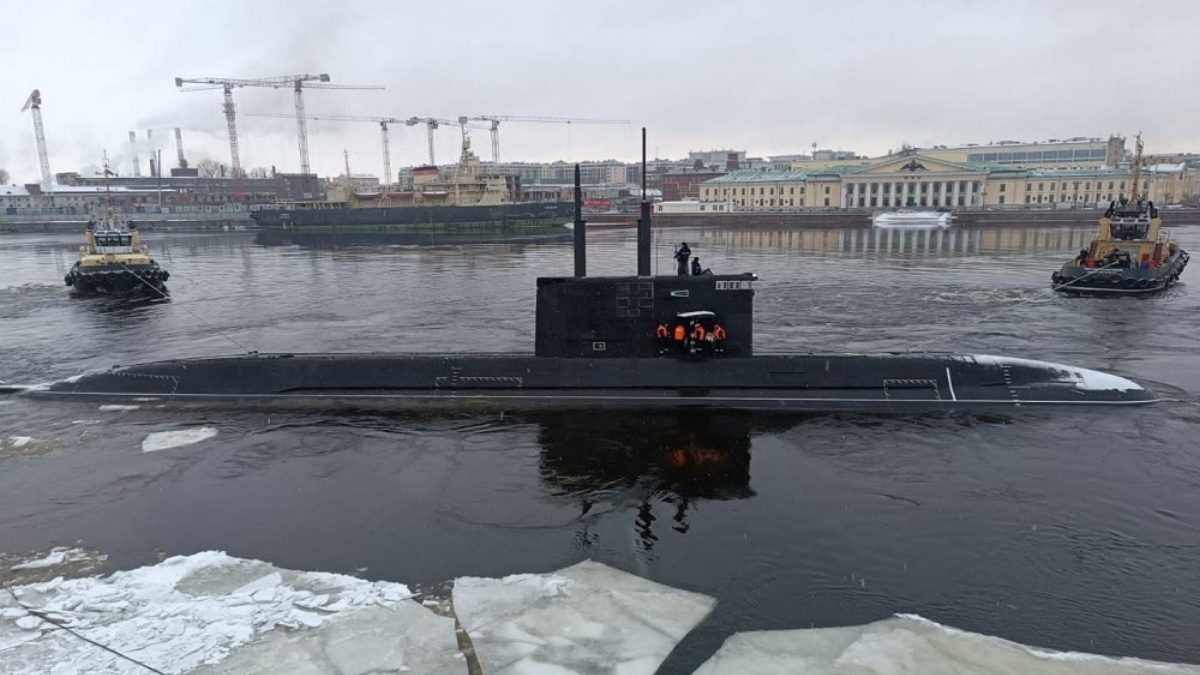
Project 677 Lada class submarine B-587 Velikiye Luki under tug escort on the Neva at St Petersburg in 2024. Maloyaroslavets was laid down at the same yard in August 2026 and has not been photographed. Image: Russian Ministry of Defence via Wikimedia Commons, CC BY 4.0.
Six Hulls in Twenty-Eight Years: Russia Lays Down the Lada Maloyaroslavets
United Shipbuilding Corporation laid the keel of the Project 677 Lada submarine Maloyaroslavets at Admiralty Shipyards in St Petersburg on 27 August 2026. It is the sixth Project 677 hull and the fifth of the serial run. The Rubin design is credited with a crew of 35, six 533 mm torpedo tubes and the Kalibr missile family, and dives to about 300 m. Three boats have entered service since 1997, and two are in service now, the prototype having been reported decommissioned in 2024.
Technical Summary
Admiralty Shipyards in St Petersburg, part of United Shipbuilding Corporation (USC), held a keel-laying ceremony on 27 August 2026 for a Project 677 Lada diesel-electric submarine named Maloyaroslavets. The boat was designed by the Rubin Central Design Bureau for Marine Engineering, which has drawn every hull of the class since the lead ship was laid down in December 1997, and Admiralty Shipyards has built all of them. Nikolay Patrushev, presidential aide and chairman of the Maritime Board, told the ceremony that the naval development strategy Vladimir Putin approved in 2025 runs to 2050 and places modernisation of the submarine force among its first priorities. Andrey Puchkov, the USC general director, spoke of the confidence the Ministry of Defence had placed in the yard and the design bureau. No delivery date was given.
The published parameters are less settled than their repetition suggests. TASS gave a length of 66.8 m, a beam of 7.1 m, a submerged speed of 21 knots, a diving depth of about 300 m, a crew of 35 and an endurance of 45 days at both the December 2025 handover and the August 2026 keel-laying. The same agency, reporting the loss of the prototype in February 2024, gave the length as 68 m and the crew as 37. ISC has found no primary document that reconciles those figures, and treats the 66.8 m and 35-crew set as the current official line rather than as a measured fact. Reference compilations put displacement at roughly 1,765 tonnes surfaced and 2,650 tonnes submerged, against a Project 877 Paltus that TASS says the Lada undercuts on surface displacement by a factor of about 1.3. The class is single hull, which open reference works describe as the first such choice for a Russian attack submarine since the 1940s, and those same works describe a permanent-magnet main propulsion motor. Neither TASS nor USC names the sonar or the combat management system in the material issued with the handover and the keel-laying, and ISC has not traced the type names that circulate in secondary sources to any primary release. Western sources add a third length, 72 m. No primary drawing or specification ISC can reach settles which figure measures what.
Twenty-eight years separate the first Lada keel-laying in December 1997 from this one. Three boats have entered service in that time, and the lead ship was struck from the fleet in February 2024, on the stated grounds that modernising it would cost about as much as building a new one. ISC analysis of United Shipbuilding and TASS programme records
Baseline specification, Project 677 Lada (open sources)
| Designer / builder | Rubin Central Design Bureau for Marine Engineering / Admiralty Shipyards, St Petersburg |
| Type | Diesel-electric attack submarine, single hull |
| Design baseline | Announced as Project 677. The December 2025 serial contract was announced as Project 677M. The relationship between the two is not published |
| Length | 66.8 m (TASS, 2025 and 2026). TASS gave 68 m in February 2024; Western sources give 72 m. Unreconciled |
| Beam | 7.1 m |
| Displacement | About 1,765 t surfaced, 2,650 t submerged (Jane's-derived compilation, and TASS) |
| Speed | 21 knots submerged, 10 knots surfaced |
| Diving depth | About 300 m |
| Crew | 35 (TASS, 2025 and 2026). TASS gave 37 in February 2024 |
| Endurance | 45 days |
| Propulsion | Diesel-electric, single shaft. Open sources describe a permanent-magnet main motor. No air-independent plant is publicly acknowledged on any hull |
| Sensors and combat system | Not named in USC or TASS releases. USC claims low acoustic signature and a sonar advantage over comparable foreign boats, without published measurements |
| Armament | 6 x 533 mm torpedo tubes; Kalibr cruise missile family. The only traceable load figure is 18 weapons, or mines in lieu of torpedoes |
| Export variants | Amur-950, Amur-1650 |
Fifth or Sixth
English-language trade coverage of the ceremony reported an apparent contradiction: a USC statement calling Maloyaroslavets the sixth of the series, while Puchkov called it the fifth. Both figures are correct, and they count different things. Maloyaroslavets is the sixth Project 677 hull ordered from Admiralty Shipyards and the fifth of the serial production run that began with Kronshtadt. The difference between the two numbers is Sankt Peterburg, which is a prototype rather than a series unit. TASS applies the serial convention elsewhere, calling Kronshtadt the first submarine of the series and Velikiye Luki the second. ISC records the convention without reading intent into it: no source states that the class has formally been recounted.
Programme Record
Six hulls have been laid down since December 1997. Three have entered service, one of those has since been reported decommissioned, and three are building. Two Project 677 boats are in service today. The record below is drawn from the TASS programme factbox published with the Velikiye Luki handover and from the August 2026 keel-laying announcement.
| Boat | Yard number | Laid down | Status |
|---|---|---|---|
| Sankt Peterburg (B-585) | 01570 | 26 December 1997 | Reported decommissioned, February 2024 |
| Kronshtadt (B-586) | 01571 | 28 July 2005 | In service, Northern Fleet, 31 January 2024 |
| Velikiye Luki (B-587) | 01572 | 10 November 2006, re-laid 19 March 2015 | In service, Baltic Fleet, 16 December 2025 |
| Vologda | 01573 | 12 June 2022 | Building |
| Yaroslavl | 01574 | 12 June 2022 | Building |
| Maloyaroslavets | Not published | August 2026 | Building |
Analysis of Effects
Open reference works give the armament as six 533 mm torpedo tubes. TASS names the Kalibr cruise missile family as the primary weapon and states that the class can strike at sea and against land targets, and that it can fire a multiple-missile salvo. No Russian release states how many weapons the boat embarks. The only figure ISC could trace to a recognised reference compilation is 18 weapons, with mines carried in lieu of torpedoes. Larger mine counts circulate in secondary sources without a traceable origin, and are not used here. The capability that matters is not the exact number. A boat that can lay a covert minefield in shallow, heavily transited water produces a sea-denial effect out of proportion to a single hull of about 2,650 tonnes, and achieving it requires no shot to be fired at a warship at all. Minelaying appears in both of the Russian mission statements issued with the Velikiye Luki handover, and the second of them adds the landing and recovery of reconnaissance and sabotage groups. The claims made for the class at the ceremony were strong and unquantified. TASS reported that the stealth of these boats is several times that of a third-generation submarine, and that the latest anti-sonar coating cuts the acoustic signature enough for the boat to pass undetected close to hostile sonar. No measurement was published for either statement, and ISC records both as state and manufacturer assertions rather than findings.
Whether this is a boat built to hunt NATO submarines depends on which Russian statement you read. The TASS factbox issued with the Velikiye Luki handover lists the mission set as destroying surface ships and vessels, patrolling, reconnaissance, protecting sea lanes and laying minefields, with no mention of submarines. A second TASS release the same day put enemy submarines first, ahead of surface ships, vessels and coastal installations, and TASS repeated that second formulation word for word on the day of the Maloyaroslavets keel-laying. The anti-submarine claim is the settled Russian description of the class, not a passing phrase. A diesel-electric boat with no air-independent plant has to snort to charge its battery, which is the moment it is most detectable, so covert endurance is counted in days rather than the weeks a nuclear attack submarine enjoys. That is a poor basis for trailing a NATO nuclear boat across the Norwegian Sea. It is a good basis for lying quiet on a battery in the Baltic approaches, where the water is shallow, the acoustic conditions are awkward for the hunter and the traffic comes to you. Velikiye Luki went to the Baltic Fleet and Kronshtadt to the Northern Fleet, which fits that reading of the class.
Personnel and Safety Considerations
For allied planners the handling question follows the magazine, and it has to be asked in the right units. TASS describes an automated control system covering the vessel, its combat and technical systems and its weapons. That is control automation. It is not a statement about physical torpedo movement, stowage or tube reloading, and ISC does not treat a crew of 35 as evidence for a handling arrangement no source describes. On the ordnance itself, the loose formulation to avoid is that a warhead sits at the top of a hazard scale. Hazard divisions 1.1 to 1.6 are categories of response, not a ranking of severity, and they are not properties of a warhead. Under the United Kingdom regime the regulation is DSA 02.OME, and the classification method sits in DSA 03.OME Part 1, Defence Code of Practice 106. That code classifies an explosive article as packaged, in the condition in which it is stowed and transported, and allocates a hazard division by test evidence or by appropriately relevant analogy, a compatibility group, and a United Nations number and proper shipping name drawn from the Dangerous Goods List. None of that follows from calibre, from the words high explosive, or from an assumed propulsion architecture. For a recovered Russian round the code already sets out the route: foreign explosives and munitions are classified by the Defence Ordnance Safety Regulator, which issues the competent authority document, and a separate foreign ordnance exploitation classification covers items held for intelligence rather than for service use. Anyone still working to JSP 482 is working to a withdrawn publication.
Data Gaps
USC has not said which fleet Maloyaroslavets will join, no delivery date has been published, and no yard number for the boat has appeared in any release ISC has been able to check. The December 2025 serial contract was announced as Project 677M while the August 2026 keel-laying was announced as Project 677, and nothing published states how the two baselines relate, so no 677M feature should be attributed to this hull. Length is given as 66.8 m by TASS in 2025 and 2026, as 68 m by the same agency in February 2024 and as 72 m in several Western reference works, and the crew is given by TASS as both 35 and 37. The claim that this is the first Russian single-hull attack submarine since the 1940s rests on secondary reference works and ISC has not verified it against primary material. Neither USC nor TASS names the sonar or the combat management system, and the claimed sonar advantage over comparable foreign boats is published without any supporting measurement. No Russian release gives the weapon load. Air-independent propulsion is the largest gap. The head of Admiralty Shipyards was reported in December 2019 as saying there were no plans to fit one, though ISC has not reached that Russian-language report and cannot confirm whether the statement covered the whole class or only the boats then in build; development of an electrochemical generator was contracted in 2019, completion targets differ between secondary accounts, and no fitted unit has been announced. Net explosive quantity, explosive fill, hazard division and compatibility group data for the class's ordnance are not in open sources, and ISC has not estimated them.
Key Questions
What is the Maloyaroslavets submarine?
Maloyaroslavets is a Project 677 Lada diesel-electric attack submarine, laid down for the Russian Navy at Admiralty Shipyards in St Petersburg on 27 August 2026. It is the sixth Project 677 hull ordered from the yard and the fifth of the serial run. It was designed by the Rubin Central Design Bureau for Marine Engineering, which has drawn every hull since 1997.
How many crew does a Lada-class submarine have?
Thirty-five, in the figures TASS published in 2025 and 2026; the same agency gave 37 in February 2024. USC describes an automated control system covering the vessel, its combat and technical systems and its weapons. No release describes automated torpedo handling or reloading, so the small crew should not be read as evidence of it.
Does the Lada class have air-independent propulsion?
No air-independent plant is publicly acknowledged on any Project 677 hull. The head of Admiralty Shipyards was reported in December 2019 as saying there were no plans to fit one. Development of an electrochemical generator was contracted in 2019, but no fitted unit has been announced, and nothing in the August 2026 material says whether the boats now building will receive one.
References
Source-evaluated per NATO source-evaluation doctrine, STANAG 2022 lineage (source reliability A–F / information credibility 1–6). Tier 1 = government primary source; Tier 2 = quality news / specialist defence media; Tier 3 = authoritative aggregator / encyclopaedia.
- T1TASS – Keel-laying ceremony for Maloyaroslavets submarine held at Admiralty Shipyard, 27 August 2026. (Reliability C / Credibility 2 (Russian state agency, on-the-record account of the ceremony))
- T1TASS – Lada submarines fulfill objectives of Russia's national maritime policy, USC, 27 August 2026. (Reliability C / Credibility 2 (Russian state agency, quoting the USC general director))
- T1TASS – Two Project 677 Lada submarines to be laid down in 2026, Navy chief, 16 December 2025. (Reliability C / Credibility 2 (Russian state agency, direct quotation of the Navy commander in chief))
- T1TASS – FACTBOX: Project 677 Lada-class submarines, 16 December 2025. (Reliability C / Credibility 2 (Russian state agency, official programme record))
- T2The Defence Blog – Russia begins construction on new Lada-class submarine, 28 August 2026. (Reliability B / Credibility 2)
- T1TASS – USC signs contract with Defense Ministry on building Lada submarines, Puchkov, 16 December 2025. (Reliability C / Credibility 2 (names the serial contract as Project 677M))
- T1TASS – Navy decommissions St. Petersburg submarine for utilization, 5 February 2024. (Reliability C / Credibility 3 (two unnamed defence-industry sources, explicitly no official confirmation))
- T1UK Ministry of Defence, Defence Safety Authority – DSA 02.OME: Defence Ordnance, Munitions and Explosives (OME) regulations, last updated 16 September 2024. (Reliability A / Credibility 1)
- T1UK Ministry of Defence, Defence Safety Authority – DSA 03.OME Part 1, Defence Code of Practice 106, Hazard Classification for Transport and Storage, v2.0, February 2026. (Reliability A / Credibility 1)
- T2Naval News – Russia Commissions First Serial Lada-class Submarine, February 2024. (Reliability B / Credibility 2)
- T3Nuclear Threat Initiative – Project 677 Lada and Amur class data sheet, Jane's-derived, accessed 29 August 2026. (Reliability B / Credibility 3 (the only traceable weapon-load figure located))
- T2Baird Maritime – Russian Navy's third Lada-class submarine commissioned into service, 18 December 2025. (Reliability B / Credibility 2)
- T3Wikipedia – Lada-class submarine, accessed 29 August 2026. (Reliability C / Credibility 3)
Editorial responsibility. This analysis is researched, written and published under the editorial responsibility of Steve Sawyers, MIExpE VR. Every technical claim is sourced to named open-source material and rated for reliability and accuracy under NATO STANAG 2022. ISC uses its own domain-trained research and drafting system under human direction; the analysis, the judgements and the accountability for them are ours. Corrections and updates welcome: if you hold open-source data that refines or corrects any parameter here, write to [email protected] citing the specific claim and your source. Verified corrections are incorporated and credited in the revision history. Full editorial and AI policy.