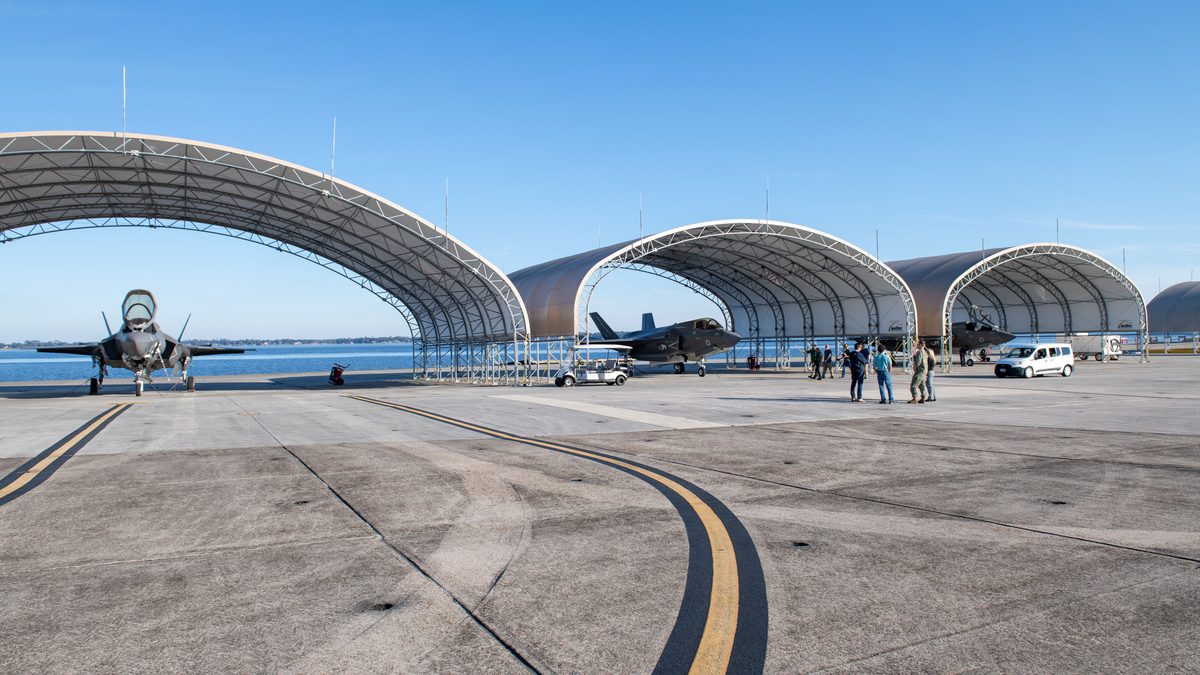
Three Royal Navy F-35 Lightning II aircraft arrive at Fleet Readiness Center Southeast, Jacksonville, Florida, on 3 December 2025 for a Production Asset Inspection Requirement Tier II corrosion-mitigation induction. US Navy photo by Toiete Jackson, Fleet Readiness Center Southeast, via the Defense Visual Information Distribution Service (DVIDS). Public domain.
Salt in the Weapons Bay: F-35B Maritime Corrosion Is Now a Magazine-Depth Problem
United States operational test staff recorded in July 2015 that F-35B vertical-landing downwash drives sea spray into the open weapons bay, lift fan and swivel-nozzle compartments, and that no scheduled inspection of those compartments then existed. On 30 April 2026 the Ministry of Defence told Parliament that prolonged maritime deployment on Operation HIGHMAST worsened corrosion and reduced aircraft availability.
Technical Summary
The Office of the Secretary of Defense, Director Operational Test and Evaluation (DOT&E), reported on the May 2015 Marine Corps F-35B shipboard demonstration aboard USS Wasp (LHD 1), an amphibious assault ship of the landing helicopter dock (LHD) type, and recorded a specific, compartment-level exposure. During a short take-off and vertical landing (STOVL) recovery, known in service as a VL, the aircraft is held on engine and lift-fan thrust directly above the deck, and the resulting downwash lifts a dense sea-spray plume around the airframe. At that moment the weapons bay, lift fan and Three-Bearing Swivel Nozzle (3BSN) doors are open. DOT&E recorded that no scheduled maintenance then existed after an at-sea vertical landing to inspect and clean those compartments, and named what sits inside them: some avionics and weapons stations that, in its words, could be damaged by repeated sea spray or salt fog exposure. That is not a coating observation. It is a finding about the compartment in which the ordnance is carried.
A decade later the bill is visible in United Kingdom readiness reporting. In a letter to the Chair of the Public Accounts Committee dated 30 April 2026, the Ministry of Defence (MOD) Permanent Secretary, Jeremy Pocklington, stated that “prolonged maritime deployment exacerbated corrosion issues and increased post-deployment recovery time, further reducing availability”, and that mission-capable rates since Operation HIGHMAST, the Carrier Strike Group deployment whose lessons the letter reports, had been reduced by a combination of operational recovery and corrosion remediation activity. Three Royal Navy F-35 aircraft were inducted at Fleet Readiness Center Southeast (FRCSE) in Jacksonville, Florida on 3 December 2025 for Production Asset Inspection Requirement Tier II (PAIR II) corrosion mitigation, the first British jets to enter that process. FRCSE, a Naval Air Systems Command (NAVAIR) depot, states that PAIR II involves detailed corrosion mapping, structural assessment and component repair or replacement, that its artisans inspect the aircraft’s underlying structure and repair any corrosion found, and that an optimised speed line has cut the standard turnaround from 180 days to approximately 60 days.
“During a VL, the aircraft downwash produces a large amount of sea spray. The weapons bay, lift fan, and Three-Bearing Swivel Nozzle (3BSN) doors are open, and this spray causes salt water ingestion into these compartments. There is currently no scheduled maintenance after an at-sea VL to inspect and clean these compartments, which contain some avionics and weapons stations that could be damaged by repeated sea spray or salt fog exposure.” OSD Director Operational Test and Evaluation, memorandum on the Marine Corps F-35B demonstration aboard USS Wasp, 22 July 2015
A further item is frequently folded into the same discussion and should not be. On 27 August 2026 the United States Department of War announced modification P00013 to contract N0001924C0042, a not-to-exceed $240,754,035 award to Pratt and Whitney to mature the F135 engine, address operational issues, improve readiness and move the Engine Core Upgrade from risk-reduction design review into engineering and manufacturing development. Of that ceiling, $214,157,355 was obligated at award, including $39,008,976 from F-35 cooperative programme partners. The Engine Core Upgrade is a thrust, cooling and durability programme sized for the Block 4 upgrade and later growth. No public source presents it as a corrosion remedy, and treating engine hot-section durability and marine chloride attack as one problem would be an error. It appears here only so that it can be set apart, because the engine programme and the corrosion account are routinely reported as one story and they are not.
Reported Figures
| Indicator | Figure | Source |
|---|---|---|
| F-35 fleet mission-capable rate, fiscal year 2021 to 2025 | 67 percent falling to 44 percent | GAO-26-108113, 11 Jun 2026 |
| F-35 fleet full mission-capable rate, fiscal year 2021 to 2025 | 38 percent falling to 25 percent | GAO-26-108113, 11 Jun 2026 |
| Afloat Spares Pack capacity against the HIGHMAST embarked force | Sized for 12 aircraft, 24 embarked | MOD to Public Accounts Committee, 30 Apr 2026 |
| Royal Navy F-35 aircraft inducted for PAIR II at FRCSE | 3 aircraft, arrived 3 Dec 2025 | FRCSE via DVIDS, 3 Dec 2025 |
| PAIR II turnaround, standard against optimised speed line | 180 days reduced to about 60 days | Naval Aviation News, 9 Apr 2026 |
| Lightning Force engineering posts, established against filled | 168 posts, about 75 percent filled | MOD to Public Accounts Committee, 30 Apr 2026 |
| F135 Engine Core Upgrade modification P00013 | $240,754,035 not-to-exceed, $214,157,355 obligated at award | US Department of War, 27 Aug 2026 |
Analysis of Effects
For a weapons and ordnance audience the readiness figures are the story, because mission-capable rate is the mechanism by which a stockpile becomes delivered effect. The United States Government Accountability Office reported on 11 June 2026 that across the F-35 fleet, from fiscal year (FY) 2021 to FY2025, the mission-capable rate fell from 67 percent to 44 percent and the full mission-capable rate fell from 38 percent to 25 percent. Service officials attributed the FY2025 decline to three causes: acceptance of new aircraft that were not mission capable because of software delays, scarce parts, and corrosion inspections and remediation. Corrosion is one contributor among several here, not the whole account. The same report records that the F-35 Joint Program Office found the programme had failed to properly mitigate corrosion, including providing the parts, equipment, data and staffing needed to conduct corrosion inspections and corrective work. Magazine depth held ashore does not survive that arithmetic. On the United Kingdom side, the MOD letter records that the surge to 24 F-35B aircraft during Operation HIGHMAST exceeded an Afloat Spares Pack sized for 12. That shortfall was mitigated by drawing on the Deployable Spares Pack and by taking additional spares from the RAF Marham base pack, and doubling the afloat pack remains subject to the Defence Investment Plan. The same letter confirms an interim Foreign Military Sales purchase of Small Diameter Bomb II to give the aircraft a stand-off weapon before SPEAR 3, the MBDA precision-strike missile, enters service. The letter is equally direct about the constraint behind the numbers: Lightning Force engineering is established at 168 posts and filled to roughly 75 percent, the Royal Air Force plans to close that gap by 2032, and the Permanent Secretary records that sustained achievement of availability aspirations is unlikely under the current global sustainment model. Buying the round is the easier half.
Three degradation mechanisms are routinely conflated in public discussion and should be kept apart, because they have different inspection signatures and different controls. The first is aqueous chloride attack on the airframe, including crevice corrosion in joints, seams and fastener holes. The second is galvanic attack at dissimilar-material interfaces: the F-35 Joint Program Office states plainly that the airframe blend of aluminium, titanium and carbon composite introduces galvanic corrosion risk in humid, salty environments, and that corrosion works concealed beneath coatings and inside seams, joints and fasteners. The third is surface discoloration of the outer coating, which the Joint Program Office states does not indicate loss of coating integrity, stealth performance or structural integrity, and against which a more durable coating is being introduced through routine maintenance. The practical consequence is that a photograph of a streaked jet is evidence of neither damage nor health. PAIR II is defined around the substructure rather than the surface: FRCSE describes its artisans inspecting the aircraft’s underlying structure and repairing the corrosion found there.
Personnel and Safety Considerations
Two handling consequences follow for armament personnel. First, internal carriage places ordnance, launchers and weapons-station electrical interfaces inside the compartment DOT&E identified as a salt-water ingestion path, so surface-salt and continuity checks belong in the load and download sequence at sea rather than only in the post-deployment depot induction. Second, bonding and electrostatic discharge control degrade in the same environment: DOT&E found that F-35B grounding cables attached to deck pad-eyes registered very high resistance, likely because those pad-eyes had been painted over repeatedly to protect against marine salt fog and corrosion, and noted that the F-35 is more susceptible to electrostatic discharge than legacy aircraft because of its structural configuration. That combination, an uncertain earth and a stealth airframe, is a live consideration during ordnance handling on a wet flight deck. Frequency of freshwater rinsing is the recognised mitigation: DOT&E recorded that aircraft at sea are washed twice as frequently as ashore and that ships steer towards rain showers for a free freshwater rinse. Rinsing is a coverage operation, and it does not reach a compartment nobody is scheduled to open.
Data Gaps
Five gaps constrain this assessment. There is no public confirmation that the F135 Engine Core Upgrade critical design review, scheduled for August 2026, has taken place; the most recent public position, reported on 28 July 2026, was that it was due during the month. No official return-to-service report or aircraft-specific corrosion finding has been published for the three Royal Navy aircraft inducted at FRCSE in December 2025. No post-vertical-landing inspection or cleaning task for the weapons bay, lift fan and 3BSN compartments has been published, and no source states that the position DOT&E recorded in 2015 has since changed. The $39,008,976 of F-35 cooperative programme partner funding obligated against modification P00013 is not broken down by nation in the contract announcement, so no United Kingdom share can be asserted. Finally, no public configuration baseline connects the Engine Core Upgrade to corrosion resistance of any kind, so the two should not be reported together as a single fix.
Key Questions
Does discoloration on an F-35 returning from deployment mean the aircraft is damaged?
No. The F-35 Joint Program Office states that shipboard discoloration is limited to the coating, does not indicate loss of coating integrity or stealth performance, and does not affect the structure. A more durable coating is being applied to fielded aircraft during routine maintenance. Structural condition is assessed separately, through the depot corrosion process.
Why did UK F-35B availability fall after Operation HIGHMAST?
The Ministry of Defence told the Public Accounts Committee on 30 April 2026 that mission-capable rates during HIGHMAST were broadly comparable to the global F-35B average, but fell afterwards through a combination of operational recovery and corrosion remediation. Prolonged maritime deployment worsened corrosion and lengthened post-deployment recovery time.
What is PAIR II and why were Royal Navy F-35s flown to Florida for it?
Production Asset Inspection Requirement Tier II is a depot corrosion process using detailed corrosion mapping, structural assessment and component repair or replacement. Fleet Readiness Center Southeast in Jacksonville, Florida runs an F-35 corrosion speed line that has cut turnaround from 180 days to about 60. Three Royal Navy aircraft were inducted there on 3 December 2025.
References
Source-evaluated per NATO source-evaluation doctrine, STANAG 2022 lineage (source reliability A–F / information credibility 1–6). Tier 1 = government primary source; Tier 2 = quality news / specialist defence media; Tier 3 = authoritative aggregator / encyclopaedia.
- T1Ministry of Defence – Letter from the Permanent Secretary to the Chair of the Public Accounts Committee on F-35 availability, 30 April 2026. (Reliability A / Credibility 1)
- T1US Government Accountability Office – GAO-26-108113, F-35 Sustainment: Actions Needed to Ensure Updated Strategy Improves Persistent Readiness Challenges, 11 June 2026. (Reliability A / Credibility 1)
- T1OSD Director Operational Test and Evaluation – Observations on the Marine Corps F-35B Demonstration on USS Wasp, 22 July 2015. (Reliability A / Credibility 1)
- T1Naval Aviation News, NAVAIR – FRCSE Begins Corrosion-Mitigation Work on Royal Navy F-35, 9 April 2026. (Reliability A / Credibility 1)
- T1US Department of War – Contracts for Aug. 27, 2026, modification P00013 to contract N0001924C0042, 27 August 2026. (Reliability A / Credibility 1)
- T1F-35 Joint Program Office, via DVIDS – The F-35 and the Fight Against Corrosion, 7 May 2025. (Reliability A / Credibility 2)
- T1Fleet Readiness Center Southeast, via DVIDS – First Royal Navy F-35 Aircraft Arrive at Fleet Readiness Center Southeast for Corrosion Mitigation, 3 December 2025. (Reliability A / Credibility 1)
- T2Air & Space Forces Magazine – F-35 Engine Core Upgrade to Face Critical Review in August, Flight Testing in 2030, 28 July 2026. (Reliability B / Credibility 2)
Editorial responsibility. This analysis is researched, written and published under the editorial responsibility of Steve Sawyers, MIExpE VR. Every technical claim is sourced to named open-source material and rated for reliability and accuracy under NATO STANAG 2022. ISC uses its own domain-trained research and drafting system under human direction; the analysis, the judgements and the accountability for them are ours. Corrections and updates welcome: if you hold open-source data that refines or corrects any parameter here, write to [email protected] citing the specific claim and your source. Verified corrections are incorporated and credited in the revision history. Full editorial and AI policy.