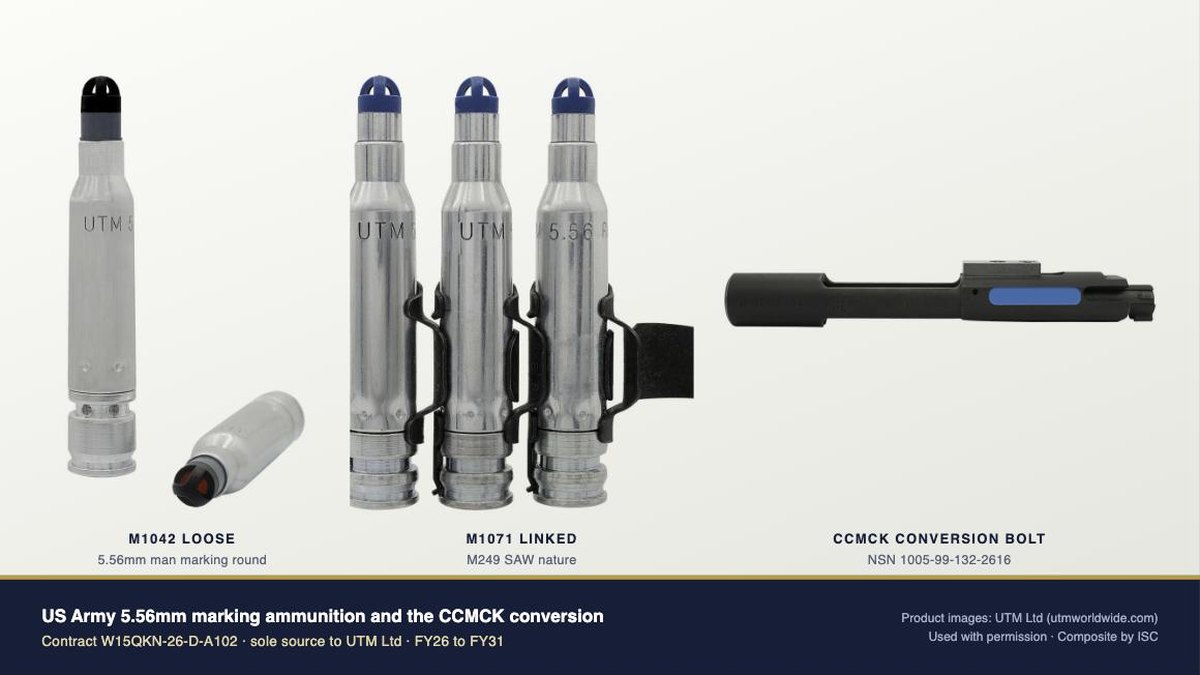
Left to right: the 5.56mm M1042 loose man marking round, the M1071 linked nature for the M249 Squad Automatic Weapon, and the CCMCK conversion bolt for the M4 and M16. Image credit: UTM Ltd (utmworldwide.com). Copyright remains with UTM Ltd.
US Army Renews Sole-Source 5.56mm Marking Ammunition Line in $257M Five-Year Award to UTM
UTM Ltd of Bury St Edmunds won a $257,402,691 firm-fixed-price order on 25 August 2026 for 5.56mm M1042 loose and M1071 linked marking cartridges used in the US Army Close Combat Mission Capability Kit, under contract W15QKN-26-D-A102. Army Contracting Command solicited the requirement as a sole source to UTM under FAR 6.302-1, against a ceiling of 255 million cartridges, with the ordering period running to 24 August 2031.
Technical Summary
The natures ordered are non-lethal small-calibre training cartridges, not ball ammunition. The M1042 is the loose 5.56mm man marking round for converted M4 and M16 rifles; the M1071 is the linked nature for the M249 Squad Automatic Weapon. Each is codified in three marking colours, and the Department of Defense identification codes do not run in the same colour order across the two natures, which is a live stores-accounting trap. The loose family runs AB09 blue, AB10 red, AB11 yellow. The linked family runs AB15 yellow, AB16 blue, AB17 red. The manufacturer publishes both sequences alongside their NATO stock numbers.
| Nature | Marking colour | DODIC | NATO stock number |
|---|---|---|---|
| M1042 loose | Blue | AB09 | 1305-01-536-5822 |
| M1042 loose | Red | AB10 | 1305-01-536-5827 |
| M1042 loose | Yellow | AB11 | 1305-01-536-5829 |
| M1071 linked | Yellow | AB15 | 1305-01-536-9289 |
| M1071 linked | Blue | AB16 | 1305-01-537-1521 |
| M1071 linked | Red | AB17 | 1305-01-537-1522 |
A parallel lead-free family exists under separate identification codes and separate stock numbers, running AC39 to AC41 for the loose nature and AC42 to AC44 for the linked. Those are distinct line items and are not interchangeable in accounting with the AB series above. The award notice names only the M1042 and M1071 designations, so which families and which colour mix the delivery orders actually call off is not established.
The projectile is not a wax slug. UTM describes an injection-moulded plastic cruciform dome seated on an aluminium case, carrying a non-toxic inert marking compound and an inertia applicator ball that expels the compound even on a glancing strike, with a driving band that engages the rifling for accuracy. The Army solicitation describes the payload as a bright, water-soluble colour marking compound that marks the Operational Camouflage Pattern of the Army Combat Uniform and personal protective equipment without penetrating either. The published figures are modest by design.
5.56mm man marking round, manufacturer-published performance
| Average muzzle velocity | 375 ft/s (114 m/s) |
| Average muzzle energy | 2.2 ft lb (2.9 J) |
| Projectile mass | 6.9 gr (0.45 g) |
| Accuracy | 1.97 in at 27 yd (50 mm at 25 m) |
| Standoff distance | 30 in (0.75 m) |
| Peak noise level | 123 dB |
| Shelf life | 6 years |
Source: UTM Product Catalog v23.5. Commercial figures. The acceptance criteria that govern the contracted natures sit in MIL-PRF-32313 and MIL-PRF-32315, which are not public.
The cartridge is half the system. It is fired through the Close Combat Mission Capability Kit conversion, in which the service bolt carrier is replaced by a training bolt whose firing pin is offset 3 millimetres from the axis of a centre-fire primer. UTM describes the result as a conversion that discharges only a rim-fire strike, so a centre-fire round, service or blank, will not initiate in a converted weapon. The manufacturer describes the change as taking seconds and requiring no gunsmithing; the Army solicitation calls it a user-installed temporary weapon conversion system. The kit received full materiel release in July 2009 and sits on unit Standards in Training Commission accounts, so this award is resupply of an established consumable rather than the introduction of a capability.
CCMCK conversion and protective equipment, NATO stock numbers
| M4 and M16 conversion bolt | 1005-99-132-2616 |
| M249 SAW conversion bolt | 1005-99-848-0609 |
| M9 Beretta 92FS conversion | 1005-99-907-6475 |
| M11 SIG P229 conversion | 1005-99-477-1641 |
| CCMCK combo kit, M4 with facemask | 6920-01-564-9657 |
| CCMCK combo kit, M249 with facemask | 6920-01-564-9655 |
| Facemask without goggles | 8415-99-359-9160 |
| Facemask with integrated goggles | 8415-01-632-4474 |
Source: UTM CCMCK stock number listing, accessed 28 August 2026. The M4 and M249 conversion bolt numbers are corroborated by the Army solicitation, which cites both.
A UTM 5.56mm marking round leaves the muzzle carrying about 2.9 joules. A service 5.56x45mm ball nature leaves it carrying roughly three orders of magnitude more. That gap is the whole product, because it is what buys the Army its training estate back. ISC Defence Intelligence technical assessment
Analysis of Effects
The award notice reads as though a market was tested. It was not. Army Contracting Command issued the presolicitation for W15QKN-26-R-A010 on 18 February 2026 and updated it on 8 April, and the notice states the position without ambiguity: the award would be made under other than full and open competition, in accordance with Federal Acquisition Regulation 6.302-1(a)(2)(iii)(B), only one responsible source and no other supplies or services will satisfy agency requirements. It names Ultimate Training Munitions, United Kingdom, as that source, and describes a sole-source, full-scale production contract against a maximum contractor obligation of 255 million cartridges across five one-year ordering periods from FY26 to FY31. The line in the 25 August announcement, bids solicited via the internet with one received, is Army boilerplate for a posted solicitation. It is not the record of a contest.
That reading is testable against the same day’s announcements. Two Air Force entries carry the explicit sentence “this contract was a sole-source acquisition”, and the Navy entry for Castelion carries “this contract action was not competed”. No Army entry on the page carries either phrase. The Army entries record bid counts instead: Griffon Aerospace, one bid solicited with one received; AEVEX Aerospace, three received; BWAY Corp, four received against a $31,710,221 award for PA154, PA157 and PA191 mortar ammunition metal containers. The absence of a sole-source label on the UTM line is therefore a house-style artefact of the Army section, not a competition claim, and reading it as one produces exactly the wrong conclusion.
Two features of the vehicle should be recorded separately, because the documents disagree. The solicitation describes a firm-fixed-price requirements contract with five one-year ordering periods. The award notice describes a firm-fixed-price, indefinite-delivery, indefinite-quantity contract. Those carry different obligations on both parties, and open sources do not resolve which form was executed. What both agree on is that $257,402,691 is a ceiling and not a commitment: no funds were obligated at award, and work locations and funding are set with each order.
The dependency is real, and the stock numbers show its shape. The cartridges are codified in the United States, with every M1042 and M1071 line item carrying a NATO stock number beginning 1305-01, where 01 is the NATO codification bureau code for the United States. The hardware they are fired through is codified in the United Kingdom. The M4 and M16 conversion bolt is 1005-99-132-2616 and the M249 bolt is 1005-99-848-0609, where 99 is the United Kingdom code, and the facemask without goggles is likewise UK-codified at 8415-99-359-9160. Cartridge and conversion are a matched pair by design, since the offset firing pin only works against a primer sited to receive it, and the pairing has a British-codified item at the weapon end of it.
What the Army is buying with this vehicle is training estate rather than lethality. The solicitation states the requirement plainly: a reduced-energy, non-lethal cartridge that marks the uniform and protective equipment without penetrating either, employed at a minimum engagement distance of five feet. A service ball nature needs a gazetted range with a surveyed surface danger area measured in kilometres. Removing that constraint moves opposed training into buildings, unimproved sites and deployed locations, and makes repetitions rather than rounds delivered the unit of value. Where repetitions are the measure, consumable supply is the binding constraint, which is precisely why a five-year single-source vehicle for the consumable is worth recording even at a modest ceiling.
Where the rounds are made is a separate question and is not on the public record. UTM operates from Suffolk in the United Kingdom and from North Branch, New Jersey. A Brownsville, Texas presence is a manufacturer claim rather than a confirmed production site, and should be treated as such until a delivery order names it. The award notice defers work location to each order, so the answer is settled order by order.
Personnel and Safety Considerations
The controlling hazard in force-on-force training is not the marking cartridge. It is the live round that enters the training area. The 3 millimetre firing-pin offset is an engineering interlock rather than a procedural measure, and it is supported by positive visual indication: a blue panel on the conversion, a blue magazine, and an ejection-port cover that will not close once the training bolt is fitted. The limit of that interlock needs stating clearly, because it is routinely overstated. It protects the converted weapon and nothing else. A live nature carried into the serial in an unconverted weapon is unaffected by any of it. Searching personnel, magazines and pouches at the entry point therefore remains the primary control, and the conversion is a verification aid rather than a substitute for segregation.
Reconversion is the other controlled step. UTM claims minimal fouling and no bore build-up from the projectile, and the same catalogue carries an unambiguous instruction alongside that claim: on converting back to live fire, the chamber and bore must be cleaned, cleared of all debris, objects and projectiles, and inspected before a live round is fired. Ammunition technicians should treat the inspection as the control and not the low-fouling claim, and should reinstate the service bolt carrier as a separate, documented action rather than a step folded into range clearance.
Open sources do not publish the hazard classification assigned to the packaged M1042 and M1071 configurations. Secondary compilations circulating a hazard division and a net explosive quantity for these identification codes could not be traced to an authoritative source and are not reproduced here. Small-arms cartridges with inert projectiles are conventionally consigned under UN 0012 at Hazard Division 1.4, Compatibility Group S. That is the convention rather than a finding for these natures. The assigned classification should be read from the packaging, the safety data sheet and the ammunition data card, and never inferred from the family.
Data Gaps
The following are not established in open sources and are recorded as gaps rather than estimated: the hazard classification, UN serial number and net explosive quantity for the packaged M1042 and M1071 configurations, per cartridge and per outer packaging; the primer and propelling charge composition, including whether propulsion is primer-only; the acceptance criteria in MIL-PRF-32313 and MIL-PRF-32315, which govern group size, velocity spread, function and environmental performance for the contracted natures but are not public; the first delivery order value, the colour and family mix, and the annual quantity called off against the 255 million cartridge maximum; whether individual orders place manufacture in the United Kingdom or in New Jersey; whether the executed vehicle is the requirements contract described in the solicitation or the indefinite-delivery, indefinite-quantity contract described in the award notice; and the authoritative surface danger zone and minimum engagement distance, where the solicitation states five feet while a five metre engagement distance and a 75 metre surface danger zone circulate in secondary accounts of the operator’s manual without a traceable primary citation.
Key Questions
Who won the US Army 5.56mm marking ammunition contract in August 2026?
UTM Ltd of Bury St Edmunds, United Kingdom, was awarded a $257,402,691 firm-fixed-price contract on 25 August 2026 by Army Contracting Command, Newark, New Jersey, under contract number W15QKN-26-D-A102. The Army solicited the requirement as a sole source to UTM under FAR 6.302-1. The ordering period runs to 24 August 2031.
What are the M1042 and M1071 marking cartridges?
They are 5.56mm non-lethal training natures. The M1042 is the loose cartridge fired from converted M4 and M16 rifles; the M1071 is the linked variant for the M249 Squad Automatic Weapon. Both use an aluminium case and an injection-moulded plastic projectile carrying a non-toxic marking compound, at an average muzzle velocity of 375 feet per second.
Was the US Army 5.56mm marking ammunition contract competed?
No. Army Contracting Command posted solicitation W15QKN-26-R-A010 as a sole source to Ultimate Training Munitions under FAR 6.302-1(a)(2)(iii)(B), only one responsible source. The award notice phrase, bids solicited via the internet with one received, is Army boilerplate for a posted solicitation and is not a record of competition.
UTM publishes scenario footage of the system in use. The episode below, filmed for the Surviving Mann: All Stars series, runs opposed serials with the marking cartridge and the weapon conversions described above, and it is the clearest open illustration of what a 2.9 joule muzzle energy actually buys: shooters in contact at conversational distance, inside structures, wearing the facemask that carries its own NATO stock number. It is supplier material rather than an independent evaluation, and it shows the commercial product line rather than the M1042 and M1071 natures under this contract.

References
Source-evaluated per NATO source-evaluation doctrine, STANAG 2022 lineage (source reliability A–F / information credibility 1–6). Tier 1 = government primary source; Tier 2 = quality news / specialist defence media; Tier 3 = authoritative aggregator / encyclopaedia.
- T1US Department of War – Contracts for Aug. 25, 2026, 25 August 2026. (Reliability A / Credibility 1)
- T1US Army Contracting Command, New Jersey – Presolicitation W15QKN-26-R-A010, 5.56mm M1042 Loose and M1071 Linked Marking Ammunition for Use in Close Combat Mission Capability Kit, posted 18 February 2026, updated 8 April 2026. (Reliability A / Credibility 1, states the sole-source basis, the FAR authority, the 255 million cartridge maximum and both conversion bolt stock numbers)
- T2Joint Forces News – UTM Ltd Awarded $257 Million Marking Ammunition Contract, 26 August 2026. (Reliability B / Credibility 1)
- T2Ultimate Training Munitions – CCMCK, Close Combat Mission Capability Kit, accessed 28 August 2026. (Reliability B / Credibility 2, manufacturer primary source)
- T2HigherGov – Solicitation record W15QKN-26-R-A010, accessed 28 August 2026. (Reliability B / Credibility 1, verbatim mirror of the presolicitation text)
- T2Ultimate Training Munitions – UTM Product Catalog v23.5, catalogue code UTM-2401-US, accessed 28 August 2026. (Reliability B / Credibility 2, manufacturer primary source for the DODIC and stock number tables, ballistic figures and conversion safety instructions)
- T3GlobeNewswire – UTM Force-On-Force Training Products Now Available to U.S. Army, 4 May 2010. (Reliability C / Credibility 3, historical context only)
Editorial responsibility. This analysis is researched, written and published under the editorial responsibility of Steve Sawyers, MIExpE VR. Every technical claim is sourced to named open-source material and rated for reliability and accuracy under NATO STANAG 2022. ISC uses its own domain-trained research and drafting system under human direction; the analysis, the judgements and the accountability for them are ours. Corrections and updates welcome: if you hold open-source data that refines or corrects any parameter here, write to [email protected] citing the specific claim and your source. Verified corrections are incorporated and credited in the revision history. Full editorial and AI policy.