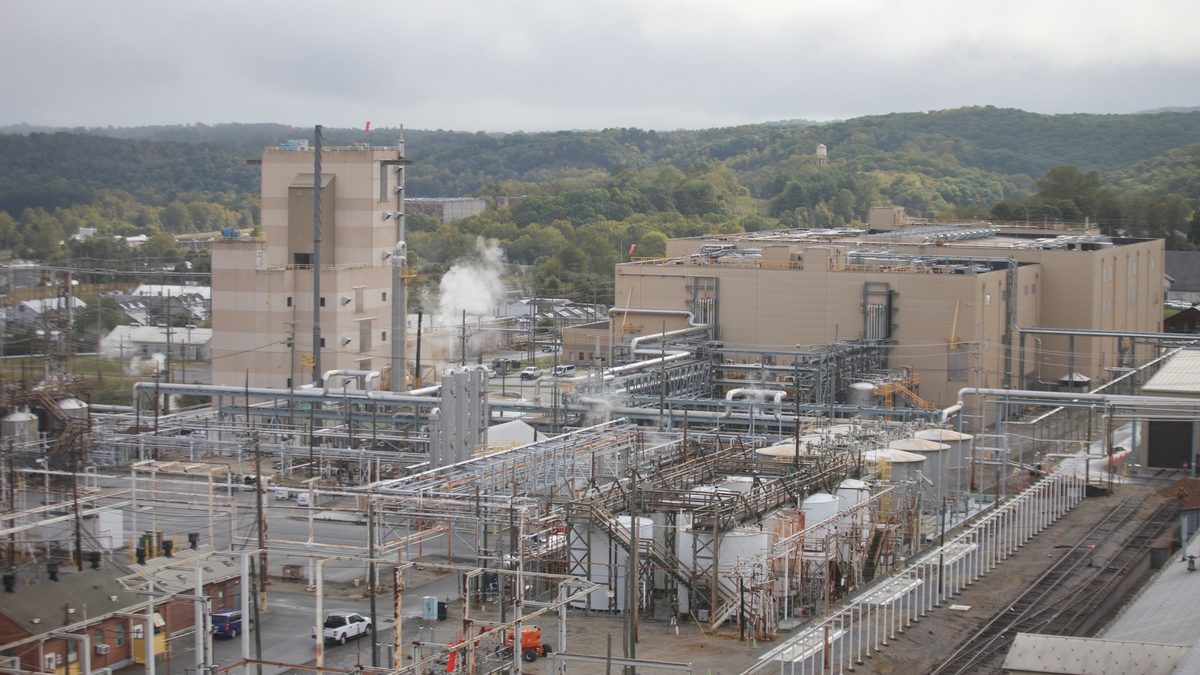
The Nitric Acid Concentrator and Sulfuric Acid Concentrator at Radford Army Ammunition Plant, 18 September 2024. Photo by Dori Whipple, Radford Army Ammunition Plant, via DVIDS. US Government work, public domain. Use does not imply endorsement.
A $16M Design Award at Radford Targets the Acid Plant That Gates US Nitrocellulose and Gun Propellant
APEX Engineering PLLC was awarded a $16,220,928 firm-fixed-price contract on 26 August 2026 for architect and engineering services to modernise the acid area tank farm at Radford Army Ammunition Plant, Virginia. Radford is the only producer of military-grade nitrocellulose in North America, and mixed acid is the feedstock for nitration. Design work completes by 28 February 2028 under contract W911S2-26-C-A004.
Technical Summary
The award is design only. APEX Engineering PLLC of Calvert City, Kentucky, a small business, received $16,220,928 firm-fixed-price for architect and engineering services to modernise the acid area tank farm at Radford Army Ammunition Plant. Three bids were solicited and three received. Work is performed at Radford, Virginia, with an estimated completion date of 28 February 2028. Fiscal 2026 ammunition procurement, Army funds of $16,220,928 were obligated in full at award, making this a fully funded design rather than an incrementally funded one. The contracting activity is the Army 419th Contracting Support Brigade at Fort Drum, New York.
An acid tank farm is bulk storage and distribution, and at Radford it is the utility the site's energetics production hangs from. Nitrocellulose is made by nitrating cellulose in mixed nitric and sulphuric acid; nitroglycerin by nitrating glycerol in the same acid system. The tank farm holds the acid, feeds the nitrators and receives spent acid for reconcentration. The preceding solicitation, W911S2-26-R-A004, required the design to support three facilities at once: the Nitric Acid Concentrator and Sulphuric Acid Concentrator, the Modernized Nitrocellulose production facility, and the legacy nitroglycerin facility designated NG-2. NG-2 should not be confused with NG-3, which is the subject of a separate design action, W911S2-26-R-A005, covering modernised pre-mix and nitrocellulose dehydration facilities. This is not a standalone tank replacement but the shared service the modernised plant depends on.
Radford is the only manufacturer of military-grade nitrocellulose in North America. Mixed acid is the feedstock for nitration. If the acid plant stops, nitrocellulose stops, and European capacity is a comparator rather than a substitute for US lot-qualified propellant. ISC Defence Intelligence technical assessment
Analysis of Effects
The sequencing is what makes this award readable. The Army has spent a decade rebuilding Radford from the process end inwards: acid concentrators constructed, coal-fired power eliminated, a Modernized Nitrocellulose facility now entering service with a commissioning period during which propellants qualify against nitrocellulose standards, and an Energetic Waste Incinerator and Contaminated Waste Processor complex due to complete in June 2026 as an alternative to open burning. Plant officials put environmental investment above $700 million over the decade and called it the most sweeping change since the site opened in the 1940s. The tank farm is the connective tissue not yet replaced, and designing it after the concentrators means the brief can be written to the throughput those plants can sustain rather than to legacy consumption. The other order is how a modernisation programme ends up capacity-limited by its own utilities.
Ageing bulk acid infrastructure at Radford is a documented issue, not a theoretical one. Plant officials reported two containment events in 2025, a nitric acid spill in April and a mixed acid leak in June, both neutralised and bermed without harm to the public or environment. Hurricane Helene swept 13 chemical totes into the New River in 2024, of which ten were recovered. No open source states that these events shaped the design requirement, and the timing is suggestive rather than evidential. The consequence chain is what matters: mixed acid feeds nitrocellulose, nitrocellulose and nitroglycerin feed single-base and double-base gun propellants, and those propelling charges sit inside effectively every US conventional gun and small arms nature. A disruption does not present as an ammunition shortage on the day. It presents downstream in propellant availability, on a lag set by held stock and lot qualification.
Personnel and Safety Considerations
The acid area is a process-safety problem inside an explosives-licensed site, and the design must satisfy both regimes. Nitric and sulphuric acid are oxidising and corrosive consignments rather than Class 1 explosives, so bulk storage is governed by containment, bunding, material compatibility and vapour control. The hazard converts at the nitrators. Nitrocellulose is shipped and stored wetted under UN 2555, UN 2556 and UN 2557 in Class 4.1 precisely because the dry, unphlegmatised material falls under UN 0340 at Hazard Division 1.1, and NG-2 handles nitroglycerin. Siting new bulk acid storage relative to those buildings is therefore a quantity-distance question under the Defense Explosives Safety Regulation, DESR 6055.09, and the Department of Defense Explosives Safety Board, as well as an engineering one. Spent acid recovery is a return leg rather than a waste stream, and its reliability forms part of the capacity calculation.
Data Gaps
Several load-bearing figures are absent from open sources and are recorded rather than estimated: the construction value, scope and award timing for the tank farm itself, this award buying design only; the acid storage volume the modernised farm must hold, and whether it increases capacity or replaces like for like; current and projected nitrocellulose output before and after the Modernized Nitrocellulose facility enters service; the total programme cost across all Radford modernisation projects as distinct from the environmental investment figure; and whether the 2025 containment events informed the requirement, which no source states. ISC has not multiplied the design fee to infer a construction value and readers should not either.
Key Questions
What did APEX Engineering win at Radford Army Ammunition Plant?
A $16,220,928 firm-fixed-price contract awarded on 26 August 2026 for architect and engineering services to modernise the acid area tank farm at Radford Army Ammunition Plant, Virginia. Three bids were solicited and three received. Work completes by 28 February 2028 under contract W911S2-26-C-A004, awarded by the Army 419th Contracting Support Brigade.
Why does an acid tank farm matter to ammunition production?
Nitrocellulose and nitroglycerin are both made by nitrating a feedstock in mixed nitric and sulphuric acid. The tank farm stores and distributes that acid and receives spent acid for reconcentration. Radford is the only military-grade nitrocellulose producer in North America, so its acid supply gates US gun and small arms propellant production.
What else is being modernised at the Radford plant?
The programme includes a Nitric Acid Concentrator and Sulphuric Acid Concentrator, a Modernized Nitrocellulose production facility, and an Energetic Waste Incinerator and Contaminated Waste Processor complex due to complete in June 2026. Plant officials reported more than $700 million of environmental investment over the last decade, including the elimination of coal-fired power.
References
Source-evaluated per NATO source-evaluation doctrine, STANAG 2022 lineage (source reliability A–F / information credibility 1–6). Tier 1 = government primary source; Tier 2 = quality news / specialist defence media; Tier 3 = authoritative aggregator / encyclopaedia.
- T1US Department of War – Contracts for Aug. 26, 2026, 26 August 2026. (Reliability A / Credibility 1)
- T1US Army – Radford Army Ammunition Plant highlights environmental progress, 24 September 2025. (Reliability A / Credibility 1)
- T2GovTribe – Radford Army Ammunition Plant Acid Farm Storage Tanks, solicitation W911S2-26-R-A004, accessed 28 August 2026. (Reliability B / Credibility 2)
- T2US Army – RFAAP Modernization Efforts Improve Munitions Readiness, accessed 28 August 2026. (Reliability A / Credibility 2)
- T2HigherGov – RFAAP Modernized Pre-Mix and Nitrocellulose Dehydration NG3 Facilities, solicitation W911S2-26-R-A005, accessed 28 August 2026. (Reliability B / Credibility 2)
- T3Lexington Institute – Radford Army Ammunition Plant, November 2013. (Reliability C / Credibility 3, sole-source nitrocellulose context)
Corrections & updates welcome. If you hold open-source data that refines or corrects any parameter in this article, please contact [email protected] citing the specific claim and your source. Verified corrections will be incorporated and credited in the revision history. AI-assisted technical assessment based on open-source material. Not a formal intelligence product.