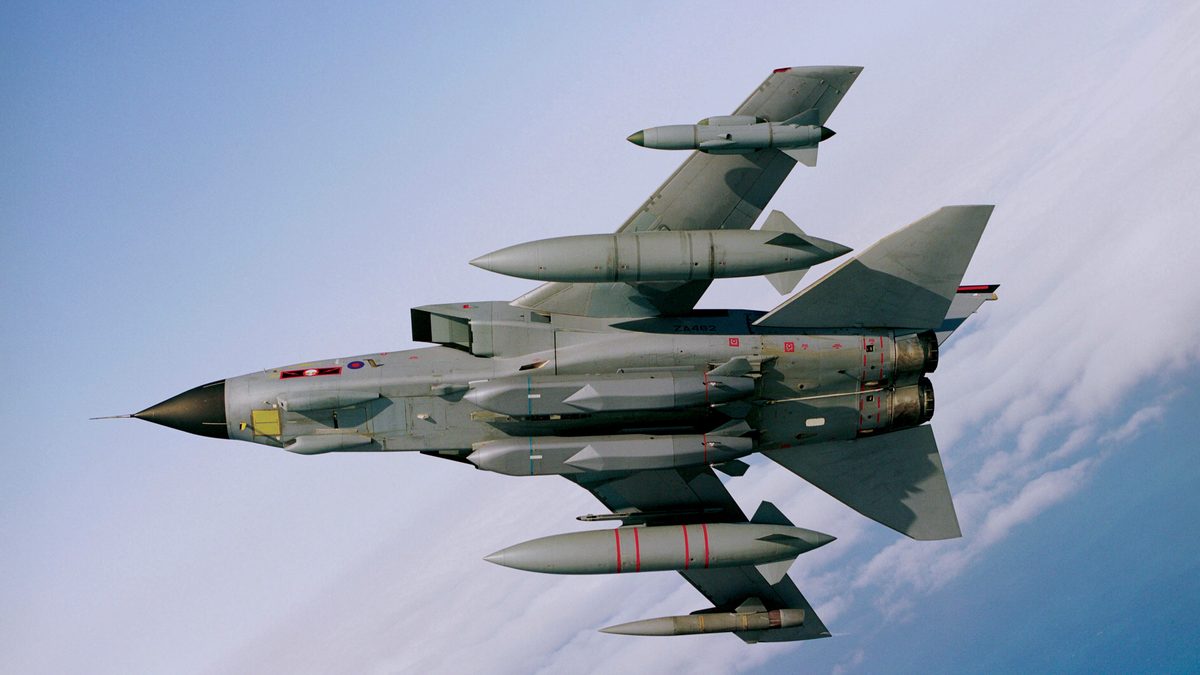
A Royal Air Force Tornado GR4 carrying two Storm Shadow missiles under the fuselage. The GR4 has since left service and Ukraine carries the weapon on the Su-24M; the image shows the round itself, not the carriage arrangement discussed here. Photo by Geoff Lee, UK Ministry of Defence, Crown Copyright, Open Government Licence v1.0, via Wikimedia Commons.
Declassifying the Deep Strike: What the UK Release of Storm Shadow Technical Data Actually Transfers
The United Kingdom cleared MBDA to release classified technical data on British-origin Storm Shadow and SCALP components on 24 August 2026, announced around Prime Minister Andy Burnham’s visit to Kyiv for Ukrainian Independence Day. France released SCALP-EG data in July 2026. Together the two decisions are intended to let Ukrainian and French industry stand up local assembly lines, reportedly by the end of 2026.
Technical Summary
Storm Shadow, and its French designation SCALP-EG, is a low-observable air-launched cruise missile in the 1,300 kilogram class, powered by a Microturbo TRI 60 turbojet and flying a subsonic low-level profile. Range is where most coverage goes wrong. The figure quoted in British public material is around 250 kilometres; the operational range carried in reference works for the national article is around 550 kilometres; and the deliberately cut export variant, Black Shaheen, supplied to the United Arab Emirates, is reported at about 290 kilometres. Those are three different numbers describing three different things, and which one applies to a Ukrainian production line is precisely what has not been stated.
For a weapons audience the interesting section is aft of the guidance bay. BROACH, the Bomb Royal Ordnance Augmented Charge, is a tandem arrangement: a precursor shaped charge opens a path through concrete or earth cover, and a follow-through penetrator then functions inside the void it has created, under a fuze that has to survive the precursor event and then count layers. The 450 kilogram figure widely quoted is the mass of the complete BROACH warhead, precursor and follow-through together, not of the follow-through alone; published splits between the two stages vary considerably between sources and none of them is certified data. These figures are the open-source consensus and are not independently verified by ISC.
The phrase used in most reporting, blueprints, understates and misdescribes what is actually needed. Drawings define geometry. An assembly line needs the process behind the geometry: the explosive fill formulation and its casting or pressing schedule, case metallurgy and heat treatment, the safety and arming device (SAD) design and its fault-tree evidence, the fuze timing logic, and the acceptance test specification against which a completed round is declared serviceable. It also needs insensitive munitions evidence of the sort NATO handles through STANAG 4439 and AOP-39, because a round that is unqualified for fast cook-off, slow cook-off, bullet impact and fragment impact is a hazard to its own supply chain long before it is a hazard to a target.
An assembly line does not run on drawings. It runs on a qualified energetic fill, a qualified safety and arming device, and an acceptance test specification that somebody with authority is prepared to sign. ISC Defence Intelligence assessment, 26 August 2026
Analysis of Effects
The export-control mechanics are more interesting than the announcement. Declassification and export authorisation are separate acts. Under the Export Control Act 2002 and the Export Control Order 2008, technology and software specially designed for military use are controlled in their own right, and transferring them by electronic means or by explanation to a foreign national is an intangible transfer requiring a licence in the same way a shipped component would. A decision to declassify UK component data therefore removes one obstacle and leaves the licensing obstacle standing, complete with end-use undertakings, re-transfer conditions and a defined list of who on the Ukrainian side may hold the data. The Missile Technology Control Regime is the second frame, and it is more awkward than most coverage allows. Category I catches systems capable of delivering a 500 kilogram payload to 300 kilometres. Black Shaheen exists because that line exists: the range was cut to keep an export sale beneath it. But the rounds Ukraine has been firing came from British and French national stocks, not from an export cut, and the national article is carried in reference works at around 550 kilometres. So the reassuring sentence, that the weapon sits deliberately below Category I, is true of one configuration and not of the one in use. Category I also turns on capability rather than on a brochure figure, and fuel load, software limits and flight profile are all arguable. There is a sharper edge to this than the range argument. Category I covers not only complete systems but their specially designed production facilities, and while Category I items themselves attract a strong presumption of denial, the transfer of Category I production facilities is not to be authorised at all. That is the regime's one unconditional clause, and standing up a local assembly line is uncomfortably close to the thing it names. Whether London and Paris are treating what they have licensed as assembly or as a production facility, and on what reading of the missile's capability, is the substantive question here, and neither government has published its answer.
The second constraint is quality assurance, and it is the one least discussed. NATO manages this through STANAG 4107 and the AQAP series, under which one member government delegates surveillance of a supplier to another member government. Ukraine is not a NATO member, so that mutual government quality assurance route is not available to it as of right. Whoever ends up accepting rounds from a Ukrainian line will have to build the assurance arrangement from first principles: qualified processes, lot acceptance, batch traceability of energetics, and a competent authority prepared to own the safety case. None of that is exotic, but it takes longer than tooling does, and it is the realistic pacing item for a delivery date at the end of 2026.
There is a third constraint that sits outside both frames, and it is the one a production announcement cannot resolve. Storm Shadow navigates mid-course on inertial reference, satellite aiding and terrain-referenced navigation, and matches an imaging infrared scene in the terminal phase. Terrain-reference data and the encrypted satellite-navigation aiding used on operational shots have repeatedly been reported as carrying a United States dependency, and Washington has previously gated how the weapon could be used. A round assembled in Ukraine that still needs American terrain data or American key material is a sovereign assembly line attached to a non-sovereign kill chain. That is a first-order limit on what the phrase local production means here, and it is not addressed by releasing warhead data.
Personnel and Safety Considerations
Standing up cruise-missile final assembly inside a country under sustained long-range attack raises a set of problems that have nothing to do with the design. In-process explosive holdings drive quantity-distance separation between the fill bay, the assembly bay and any magazine, and NATO practice for those separations assumes a site that is not itself a target. Dispersal reduces the consequence of a single strike and multiplies the number of licensed explosives areas that need surveillance, lightning protection, electrostatic control and trained supervision. The BROACH configuration compounds this because a shaped-charge precursor and a penetrating follow-through are two separate energetic assemblies with different compatibility characteristics, and they will not always sit comfortably in the same building. It is, in explosives-safety terms, two munitions sharing one airframe. Some qualification pedigree for the warhead does exist outside this missile, since BROACH was also fielded on the unitary AGM-154C variant of the Joint Standoff Weapon, but none of it transfers to a new fill plant without a fresh safety case written against that plant's own processes. Any realistic programme plan needs an explosives safety case and a competent-person structure alongside the production plan, not after it.
Data Gaps
The scope of the release is not public: whether it covers warhead process data, the safety and arming device, the seeker and navigation suite, or only structural and non-energetic components is unstated. No production rate, facility location, funding line or contracting vehicle has been identified. It is unclear whether the intended output is a Storm Shadow copy or a Ukrainian derivative sharing subsystems, and whether the airframe is intended for continued Su-24 carriage or for a different launch platform. The relationship to existing Ukrainian long-range programmes such as the Fire Point FP-5 is not described, though the two are complementary rather than substitutable: a large cheap ground-launched cruise missile for volume strike is a different instrument from a 450 kilogram-class tandem penetrator with imaging terminal guidance, and they share neither warhead nor seeker nor launch architecture. Nor is it stated whether the release reaches the interface control data that carriage depends on, which matters because the current Su-24 fit relies on British-developed pylon adapters and the French July package points at a Rafale tranche later in the decade. The licensing instrument used on the UK side, and the conditions attached to it, have not been published.
Key Questions
What did the UK actually agree to release about Storm Shadow?
The UK government cleared MBDA to release classified information about British-origin components of the Storm Shadow and SCALP cruise missile, announced on 24 August 2026. France had already released data on the SCALP-EG variant in July 2026. The stated purpose is to let Ukrainian and French industry establish assembly lines inside Ukraine.
How quickly could Ukraine build its own Storm Shadow?
Reporting points at assembly lines by the end of 2026, but that is a tooling timeline rather than a qualification timeline. The pacing items are a qualified energetic fill, a qualified safety and arming device, insensitive munitions evidence and an agreed acceptance specification. Those take longer to establish than the physical line does.
Does releasing missile data breach the Missile Technology Control Regime?
It depends which version gets built, and that has not been stated. Missile Technology Control Regime Category I catches systems able to deliver a 500 kilogram payload to 300 kilometres. The cut-down export variant, Black Shaheen, was reduced to about 290 kilometres to stay under that line, but the national article Ukraine has actually been firing is carried at around 550 kilometres. A Ukrainian line building the export geometry raises little regime difficulty; one building the national article raises a great deal.
References
Source-evaluated per NATO source-evaluation doctrine, STANAG 2022 lineage (source reliability A–F / information credibility 1–6). Tier 1 = government primary source; Tier 2 = quality news / specialist defence media; Tier 3 = authoritative aggregator / encyclopaedia.
- T1GOV.UK, Export Control Joint Unit – Export controls: military goods, software and technology, accessed 26 August 2026. (Reliability A / Credibility 1)
- T2Aviation Week – UK Hands Over Storm Shadow/Scalp Data To Enable Ukrainian Domestic Production, 24 August 2026. (Reliability B / Credibility 2)
- T2The War Zone – Storm Shadow Cruise Missile Production Is Coming To Ukraine, August 2026. (Reliability B / Credibility 2)
- T2Army Recognition – UK Prime Minister hands over Storm Shadow missile blueprints to Ukraine for domestic production, 24 August 2026. (Reliability B / Credibility 2)
- T3United24 Media – Ukraine is granted permission to build Storm Shadow/SCALP missiles, August 2026. (Reliability C / Credibility 3)
Corrections & updates welcome. If you hold open-source data that refines or corrects any parameter in this article, please contact [email protected] citing the specific claim and your source. Verified corrections will be incorporated and credited in the revision history. AI-assisted technical assessment based on open-source material. Not a formal intelligence product.