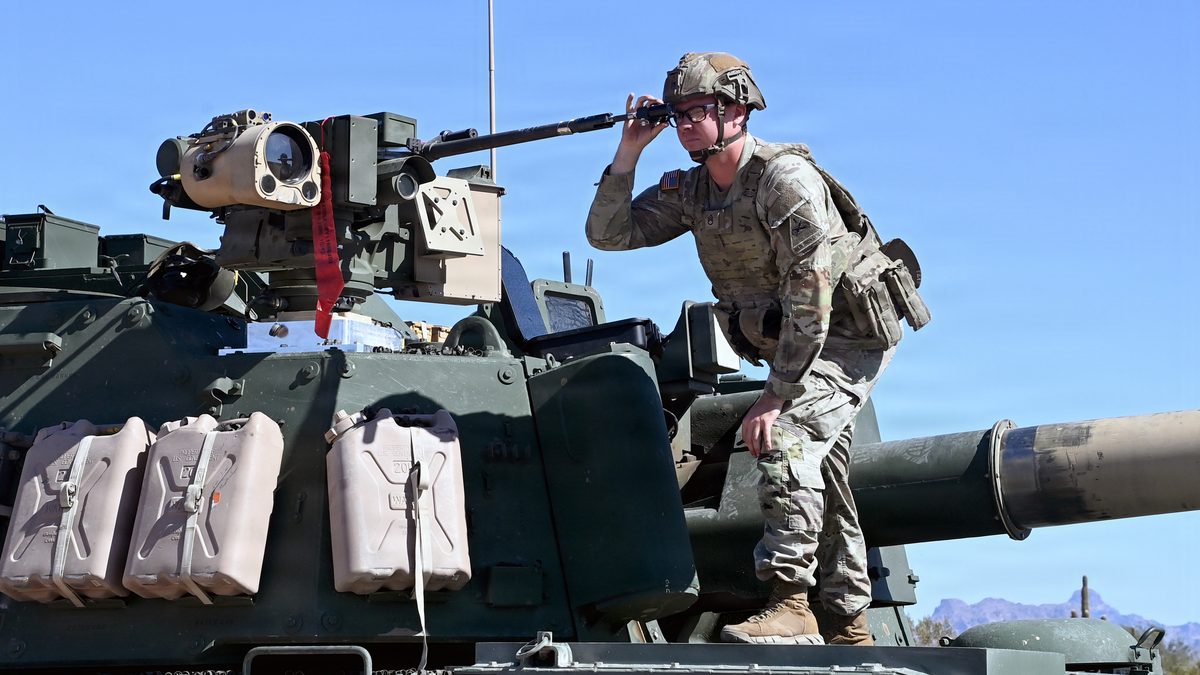
Illustrative. A Common Remotely Operated Weapon Station, the U.S. Army designation for the same KONGSBERG PROTECTOR family, in integration testing at U.S. Army Yuma Proving Ground, April 2026. U.S. Army photo by Mark Schauer via DVIDS, public domain. Appearance of U.S. Department of Defense visual information does not imply or constitute endorsement.
Canada Bought 178 Weapon Stations for 360 Hulls. Where the New NOK 1.1 Billion Order Goes Is Not Stated.
KONGSBERG announced on 20 August 2026 that it had signed a NOK 1.1 billion contract with General Dynamics Land Systems-Canada for PROTECTOR RS4 remote weapon stations on the Canadian Army's Armoured Combat Support Vehicle. Canada bought 178 stations for the original 360-vehicle fleet, which is now growing to 550. Neither party has said how many stations this contract covers, or which vehicles they are for.
Technical Summary
KONGSBERG announced on 20 August 2026 that it had signed a contract with General Dynamics Land Systems-Canada, valued at NOK 1.1 billion (Norwegian kroner), for PROTECTOR RS4 Remote Weapon Systems. The stations go onto the Canadian Army's Armoured Combat Support Vehicle (ACSV), a family of eight mission variants built on the Light Armoured Vehicle (LAV) 6.0 hull at the GDLS-Canada plant in London, Ontario. Kjetil Reiten Myhra, Executive Vice President of KONGSBERG and President of its Defence Systems division, described the award as a follow-on to earlier RS4 deliveries for the same platform. Trade reporting converted the figure to roughly 118 million US dollars. The release gives no unit quantity, no delivery schedule and no configuration.
The timing sits five weeks after Ottawa expanded the vehicle programme. On 16 July 2026 Prime Minister Mark Carney announced a strategic partnership with GDLS-Canada worth close to two billion Canadian dollars over four years, covering 190 additional ACSVs and lifting the planned fleet from 360 to 550. The Department of National Defence project page, updated on 7 August 2026, puts the contract value for 550 vehicles and associated materiel at four billion Canadian dollars including taxes, records initial operational capability on 15 January 2025, and separates full operational capability for equipment in 2029 from full operational capability for infrastructure in 2031. It also confirms three donations totalling 124 vehicles to Ukraine with contractor replacement and no reduction in project scope. The eight variants split into five Type 2 high-roof configurations and three Type 3 low-roof ones. The RS4 itself is built around a stabilised four-axis architecture KONGSBERG calls Detached Line of Sight, which holds the sight on the target independently of where the weapon is pointing.
Every Armoured Combat Support Vehicle is built to take a remote weapon station. Canada bought 178 of them for a fleet of 360. The hulls that went without carry a pintle-mounted C6A1, and the soldier serving it stands in the open. ISC assessment, on figures given by Maj Phil Gartner, ACSV project director, in Canadian Army Today, 16 December 2024
Analysis of Effects
For anyone who has to feed the thing, the weapon list matters more than the contract value. KONGSBERG's published data sheet for the RS4 covers the Browning M2 and the WKM-B in 12.7 x 99mm, the MK19, MK47 and Heckler and Koch grenade machine gun (GMG) in 40 x 53mm, the M240, UKM-2000C and M134 in 7.62 x 51mm, and the M249 in 5.56 x 45mm, with Javelin or Spike offered as the missile option. The project director told Canadian Army Today that the Army's PROTECTOR takes the C6, C9, M2 or C16. Some of those are Canadian service designations for the same weapon families the sheet lists, and the M2 sits on both lists under the same name. A photograph published with that interview shows a C16 marker round being fired from an ACSV station during the 2024 reliability trials, so the 40mm fit is demonstrated by the programme rather than inferred from a brochure. Canada has been here before: the KONGSBERG PROTECTOR Dual station on the Tactical Armoured Patrol Vehicle, contracted in 2012, already pairs a C6 with a 40mm grenade machine gun, so the reload drill and the link and case management problem are not new to the Army.
The temptation at this point is to say the calibres are NATO-standardised, so nothing downstream changes. That is the error, and it is the wrong one to make in front of an ammunition audience. A calibre is not a nature. Canadian policy says so in terms: DAOD 3002-5 warns that a shared calibre between Canadian and allied service firearms does not guarantee that the ammunition is compatible, and requires every nature to be qualified through the Ammunition Safety and Suitability Board and approved before it enters service. Within 40 x 53mm alone, target practice, target practice tracer, high-explosive dual-purpose and airburst are distinct natures with different fillings, different link and packaging configurations, and hazard classifications that have to be established for the tested configuration rather than read off the bore diameter. What the RS4 genuinely avoids is obliging Canada to introduce a weapon family it does not already operate. That is a real saving in training, spares and tooling. It is a narrower claim than calibre commonality is usually made to carry.
The mass figures need the same care. KONGSBERG gives the RS4 as "from 195 kg" without weapon or ammunition and "from 295 kg" with a Browning M2 and 400 rounds of 12.7 x 99mm aboard. Both are lower bounds for configured systems rather than a component breakdown, so the hundred kilogram difference between them is a nominal comparison and not a verified weapon-and-ammunition mass. It is still the right order of magnitude for the part that gets consumed and has to be replaced. Four hundred rounds runs 40 to 53 seconds at the M2's cyclic rate of 450 to 600 rounds per minute. Measured instead against a sustained rate, which allied gunnery practice puts below 40 rounds per minute with barrel-change discipline, the same 400 rounds is more than ten minutes of firing. Those are two different measures of endurance, and the distance between them is the point: 400 rounds is ready-use depth, not an engagement length. The architecture protects the operator while the gun is firing, which is the entire point of a remote station, and returns the problem the moment the belt runs out, because reloading a roof-mounted station on a vehicle with no under-armour feed path means somebody opening a hatch. What the ACSV installation provides is not published.
Personnel and Safety Considerations
Two safety points follow from the published figures rather than from anything Canada has said. The first is the elevation ceiling. The baseline RS4 traverses a full 360 degrees in azimuth at 90 degrees per second and elevates from minus 20 to plus 60 degrees at 70 degrees per second. Against ground targets that envelope is generous. Against a small uncrewed aircraft overflying the vehicle it is not, because a cone of 30 degrees half-angle about the vertical, 60 degrees included, falls outside the station's engagement envelope, and an approaching quadcopter crosses that cone in the seconds when the crew most wants a gun on it. The RS4 product sheet states that PROTECTOR counter-uncrewed-aerial-system capability is enabled by integrating radars and other sensors and effectors into the fire control system, and that it is currently fielded in both naval and land-based applications. That is a claim about a configured system with cueing sensors, not about elevation limits alone. KONGSBERG described the 2020 Canadian order as prepared for wireless control, counter-uncrewed-aerial-system capability and multi-sensor fusion, which is provision rather than proof that any of it was bought or fielded. The second point is nature selection. A 40mm grenade machine gun firing programmable airburst is a materially different counter-drone proposition from one firing ball or high-explosive dual-purpose. Here the record is better than it first appears: the 2010 announcement of the C$95 million purchase of 304 C16 systems from Rheinmetall Canada states that the buy included multi-purpose and airburst ammunition alongside the fire control system, thermal sight and ground mount. What is still unpublished is whether Canada holds those natures in quantity today, and whether airburst forms any part of the ACSV RS4 configuration.
Data Gaps
Seven areas are not in the public record and should not be inferred from what is. The number of RS4 stations covered by the NOK 1.1 billion contract is undisclosed, so no unit price can be derived from it. The allocation of those stations, whether to the 190-vehicle increment announced in July, to the 182 original hulls that never received one, to attrition and spares, or to some mixture, is unstated by both parties. No delivery schedule or in-service date has been published for the new order. The weapon fit per ACSV variant is unpublished, as is the priority order by which variants receive a station. Whether the counter-uncrewed-aerial-system option is included is unknown, as is the current Canadian stock of 40 x 53mm airburst natures, which were part of the 2010 C16 buy but whose present holdings are not published. Ready-round stowage, total vehicle ammunition load, and the hazard division, compatibility group and net explosive quantity underpinning the vehicle's stowage arrangements are not public, and in the normal course would not be. Finally, whether Canada takes up the configuration free of International Traffic in Arms Regulations (ITAR) content that the data sheet offers as an option is unknown.
Key Questions
How much is the Kongsberg RS4 contract with Canada worth?
KONGSBERG announced on 20 August 2026 that it had signed a contract with General Dynamics Land Systems-Canada worth NOK 1.1 billion, roughly 118 million US dollars, for PROTECTOR RS4 remote weapon systems on the Canadian Army's Armoured Combat Support Vehicle. An earlier PROTECTOR order for the same platform, worth NOK 500 million, was announced in May 2020. No unit quantity has been published for either contract.
Does every Canadian ACSV have a remote weapon station?
No. The project director told Canadian Army Today in December 2024 that although every Armoured Combat Support Vehicle is built to accept a remote weapon station, the Army was only able to buy 178 of them for the 360-vehicle fleet because of cost and availability. Hulls without a station carry a pintle-mounted C6A1 general purpose machine gun instead.
Can a remote weapon station shoot down drones?
PROTECTOR stations can be configured for counter-uncrewed-aerial-system work using KONGSBERG's fire control system with radar and sensor cueing, and the company says the capability is fielded on land and at sea. The baseline RS4 data sheet gives an elevation limit of 60 degrees, which leaves a cone directly overhead the station cannot engage.
Corrections and revisions
26 August 2026, 17:20 BST. Amended after external review; seven corrections applied. The headline previously stated that the new order was about the fit-out gap. No public source assigns the RS4 order to any particular vehicles, and the headline now says so. An earlier version said the contract was signed on 20 August; that is the announcement date. An earlier version argued that because the calibres are NATO-standardised the order brought no new nature, packaging configuration or storage and transport classification. That conflated calibre with nature and has been rewritten against DAOD 3002-5. An earlier version treated the gap between the data sheet's 195 kg and 295 kg figures as a verified weapon-and-ammunition mass; both are lower bounds, so the comparison is nominal. An earlier version said nothing published established that the C16 buy included airburst ammunition; a 2010 Government of Canada publication states that it did. The claim that Canada does not use the data sheet's weapon designations was wrong, since the M2 appears on both lists. Source ratings were revised so that a single corporate announcement is not rated as confirmed by independent sources. With thanks to the reviewer who raised them.
References
Source-evaluated per NATO source-evaluation doctrine, STANAG 2022 lineage (source reliability A–F / information credibility 1–6). Tier 1 = government primary source; Tier 2 = quality news / specialist defence media; Tier 3 = authoritative aggregator / encyclopaedia.
- T1KONGSBERG – KONGSBERG to deliver Remote Weapon Systems to Canada, 20 August 2026. (Reliability A / Credibility 2: single corporate announcement; trade repeats are derivative)
- T1Prime Minister of Canada – Prime Minister Carney announces landmark partnership with General Dynamics Land Systems-Canada, 16 July 2026. (Reliability A / Credibility 1)
- T1KONGSBERG – PROTECTOR RS4 product page and technical data sheet, version 3, 21 January 2026. (Reliability A / Credibility 2)
- T2The Defense Post – Kongsberg Wins $118-Million Canadian Army Remote Weapon System Contract, 24 August 2026. (Reliability B / Credibility 2)
- T2Army Technology – Kongsberg lands $118m RS4 weapon systems deal for Canada's ACSV fleet, 21 August 2026. (Reliability B / Credibility 2)
- T1Department of National Defence, Canada – Armoured Combat Support Vehicle (ACSV) project page, updated 7 August 2026. (Reliability A / Credibility 1)
- T2Canadian Army Today – Enter the Armoured Combat Support Vehicle, 16 December 2024. (Reliability B / Credibility 1)
- T1KONGSBERG – KONGSBERG awarded contract to provide Remote Weapon Stations to the Canadian Army worth 500 MNOK, 25 May 2020. (Reliability A / Credibility 2)
- T1Department of National Defence, Canada – DAOD 3002-5, Use of Firearms, Ammunitions and Explosives, last modified 3 October 2024. (Reliability A / Credibility 1)
- T1Government of Canada – The Maple Leaf: Close Area Suppression Weapon contract, 304 C16 systems, 2010. (Reliability A / Credibility 1)
- T2Rheinmetall Canada – Close Area Suppression Weapon (C16) programme page, accessed 26 August 2026. (Reliability B / Credibility 2)
Corrections & updates welcome. If you hold open-source data that refines or corrects any parameter in this article, please contact [email protected] citing the specific claim and your source. Verified corrections will be incorporated and credited in the revision history. AI-assisted technical assessment based on open-source material. Not a formal intelligence product.