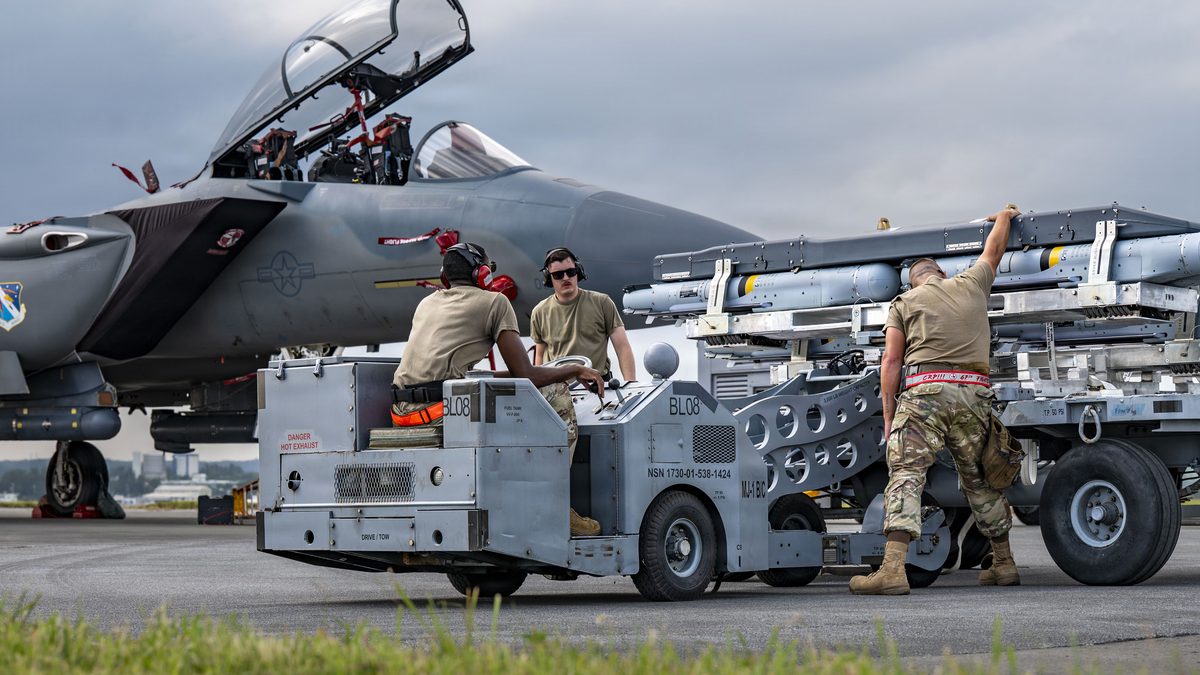
Airmen of the 67th Fighter Generation Squadron prepare to load munitions onto an F-15EX Eagle II of the 85th Test and Evaluation Squadron at Kadena Air Base, Japan, 8 July 2026. US Air Force photo by Airman 1st Class Gracelyn Hess, 18th Wing, via DVIDS. US Government work, public domain. Use does not imply endorsement by the US Department of War or the US Air Force.
A $131 Billion Ceiling, $343,740 Obligated: What Boeing Actually Won on the F-15
The US Department of War awarded Boeing a $131.23 billion indefinite-delivery, indefinite-quantity contract for the F-15 Eagle Crest programme on 24 August 2026. That figure is a ceiling, not an order. Only $343,740 of fiscal 2026 research and development funding was obligated at award, roughly one dollar committed for every $380,000 of contractual headroom.
Technical Summary
The award, contract number FA8634-26-D-B001, was announced in the US Department of War daily contract list for 24 August 2026. The contracting activity is the Air Force Life Cycle Management Center at Wright-Patterson Air Force Base, Ohio, acting for the F-15 Program Office. The scope is unusually wide for a single vehicle: aircraft production, systems integration, modernisation, upgrades, retrofits, sustainment, and the establishment of organic depot maintenance capabilities, in support of the US Air Force, the Air National Guard and other Department of War customers. Work is to be performed at St. Louis, Missouri, where Boeing has built F-15 airframes since the McDonnell Douglas era, and the contract is expected to be complete by August 2037. The ordering period runs to 24 August 2031 with an option to extend to 24 August 2036. The acquisition was sole source, which for a type in production at one prime is the expected route rather than an anomaly.
The number that travelled fastest was $131.23 billion. It is a ceiling on an indefinite-delivery, indefinite-quantity vehicle, meaning it sets the maximum value of delivery orders the government may place over the life of the contract. It is not a commitment to place them, and the announcement states no minimum quantity and no guaranteed value. Each delivery order will carry its own funding, quantity and configuration baseline. The only funds obligated on the day of award were $343,740 in fiscal 2026 research, development, test and evaluation money. Put beside the ceiling, that is a ratio of about 1 to 381,770. For scale on the demand side rather than the headroom side, the fiscal 2027 budget request buys 24 F-15EX at roughly $3 billion. Ten years of new-build at that rate would consume in the region of $30 billion, near a quarter of the ceiling, before any allowance for sustainment, retrofit or partner-nation orders. The ceiling is sized so that the vehicle never has to be renegotiated, not because anyone expects to spend it.
A ceiling is permission to spend, not a decision to spend. The $343,740 obligated on 24 August 2026 is the only money that has actually moved. Everything after that waits on a delivery order that has not yet been written. ISC assessment, 25 August 2026
Scope note: why an aircraft contract appears on a WOME site
ISC covers weapons, ordnance, munitions and explosives, not airframes. This award earns coverage on two clauses rather than on its value. Systems integration is the mechanism by which munitions are cleared onto a platform, and organic depot maintenance transfers armament-related depot work, with its explosives safety obligations, from contractor to government. The aircraft is the carriage. The certification and the depot licensing are the subject.
Analysis of Effects
The Foreign Military Sales list is the part of the announcement worth slowing down over. Seven countries are named: Japan, Israel, Saudi Arabia, South Korea, Singapore, Indonesia and Poland. Five of those already operate the type, in the F-15J, F-15I, F-15SA, F-15K and F-15SG variants respectively, and their presence is routine sustainment and upgrade plumbing. Israel is the live production case, having contracted for 25 F-15IA aircraft in a deal reported at $5.2 billion, with a second squadron announced in May 2026. Indonesia and Poland are the outliers, because neither flies the F-15 and neither has an order. Indonesia signed a memorandum of understanding in 2023 covering up to 24 F-15EX, but the campaign never converted to a binding contract and Boeing itself closed the pursuit in February 2026. Poland has been briefed on the F-15EX, latterly packaged with the MQ-28 uncrewed teaming aircraft, but has bought F-16, F-35A and FA-50 instead and has announced no selection.
Naming a country on an FMS clause is not a sale. It is a pre-cleared lane. Adding a new partner to an existing vehicle after award is slow and contestable; naming them at award means a future Indonesian or Polish requirement could be placed as a delivery order rather than starting a fresh acquisition. Read that way, the seven names are a statement about optionality, not about pipeline. The distinction matters because contract-ceiling figures and FMS country lists are routinely reported as though they were orders, and a reader who takes the Indonesian entry at face value would conclude that a campaign Boeing publicly abandoned six months ago has quietly revived. Nothing in the announcement supports that. The second structural point sits in the phrase establishment of organic depot maintenance capabilities. Organic, in US depot usage, means government-owned and government-staffed, as distinct from contractor logistics support. F-15 programmed depot maintenance already runs through the Warner Robins Air Logistics Complex in Georgia, so the clause funds the extension of that capability to the newer configurations rather than the creation of a depot from nothing.
Personnel and Safety Considerations
For weapons, ordnance, munitions and explosives readers, the load-bearing words in this contract are systems integration and organic depot maintenance, not the headline value. Every armament change to an F-15 configuration carries a certification tail: stores clearance and separation testing, aircraft-store electrical interface verification, revised loading procedures, and updated technical orders that weapons load crews are examined against. The photograph above is the visible end of that chain, a fighter generation squadron loading munitions onto a variant its personnel are still building experience with. Where depot work moves organic, the government also inherits the explosives safety and ordnance-handling obligations that go with armament and pylon work in a maintenance environment: licensed explosives locations, net explosive quantity limits on any facility handling live stores, and compatibility group segregation for the cartridge-actuated devices and impulse cartridges that ejector racks depend on, all of it governed by the Defence Explosives Safety Regulation, DESR 6055.09, and the Air Force instructions beneath it. Those devices are the quiet WOME content of a fast-jet sustainment contract, and they are governed by the same hazard classification discipline as any other energetic item.
Data Gaps
Several things the announcement does not settle. First, no delivery order has been published, so the split of the ceiling between US new-build, modernisation of the existing fleet, sustainment and partner-nation work is unknown. Second, the announcement does not identify which depot or depots receive the organic capability, nor the workload or timeline, so the Warner Robins reading above is an inference from where F-15 programmed depot maintenance is performed today and not a stated fact. Third, the announcement does not name the statutory authority for the sole-source justification, which is a thinner disclosure than two much smaller items carried on the same list: a $20.9 million actuator repair order and a $37.6 million oxygen-regulator award both cite 10 U.S. Code 3204(a)(1) explicitly. Nothing turns on the omission, and the authority for a single-prime type in production is not in doubt, but the largest entry of the day is the one that shows least of its working. Fourth, no unit price, aircraft quantity or configuration baseline is attached to the vehicle itself. Fifth, whether the Indonesian and Polish entries reflect any current government-to-government activity, as opposed to administrative pre-clearance, is not disclosed and ISC has found no evidence either way.
Key Questions
Did Boeing actually receive $131 billion for the F-15?
No. The $131.23 billion is a ceiling on an indefinite-delivery, indefinite-quantity contract, which is the maximum the government may order over the life of the vehicle. Only $343,740 of fiscal 2026 research and development funding was obligated at award on 24 August 2026. Everything beyond that requires a separate delivery order.
Why are Indonesia and Poland listed if they do not fly the F-15?
Naming a country on the Foreign Military Sales clause creates a contracting route, not a sale. Boeing closed its Indonesian F-15EX campaign in February 2026 and Poland has selected other aircraft. Listing them means any future requirement could be placed against this vehicle rather than through a fresh acquisition.
What does establishing organic depot maintenance mean?
Organic depot maintenance is performed by government-owned facilities and government employees rather than by the contractor. F-15 programmed depot maintenance already runs through the Warner Robins Air Logistics Complex, so the clause funds extending that government capability to current configurations, including the armament and explosives-handling work it carries.
References
Source-evaluated per NATO source-evaluation doctrine, STANAG 2022 lineage (source reliability A–F / information credibility 1–6). Tier 1 = government primary source; Tier 2 = quality news / specialist defence media; Tier 3 = authoritative aggregator / encyclopaedia.
- T1US Department of War – Contracts for Aug. 24, 2026 (Boeing, F-15 Eagle Crest, FA8634-26-D-B001), 24 August 2026. (Reliability A / Credibility 1)
- T2Air & Space Forces Magazine – Air Force Doubles Planned F-15EX Fleet to 267 Fighters, April 2026. (Reliability B / Credibility 2)
- T2Breaking Defense – Boeing abandons Indonesia F-15 bid, February 2026. (Reliability B / Credibility 2)
- T2Defense News – Boeing sweetens its Polish F-15EX offer with local deals, Ghost Bat, 31 October 2025. (Reliability B / Credibility 2)
- T2The War Zone – Israel To Buy Extra F-15IA And F-35I Squadrons, May 2026. (Reliability B / Credibility 2)
- T1Robins Air Force Base – Warner Robins Air Logistics Complex (F-15 programmed depot maintenance), accessed 25 August 2026. (Reliability A / Credibility 2)
Corrections & updates welcome. If you hold open-source data that refines or corrects any parameter in this article, please contact [email protected] citing the specific claim and your source. Verified corrections will be incorporated and credited in the revision history. AI-assisted technical assessment based on open-source material. Not a formal intelligence product.