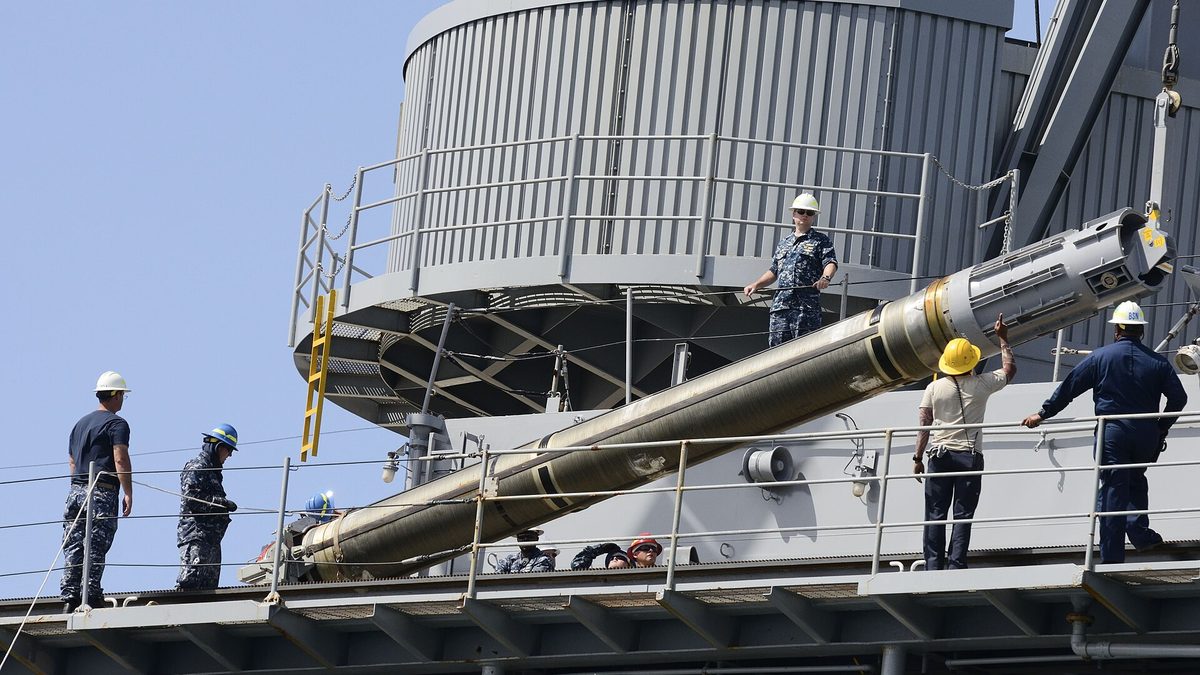
Sailors and Civilian Mariners assigned to the submarine tender USS Frank Cable (AS 40) raise a Tomahawk cruise missile at Polaris Point, Guam, 16 November 2012. US Navy photograph, public domain, via Wikimedia Commons. Illustrative; not the hardware in this award.
Five Hundred and Fifty-Nine Warhead Cases and No Explosive: What the Navy Actually Bought for Tomahawk
On 20 August 2026 the US Navy awarded General Dynamics Ordnance and Tactical Systems Defense Research Institute Inc. a 41,571,985 US dollar modification for 559 WDU-36/B warhead cases and 559 fuzewells for the U/RGM-109E Tactical Tomahawk. The award buys machined structural hardware. The PBXN-107 main charge, the BBU-47 booster and the FMU-148 fuze are procured, qualified and loaded under separate arrangements.
Technical Summary
The award, modification P00016 to firm-fixed-price contract N6893619C0039, was placed by Naval Air Warfare Center Weapons Division, China Lake, California, and was not competed. The same command developed and qualified the WDU-36/B for the Block III upgrade, which reached initial operational capability in May 1993, so the organisation buying the cases is the organisation that originated the warhead. Work is split between Anniston, Alabama at 99 per cent and Houston, Texas at 1 per cent, with completion expected in April 2028. Fiscal 2026 Weapons Procurement, Navy funds of 41,571,985 US dollars were obligated at award. The line item names two things and only two: the warhead case and the fuzewell. Neither is an energetic component.
The WDU-36/B is the blast-fragmentation warhead of the Tactical Tomahawk. Open sources do not agree on the complete warhead mass. Most reference works give approximately 310 kg, while the Directory of U.S. Military Rockets and Missiles gives 340 kg for the same item, and no primary specification is available to settle it. Those sources do converge on a main charge of approximately 120 kg of PBXN-107, an RDX-based polymer-bonded composition, initiated through a BBU-47 booster charged with PBXN-7 and an FMU-148 fuze. The case is the structural pressure vessel that contains that fill and governs fragment mass distribution on detonation. The fuzewell is the machined cavity and threaded liner that positions the booster on the charge axis. Both are delivered inert. Hazard Division and Compatibility Group assignment attaches to the loaded item, not to these components as shipped, which is why 559 sets of hardware can move on ordinary freight terms while a filled warhead section cannot.
Divide the modification by the quantity and each warhead case and fuzewell set carries roughly 74,400 US dollars of machined structural hardware, before a single kilogram of PBXN-107 enters the cavity. ISC calculation from the 20 August 2026 award value and quantity
Analysis of Effects
Five hundred and fifty-nine is a production-rate number, not a replenishment number. It sits against a funded ambition rather than a stated one. On 17 August 2026 the Navy awarded Raytheon a seven-year, 22.9 billion US dollar Tomahawk contract under the Department of War Arsenal of Freedom, which the company says supports an annual production ramp to more than 1,000 missiles and associated support. ISC examined that ramp on 19 August in the context of energetics supply. Read together, the two data points describe where the constraint actually sits. Case machining is a metalworking problem with a known supplier at Anniston and a 20-month delivery horizon. Filling those cases is a different problem, governed by explosive load, assemble and pack capacity, by qualified PBXN-107 supply, and by the quantity-distance limits of the facilities that do the work.
The fuzewell deserves more attention than its line-item cost suggests. Booster alignment and concentricity determine whether the initiation train transfers reliably from a small PBXN-7 charge into roughly 120 kg of PBXN-107. A case that is dimensionally acceptable but whose fuzewell sits off axis produces an initiation train fault that surface inspection will not catch. That is why the two items are bought as a matched pair, 559 and 559, rather than as independent quantities, and why acceptance testing on this class of hardware is a dimensional and metallurgical exercise rather than a functional one.
Personnel and Safety Considerations
For ammunition technicians and storage staff the practical point is the classification boundary. An unfilled WDU-36/B case with an unloaded fuzewell holds no net explosive quantity and carries no Hazard Division; it is ordnance hardware, not ammunition. It acquires HD 1.1 and its Compatibility Group only once the main charge is loaded and, in the fuzed configuration, once the initiation train is assembled. Storage licensing, quantity-distance calculation under AASTP-1 Edition C and DESR 6055.09 Change 2, and the transport regime under the UN Recommendations on the Transport of Dangerous Goods therefore change at the load line, not at the machine shop. Personnel handling in-process hardware at Anniston and staff receiving filled sections downstream are working to two different regulatory pictures on the same item number.
Data Gaps
Several parameters are not established in open source and are recorded here rather than estimated. The case material and heat-treat specification is not stated in the award; open reporting has described the WDU-36/B case as titanium, and ISC has not verified that against a primary specification. The 559 quantity is not attributed in the announcement to a specific missile block, so the split between Block IV recertification and Block V new build is unknown. The load, assemble and pack facility that will fill these cases is not named. Net explosive quantity per loaded warhead is quoted from secondary sources at approximately 120 kg of PBXN-107 and has not been confirmed against a Tier 1 document. Total warhead mass is likewise unsettled in open source, with reputable references splitting between roughly 310 kg and 340 kg. The unit cost stated in this article is an ISC arithmetic division of award value by quantity and does not reflect any cost breakdown the Navy holds.
Key Questions
What did the US Navy buy in the 41.6 million dollar Tomahawk warhead award?
The 20 August 2026 modification buys 559 WDU-36/B warhead cases and 559 fuzewells for the U/RGM-109E Tactical Tomahawk. These are inert machined components: the structural case that contains the main charge, and the cavity that positions the booster. Explosive fill, booster and fuze are not part of this award.
What is a fuzewell on a missile warhead?
A fuzewell is the machined cavity and threaded liner built into a warhead case to hold the fuze and its booster charge on the charge axis. Its concentricity and thread tolerance govern whether the initiation train transfers reliably from the small booster charge into the main explosive fill.
Does an unfilled warhead case have a hazard classification?
No. An unfilled WDU-36/B case with an unloaded fuzewell contains no net explosive quantity and carries no Hazard Division or Compatibility Group. Classification attaches once the main charge is loaded and the initiation train assembled, which is also where quantity-distance and transport obligations begin.
References
Source-evaluated per NATO source-evaluation doctrine, STANAG 2022 lineage (source reliability A–F / information credibility 1–6). Tier 1 = government primary source; Tier 2 = quality news / specialist defence media; Tier 3 = authoritative aggregator / encyclopaedia.
- T1US Department of War – Contracts for Aug. 20, 2026, 20 August 2026. (Reliability A / Credibility 1)
- T2Defence Blog – U.S. Navy adds $41.5M for Tomahawk warhead production in Alabama, August 2026. (Reliability B / Credibility 2)
- T2L3Harris – Tactical Tomahawk capability page, accessed 24 August 2026. (Reliability B / Credibility 2)
- T2GlobalSecurity.org – Contracts for Aug. 20, 2026, mirror of the DoW announcement, 20 August 2026. (Reliability B / Credibility 2)
- T3Directory of U.S. Military Rockets and Missiles – Raytheon (General Dynamics) AGM/BGM/RGM/UGM-109 Tomahawk, updated 22 December 2024, accessed 24 August 2026. (Reliability C / Credibility 2)
- T2RTX – RTX’s Raytheon awarded seven-year contract for Tomahawk cruise missiles, 17 August 2026. (Reliability B / Credibility 1)
- T3Open Source Munitions Portal – RGM/UGM-109 Tomahawk Land Attack Missile (TLAM) series, accessed 24 August 2026. (Reliability C / Credibility 3)
Corrections & updates welcome. If you hold open-source data that refines or corrects any parameter in this article, please contact [email protected] citing the specific claim and your source. Verified corrections will be incorporated and credited in the revision history. AI-assisted technical assessment based on open-source material. Not a formal intelligence product.