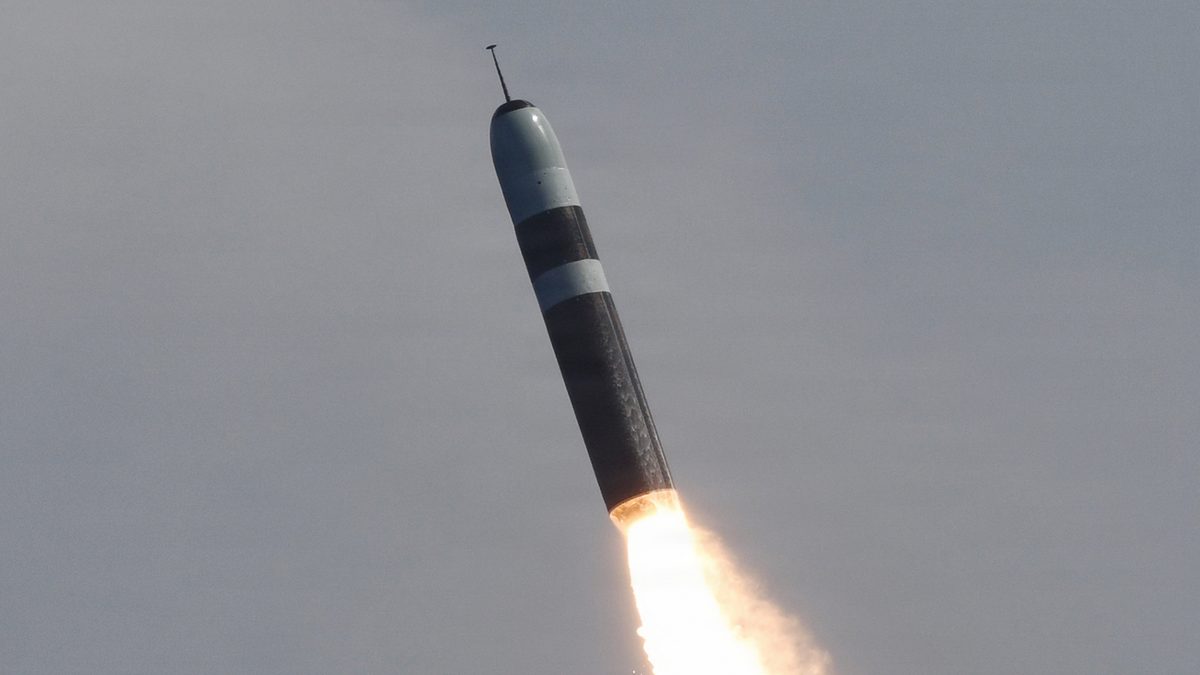
An unarmed Trident II D5 Life Extension missile launches from an Ohio class ballistic missile submarine off the Florida coast during the scheduled test event of 17 to 21 September 2025. The Mk4B is the reentry body that this missile bus deploys. Photo: US Navy Strategic Systems Programs via the Defense Visual Information Distribution Service (DVIDS), public domain.
Three Months Early: NNSA’s W76/Mk4B Reentry Body and the Aeroshell Britain Does Not Own
The National Nuclear Security Administration (NNSA) completed the first production unit of the W76/Mk4B reentry body nearly three months ahead of schedule, announced on 20 May 2026. The acceleration came from reusing a Pantex readiness determination made a year earlier for the W76-1, and from Kansas City National Security Campus delivering non-nuclear components early. No nuclear explosive operation was shortened.
Technical Summary
NNSA, part of the US Department of Energy, announced on 20 May 2026 that it had completed the first production unit of the Mark 4B (Mk4B) reentry body for the W76 nuclear warhead. Sandia National Laboratories published the enterprise-level detail on 13 August 2026. The reentry body is the ordnance assembly that carries the physics package through atmospheric reentry: aeroshell, thermal protection system, arming, fuzing and firing set, and the warhead itself. It is released after third-stage motor separation by the Trident II D5 submarine-launched ballistic missile, a three-stage solid-propellant weapon of 13.41 m length, 2.11 m diameter and 58,500 kg launch mass, with a stated range of 4,000 nautical miles (7,360 km). Ohio class submarines carry 20 missile tubes, reduced from the 24 they were built with after four per boat were deactivated for New START compliance. The Royal Navy’s Vanguard class carries 16.
The programme is converting every W76-1/Mk4A and W76-2/Mk4A in the stockpile to the Mk4B configuration, which NNSA and Sandia both describe as improving on the reliability of the Mk4A. Sandia holds system integration leadership and is the design agency for NNSA’s non-nuclear components; Los Alamos National Laboratory and Lockheed Martin Space are also named design agencies. Conversion work is done at the Pantex Plant, Amarillo, Texas. Kansas City National Security Campus produced the non-nuclear components, and Sandia and Los Alamos each issued a Qualification Evaluation Release to clear the compressed timeline. NNSA names the next sea-leg milestones as the W88 Alteration 376 programme, the W93 warhead, and the W80-5 for the nuclear-armed sea-launched cruise missile, with first production units expected through the early to mid 2030s. Alteration 376 is worth separating from Alteration 370, which it is easily mistaken for and is not. Alt 370 is finished: first production unit July 2021, last production unit announced on 16 December 2025, and its scope was a replacement arming, fuzing and firing assembly, a lightning arrestor connector, a refresh of the conventional high explosive and concurrent limited-life component replacement. Alt 376 is a separate and much earlier programme, recorded in the Y-12 National Security Complex performance evaluation report for financial year 2025 as new and at Conceptual Design Review, with disassembly process method development under way.
“The Pantex Plant capitalized on a previous readiness determination conducted for the W76-1 a year prior in collaboration with the Nuclear Explosive Safety Study team.” The three months were bought at the authorisation-basis layer, not on the production floor. NNSA press release, 20 May 2026
Analysis of Effects
The interesting figure here is not the three months. It is where the three months came from. Schedule compression in nuclear explosive operations is normally purchased in one of two currencies: removing hold points from the operation, or removing steps from the safety case that authorises it. Both are expensive in risk terms and both are the reason acceleration announcements in this domain deserve reading twice. NNSA’s own account describes a third route. Pantex reused a readiness determination already conducted a year earlier for the W76-1, in collaboration with the Nuclear Explosive Safety Study team. Kansas City delivered components early. Sandia and Los Alamos issued Qualification Evaluation Releases against work already largely done. In other words the authorisation basis was inherited rather than rebuilt, because the operation being authorised was close enough to one already assessed.
That is a genuinely reusable lesson for conventional ammunition programmes, where the same pattern applies at lower consequence. Where a modification changes non-nuclear components inside an assembly whose hazardous behaviour is unchanged, the qualification and safety-case burden can legitimately be inherited from the parent configuration rather than regenerated. The condition is that the delta is genuinely bounded by the existing assessment, and that somebody competent has said so on the record. NNSA names the body that said so. The W88 Alteration 370 is the nearest precedent in the same leg of the triad: a non-nuclear alteration to an existing warhead, run to completion across the same set of sites, against an established authorisation basis rather than a new one. What is absent from both releases matters as much: no reliability figure, no failure mode, no statement of what the Mk4A did less well. “Improving upon the reliability of Mk4As” is the entirety of the public technical justification for converting an entire stockpile of reentry bodies.
Personnel and Safety Considerations
The instinct a conventional ammunition technician brings to an announcement like this is to ask for net explosive quantity, hazard division and compatibility group, and that instinct does not transfer cleanly. A nuclear reentry body is not classified or stored under the conventional United Nations hazard classification regime administered through NATO Allied Ammunition Storage and Transport Publication 1 (AASTP-1) and, in UK service, Defence Safety Authority regulation DSA 03.OME. Its conventional energetics, the high explosive of the physics package, the detonators, and the thermal battery in the arming, fuzing and firing set, are real and are handled under the separate nuclear explosive safety regime that the NNSA release names when it credits the Nuclear Explosive Safety Study team. None of those quantities are in the public domain and none should be expected to be. The practical point for readers working in Weapons, Ordnance, Munitions and Explosives (WOME) is blunt: net explosive quantity, hazard division and compatibility group are the wrong questions to bring to this object. The governing framework, the competence set and the authorisation chain are all different from the conventional lane, even though the engineering vocabulary looks familiar.
Data Gaps
Six gaps are worth stating plainly. First, no net explosive quantity, hazard division or compatibility group is published for the Mk4B assembly or any sub-component, and none is expected. Second, no conversion rate is given: no units per year, no total quantity, no completion date for the stockpile-wide conversion. Third, “improved reliability” is not quantified and no failure mode is identified. Fourth, neither release states whether the Mk4B changes the MC4700 arming, fuzing and firing set introduced during the W76-1 life extension programme, or whether the change is confined to the aeroshell and thermal protection system. On that fourth point ISC assesses, on the strength of the qualification route NNSA describes rather than on any statement of scope, that the change is more likely to sit in the aeroshell, thermal protection system or manufacturing process than in the arming, fuzing and firing set. A change to the firing set would normally drive a wider qualification effort than the two Qualification Evaluation Releases named here. That is an inference from process, not a sourced fact, and it is offered as such. Fifth, no programme cost figure appears in either release. Sixth, and most relevant to a UK reader, nothing located in open source states whether the Royal Navy’s reentry bodies will be converted to the Mk4B standard, on what timescale, or at whose cost. What is on the record cuts the other way. A written parliamentary answer in October 2025 placed Astraea funding inside a £15 billion sovereign warhead investment for this Parliament, a figure that also covers sustaining the existing Mk4A warhead and modernising infrastructure at the Atomic Weapons Establishment. Sustainment and replacement are both funded. A Mk4B-equivalent conversion is not identified as a line of its own in anything located here, which is not the same as ruling it out, but it is where a UK reader should start asking.
Key Questions
What is the Mk4B reentry body and what does it do?
The Mk4B is the reentry body that protects a W76 nuclear warhead during atmospheric reentry after release from a Trident II D5 submarine-launched ballistic missile. It replaces the Mk4A. NNSA is converting every W76-1/Mk4A and W76-2/Mk4A in the United States stockpile to the Mk4B configuration, work carried out at the Pantex Plant in Amarillo, Texas.
How did NNSA finish the first Mk4B three months early?
By inheriting authorisation rather than compressing operations. Pantex reused a readiness determination made a year earlier for the W76-1, working with the Nuclear Explosive Safety Study team. Kansas City National Security Campus delivered non-nuclear components ahead of deadline, and Sandia and Los Alamos issued Qualification Evaluation Releases to support the accelerated first production unit date.
Do British Trident submarines carry the W76 and will they get the Mk4B?
The UK Ministry of Defence (MoD) states that Royal Navy Trident missiles carry the UK Mk4A warhead, the design of which is sovereign to the UK and maintained by the Atomic Weapons Establishment (AWE) at Aldermaston. The missiles themselves are drawn from a shared pool under the 1963 Polaris Sales Agreement. No open source located states whether UK reentry bodies will be converted to Mk4B.
References
Source-evaluated per NATO source-evaluation doctrine, STANAG 2022 lineage (source reliability A–F / information credibility 1–6). Tier 1 = government primary source; Tier 2 = quality news / specialist defence media; Tier 3 = authoritative aggregator / encyclopaedia.
- T1NNSA, US Department of Energy – NNSA Completes First Production Unit of W76/Mk4B Reentry Body, 20 May 2026. (Reliability A / Credibility 1)
- T1Sandia National Laboratories, Lab News – Sustaining deterrence: converted reentry body ready for the US nuclear stockpile, 13 August 2026. (Reliability A / Credibility 1)
- T1US Navy, Strategic Systems Programs – Fact File: Trident II (D5) Missile, last updated 22 September 2021. (Reliability A / Credibility 1)
- T1UK Ministry of Defence – Defence Nuclear Enterprise 2025 Annual Update to Parliament, 2025. (Reliability A / Credibility 1)
- T2US Navy Strategic Systems Programs via DVIDS – Successful Trident II D5 Life Extension (D5LE) Launches Demonstrate Continued Readiness of the Sea-Based Deterrent, 22 January 2026. (Reliability A / Credibility 1)
- T3Federation of American Scientists – British Submarines to Receive Upgraded US Nuclear Warhead, 1 April 2011. (Reliability C / Credibility 3)
- T1US Department of State – United States and United Kingdom Bring Amendment to Mutual Defense Agreement into Force, 14 November 2024. (Reliability A / Credibility 1)
- T1Royal Navy – Dreadnought Class Nuclear Submarine, accessed 23 August 2026. (Reliability A / Credibility 1)
- T3Nuclear Threat Initiative – United States Submarine Capabilities, accessed 23 August 2026. (Reliability B / Credibility 2)
- T2Bulletin of the Atomic Scientists – How US nuclear force modernization is undermining strategic stability: the burst-height compensating super-fuze, 1 March 2017. (Reliability B / Credibility 2)
- T1Sandia National Laboratories, News Releases – Sustaining deterrence: converted reentry body ready for the US nuclear stockpile, 19 August 2026. The same story ran in Sandia Lab News on 13 August 2026; the two dates are two Sandia publication surfaces, not a discrepancy. (Reliability A / Credibility 1)
- T1NNSA, US Department of Energy – NNSA completes Last Production Unit of W88 Nuclear Warhead Upgrade, 16 December 2025. (Reliability A / Credibility 1)
- T1NNSA, US Department of Energy – Y-12 National Security Complex, Financial Year 2025 Performance Evaluation Report, February 2026. Names the W88 Alteration 376 at Conceptual Design Review, separately from the W88 Alteration 370. (Reliability A / Credibility 1)
- T2UK Defence Journal – UK confirms new Astraea nuclear warhead progressing, 21 October 2025. Quotes the written parliamentary answer on the £15 billion sovereign warhead investment. (Reliability B / Credibility 2)
Corrections & updates welcome. If you hold open-source data that refines or corrects any parameter in this article, please contact [email protected] citing the specific claim and your source. Verified corrections will be incorporated and credited in the revision history. AI-assisted technical assessment based on open-source material. Not a formal intelligence product.