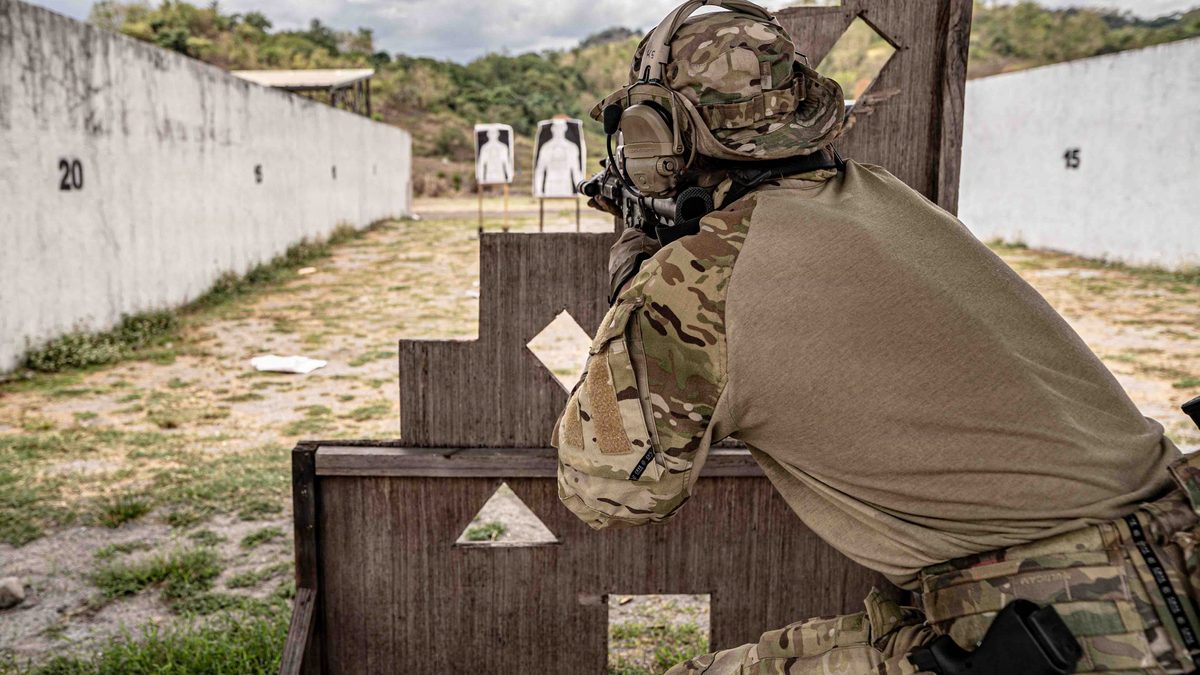
Illustrative: a U.S. Air Force Special Operations Command operator aims an M4A1 carbine downrange during a flat range shoot, Exercise Balikatan 2026, Cerab, Philippines, 28 April 2026. HICAR is an upper receiver group for this same M4A1 lower; the weapon shown is a conventional-pressure carbine, not a HICAR contender. U.S. Air Force photo by Airman 1st Class Arnet Tamayo / DVIDS, public domain.
Eighty-Two Thousand PSI in an Eleven-and-a-Half-Inch Barrel: Geissele Puts a HICAR Contender on the Firing Line
Geissele Automatics revealed its first prototype for the United States Special Operations Command (USSOCOM) Hypervelocity Improved Capability Assault Rifle (HICAR) programme on 9 August 2026: an 11.5-inch 5.56mm carbine firing a 77-grain match projectile at roughly 2,700 feet per second, on cases loaded in-house to produce at least 82,000 pounds per square inch. Live-fire evaluation runs on 15 and 16 September 2026 at Parks Range, Fort Moore, Georgia.
Technical Summary
USSOCOM issued the HICAR area of interest through Naval Surface Warfare Center (NSWC) Crane on 18 May 2026 under special notice N0016426SCA004. The requirement is an upper receiver group that mates to the fielded M4A1 lower receiver, feeds from Gen 3 PMAG magazines, and functions with three ammunition natures: the M855A1 Enhanced Performance Round, reported in open sources at a mean chamber pressure of approximately 62,000 pounds per square inch (psi, roughly 427 megapascals) though the Army specification itself is not public, Mk262 77-grain match, and a government-furnished M855A1+ hypervelocity round specified at 82,000 psi (approximately 565 MPa) [1][3]. The chambering requirement is 5.56×45mm NATO throughout; function with the wider family of allied training natures, including frangible and tracer, is written as an objective rather than a threshold [3]. The stated capability goal is to move the practical engagement envelope of an 11.5-inch carbine from roughly 300 metres to 600 metres without changing the serialised lower, the magazine, the optic mount or the training pipeline [1][3].
The published thresholds are unusually tight for a weapon asked to absorb a 32 per cent rise in chamber pressure. Barrel length is fixed between 11 and 12 inches. Unloaded weight without suppressor is capped at 8 pounds (3.63 kg) against a 6.5-pound objective, and overall length at 31 inches against a 28-inch objective. Accuracy threshold is 1 minute of angle (MOA) average mean radius with a 0.5 MOA objective, averaged across one ten-round group fired from each of three separate weapons at 100 metres using Black Hills Mk262 Mod 1-C, unsuppressed and supported, with no single group exceeding 2.5 MOA extreme spread. Reliability is set at 800 mean rounds between stoppages against a 1,600-round objective, and 5,000 mean rounds between failures against 10,000. Barrel life is 8,000 rounds threshold and 20,000 objective, and the endpoint is defined: firing M855A1+ until muzzle velocity falls 5 per cent below the mean or dispersion rises above an established threshold, whichever comes first. The HUXWRX Flow 556k suppressor is fitted during evaluation as a surrogate, with an optimised suppressor requirement to follow [1][3].
Bolt thrust scales with chamber pressure. Moving from 62,000 psi to 82,000 psi raises the axial load at the case head by 32 per cent, and the competitor has to carry that inside an eight-pound weight cap on a lower receiver it is not allowed to change. ISC assessment, 22 August 2026
Introducing our first iteration of the HICAR project. Engineered for high velocity, accuracy and consistent performance at distances once considered unattainable from 5.56, all in a compact 11.5" frame.
— Geissele Automatics (@GeisseleAuto) August 9, 2026
Analysis of Effects
Geissele's demonstration answers the ammunition half of the problem before the weapon half. The company loads its own demonstration cartridge in-house to produce a minimum of 82,000 psi on Federal Peak Alloy alloy-steel cases, and Bill Geissele put the load shown on the day above 85,000 psi (approximately 586 MPa) on camera [5]. A 77-grain Sierra MatchKing leaves the 11.5-inch (292 mm) barrel at approximately 2,700 feet per second (823 metres per second) against roughly 2,300 to 2,350 feet per second for the same projectile at conventional pressure from the same barrel, a gain of 350 to 400 feet per second [5]. Conventional drawn brass cases are generally worked to a practical ceiling in the 62,000 to 65,000 psi band, so the alloy-steel case is the enabling technology for the pressure step itself. It is not the whole answer: the barrel alloy, the propellant and the locking geometry each have to survive that pressure on their own terms, and none of those problems is solved by a stronger case. Federal executed an agreement in May 2026 allowing the United States Army to use Peak Alloy across cartridges at .50 calibre and below, with government purpose rights conditional on delivery of 40 million cases; Federal states the same case technology is under evaluation by several allied European countries [6].
The engineering consequence sits at the bolt face. An idealised bolt thrust is the product of chamber pressure and the cross-sectional area the pressure acts on at the case head. Working from the nominal 5.56×45mm case-head diameter of 0.376 inches as a bounding proxy gives 0.111 square inches, from which ISC estimates approximately 6,880 pounds-force (30.6 kN) at 62,000 psi rising to approximately 9,100 pounds-force (40.5 kN) at 82,000 psi. Both figures are ISC-derived from published case dimensions rather than a manufacturer drawing, and using the external head diameter makes them an upper bound rather than a measured lug load; case-wall grip, pressure-time history and the switch from brass to alloy steel all move the real number. They are offered as idealised estimates with low to moderate confidence. What survives the uncertainty is the ratio: the 32 per cent pressure step is firm because both figures come from the same requirement, and under the idealisation the load scales with it. A short barrel worsens the picture a second time, and there is measured precedent for it at exactly this barrel length: firing M855A1, the special operations 11.5-inch M4 barrel develops a gas port pressure of 23,767 psi against 16,067 psi from the M16A2's 20-inch barrel, roughly 48 per cent higher, with documented port erosion and a rising automatic rate of fire as the consequence [9]. Whether HICAR reproduces that behaviour at 82,000 psi cannot be stated, because gas port position and diameter, reciprocating mass, buffer arrangement and suppressor back-pressure are all undisclosed for this weapon. The direction of the effect is established; its magnitude here is not. Geissele's visible response is structural: a deep solid handguard root, an angled gusset into the upper receiver and an oversized boss at the barrel-nut position, all consistent with a heavier barrel extension and a stiffer receiver interface [5].
One further caveat governs every pressure figure in this article. The 62,000, 82,000 and 85,000 psi numbers arrive from three different places – a fielded cartridge specification, a solicitation requirement and a manufacturer's on-camera statement – and none of the three is published with its measurement basis. Whether each is a maximum average pressure or an individual peak, whether it was taken by conformal transducer at the case mouth under NATO EPVAT procedure or by another method, and against what sample size, is not in open source. The figures are therefore comparable in magnitude but not reproducible against a common protocol.
Personnel and Safety Considerations
Packaged small arms ammunition of this class is normally consigned as UN 0012, cartridges for weapons with inert projectile, at Hazard Division 1.4 Compatibility Group S (1.4S) [7]. For inert ball and match natures the net explosive quantity does not drive the classification: the propellant charge per round is small and the hazard assessment turns on confinement within the cartridge case rather than mass detonation. That does not make NEQ irrelevant elsewhere – licensed storage quantity and transport limits are separate calculations against separate rules – but it is not what decides the division here. The safety questions HICAR actually raises are metallurgical, and they arrive first as proof and acceptance questions rather than magazine questions. A cartridge developing 82,000 psi will not be safe in every 5.56mm chamber it physically fits, so the programme carries an inherent segregation risk in any unit holding both conventional and hypervelocity natures – and segregation is a storage, marking and inventory-control problem as much as a metallurgical one. Proof and inspection acceptance for NATO 5.56mm rests on Allied Engineering Publication 97 (AEP-97, Multi-Calibre Manual of Proof and Inspection for NATO Small Arms Ammunition, Edition A Version 1, October 2020) and, for the calibre itself, STANAG 4172 with its associated AOP-4172 [8]. The size of the gap is worth stating precisely. NATO maximum service pressure for 5.56×45mm is 430 megapascals, or 62,366 psi, and every rifle-and-cartridge combination is proofed at 125 per cent of that figure – 537.5 MPa, about 77,960 psi – before it is certified for service issue [10]. The M855A1+ requirement of 82,000 psi is therefore roughly 5 per cent above the pressure to which conventional NATO 5.56mm weapons are proof-tested, not merely above their working pressure. A HICAR nature loaded into a legacy chamber would exceed the proof condition that certified it. Throat erosion and bolt lug fatigue at sustained 82,000 psi also make the 8,000-round barrel life threshold the single most demanding line in the requirement, particularly given the precedent from the last pressure step. A United States Special Operations Command test of weapons firing M855A1 found cracks in locking lugs and at bolt cam pin holes at an average of 6,000 rounds, and in as few as 3,000 rounds of intense automatic fire [9]. That was the consequence of a rise of a few thousand psi. HICAR proposes twenty thousand.
Data Gaps
Seven gaps limit confidence. First, the M855A1+ specification is not public, so the projectile, propellant and primer configuration behind the 82,000 psi figure cannot be independently assessed. Second, USSOCOM has not published the vendors invited after the 29 June 2026 down-select, so the size and composition of the competitive field is unknown. Third, Geissele has not disclosed the bolt, barrel extension or locking geometry beneath the visible reinforcement. Fourth, ISC found no open-source barrel life data for any 5.56mm barrel run at this pressure class in searches conducted to 22 August 2026. Fifth, the demonstration used Geissele's own load rather than the government-furnished M855A1+ that will be used in September, so the two data sets are not comparable. Sixth, on the same search cut-off, ISC identified no published NATO standardisation activity on a 5.56mm nature above the STANAG 4172 pressure envelope; absence from open source is not proof that none is under way. Seventh, none of the three pressure figures central to this article is published with its measurement protocol, so they cannot be reconciled to a single basis.
Key Questions
What is the HICAR programme?
HICAR is the United States Special Operations Command Hypervelocity Improved Capability Assault Rifle programme, announced through NSWC Crane on 18 May 2026. It seeks an upper receiver group for the existing M4A1 lower that can fire 5.56mm ammunition at about 82,000 psi and extend practical engagement range from roughly 300 metres to 600 metres.
Why does 82,000 psi need a steel cartridge case?
Conventional drawn brass cases are generally worked to a practical ceiling around 62,000 to 65,000 psi. Federal's Peak Alloy high-strength alloy steel case is what allows the chamber pressure to rise beyond that band without case failure, which is why Geissele loads its demonstration ammunition on Peak Alloy rather than brass.
Does HICAR break NATO 5.56mm interchangeability?
Not in the weapon. HICAR must be chambered in 5.56×45mm NATO and must still fire M855A1 and Mk262 at threshold, so a HICAR-equipped unit can draw on standard stocks. The gap runs the other way: an 82,000 psi round has no STANAG 4172 or AEP-97 basis and is not safe to issue into conventional 5.56mm weapons.
References
Source-evaluated per NATO source-evaluation doctrine, STANAG 2022 lineage (source reliability A–F / information credibility 1–6). Tier 1 = government primary source; Tier 2 = quality news / specialist defence media, or an industry primary source such as a manufacturer statement, which is rated for reliability on its own account and is not independent of the subject; Tier 3 = authoritative aggregator, standards catalogue or encyclopaedia. Numbered markers in the body text indicate which reference supports each claim.
- T1Naval Surface Warfare Center Crane / SAM.gov – AOI Hypervelocity Improved Capability Assault Rifle (HICAR), special notice N0016426SCA004, 18 May 2026. (Reliability A / Credibility 1)
- T2Geissele Automatics (@GeisseleAuto) on X, industry primary source – Introducing our first iteration of the HICAR project, 9 August 2026. (Reliability B / Credibility 2)
- T2Soldier Systems Daily – USSOCOM Seeks Hypervelocity Improved Capability Assault Rifle (HICAR), 20 May 2026. (Reliability B / Credibility 2)
- T2Army Recognition – US Special Forces launches HICAR hypervelocity ammunition program to double M4 carbine range, 1 June 2026. (Reliability B / Credibility 2)
- T3Rifle Configurator – Geissele HICAR Rifle: 2,700 FPS 5.56 From an 11.5-Inch Barrel, 17 August 2026. (Reliability C / Credibility 3)
- T2Soldier Systems Daily – Federal Signs Landmark Agreement with U.S. Army to Accelerate High-Performance Ammunition, 31 May 2026, carrying the Federal Ammunition statement on Peak Alloy, the 40-million-case government purpose rights condition and European evaluation. (Reliability B / Credibility 2)
- T2Sporting Arms and Ammunition Manufacturers' Institute (SAAMI) – Transport Data Sheet, UN 0012 1.4S Ammunition, accessed 22 August 2026. (Reliability B / Credibility 2)
- T3European Security & Defence – Ammunition Standardisation and Interchangeability, November 2022, on the role of AEP-97 and the calibre STANAGs including STANAG 4172. (Reliability B / Credibility 3)
- T3American Rifleman – Testing The Army's M855A1 Standard Ball Cartridge, on M855A1 gas port pressure in the 11.5-inch barrel and the USSOCOM locking lug and bolt cracking findings. (Reliability B / Credibility 3)
- T3NATO EPVAT / STANAG 4172 pressure values as published in open reference literature – 5.56×45mm NATO maximum service pressure 430 MPa (62,366 psi) and the 125 per cent proof condition of 537.5 MPa (77,958 psi), accessed 22 August 2026. Secondary restatement of the STANAG figures; the standard itself is not public. (Reliability C / Credibility 3)
Corrections & updates welcome. If you hold open-source data that refines or corrects any parameter in this article, please contact [email protected] citing the specific claim and your source. Verified corrections will be incorporated and credited in the revision history. AI-assisted technical assessment based on open-source material. Not a formal intelligence product.