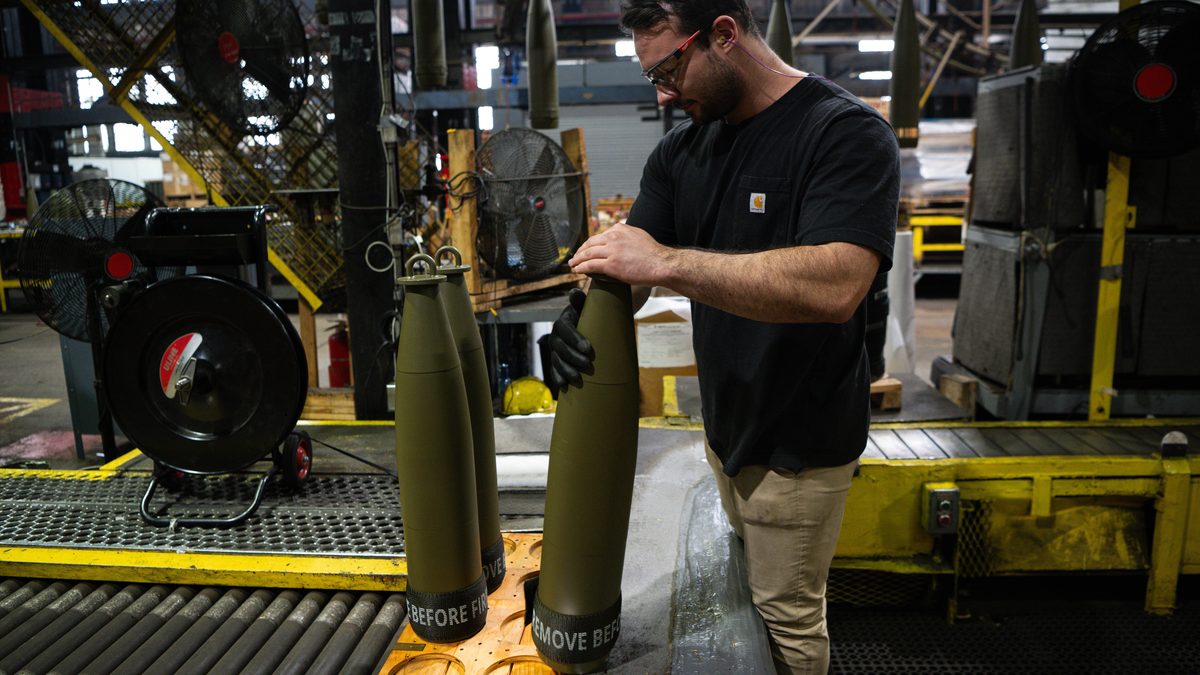
Illustrative: an employee prepares a 155mm shell at Scranton Army Ammunition Plant, Pennsylvania, 26 March 2024. A United States facility, shown as an example of the weapons and ammunition manufacturing work the MOD industry group counts; it is not a United Kingdom site. U.S. Army photo by Henry Villarama, via DVIDS. Work of the U.S. federal government, public domain.
The MOD Estimates Its “Weapons and Ammunition” Supported Jobs Rose 51 Percent. The MOD Points to Armoured Vehicle Payments
Ministry of Defence statistics published on 20 August 2026 estimate 5,900 direct full-time-equivalent jobs supported by MOD spending in the Weapons and Ammunition group, up from 3,900: a rise of 51 percent, the largest percentage increase of any group. The MOD links it to a real-terms rise in sector spending that included £200 million more in OCCAR payments for the Boxer armoured vehicle. The group counts military fighting vehicles alongside ammunition.
Technical Summary
The Ministry of Defence (MOD) published its supported employment estimates for financial year 2024/25 on 20 August 2026. Total employment supported by MOD expenditure with United Kingdom industry reached 274,000 full-time equivalent (FTE) posts, comprising 164,000 direct and 110,000 indirect estimated full-time-equivalent jobs supported, against a revised 248,000 the previous year. Direct MOD expenditure with UK industry and commerce was £31.9 billion, a real-terms increase of 6 percent. Within that total, the Weapons and Ammunition industry group rose from an estimated 3,900 direct full-time-equivalent jobs supported in 2023/24 to 5,900 in 2024/25, an increase of 2,000 and 51 percent, which the MOD identifies as the largest percentage increase of any industry group in the release. Both endpoints are rounded to the nearest 100, so the underlying change is about 1,900 to 2,100 and the derived percentage sits somewhere between roughly 48 and 55 percent.
The figure needs unpacking before it is read as evidence of munitions capacity. The MOD defines the group in the release itself: the Weapons and Ammunition Standard Industrial Classification (SIC) group "includes the manufacture of weapons, ammunition and military fighting vehicles". The MOD then identifies, as one component of the increase, a 21 percent real-terms rise in expenditure in that sector, "attributed to a £200 million increase in payments to OCCAR this year for the BOXER project". OCCAR is the Organisation for Joint Armament Cooperation. The MOD release attributes the payment increase to OCCAR and links it to the Boxer programme; the detail of OCCAR's management role is not set out in the release and is not sourced here. Boxer is a wheeled armoured vehicle. It is not ammunition, and it is not an energetic material.
"The Weapons and Ammunition industry saw the largest percentage increase (51%) in direct jobs supported by MOD expenditure from the previous year, increasing from 3,900 in 2023/24 to 5,900 in 2024/25 ... attributed to a £200 million increase in payments to OCCAR this year for the BOXER project." Ministry of Defence, MOD supported employment estimates 2024/25, 20 August 2026
Analysis of Effects
For anyone tracking UK energetics and ammunition capacity, the practical consequence is that this series cannot answer the question being asked of it. An estimate of full-time-equivalent jobs supported by departmental spending, in a group the MOD defines as covering the manufacture of weapons, ammunition and military fighting vehicles, so that vehicle and ammunition work report into one line, tells you nothing about propellant throughput, explosive fill capacity, the number of licensed filling bays, net explosive quantity (NEQ) held under licence at a given site, or 155mm output. Those are among the measures that determine whether the UK can generate and sustain a war stock, and a usable series would state output per month against requirement rather than an unqualified figure. None of them appears in this publication, and the release makes no claim that they do.
There is a second reason for caution about the size of the number. The MOD's own Key Points table attributes the rise to "a 344 million increase in spending in this sector from the previous year, when accounting for inflation" (the release omits the currency symbol; the context is sterling), while the body of the bulletin attributes it to the £200 million OCCAR increase inside a 21 percent sector rise. The release does not reconcile the two figures, so the £200 million is best read as one identified component of a larger real-terms movement rather than the whole of it. The MOD also states that industry-group job figures are rounded to the nearest 100, that contract payment data "can fluctuate naturally across years due to occurrences of large payments", and that year-on-year comparison "should be used with caution" against longer-term trend. A base of 3,900 is small enough that a single large programme payment moves the percentage a long way.
Personnel and Safety Considerations
The competence question sits underneath the capacity question and is not addressed by either. Ammunition manufacture, proof, surveillance and disposal depend on qualified populations built through competence pathways that ISC judges to be long, with no public metric identified that differ by role, and for which no comparable public qualification-pipeline or time-to-competence data was identified in the sources reviewed: ammunition technicians, explosives safety practitioners, qualified persons under Defence Safety Authority regulation DSA 03.OME, and the Government Quality Assurance Representative function exercised under Allied Quality Assurance Publication (AQAP) 2110 and Standardization Agreement (STANAG) 4107. Vehicle integration headcount does not substitute for any of these. A reader treating the 51 percent as a signal that UK explosive-ordnance skills are recovering would be drawing a conclusion the data does not support, and would be doing so in an area where ISC judges, on practitioner experience rather than on any published figure, that a shortfall is slow to reverse. No qualification-pipeline or time-to-competence data was identified to put a period on it.
Data Gaps
The release gives no indirect-jobs figure for the Weapons and Ammunition group, no regional split for it, and no narrative figures for the group before 2023/24: earlier years appear only inside Figure 7, published as an image, and the release's two supporting spreadsheets cover regional employment and the SIC group-to-class mapping, not the industry-group time series. It gives no split between ammunition and vehicle activity inside the group, no energetics or propellant sub-series, and no capacity measure of any kind. Northern Ireland Business Register and Employment Survey data was unavailable for 2024/25, so Great Britain data was used, which the MOD estimates removes roughly 1 percent of total industry jobs. Prior-year figures across the series were revised: direct jobs by up to 2 percent fewer for 2021/22 to 2023/24, indirect jobs by up to 17 percent fewer for 2022/23 and 2023/24. The publication carries Official Statistics status, not Accredited Official Statistics.
Key Questions
Did UK ammunition manufacturing jobs really rise 51% in 2024/25?
The MOD estimates that full-time-equivalent jobs supported by its expenditure in the Weapons and Ammunition industry group rose 51 percent, from 3,900 to 5,900 direct posts in 2024/25. That group also counts the manufacture of military fighting vehicles, and the MOD links the increase to a larger real-terms rise in sector spending that included £200 million more in payments to OCCAR for the Boxer armoured vehicle programme. The release does not show whether ammunition output increased.
What does the MOD Weapons and Ammunition industry group actually cover?
The MOD states the group “includes the manufacture of weapons, ammunition and military fighting vehicles”. It is a Standard Industrial Classification grouping, so armoured vehicle work, small arms, guided weapons and filled ammunition natures all report into the same line. The release publishes no split between them.
How many UK jobs does MOD spending support in total?
MOD expenditure with UK industry supported an estimated 274,000 full-time equivalent jobs in 2024/25, made up of 164,000 direct and 110,000 indirect posts, an increase of 26,000 on the revised 248,000 for 2023/24. Including civilian and UK-based military personnel, the MOD puts the total at 462,000, or one in every 60 UK jobs.
References
Source-evaluated per NATO source-evaluation doctrine, STANAG 2022 lineage (source reliability A–F / information credibility 1–6). Tier 1 = government primary source or governing standard; Tier 2 = quality news / specialist defence media; Tier 3 = authoritative aggregator, encyclopaedia or vendor primary material.
- T1Ministry of Defence (GOV.UK) – MOD supported employment estimates: 2024/25, 20 August 2026. (Reliability A / Credibility 1)
- T1Ministry of Defence (GOV.UK) – MOD supported employment estimates 2024/25, main bulletin, 20 August 2026. (Reliability A / Credibility 1)
- T1Ministry of Defence (GOV.UK) – Background quality report: MOD supported employment estimates 2024/25, 20 August 2026. (Reliability A / Credibility 1)
- T1Ministry of Defence (GOV.UK) – Annex A Regional Employment 2024/25, 20 August 2026. (Reliability A / Credibility 1)
- T2Defence Industry Europe – UK Ministry of Defence says weapons and ammunition jobs rose 51% as wider defence industry employment grew by 26,000 roles, 20 August 2026. (Reliability B / Credibility 2)
- T1Ministry of Defence (GOV.UK) – MOD regional expenditure with industry index, 2026. (Reliability A / Credibility 1)
- T1UK Defence Safety Authority – DSA 03.OME, Defence Ordnance, Munitions and Explosives Safety Regulations. Cited for the qualified-person and explosives safety competence requirements. Supersedes the withdrawn JSP 482. (Reliability A / Credibility 1)
- T1NATO Standardization Office – STANAG 4107 and AQAP-2110: mutual government quality assurance of defence products, and the NATO quality assurance requirements for design, development and production. Cited for the Government Quality Assurance Representative function. (Reliability A / Credibility 1)
- T1Ministry of Defence (GOV.UK) – 100 extra Boxer vehicles for the British Army. The programme page the statistical bulletin itself links to when attributing the sector increase to the OCCAR Boxer payment. (Reliability A / Credibility 1)
- T1Find a Tender (Crown Commercial / GOV.UK) – DGM/1911, Supply of Small Arms Ammunition, Primers and Grenades, two-year contract extension, notice 2026/S 000-013384, published 13 February 2026. Defence Equipment and Support to SwissP Defence AG, Thun, Switzerland; £42,303,333.30 excluding VAT; 1 April 2026 to 31 March 2028; direct award on technical grounds because Swiss P is the original equipment manufacturer of the in-service natures making up the current stockpile. (Reliability A / Credibility 1)
Corrections & updates welcome. If you hold open-source data that refines or corrects any parameter in this article, please contact [email protected] citing the specific claim and your source. Verified corrections will be incorporated and credited in the revision history. AI-assisted technical assessment based on open-source material. Not a formal intelligence product.