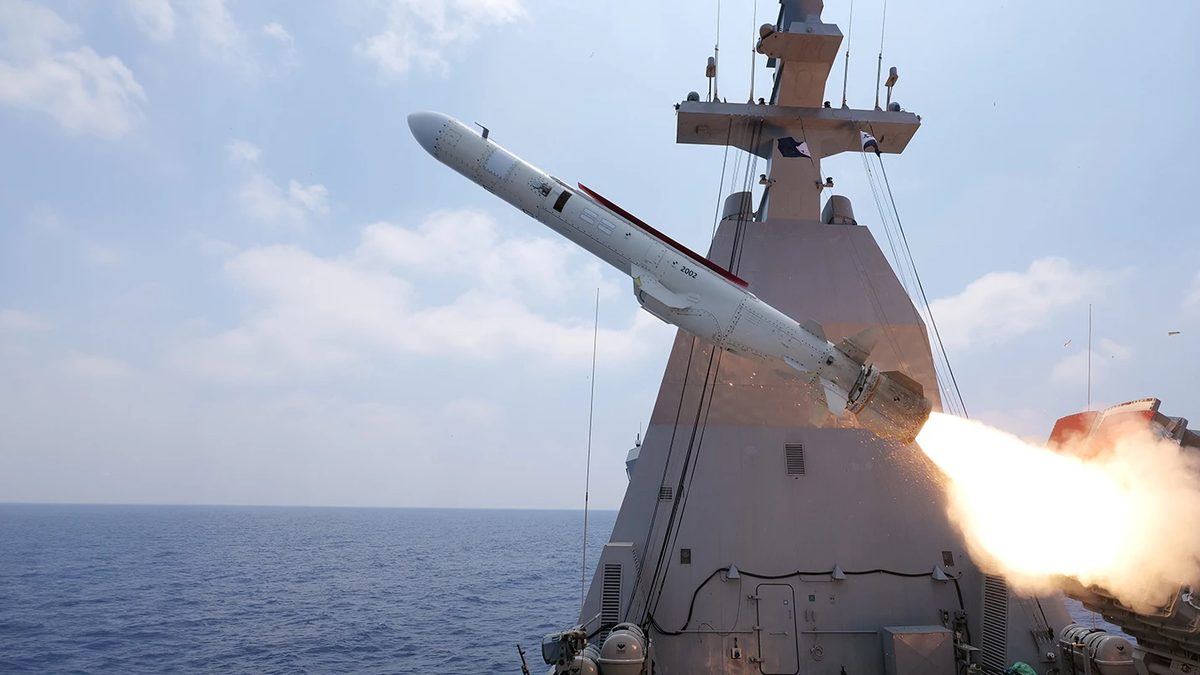
Blue Spear launch imagery published by Israel Aerospace Industries on its Blue Spear product page. IAI does not identify the launching vessel or the date, and this is not an image of RSS Steadfast. Image: Israel Aerospace Industries. © 2026 Israel Aerospace Industries, all rights reserved, reproduced here for editorial reporting.
Blue Spear Goes to Sea: The Harpoon Successor’s Launcher Photographed on RSS Steadfast
Photographs taken in Tokyo on 19 August 2026 show a Blue Spear launcher aboard RSS Steadfast, one of six Republic of Singapore Navy Formidable-class frigates. Collin Koh of the S. Rajaratnam School of International Studies called them the first such images in the public domain, and they do not establish that the class-wide conversion is complete. The missile carries a 150 kg class warhead to roughly 290 km, against about 130 km for the Harpoon it replaces.
Technical Summary
Blue Spear, marketed as the 5G SSM, a vendor label expanded as fifth-generation surface-to-surface missile rather than a defined technical generation, comes from Proteus Advanced Systems, a 50/50 joint venture formed in 2020 between Israel Aerospace Industries (IAI) and Singapore’s ST Engineering. It descends from the Israeli Gabriel family, with the baseline Gabriel V already in Finnish Navy service. Israel Aerospace Industries’ own product page gives a range of up to 290 km at a sub-sonic 0.85 Mach, a jet-propelled engine and what the company calls a highly explosive and insensitive warhead. Defence trade reporting from the 2022 Singapore Airshow puts that warhead in the 150 kg class. Guidance is built around inertial navigation, with satellite navigation in support and the manufacturer claiming resilience in degraded or denied conditions, an RF seeker head and a two-way datalink. IAI says the missile incorporates mid-course updates from real-time ISTAR feeds and overcomes both kinetic counter-fire and electronic countermeasures. The turbojet-powered round can be launched fire-and-forget or fire-and-update, flies a low sea-skimming profile, and carries a secondary land-attack mode.
The Republic of Singapore Navy (RSN) operates six Formidable-class frigates, 3,200-tonne derivatives of the French La Fayette design, on the displacement figure carried in the reference literature, which does not state whether it is standard or full load built between 2002 and 2009. Steadfast, pennant FFG 70, was launched in January 2005 and commissioned in February 2008. Each hull carried the RGM-84C Harpoon, a missile of roughly 130 km reach with no land-attack mode, in quad launchers on an open midships deck, each launcher holding four cells. The class specification lists eight rounds as the standard Harpoon fit, with structural provision for six launchers, or 24 rounds. Singapore has not confirmed the Blue Spear loadout, so the Harpoon-era figure is a baseline rather than a statement about the new weapon. The Tokyo images show a single quad launcher on Steadfast. That is launcher hardware rather than a verified round count, and it is well short of the structural provision. The class-wide position is not established in public sources, and one datum bounds it. Singapore’s Ministry of Defence published photographs of the sister ship RSS Supreme firing a Harpoon off Guam during Exercise Pacific Griffin in June 2025, fourteen months before the Tokyo sighting, so Harpoon was still in operational use on a hull of this class at that date. The upgrade work is expected to complete by 2028.
Blue Spear’s quoted 290 km reach against roughly 130 km for the RGM-84C Harpoon is not an incremental upgrade. It roughly doubles the radius from which a 3,200 tonne frigate can hold a surface target at risk. ISC open-source technical assessment, 20 August 2026
Blue Spear (5G SSM): baseline specification from open sources
| Designation | Blue Spear, marketed as 5G SSM |
| Manufacturer | Proteus Advanced Systems (IAI and ST Engineering, 50/50, formed 2020) |
| Lineage | Gabriel family; baseline Gabriel V in Finnish Navy service |
| Maximum range | Up to 290 km (IAI product page) |
| Speed and propulsion | 0.85 Mach, sub-sonic, jet propelled (IAI product page) |
| Flight profile | Low sea-skimming, in-flight path modification against moving targets |
| Warhead | 150 kg class high explosive, described as an insensitive munition |
| Net explosive quantity | Not published (data gap) |
| Hazard division / compatibility group | Not published (data gap) |
| Guidance | Inertial navigation, satellite navigation, active RF seeker, two-way datalink |
| Launch modes | Fire-and-forget or fire-and-update |
| Secondary role | Land attack |
| Warhead and booster origin | ST Engineering Land Systems designs, develops and produces the booster motor and the insensitive-munition warhead |
| Shipboard fit observed | One quad launcher (four cells) on the open midships deck; class provision for six launchers, 24 cells. Rounds embarked not disclosed |
| System replaced | RGM-84C Harpoon, about 130 km, 221 kg WDU-18/B warhead, no land-attack mode |


IAI is excited to share that the Estonian Centre for Defence Investment has selected Proteus Advanced Systems, a joint venture between IAI and ST Engineering Land Systems, to equip the Estonian Defence Forces with the advanced Blue Spear #missile systems 1/3
Israel Aerospace Industries (@ILAerospaceIAI) 6 October 2021
Analysis of Effects
The interesting number is not the range. It is the gap between the range and the ship’s own eyes. A masthead sensor roughly 30 m above the waterline, looking at a target with 10 m of freeboard, has a radar horizon near 36 km, using the standard approximation of 4.12 multiplied by the sum of the square roots of the two heights in metres. That coefficient already carries the conventional four-thirds-Earth refraction assumption. A strictly geometric line of sight, coefficient 3.57, gives about 31 km. Blue Spear’s advertised envelope is about eight times the refraction-adjusted figure. What the calculation establishes is narrow but decisive: at the advertised maximum range a mast sensor has no direct line of sight to a surface target of the assumed height, so the firing solution has to come from somewhere else. That is why the two-way datalink, the upgraded combat management system inside the mid-life package and Singapore’s separate purchase of the P-8A Poseidon all bear on whether the range is usable. Whether those elements can actually generate and hold a firing-quality track for this weapon is not established in open sources. Buying reach without buying the kill chain to feed it produces an expensive paper capability.
Geography sharpens the point. The Singapore Strait runs about 105 km end to end and the Strait of Malacca about 800 km. A 290 km envelope is 2.8 times the length of the former and about 36 per cent of the length of the latter. Those are kinematic figures rather than coverage: launch position, routing, coastal masking and target-quality data all cut into them. The direction of travel is still clear. Regional peers have been moving the same way. Indonesia fitted the supersonic Yakhont to one modified Ahmad Yani class frigate, KRI Oswald Siahaan, and test-fired it in 2011. Turkish ATMACA is on order. Malaysia’s littoral combat ship programme lost its Naval Strike Missile fit and is still hunting a replacement. Set against that, the RSN step reads less as escalation than as a refusal to fall behind.
Singapore’s Blue Spear Missile Could Double Naval Strike Reach as 8,400-Tonne MRCVs Reshape Indo-Pacific Deterrence
Defence Security Asia (@defence_asia) 8 August 2026
Personnel and Safety Considerations
For anyone who has to stow the round rather than fire it, the published figures stop just short of the useful ones. A 150 kg class figure is a nominal warhead mass, not a net explosive quantity (NEQ), and not necessarily the actual warhead section mass either. The explosive fill is a fraction of that figure and is not published. Nor is the net explosive quantity for the classified all-up round in its canister, which is the number quantity-distance work actually takes, and which is not simply the fill mass. Without it no quantity-distance calculation, stowage safety case or licensed-capacity check can be built from open sources. The hazard division (HD) and compatibility group (CG) of the all-up round in its canister are likewise absent. A hazard classification attaches to a defined packaged configuration. The division carries the predominant hazard and drives quantity-distance; the compatibility group answers what may be stowed alongside what. A complete classification needs both. The Harpoon all-up round in its launch canister is conventionally handled at HD 1.1 in the configurations for which national authorities have classified it, and the compatibility group follows from that same classification rather than from the division alone. Expecting comparable treatment for Blue Spear pending a national classification is reasonable, but a reasonable expectation is not a classification, and no classifying authority for the Singapore configuration is identified in open sources. The insensitive-munition claim carries a second caveat. STANAG 4439 and AOP-39 are not public documents, and the description of them used here follows NATO’s own published educational material on insensitive-munitions testing and assessment. Neither Israel nor Singapore is bound by STANAG 4439, the NATO policy for the introduction of insensitive munitions, so any obligation to qualify the warhead against the response tests set out in AOP-39, its supporting guidance, would have to come from a national regulator or from the contract rather than from that policy. No such requirement is named in any source located for this assessment. That question points at Singapore rather than at Israel, because ST Engineering Land Systems, not IAI, designs and produces the insensitive-munition warhead and the booster motor. The phrase therefore describes a design intent whose qualifying test regime, covering fast and slow cook-off, bullet and fragment impact, shaped-charge jet impact and sympathetic reaction, is not named in any source located for this assessment. On a 3,200-tonne hull with structural provision for 24 rounds on an exposed deck, that response profile is one of the larger terms in how bad an event on that deck gets, alongside ship design, siting, mitigation and damage control. What is actually embarked on any given sailing is not disclosed.
What Is Not a Blue Spear Specification
A cluster of precise-looking numbers circulates against this missile that neither Israel Aerospace Industries nor ST Engineering has published for it. A 5.5 m length and a 1,250 kg launch weight belong to the related Gabriel V, known in Finnish service as PTO 2020, and should not be carried across. A 400 km range appears in no manufacturer material located for this assessment, which consistently says 290 km. A 2.5 m sea-skimming height attaches to Gabriel-family reporting rather than to any Blue Spear figure. Length, launch weight, circular error probable and unit price were not found in any source reviewed here. Treating a Gabriel V data sheet as a Blue Spear one is the commonest error in the secondary coverage.
Data Gaps
Net explosive quantity and explosive fill type are not published. Hazard division and compatibility group for the all-up round in its canister are not published. The insensitive-munition qualification standard and its test regime are not named. The number of rounds actually embarked, and whether all six hulls have been converted, are not disclosed. No unit price or contract value for the Blue Spear element of the mid-life upgrade has been released, and Singapore has not confirmed whether it bought the land-attack mode. IAI publishes the cruise speed as 0.85 Mach but not the sea-skimming altitude band. and describe the approach only as low sea-skimming, with no altitude band. The seeker band and acquisition range, and the datalink band, range and interface, are not published either, which matters because the whole over-the-horizon argument rests on them. One further limit matters. The photographs establish that a launcher is fitted. They do not establish a round count, and they do not establish that the system has been accepted into service.
Key Questions
What is the Blue Spear missile?
Blue Spear, also called the 5G SSM, is a subsonic anti-ship and land-attack missile built by Proteus Advanced Systems, a joint venture between Israel Aerospace Industries and ST Engineering. It descends from the Israeli Gabriel family, carries a 150 kg class warhead and has a published range of about 290 km.
How much further will Blue Spear let Singapore's frigates shoot?
On published figures the envelope goes from roughly 130 km for the RGM-84C Harpoon to about 290 km, roughly double, once the weapon is in service. Blue Spear is also offered with a secondary land-attack mode, though Singapore has not confirmed whether it bought that option.
Has Singapore confirmed the Blue Spear fit officially?
The programme is confirmed, the class-wide conversion is not. Singapore's Ministry of Defence stated in a March 2022 fact sheet that Blue Spear would replace Harpoon under the mid-life upgrade, and photographs of RSS Steadfast on 19 August 2026 show a launcher fitted. Sister ship RSS Supreme still fired a Harpoon in June 2025.
References
Source-evaluated per NATO source-evaluation doctrine, STANAG 2022 lineage (source reliability A–F / information credibility 1–6). Tier 1 = government or primary-party source, including a contracting company’s own announcement; Tier 2 = quality news / specialist defence media; Tier 3 = authoritative aggregator / encyclopaedia.
- T1Singapore Ministry of Defence – Fact Sheet: Mid-life Upgrades to Formidable-class Frigates, 2 March 2022. (Reliability A / Credibility 1)
- T1Singapore Ministry of Defence – Reply to Media Queries from Janes and Shephard Media on Formidable-class Frigates’ Mid-Life Upgrade Programme, 5 May 2023. (Reliability A / Credibility 1)
- T1ST Engineering – ST Engineering Awarded Contract for Mid-Life Upgrade of Formidable-class Frigates, 14 December 2023. (Reliability A / Credibility 2)
- T2The War Zone (TWZ) – Singapore’s Formidable Class Frigate Appears Armed With Blue Spear Anti-Ship Missiles, 19 August 2026. (Reliability B / Credibility 2)
- T2Naval News – Estonia’s Blue Spear AShM System achieves IOC, 12 February 2024. (Reliability B / Credibility 2)
- T2Defense News – Singapore, Israeli firms team to develop new ship-killing missile, 28 July 2020. (Reliability B / Credibility 2)
- T2Defense News – Proteus reveals more details of Blue Spear missile, 15 February 2022. (Reliability B / Credibility 2)
- T1Republic of Singapore Navy – Fact Sheet: The Republic of Singapore Navy’s Formidable-class Frigates and Sikorsky S-70B Seahawk Naval Helicopters, 21 July 2018. (Reliability A / Credibility 1)
- T1NATO Science and Technology Organization – Insensitive Munitions Testing and Assessments (STO-EN-AVT-214), accessed 20 August 2026. (Reliability A / Credibility 1)
- T1Singapore Ministry of Defence – Singapore and US Navies Conduct Bilateral Exercise Pacific Griffin, 19 June 2025 (records RSS Supreme firing a Harpoon). (Reliability A / Credibility 1)
- T2Koji Inoue (@kojiinet) – Photographs of RSS Steadfast arriving at the Tokyo International Cruise Terminal, 19 August 2026 (the primary imagery on which the sighting rests). (Reliability B / Credibility 2)
- T1Israel Aerospace Industries – Blue Spear: Surface to Surface Missile (SSM), product page, accessed 20 August 2026. (Reliability A / Credibility 2, manufacturer primary)
- T2Collin Koh (@CollinSLKoh), S. Rajaratnam School of International Studies – Assessment that these are the first public-domain images of Blue Spear aboard RSS Steadfast, 19 August 2026. (Reliability B / Credibility 2, named subject-matter expert)
- T1Israel Aerospace Industries (@ILAerospaceIAI) – Announcement that the Estonian Centre for Defence Investment selected Proteus Advanced Systems for Blue Spear, 6 October 2021. (Reliability A / Credibility 2, manufacturer primary)
- T2Defence Security Asia (@defence_asia) – Blue Spear strike reach and the Multi-Role Combat Vessel programme, 8 August 2026. (Reliability C / Credibility 3)
Corrections & updates welcome. If you hold open-source data that refines or corrects any parameter in this article, please contact [email protected] citing the specific claim and your source. Verified corrections will be incorporated and credited in the revision history. AI-assisted technical assessment based on open-source material. Not a formal intelligence product.