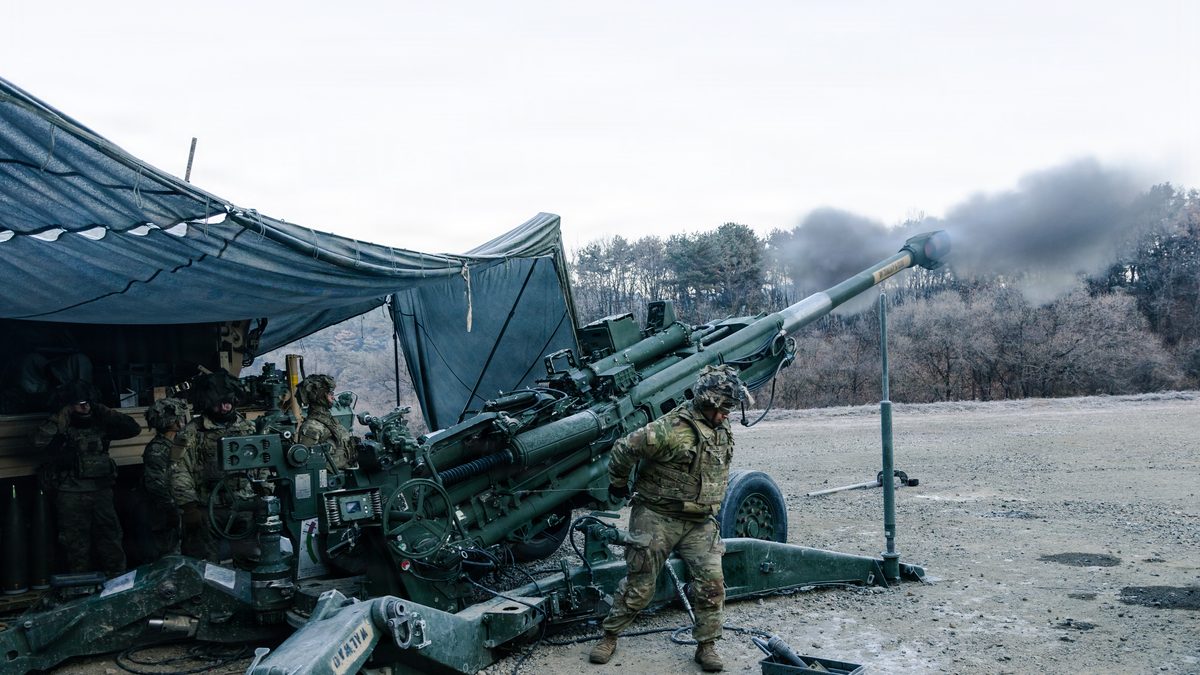
Artillerymen of 2nd Battalion, 12th Field Artillery Regiment, 1st Stryker Brigade Combat Team, 4th Infantry Division fire an M777 towed howitzer at Rodriguez Live Fire Complex, South Korea, 19 December 2025. U.S. Army photo by Sgt. Fabrice Bodjona (public domain, via DVIDS). Illustrative: the M777 is the system the Mobile Tactical Cannon would replace in select formations. Not a K9MH.
Six Prototypes, Up to Eighteen Systems: The US Army Picks Hanwha’s Wheeled K9 for Mobile Tactical Cannon
On 18 August 2026 the US Army awarded Hanwha Defense USA a competitively selected, firm fixed price Other Transaction agreement worth $100,302,961 for six wheeled 155 mm self-propelled howitzer prototypes under the Mobile Tactical Cannon programme, with a priced option for twelve more that lifts the cumulative face value to $262,903,274. Hanwha is supplying the K9 Mobile Howitzer. No fielding decision has been taken.
Technical Summary
The US Army announced the agreement on 18 August 2026. It was competed and awarded under Other Transaction Authority at 10 U.S.C. § 4022, on firm fixed price terms, to Hanwha Defense USA of Arlington, Virginia. The stated value of the action is $100,302,961 against a total cumulative face value of $262,903,274. Six prototype systems are to be delivered on an accelerated schedule, with a priced option for a further twelve, giving a ceiling of eighteen wheeled self-propelled howitzers across an estimated four-year period of performance. The Army release names no platform. Hanwha’s own release, issued the same day, confirms the offering is the K9 Mobile Howitzer, designated K9MH. Competitors reported in the running included American Rheinmetall, BAE Systems, General Dynamics Land Systems and Elbit Systems of America.
#NEWS: The @USArmy just awarded us a contract to deliver prototype K9 Mobile Howitzers for the Army’s new Mobile Tactical Cannon program.
— Hanwha Defense USA (@HanwhaDefenseUS) August 18, 2026
We were born ready to be the Army’s long-term artillery modernization partner.
Read more: https://t.co/rTHK6xUs5A pic.twitter.com/Nbv8aJM8Dr
The K9MH is the wheeled member of the K9 family. Hanwha states that more than 2,500 K9 howitzers have been fielded worldwide, with operators including South Korea, Australia, Egypt, Estonia, Finland, India, Norway, Poland and Türkiye. Wheeled and tracked variants share the same 155 mm 52 calibre ordnance, which Hanwha describes as compliant with the Joint Ballistics Memorandum of Understanding (JBMoU). Specialist reporting places the gun on a Tatra T815-7 8x8 chassis, with an armoured cab for a crew of three and an unmanned, fully automated turret. A redesigned dual-feed autoloader that handles projectile and charge in parallel lifts the maximum rate of fire to 8 or 9 rounds per minute, against 6 to 8 on the K9A1. Onboard capacity is 40 rounds, replenished by the companion K10 automated resupply vehicle. The company states compatibility with the full US Army munitions suite and points to a live-fire demonstration at Yuma Proving Ground. ISC has seen no test report behind that claim and treats it as a vendor assertion pending Army data.

A 52 calibre 155 mm tube measures about 8.06 m. The M777’s 39 calibre tube measures about 6.05 m. Two metres of additional barrel, not the wheels, is where most of the claimed range increase originates. ISC technical assessment, derived from stated calibre lengths
Analysis of Effects
Range is the headline and the least interesting part of it. Open reporting puts the K9MH beyond 40 km on standard natures and past 60 km on rocket-assisted projectiles, against an M777 credited with a little under 32 km even on specialised rounds. Hanwha does not name the projectile and charge combination behind its own top figure. The number that matters more in 2026 is the clock, and the clock is where the open sources stop agreeing. Hanwha markets emplacement or displacement in under 30 seconds. Specialist reporting of the demonstrations puts withdrawal nearer 50 seconds. That gap deserves more scrutiny than the range claim, because BAE Systems advertises the Archer as stopping and firing inside 20 seconds and moving again within 20. Cheap sensors and loitering munitions have compressed the counter-battery timeline to the point where the gun that cannot leave is the gun that does not survive. The Army names survivability on a “highly transparent battlefield” as a reason for the programme, and that phrasing is doing more work than any range figure.
Ammunition interoperability decides whether any of this converts into fielded capability. A 52 calibre barrel built to the JBMoU standard uses a nominal 23 litre chamber, and that chamber is the interface that lets allied gunners fire each other’s projectiles and propelling charges. Hanwha asserts compliance for the common gun system. Proving it in American hands means firing the M231 and M232A1 Modular Artillery Charge System (MACS) increments, the M795 high-explosive projectile and precision natures such as the M982 Excalibur, then building the ballistic and safety data a US Army firing table needs. That is the real content of a four-year experimentation phase. The industrial half of the award carries the longer tail. Hanwha has signed a three-year lease on a phase one integration and test facility at Opelika, Alabama, and cites local production in Australia, Egypt, Poland and Romania as the template it intends to repeat.
Personnel and Safety Considerations
Three practical consequences follow for ammunition technicians and explosive safety staff. First, an onboard magazine of 40 complete rounds with their propelling charges places a meaningful net explosive quantity (NEQ) inside a crewed armoured vehicle rather than in a separate ammunition vehicle, so vehicle-level hazard division and compatibility group assignment, firefighting policy and separation distances have to be established from test data rather than inherited from the M777 detachment model. Second, an automated loading system takes hands off the breech and rewrites the failure modes: an unmanned turret keeps the crew out of the ammunition handling cycle, which is a gain, but a stoppage with a charge partly rammed is a different problem from a manual misfire, and drills, extraction tooling and the misfire waiting period need writing rather than adapting. Third, a foreign-designed gun entering US Army service requires its own safety confirmation and firing tables before Soldiers handle live natures on it, work that sits under the Defense Explosives Safety Regulation (DESR) 6055.09 Edition 1 Change 2 for storage and siting and under the Army materiel release process for the system itself. No open source published to date states the vehicle NEQ, the hazard division or the compatibility group under which a loaded K9MH would be handled.
Data Gaps
Neither release closes the questions that matter to a gunner or a safety officer. Two gaps have been closed by specialist reporting rather than by Army or company documents: the rate of fire is 8 or 9 rounds per minute on a dual-feed autoloader, and the demonstrated base vehicle is a Tatra T815-7 8x8 with a three-crew armoured cab. Four remain open. One: Hanwha does not name the projectile and charge combination behind the figure just past 60 km, so it cannot be compared like for like with the M777. Two: Hanwha asserts JBMoU compliance for the common gun system, and no open source confirms chamber conformance for the wheeled variant specifically. Three: vehicle NEQ, hazard division and compatibility group are unpublished, as are gross vehicle weight, protection level and US transportability data. Four: the timing figures do not agree, with a company claim of under 30 seconds for emplacement or displacement against reporting of roughly 50 seconds for withdrawal, and no Army-measured timing exists in the public record. Separately, a future requirement near 500 systems circulates in South Korean reporting and appears in no Army document. Read it as market commentary, not a plan.
Key Questions
What did the US Army actually buy from Hanwha?
A prototype agreement, not a production run. The Army committed $100,302,961 for six wheeled 155 mm self-propelled howitzer prototypes under Other Transaction Authority, with a priced option for twelve more. The $262,903,274 ceiling covers up to eighteen systems for testing and Soldier experimentation across roughly four years.
Will the K9MH replace the M777 howitzer?
Not yet, and not everywhere. The Army says that if fielding is approved, the Mobile Tactical Cannon will replace M777 towed howitzers in select formations. Earlier contracting material pointed at Stryker brigade combat teams first. No fielding decision has been taken and no production quantity has been set.
Why does a Korean company winning a US Army contract matter?
It is the first US Army prototype award to a South Korean firm for a complete weapon system. Hanwha is anchoring the work at Opelika, Alabama, on a three-year lease for a phase one integration and test site, which puts Korean artillery manufacturing inside the American defence industrial base.
References
Source-evaluated per NATO source-evaluation doctrine, STANAG 2022 lineage (source reliability A–F / information credibility 1–6). Tier 1 = government primary source; Tier 2 = quality news / specialist defence media; Tier 3 = authoritative aggregator / encyclopaedia.
- T1U.S. Army – Army selects Mobile Tactical Cannon prototype system to advance Fires modernization, 18 August 2026. (Reliability A / Credibility 1)
- T1Hanwha Defense USA – Hanwha Wins U.S. Army Mobile Tactical Cannon Contract, 18 August 2026. (Reliability C / Credibility 2, vendor primary source, interested party)
- T2The War Zone (TWZ), Joseph Trevithick – South Korea’s Highly Mobile 155mm Artillery System Wins U.S. Army Howitzer Contract, 18 August 2026. (Reliability B / Credibility 2)
- T2Breaking Defense – Army picks Hanwha’s wheeled K9 for self-propelled howitzer prototypes, 18 August 2026. (Reliability B / Credibility 2)
- T2Stars and Stripes – US, South Korea cut joint exercise short after Trump calls for fewer drills, 18 August 2026. (Reliability B / Credibility 2)
- T2Al Jazeera – South Korea, US scale back annual military drills after Trump’s order, 19 August 2026. (Reliability B / Credibility 2)
- T2Army Recognition, Erwan Halna du Fretay – South Korea K9MH 155mm Mobile Howitzer Raises Fire Rate to 9 RPM with New Autoloader, 15 April 2026. (Reliability B / Credibility 2, autoloader, chassis and timing detail)
- T3BAE Systems – ARCHER, Power Under Pressure, accessed 19 August 2026. (Reliability C / Credibility 3, vendor comparison baseline)
Corrections & updates welcome. If you hold open-source data that refines or corrects any parameter in this article, please contact [email protected] citing the specific claim and your source. Verified corrections will be incorporated and credited in the revision history. AI-assisted technical assessment based on open-source material. Not a formal intelligence product.