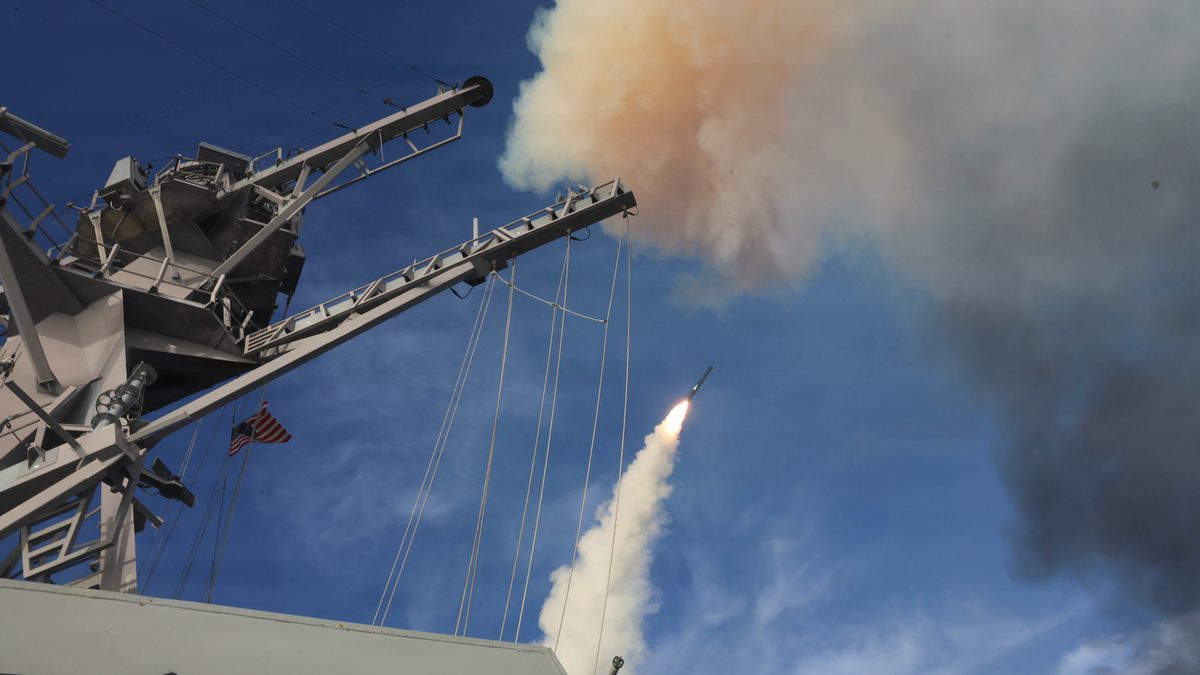
Arleigh Burke-class guided-missile destroyer USS Thomas Hudner (DDG 116) fires a Tomahawk land attack missile during Operation Epic Fury, 21 March 2026. U.S. Navy photo via DVIDS (image 9579229, U.S. Central Command Public Affairs). Public domain work of the U.S. Government; use does not imply endorsement.
22.9 Billion Dollars Buys a Rate, Not a Missile: What 1,000 Tomahawks a Year Asks of the Energetics Base
On 17 August 2026 the US Department of War announced a 22.9 billion dollar, seven-year US Navy award to Raytheon, an RTX business, to lift Tomahawk output above 1,000 missiles a year. Raytheon puts the current build rate at 60 rounds a year, so the award buys a roughly 17-fold rate increase rather than a single new capability.
Technical Summary
The Department of War announced on 17 August 2026 a 22.9 billion dollar contract with Raytheon, an RTX business, awarded by the US Navy, to accelerate production of the Tomahawk Land Attack Missile of the BGM-109 family. Under Secretary of War for Acquisition and Sustainment Michael P. Duffey framed the award as industry answering a departmental call to expand munitions production, and Acting Secretary of the Navy Hung Cao described it as accelerating delivery at unprecedented speed. The contracting organisation is Portfolio Acquisition Executive Munitions, a Department of the Navy body that consolidates naval weapons programmes and the associated weapons industrial base. Raytheon's own statement describes a seven-year term and annual output rising above 1,000 missiles, and Reuters reports that the award formalises a framework agreement the department and the company signed in February 2026, so the rate target predates this contract rather than originating in it.
That target has to be read against the baseline. Raytheon, in a statement reported by Reuters, puts current Tomahawk output at 60 rounds a year. Against procurement the gap is wider still: the Center for Strategic and International Studies puts Tomahawk procurement at an average of 86 rounds a year across fiscal years 2015 to 2026, and Navy Times reports Congress funded 55 rounds in fiscal year 2026 at about 258 million dollars. A target above 1,000 rounds a year is therefore a rate multiple of roughly 17 against build and roughly 12 against that procurement average. Nothing in the announcement changes the round itself. The Block V family retains the WDU-36/B warhead, a blast-fragmentation unit of the nominal 1,000 lb class whose actual mass is approximately 310 kg, carrying a main charge of approximately 120 kg of PBXN-107, a charge-to-weight ratio of about 39 per cent, initiated through an explosive train of the FMU-148 fuze and the BBU-47 fuze booster, the booster loaded with PBXN-7. That combination is not incidental. On the published programme account, China Lake designed and qualified the WDU-36/B in 48 months specifically to meet an insensitive munitions compliance requirement alongside range enhancement, with the FMU-148 fuze and the PBXN-7-loaded BBU-47 booster developed and qualified for that application. The route taken for that requirement on this round was a cast-cured polymer-bonded fill rather than a melt-cast one, and a cast-cured charge occupies its mould for a fixed cure period, which is what makes cure cycle time rather than shift pattern the governing constraint on output. Insensitive munitions compliance can be met by other formulation routes; the narrower point is that the route this round took is a dwell-limited one. Launch energy comes from the Mk 135 solid propellant booster before the turbofan sustainer takes the cruise phase. The award buys throughput of those components, not a redesign of them.
At approximately 120 kg of PBXN-107 per round, a 60-round year consumes about 7.2 tonnes of main-charge explosive. A 1,000-round year consumes about 120 tonnes. The contract is signed; that additional 113 tonnes a year of qualified energetic fill is not. ISC assessment, derived from published per-round charge mass and the stated rate target
Analysis of Effects
For Weapons, Ordnance, Munitions and Explosives practitioners the interesting quantity in this award is not the dollar figure but the mass flow it implies. Taking the published WDU-36/B main charge of approximately 120 kg of PBXN-107 and applying it to the stated rate, and assuming for the calculation a uniform WDU-36/B fit across the quantity, annual main-charge consumption on this line moves from roughly 7.2 tonnes at 60 rounds a year to roughly 120 tonnes at 1,000 rounds a year, an increase of about 113 tonnes. That uniform fit is an ISC modelling assumption rather than a stated fact, since the variant split across the seven years is recorded below as a data gap, and a mixed fit would move the figure. The charge mass is itself quoted to two significant figures, so a tolerance of plus or minus 10 kg spans roughly 103 to 122 tonnes. PBXN-107 is a cast-cured, RDX-based polymer-bonded composition, so that figure is a direct claim on nitramine feedstock and on cast-cure bay availability. Cure time is the parameter that resists money most stubbornly: a charge occupies its mould for a fixed period however urgent the requirement, so capacity scales with bay count and floor area rather than with shift patterns. The same logic applies in miniature to the BBU-47 booster and its PBXN-7 fill, and with different chemistry to the Mk 135 solid rocket motor, whose grain competes for the same national ammonium perchlorate and cast-and-cure infrastructure that every other expanding US missile programme is now bidding for. Both of those energetic items sit outside the prime named on the contract. L3Harris states that it produces the Mk 135 booster and loads the WDU-36/B with its PBXN-107 fill, so a 17-fold airframe rate lands on a second company for the two parts of the round that are actually energetic. That company is absorbing its own ramps at the same time, having announced framework agreements in July 2026 to quadruple THAAD propulsion output and to raise its PAC-3 MSE propulsion production. The Tomahawk rate target is competing for loading and motor capacity with the interceptor programmes rebuilding after the same conflict.
The second-order consequence is explosives-safety infrastructure, and it is routinely underestimated in rate-increase announcements. Higher throughput raises the standing net explosive quantity held at every node between the energetics plant and the final assembly line: charge plant, transit packaging, intermediate holding, all-up-round assembly, and the depot stocks that buffer delivery to the fleet. Each node is licensed against a quantity-distance relationship under the DoD Explosives Safety Regulation, DESR 6055.09 Edition 1 Change 2, and once the licensed net explosive quantity for a potential explosion site is exceeded, the remedy is a new safety case, additional earth-covered magazines, or greater separation distance. None of those is delivered on a contract-award timescale. The Iran conflict expenditure that motivated this award shows the asymmetry in numbers. CSIS records more than 1,000 Tomahawks expended during the Iran War against a pre-war inventory in the low 3,000s, and counts 850 launched in Operation Epic Fury alone, which CSIS assesses as more than the 802 fired during the 2003 invasion of Iraq and the heaviest use of the round in any single campaign. Set against a 60-round build year, that single operation consumed something over fourteen years of output. The replacement side moves on a different clock. The Navy requested 785 Tomahawks in the fiscal year 2027 budget, and on the CSIS reading of current departmental delivery projections those rounds begin arriving in March 2030 after 34 months of production lead time, with the missiles fired at Iran not fully replaced until late 2030. That request is itself smaller than the quantity expended. Expenditure is limited by sortie rate and target sets. Replenishment is limited by cure cycles, qualified fill capacity and magazine licensing, and those are measured in construction seasons.
Personnel and Safety Considerations
Complete Tomahawk all-up rounds combine a solid rocket motor with a high-explosive blast-fragmentation warhead, so the storage, handling and transport hazard classification for the assembled round is the assignment made for that packaged configuration under test, not a value read off the warhead alone. The specific hazard division and compatibility group for the current Block V all-up round in its shipping and stowage configuration is not stated in the open sources supporting this article and is recorded below as a data gap. Two further constraints sit behind the headline rate. The first is that a capacity target is not a production rate. CSIS, reading the departmental budget materials, sets out three published rates: a minimum sustaining rate, an economical rate based on a single eight-hour shift five days a week, and a maximum surge rate achievable only with existing or prior-year tooling, and it notes that reaching the surge figure still requires hiring and supply-chain resolution. The second is the allied queue. On the CSIS accounting, Japan has 400 rounds on order, Australia more than 200 and the Netherlands 175, and CSIS notes reporting that the Japanese delivery may slip while the department prioritises US stocks. Those orders total at least 775 rounds, and they draw on the same warhead loading and motor capacity as the US replenishment. Practitioners planning against this rate increase face three practical questions: whether the receiving site's licensed net explosive quantity accommodates the buffer stock implied by a 17-fold delivery rate; whether intermediate-magazine and inhabited-building distances remain satisfied at that higher holding; and whether additional cast-cure and motor-loading capacity is being licensed in parallel with the production contract or sequentially behind it. Historically the sequential answer is the one that binds.
Data Gaps
The following are not established in the open sources supporting this article and should not be inferred. First, the hazard division and compatibility group assigned to the Block V all-up round in its current shipping and stowage configuration, and the corresponding net explosive quantity per packaged unit. Second, the TNT-equivalence factor applied to PBXN-107 for quantity-distance purposes in current US and NATO practice, which governs how the additional tonnage translates into separation distance; the governing figure sits in the Joint Hazard Classification System entry rather than in open literature, and should be drawn from there rather than assumed at unity. Third, the variant split within the seven-year quantity, which determines whether warhead demand is uniformly WDU-36/B. Fourth, whether the award funds new energetics or solid rocket motor capacity directly, or assumes that capacity is funded through separate industrial-base lines. Fifth, the delivery profile across the seven years, without which the 1,000-round figure cannot be read as either a steady state or a terminal-year peak. Sixth, and central to the argument above, the cure cycle duration for the PBXN-107 charge: no figure for mould occupancy per charge appears in the open sources supporting this article, so the cure constraint is asserted qualitatively here and cannot be converted into a bay count. Seventh, the PBXN-7 charge mass in the BBU-47 booster and the propellant grain mass of the Mk 135 booster motor, neither of which is stated in these sources, so the booster and motor demand implied by the rate increase is described in this article directionally and not quantified.
Key Questions
How many Tomahawk missiles does the US currently build each year?
Raytheon, reported by Reuters, puts current output at 60 Tomahawk missiles a year. CSIS puts procurement at an average of 86 rounds a year across fiscal years 2015 to 2026, and Congress funded 55 rounds in fiscal year 2026. The 22.9 billion dollar award announced on 17 August 2026 targets more than 1,000 a year, roughly a 17-fold increase on the build baseline.
Why is explosive fill the limiting factor in scaling missile production?
The Tomahawk WDU-36/B warhead carries approximately 120 kg of PBXN-107, a cast-cured polymer-bonded explosive. Cast-cured charges occupy a mould for a fixed cure period, so capacity grows by adding cure bays and buildings rather than shifts. Moving from 60 to 1,000 rounds a year implies about 113 additional tonnes of qualified fill annually.
What does a higher production rate mean for ammunition storage sites?
Higher throughput raises the standing net explosive quantity at every node from charge plant to depot. Each site is licensed against quantity-distance criteria, so exceeding the licensed net explosive quantity requires a revised safety case, additional earth-covered magazines or greater separation distance. None of those is deliverable on a contract-award timescale.
References
Source-evaluated per NATO source-evaluation doctrine, STANAG 2022 lineage (source reliability A–F / information credibility 1–6). Tier 1 = government primary source; Tier 2 = quality news, specialist defence media, established research institute, or corporate primary source for a statement about the company's own work; Tier 3 = authoritative aggregator / encyclopaedia.
- T1US Department of War – Department of War and RTX Accelerate Critical Munitions Production Through Navy Tomahawk Award, 17 August 2026. (Reliability A / Credibility 1)
- T2Stars and Stripes – Raytheon to dramatically expand Tomahawk production under $22.9 billion deal, 18 August 2026. (Reliability B / Credibility 2)
- T2The Aviationist – RTX Receives $22 Billion Contract to Accelerate Tomahawk Production, 18 August 2026. (Reliability B / Credibility 2)
- T2Center for Strategic and International Studies – Rebuilding U.S. Missile Inventory: A Multiyear Project (Cancian and Park), 27 May 2026. (Reliability B / Credibility 2)
- T2L3Harris Technologies – Tactical Tomahawk (capability page stating Mk 135 booster production and WDU-36/B warhead loading), accessed 19 August 2026. (Reliability B / Credibility 2)
- T2Reuters via Defense News – US awards Raytheon $22.9 billion deal to boost Tomahawk output, 17 August 2026. (Reliability B / Credibility 2)
- T2Center for Strategic and International Studies – The 850 Tomahawks Launched in Operation Epic Fury Is the Most Fired in a Single Campaign, 2026. (Reliability B / Credibility 2)
- T2Navy Times – US Navy seeks 1,200% increase in Tomahawk missile procurement for 2027, 7 April 2026. (Reliability B / Credibility 2)
- T2L3Harris Technologies – L3Harris Signs Framework to Quadruple THAAD Propulsion Production, 27 July 2026. (Reliability B / Credibility 2)
- T3GlobalSecurity.org – Explosives - Compositions (China Lake WDU-36 programme account, PBXN-7 and PBXN-107), accessed 19 August 2026. (Reliability C / Credibility 3)
- T3Federation of American Scientists – BGM-109 Tomahawk - Smart Weapons, accessed 19 August 2026. (Reliability C / Credibility 3)
Corrections & updates welcome. If you hold open-source data that refines or corrects any parameter in this article, please contact [email protected] citing the specific claim and your source. Verified corrections will be incorporated and credited in the revision history. AI-assisted technical assessment based on open-source material. Not a formal intelligence product.