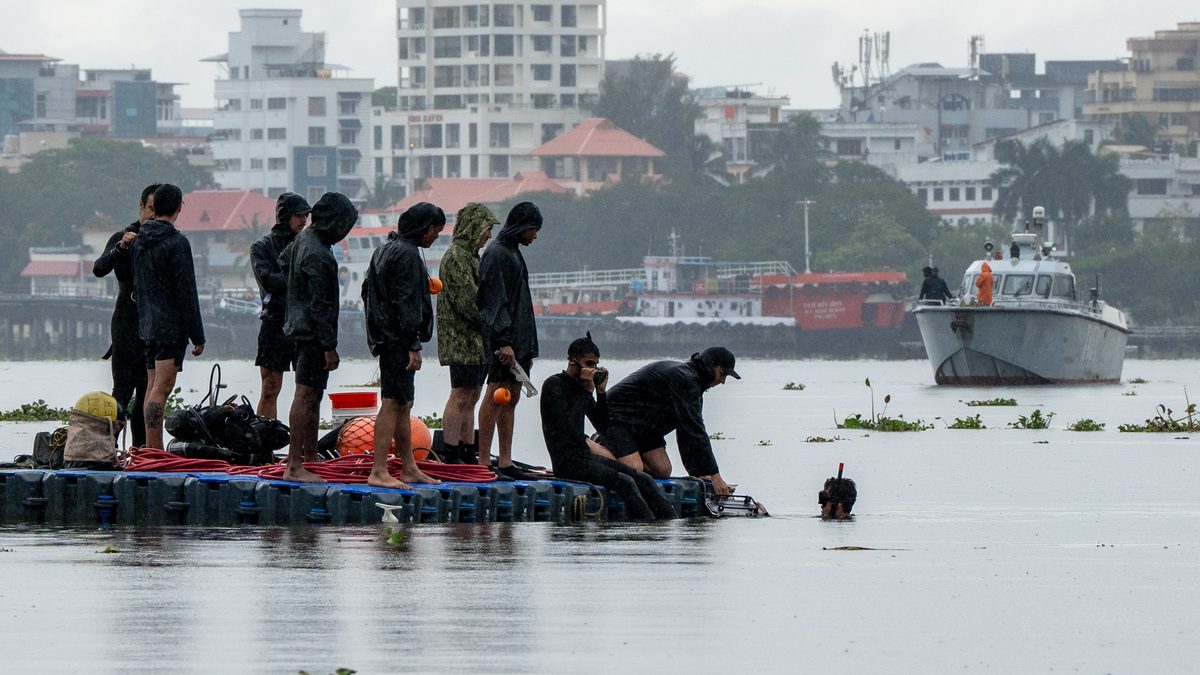
Kochi, India, 3 July 2023: a diver of Mobile Diving and Salvage Unit One surveys the working area during a joint diving-and-salvage exercise with the Indian Navy, the seventh edition of this bilateral series. U.S. Navy photo by Mass Communication Specialist 2nd Class Jomark A. Almazan/Released; public domain, via the Defense Visual Information Distribution Service (asset image:7908688). Illustrative: the imagery is from the 2023 serial, not the August 2026 exercise.
India and the United States Close an Eighth Joint Explosive Ordnance Disposal Exercise at Kochi
The eighth Indian Navy and United States Navy Explosive Ordnance Disposal Exercise ran at Southern Naval Command, Kochi, from 10 to 14 August 2026. Across five days the two navies worked underwater improvised explosive device threats, render-safe procedure doctrine, mine neutralisation and unmanned underwater systems, plus wreck location, salvage and specialist equipment employment.
Technical Summary
Agency reporting on 17 August 2026, carrying an Indian Ministry of Defence statement, recorded that the eighth edition of the Indian Navy and United States Navy Explosive Ordnance Disposal (EOD) Exercise 2026 had concluded at Southern Naval Command, Kochi, on 14 August. ISC has not located a Press Information Bureau release covering the conclusion, so the closing detail below rests on that agency reporting rather than on a government primary source, and is rated accordingly. The Press Information Bureau release of 9 August set the serial at five days, 10 to 14 August, framed it around the specialist diving and EOD teams of both navies rather than around a fleet or formation manoeuvre, and stated that the two navies "have been conducting joint Salvage and EOD exercises since 2005" and that the engagement "marks the eighth edition of this specialised bilateral training exercise". The ordinal is therefore the Ministry's own count, not an ISC reconstruction. The Press Information Bureau release closing the previous serial uses the same anchor year and the preceding ordinal, describing "the Seventh edition" of the Indian Navy and United States Navy Salvage and Explosive Ordnance Disposal exercise, SALVEX, at Kochi from 26 June to 6 July 2023. The two releases therefore place both events in one series running from 2005, and that continuity is the Ministry's claim rather than an ISC inference. What has changed is the packaging. The 2023 serial committed two ships, INS Nireekshak and USNS Salvor, alongside the specialist diving and EOD teams, was described by the Press Information Bureau as "spanning over 10 days", and covered EOD on land as well as at sea. The 2026 serial runs 10 to 14 August, names no ships, drops the SALVEX title in the official releases and confines itself to diving and underwater EOD.
The declared content is squarely underwater EOD (UWEOD) rather than land clearance. Subject Matter Expert Exchanges covered real-time improvised explosive device (IED) threats, render-safe procedure (RSP) doctrine, mine neutralisation and the employment of unmanned underwater systems. The cross-training phase added wreck location and salvage, specialist equipment employment and slithering operations. No ordnance natures, Hazard Division and Compatibility Group assignments, Net Explosive Quantity (NEQ) figures or disposal charge weights were released, which is normal for a bilateral training announcement and is recorded below as a data gap rather than an omission.
Subject Matter Expert Exchanges covered real-time threats from Improvised Explosive Devices, render-safe procedures, mine neutralisation, and employment of unmanned underwater systems. Indian Ministry of Defence statement, as reported by ANI News, 17 August 2026
Analysis of Effects
For a WOME readership the significant word in the release is unmanned. Placing unmanned underwater systems alongside mine neutralisation in the same Subject Matter Expert Exchange puts remote identification and neutralisation on the same syllabus footing as diver-delivered work. That is a statement about the training package, not evidence that either navy has adopted remote neutralisation as declared operational practice. The release names no system and claims no disposal outcome. The operational driver is exposure. A diver working an underwater item of ordnance accepts two distinct hazard sets that a remotely operated or autonomous vehicle does not. The first is blast loading: shock front and peak overpressure. The second is the diving physiological burden, decompression illness among it. Water compounds the first, because its acoustic impedance is close to that of soft tissue and it therefore couples blast energy into a body far more efficiently than air does, concentrating injury at gas-filled interfaces such as the lungs and the bowel. Any serial that shifts identification and approach work onto a vehicle reduces the number of diver-minutes spent inside the controlled explosive danger area. There is precedent inside this series. United States Navy imagery from the 2023 Kochi serial records a diver of Mobile Diving and Salvage Unit One operating what the official caption calls a "Shark Marine remote operating vehicle" to survey the working area, and demonstrating that equipment to Indian Navy divers (Defense Visual Information Distribution Service assets image:7908688 and image:7908686, both dated 3 July 2023). The vehicle class is the caption's characterisation, not an ISC identification. Remote survey was therefore already being passed between the two navies three years before it surfaced as a headline syllabus item. What the 2026 release adds is the pairing of unmanned systems with mine neutralisation and render-safe doctrine inside a single exchange. No unmanned system was named for the 2026 serial. As baseline context only, United States Navy expeditionary mine countermeasures companies field the Mk 18 Mod 1 Swordfish, derived from the REMUS 100, and the Mk 18 Mod 2 Kingfish, derived from the REMUS 600. Neither has been linked to the Kochi exercise in any open source, and neither should be read as an attribution.
The interoperability content matters for a second reason. Indian and United States EOD teams work to separate national doctrine, separate equipment scales and separate authorisation chains for disposal action. Cross-training on specialist equipment and on render-safe doctrine is where those differences surface. Wreck location and salvage sit in the same package because a wreck in a littoral approach is simultaneously a navigation hazard, a potential source of explosive remnants of war (ERW) and a recovery task. The Kochi serial therefore reads as maritime clearance capability building rather than as a diplomatic set piece, which is a distinction worth holding when similar announcements are assessed. The gain is realised at the procedural and equipment-familiarisation level rather than as doctrinal harmonisation. Neither navy adopts the other's authorisation chain on the strength of a five-day serial.
Personnel and Safety Considerations
Nothing in the open reporting describes a technique that is not already in the public domain, and this assessment adds none. Two points are worth flagging for practitioners. First, water at sea level is roughly 800 times denser than air, so it couples shock energy into a body far more efficiently and adds bubble pulse loading that can deliver more than one pressure peak from a single charge. Underwater disposal decisions therefore turn on the water shock and bubble pulse behaviour of the charge as much as on the target item, so a land-derived separation distance, whether inhabited building distance, inter-magazine distance or process building distance, cannot be carried across to a maritime task without recalculation. ISC records the applicable underwater separation distance for this serial as a data gap: none was released. International Mine Action Standard (IMAS) 09.60, Underwater Survey and Clearance of Explosive Ordnance, Edition 1 of 1 December 2014, is the international reference point for the survey and clearance side of that problem, although national military EOD is governed by service publications rather than by the mine action standards. Within NATO the reference point for military EOD proficiency and interoperability is Standardisation Agreement (STANAG) 2143, promulgated as Allied Explosive Ordnance Disposal Publication (AEODP) 10, Explosive Ordnance Disposal Principles and Minimum Standards of Proficiency, Edition C of 7 February 2020. India is not a NATO member and that edition is a restricted publication, so its content cannot be assessed from open sources and ISC records it as a data gap rather than summarising it. It is named because it is the yardstick against which render-safe doctrine exchanges of this kind are normally measured, not because it governs this serial. For a sense of scale, IMAS 09.30 Edition 2 Amendment 6, at clause 4.2, sets its Level 3 EOD qualification at "render-safe procedures and demolitions up to 50 kg net explosive quantity", above which a demining organisation must certify further competence in writing. The standard states the figure as net explosive quantity without a stated explosive-type basis. Military underwater practice does not adopt that threshold, but it shows the order of magnitude at which the international framework treats a charge as needing an additional authorisation step. Second, the released term is slithering operations. ISC reads that as a rapid rope descent placing a team on or beside a target at speed and with limited kit, which constrains what can be carried for diagnosis before a decision is taken. That reading is an ISC interpretation, not a released detail. Neither the Press Information Bureau release nor the agency reporting states whether live explosive charges were used in any demonstration phase, and that should not be assumed either way.
Data Gaps
Seven gaps are recorded. One, no participating unit designations were released for either navy. Two, no personnel numbers were given. Three, no unmanned underwater system types or manufacturers were named for the 2026 serial, and the Shark Marine vehicle recorded in the 2023 edition does not close that gap for this one. Four, no ordnance natures, Hazard Division, Compatibility Group or NEQ figures were disclosed, so no plausibility check on any disposal claim is possible. Five, it is not stated whether live energetic material featured in any demonstration. Six, no follow-on serial date was announced, so the cadence of the series cannot be projected from this release alone. Seven, AEODP-10 Edition C is restricted, so the proficiency baseline that NATO members would measure such an exchange against cannot be inspected in open sources.
Key Questions
When and where did the 2026 India-US Navy EOD exercise take place?
The eighth Indian Navy and United States Navy Explosive Ordnance Disposal Exercise ran at Southern Naval Command, Kochi, from 10 to 14 August 2026. Its conclusion on 14 August was reported on 17 August 2026 by news agencies carrying an Indian Ministry of Defence statement; ISC has not located a Press Information Bureau release covering the close.
What did the two navies actually train on?
Subject Matter Expert Exchanges covered underwater improvised explosive device threats, render-safe procedure doctrine, mine neutralisation and unmanned underwater systems. Cross-training added wreck location and salvage, specialist equipment employment and slithering operations, delivered through equipment demonstrations and scenario-based practical exercises.
Why does unmanned underwater system training matter for EOD?
Water has an acoustic impedance close to that of soft tissue, so it transmits blast energy into a diver far more efficiently than air does, concentrating injury at gas-filled interfaces. Moving identification and approach work onto a remotely operated or autonomous vehicle cuts the time a diver spends inside the controlled explosive danger area, which is among the most directly controllable risks in underwater explosive ordnance disposal.
References
Source-evaluated per NATO source-evaluation doctrine, STANAG 2022 lineage (source reliability A–F / information credibility 1–6). Tier 1 = government or intergovernmental primary source, including official imagery releases; Tier 2 = quality news, specialist defence media and published international standards; Tier 3 = authoritative aggregator / encyclopaedia.
- T1Press Information Bureau, Ministry of Defence (India) – Indian Navy-US Navy Explosive Ordnance Disposal Exercise 2026 to Commence at Southern Naval Command, Kochi, 9 August 2026. (Reliability A / Credibility 1)
- T1Press Information Bureau, Ministry of Defence (India) – IN-USN Salvage and Explosive Ordnance Disposal Exercise SALVEX (seventh edition, 26 June to 6 July 2023), 6 July 2023. (Reliability A / Credibility 1)
- T2ANI News – India-US navies strengthen specialised maritime ops cooperation as ordnance disposal exercise concludes, 17 August 2026. (Reliability B / Credibility 2)
- T1NewsOnAir, Prasar Bharati (Indian public service broadcaster) – India-US Navy EOD Exercise 2026 to begin from Aug 10, 9 August 2026. (Reliability A / Credibility 1)
- T2International Mine Action Standards – IMAS 09.30 Explosive Ordnance Disposal, Edition 2 Amendment 6, 23 September 2022. (Reliability B / Credibility 2)
- T2International Mine Action Standards – IMAS 09.60 Underwater Survey and Clearance of Explosive Ordnance, Edition 1, 1 December 2014. (Reliability B / Credibility 2)
- T1Defense Visual Information Distribution Service – MDSU, Indian Navy Participate In SALVEX (assets image:7908688 and image:7908686, Kochi, 3 July 2023), 3 July 2023. (Reliability A / Credibility 1)
- T2NATO Explosive Ordnance Disposal Centre of Excellence – EOD Publications Overview: STANAG 2143 / AEODP-10, accessed 18 August 2026. (Reliability B / Credibility 2)
Corrections & updates welcome. If you hold open-source data that refines or corrects any parameter in this article, please contact [email protected] citing the specific claim and your source. Verified corrections will be incorporated and credited in the revision history. AI-assisted technical assessment based on open-source material. Not a formal intelligence product.