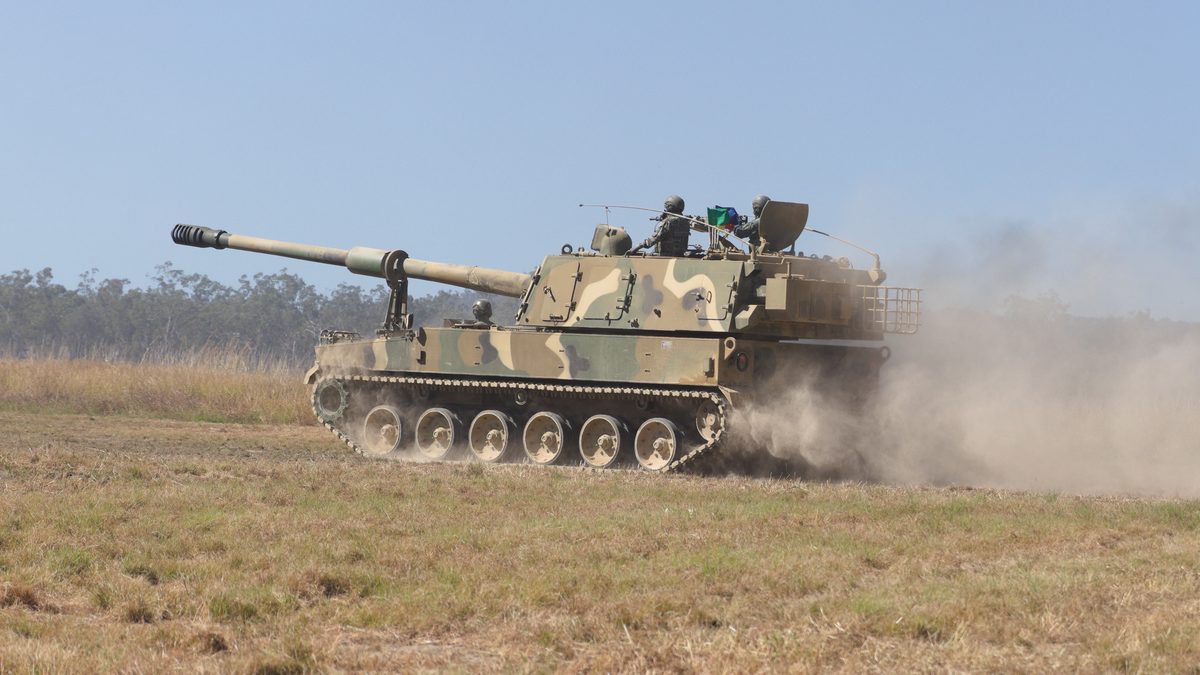
A K9 Thunder 155 mm self-propelled howitzer, the lineage from which Australia's AS9 Huntsman derives, manoeuvres during the combined live fire phase of Exercise Talisman Sabre 25, 14 July 2025. U.S. Army photo by Master Sgt. Matthew Keeler, 340th Public Affairs Detachment (public domain, via DVIDS). Illustrative: not an Australian AS9.
Australia Fields Its First AS9 Huntsman Battery, and the Constraint Moves to the Ammunition Column
The Australian Army has fielded its first protected mobile fires battery: six AS9 Huntsman 155 mm self-propelled howitzers and one AS10 armoured ammunition resupply vehicle, delivered to 106 Battery, 4th Regiment, Royal Australian Artillery at Lavarack Barracks, Townsville. The planned fleet is 30 AS9 and 15 AS10, a two-to-one ratio the initial battery does not yet meet.
Technical Summary
The Australian Army marked the milestone with a parade on 12 August 2026, reported by Defence Industry Europe on 16 August, at which 106 Battery, 4th Regiment, Royal Australian Artillery, at Lavarack Barracks in Townsville, has taken six AS9 Huntsman 155 mm self-propelled howitzers and one AS10 armoured ammunition resupply vehicle into service with 3rd Brigade. Thirty gunners from the regiment completed a six-week conversion course at the School of Artillery, Puckapunyal, Victoria, in May 2026, moving from the Geelong production line to live firing inside a few months. The Army is working toward full operational capability for protected mobile fires in 2028, against a planned fleet of 30 AS9 and 15 AS10 vehicles.
The AS9 is the Australian variant of the Hanwha K9 tracked self-propelled howitzer and mounts a 155 mm 52 calibre ordnance. It is assembled by Hanwha Defence Australia at the Hanwha Armoured Vehicle Centre of Excellence in the Geelong region of Victoria, under LAND 8116 Phase 1, the Protected Mobile Fires programme, contracted in 2021 at about one billion Australian dollars for 30 AS9 and 15 AS10 vehicles. The AS10, derived from the K10 resupply vehicle of the same family, is its dedicated resupply partner, crewed by three and described in Australian Defence material as sized to resupply two AS9s. That is where the fleet ratio comes from: 30 guns to 15 resupply vehicles is exactly two to one. The battery as delivered stands at six guns to one resupply vehicle, three times the designed span. Sergeant Dale Chivers of 106 Battery described crews coming into action in about 30 seconds before firing and relocating. In Australian service the AS9 takes over the protected mobile fires role from the M777A2 lightweight towed howitzer in 3rd Brigade; the M777A2 is retained, and is named alongside the AS9 as a consuming platform for the new domestic M795 projectile line.
Thirty AS9 to fifteen AS10 is a designed ratio of two guns per resupply vehicle. The first battery has been fielded at six to one, three times that span, with collective training on Exercise Pozieres Run still ahead of it. ISC assessment, from Australian Department of Defence fleet and delivery figures, 16 August 2026
Analysis of Effects
A self-propelled howitzer is an ammunition consumption device and its usefulness is bounded by the column behind it rather than by the gun. The shoot and scoot profile that makes the AS9 survivable is also what makes it demanding to feed: a gun that displaces after each fire mission cannot be resupplied at a fixed gun position, so the resupply vehicle has to find it, under armour, at a location that changes. That is the function the AS10 performs, and it is why the fleet was specified at two guns per vehicle rather than as a battery-level pool. Fielding at six to one is consistent with an initial delivery tranche rather than a settled establishment, but until further AS10s arrive the battery's sustained rate of fire is bounded by a single vehicle's turnaround cycle rather than by barrel wear or crew endurance.
The published figures allow the constraint to be sized rather than asserted. Hanwha's own K9 and K10 specifications give the gun an on-board load of 48 rounds and the resupply vehicle 104 projectiles with 504 modular charges, transferred automatically at up to twelve rounds a minute by a crew of three. The Australian Army's professional journal The Cove carries the same 48 and 104 figures for the AS9 and AS10, which is the closest thing to Australian confirmation in open source.
Six guns at 48 rounds each is 288 rounds held organically, with a further 104 aboard the single AS10, so the battery as fielded holds about 392 rounds. The AS10 is therefore roughly a quarter of the battery's immediate holding rather than the whole of it, and the constraint is not the first fire mission, which the guns largely carry themselves. It is the second and the third. Rate of fire sets the clock: the manufacturer certifies a burst of three rounds in under fifteen seconds, a maximum of six to eight rounds a minute sustainable for three minutes, and a sustained rate of two to three rounds a minute for one hour. A gun firing at its maximum rate empties 48 rounds in six to eight minutes; at the sustained rate the same load lasts sixteen to twenty-four minutes. One AS10 has to refill six of those guns in turn, under armour, at positions that move between missions.
The ratio the fleet was bought against is the manufacturer's own. Hanwha's reference K9 battalion is eighteen guns to nine K10 vehicles, exactly the two to one that Australia's 30 and 15 reproduce, and the brochure sets that structure against the 216 soldiers a towed battery equivalent would need versus 99 for the self-propelled pairing. The efficiency case for the AS9 is therefore inseparable from the AS10 being present in the designed proportion. A K10 is rated at 304 rounds a day in the resupply role; against a six-gun battery firing at even the sustained rate, one vehicle is a day's throughput for a fraction of an hour's firing.
The natures question sits behind that. A 155 mm 52 calibre ordnance brings the full modern 155 mm family into scope: high explosive, smoke, illuminating, base bleed extended range and precision guided rounds, each with its own Hazard Division and Compatibility Group and its own charge combination. Range is a function of the nature chosen rather than of the gun: the manufacturer quotes 18 km with M107 high explosive, 30 km with M549A1 rocket-assisted, over 40 km with K307 base-bleed and over 50 km with K315 rocket-assisted, all through a 23-litre chamber conforming to the Joint Ballistics Memorandum of Understanding. A brigade ammunition point holding that mix is a mixed storage problem rather than a single nature problem, and the governing Hazard Division for a mixed stack is the most restrictive present. The domestic supply position has firmed up considerably in the last three months. In June 2026 the Australian Government contracted Rheinmetall NIOA Munitions at about 72 million Australian dollars to establish a forging line for the M795 155 mm high explosive projectile at Maryborough, Queensland, the first M795 line outside North America. It is to begin operating by the end of 2028 at an initial 15,000 rounds a year, with a stated surge capacity of 100,000. The release names the consuming platforms explicitly: the M795 is for use “including in the M777A2 Lightweight Towed Howitzer and the AS9 Huntsman self-propelled howitzer”. So the gun fielded this month and the projectile line contracted in June are already stated as the same supply chain. Trade reporting adds that Maryborough will be the first M795 line outside North America and puts surge capacity at 100,000 rounds a year. What the release does not state is qualification status: naming a platform as an intended user is not the same as certifying a specific forged projectile against it, and no qualification date is published. Nor is annual consumption for a 30 gun fleet published, so 15,000 rounds a year cannot be converted into a coverage figure.
Personnel and Safety Considerations
For ammunition technicians and unit safety staff, converting from towed to protected mobile fires changes the risk picture in three specific ways. First, ammunition now travels loaded inside an armoured vehicle rather than moving separately to a static gun line, which brings vehicle fire, roll-over and crash cases into the explosive safety assessment alongside storage cases. Second, assisted or automated loading introduces mechanical handling hazards at the round and charge interface, and the immediate action for a jam or a misfeed with a charge in the chamber differs materially from towed gun practice, so the drills and the associated training records need to be rebuilt rather than transferred. Third, forward holdings at a brigade ammunition point during Exercise Pozieres Run require licensing against the aggregate Net Explosive Quantity actually held, with Inter-Magazine Distance and Inhabited Building Distance calculated for a field storage configuration rather than a permanent magazine. None of this is novel doctrine, but all of it is new to a regiment that has just converted.
Data Gaps
Open sources differ on the number of AS10 vehicles delivered, and the difference decides the analysis, so this records how it was resolved. The Australian Army's own account of the parade, written by Capt Andrew Page Nugent and dated 12 August 2026, states that "the parade followed the delivery of six AS9s and one AS10 to 106 Bty". That is an explicit delivery statement in the service's own words, and Defence Industry Europe reports the same figure. PS News, covering the same parade on 13 August, writes instead that "the six AS9s and three AS10s provide 3rd Brigade" with the capability, but that sentence describes the capability rather than the handover, and the same PS News report refers elsewhere to the "first AS10 ARV" in the singular. ISC therefore follows the Army's delivery figure of one. Were the higher count correct the ratio would be the designed two-to-one and the argument below would not stand, so the point is recorded here rather than buried. Rate-of-fire and stowage figures here are Hanwha K9/K10 baseline specifications; no Australian AS9 or AS10 specification sheet is published, so any Australian-specific variation in load, armour weight or charge handling is unquantified. The charge system in Australian service is not stated, nor are the specific natures the AS9 is certified to fire; the M795 is named as an intended platform match but no qualification status or date is published for the Maryborough-forged projectile. Annual 155 mm consumption for a 30 gun fleet is not published, so the 15,000 round initial output cannot be converted into a coverage percentage. Whether further AS10 vehicles are scheduled for 106 Battery before Exercise Pozieres Run is not stated, and no establishment table confirms whether six guns is the intended battery strength or an initial tranche.
Key Questions
What is the AS9 Huntsman?
The AS9 Huntsman is the Australian variant of the Hanwha K9 tracked 155 mm self-propelled howitzer, built by Hanwha Defence Australia in Geelong, Victoria. Australia plans a fleet of 30 AS9 guns supported by 15 AS10 armoured ammunition resupply vehicles, with full operational capability for protected mobile fires targeted for 2028.
How many AS9 Huntsman howitzers has Australia fielded?
Six. The first protected mobile fires battery, comprising six AS9 howitzers and one AS10 resupply vehicle, entered service with 106 Battery, 4th Regiment, Royal Australian Artillery at Lavarack Barracks, Townsville, at a parade on 12 August 2026 reported by Defence Industry Europe on 16 August. It forms part of 3rd Brigade and moves next to collective training on Exercise Pozieres Run.
What does the AS10 armoured ammunition resupply vehicle do?
The AS10 carries and transfers 155 mm ammunition to AS9 howitzers under armour, with a crew of three. Australian Defence material describes it as sized to support two AS9s, which is why the planned fleet is 30 guns to 15 vehicles. The first battery was fielded at six guns to one vehicle.
References
Source-evaluated per NATO source-evaluation doctrine, STANAG 2022 lineage (source reliability A–F / information credibility 1–6). Tier 1 = government primary source; Tier 2 = quality news / specialist defence media; Tier 3 = authoritative aggregator / encyclopaedia.
- T1Australian Government Department of Defence – Australian-built howitzer sends the thunder, 4 June 2026. (Reliability A / Credibility 1)
- T2Australian Government Department of Defence – Firing Huntsman puts smiles on soldiers' faces, 5 June 2026. (Reliability B / Credibility 2)
- T2Defence Industry Europe – Australian Army fields first AS9 Huntsman battery, moving Geelong-built 155mm self-propelled artillery systems toward full operational capability in 2028, 16 August 2026. (Reliability B / Credibility 2)
- T2Australian Government Department of Defence – Huntsman firing marks milestone, 3 December 2025. (Reliability B / Credibility 2)
- T3The Cove, Australian Army – Transforming Artillery Resupply: The Impact of Self-Propelled Howitzers, Accessed 17 August 2026. (Reliability C / Credibility 3)
- T1Australian Government, Minister for Defence Industry – Australia fires up second artillery forging capability, 8 June 2026, for the 72 million dollar Rheinmetall NIOA Munitions M795 forging contract, 15,000 rounds a year initial output and 100,000 surge. (Reliability A / Credibility 1)
- T1Australian Government Department of Defence – LAND 8116 Phase 1 Protected Mobile Fires – Hanwha Defence Australia Australian Industry Capability Public Plan, 2024. (Reliability A / Credibility 1)
- T2Janes – Australia conducts first live fire of locally built AS9 Huntsman, 2026, for the 155 mm/52 calibre designation, the 2021 AUD 1 billion contract for 30 AS9 and 15 AS10, and the M777 replacement role. (Reliability B / Credibility 2)
- T2Hanwha Defense USA – K9 Thunder 155mm/52Cal. Self-Propelled Howitzer and K10 Ammunition Resupply Vehicle, manufacturer specification brochure, accessed 17 August 2026, for on-board load, rate of fire, range by nature, K10 capacity and transfer rate, and the 18:9 reference battalion. (Reliability B / Credibility 2)
- T1Australian Army, Capt Andrew Page Nugent – Parade marks major advance in artillery capability, 12 August 2026 (Australian Army release, read via verbatim GlobalSecurity.org mirror; defence.gov.au was not reachable at time of writing). (Reliability A / Credibility 1)
Corrections & updates welcome. If you hold open-source data that refines or corrects any parameter in this article, please contact [email protected] citing the specific claim and your source. Verified corrections will be incorporated and credited in the revision history. AI-assisted technical assessment based on open-source material. Not a formal intelligence product.