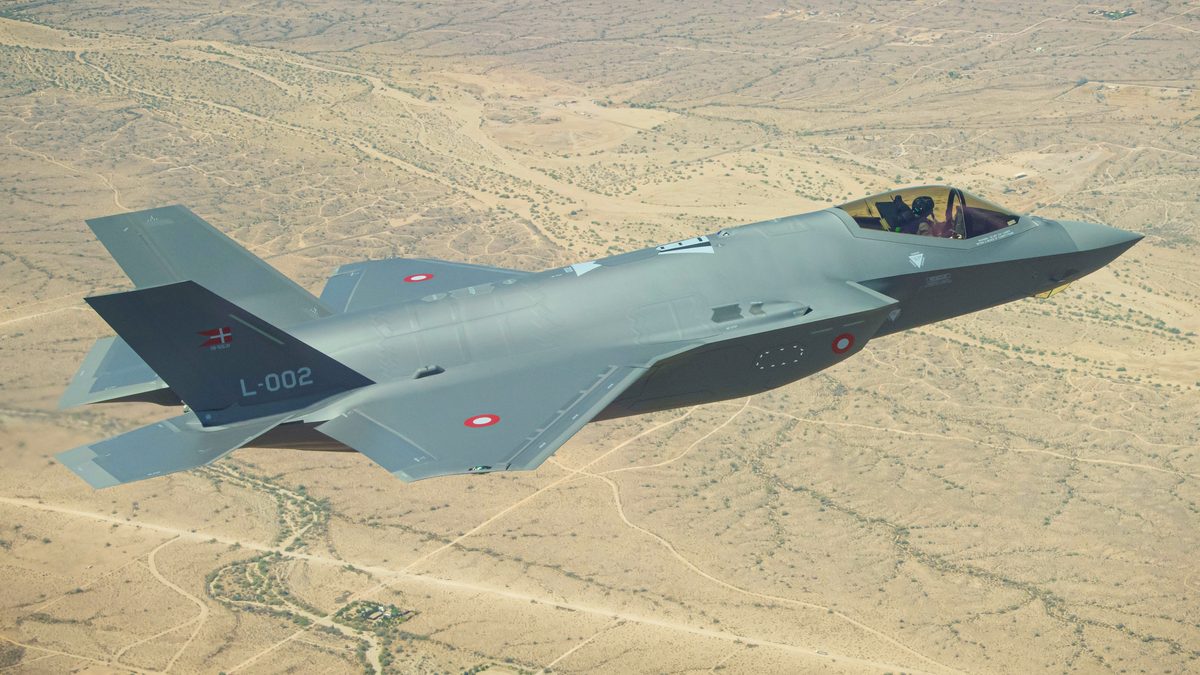
A Royal Danish Air Force F-35A Lightning II during Danish pilot training from Luke Air Force Base, Arizona, May 2021. U.S. Air Force photo by Airman 1st Class Dominic Tyler (via Wikimedia Commons, public domain).
Denmark's Deployable F-35 Planning Facility Is Fully Operational: Where the Other 19 F-35 Nations Stand
Denmark declared its containerised F-35 planning facility fully operational on 11 August 2026, after four Royal Danish Air Force F-35As first used it at Ørland Air Base, Norway, during Ramstein Flag 2026. Eleven of the twenty F-35 nations now have publicly documented deployable or platform-based classified planning programmes. The other nine, including Israel, Japan and Finland, have disclosed none.
Technical Summary
The Danish Armed Forces (Forsvaret) announced on 11 August 2026 that the Royal Danish Air Force now holds a fully operational, deployable facility for planning, directing and supporting F-35 operations from forward locations. The declaration follows Ramstein Flag 2026, the first exercise in which Denmark operated its F-35s abroad under the new deployable concept: four aircraft, supported by two reserves, flew from Ørland Air Base in Norway between 8 and 19 June 2026 and planned, executed and debriefed multinational missions without recourse to the fixed secure infrastructure at Fighter Wing Skrydstrup. The Chief of the Royal Danish Air Force stated that the capability has reached the operational maturity the service had been working towards. That is the update. The substance of this assessment is what follows: the referenced status of this capability across every F-35 nation.
The Danish operational concept was developed by the F-35 office of the Danish Defence Acquisition and Logistics Organisation (FMI) together with Danish Air Command. Manufacture and integration sit with Contour Advanced Systems, the Dutch specialist that previously delivered comparable secure container sets to Norway and the Netherlands; Denmark's industrial-cooperation records name the product the Deployable Classified Planning Facility (DCPF). Three sets are in production, two for the Royal Danish Air Force and one purchased by Germany. Danish official reporting describes the system as a container-based deployable operations facility; DCPF is the product designation recorded under the industrial-cooperation programme, and this assessment uses the two terms for the same equipment.
Eleven of the twenty F-35 nations have publicly documented deployable or platform-based classified planning programmes. The other nine have disclosed none, and under the programme's security framework that silence is a data point, not an answer. ISC assessment, 16 August 2026
Denmark's Deployable Classified Planning Facility: what open sources disclose
| Role | Secure mission planning, classified briefing, post-flight debriefing and mission-data exploitation for a deployed F-35 detachment |
| Concept owner | FMI F-35 office with Danish Air Command; manufactured and integrated by Contour Advanced Systems (Netherlands) |
| Disclosed fit | Workstations and display mounts; 19-inch information technology racks; electrical distribution; fibre-optic infrastructure |
| Environmental plant | Fresh-air and heating units; sound attenuation; glycol or brine cooling, some housed in 20-foot containers; climatic systems referenced to NATO AECTP requirements under the STANAG 4370 environmental testing series (applied editions and test severities undisclosed) |
| Sets | Three: two Royal Danish Air Force, one purchased by Germany |
| Status | Declared fully operational 11 August 2026 after first employment at Ramstein Flag 2026 |
Why Every F-35 Nation Carries This Requirement
The pattern is programme-wide, not a Danish preference. F-35 mission planning, briefing, debriefing and mission data files are handled in open procurement records as special-access-protected information under United States security policy. The governing framework is the US Department of Defense Manual 5205.07 series: the National Institute of Standards and Technology glossary, drawing on that series, defines a Special Access Program Facility (SAPF) as a specific physical space formally accredited in writing by the cognizant programme security officer, while DoDM 5205.07 and Unified Facilities Criteria 4-010-05 set the physical-security and construction standards such a space must meet. The distinction matters for containerised systems: a module built to the construction criteria is not an accredited SAPF until accreditation is granted for that specific space. Whether every operating location is contractually required to hold SAPF-equivalent accreditation cannot be verified from public documents, because the programme security guidance and the bilateral security annexes are not public; the pattern is evidenced through the procurement record instead.
That record is consistent. When the Italian carrier Cavour was prepared for F-35B certification in 2021, specialist reporting described the SAPF installed aboard as one of two F-35-specific support systems used by all operators, alongside the Autonomic Logistics Information System (ALIS), which the programme has since been replacing with the Operational Data Integrated Network (ODIN). Dutch procurement documentation states the Contour container sets meet the specific security requirements of the F-35 programme. Poland's 2025 contract, worth approximately PLN 66 million gross, specifies SAPF containers for processing information carrying a SECRET special-access-requirement clause. Canada's tender for a Tactical Special Access Program Facility calls for secure, transportable operational workspace for the Royal Canadian Air Force, including accreditation support. And the United States is constructing a dedicated F-35 SAPF in Arkansas to support the Foreign Military Sales training centre at Ebbing Air National Guard Base, which will host pilots from Singapore, Switzerland, Poland, Germany and Finland. Fixed accredited facilities answer the pattern at home stations; the deployable versions in the table below exist so the same work can follow the aircraft forward.
Confirmed: Nations With Deployable or Platform-Based Classified Planning Programmes
Eleven F-35 nations have publicly documented a deployable or platform-based classified planning or secure-workspace programme. Every documented case is listed here; each row is supported by the references at the foot of this article.
| Nation | Publicly documented capability | Status |
|---|---|---|
| United States | Lightning Modular Extendable Rigid Wall Shelters, 1,400 sq ft expandable deployed squadron operations and debrief facilities; stated plan for every US Air Force F-35 squadron to hold one | Fielded |
| United Kingdom | 192 square metre Deployable F-35 Operations Facility housing servers and classified systems; shielded against weapons effects, moves by air, road, rail or sea, operational in under 24 hours | Fielded since 2018 |
| Australia | 29 deployable mission system facilities designed and developed by Varley: transportable secure workspaces supporting F-35A operations and maintenance away from Williamtown and Tindal | First delivered 2018 |
| Canada | Tactical Special Access Program Facility (TAC-SAPF) tender: secure, transportable operational workspaces for the Royal Canadian Air Force, with accreditation and in-service support, deliverables by May 2027; the Auditor General separately records an interim F-35 operations plan using movable facilities. Mission-planning scope and overseas deployability undisclosed | In procurement, to 2027 |
| Italy | SAPF installed aboard the carrier Cavour for F-35B mission planning, briefing and debriefing; Carrier Strike Group Initial Operational Capability declared August 2024 | Fielded, sea-based |
| Norway | First export customer for Contour Advanced Systems secure F-35 container sets | Contracted; delivery status not published |
| Netherlands | Five to ten containers per squadron: secure workplaces and information systems for operations away from Leeuwarden and Volkel | Deliveries from 2021 |
| Denmark | Two Deployable Classified Planning Facility sets to a national concept; first employed at Ramstein Flag 2026 | Fully operational Aug 2026 |
| Belgium | Nationally procured modular containers by Automation NV with Arcadis; standard-container principle, A400M transportable; first set installed at Florennes | First set Jan 2026 |
| Germany | One of the three sets ordered under Denmark's programme, manufactured by Contour Advanced Systems; government-to-government purchase | Ordered |
| Poland | Two seven-container SAPF sets from Contour Advanced Systems, approximately PLN 66 million gross, explicitly for field locations and highway strips | Delivery by end 2028 |
Not Publicly Confirmed: The Other Nine F-35 Nations
The remaining nine F-35 nations have no publicly documented deployable classified planning facility. That is a finding about the public record as at 16 August 2026, and it cannot be proven in the negative: failure to locate an open source does not establish non-existence. Israel discloses almost nothing about F-35I support infrastructure, several nations are years from first delivery and have no need to contract deployable facilities yet, and Foreign Military Sales training customers will initially exploit US-accredited facilities such as the Ebbing SAPF.
| Nation | F-35 position (open sources) | Deployable classified planning facility |
|---|---|---|
| Czechia | On order (24 F-35A) | Not publicly documented |
| Finland | First aircraft accepted; pilot training under way in the United States | Not publicly documented |
| Greece | On order (20 F-35A) | Not publicly documented |
| Israel | In service since 2016 (F-35I Adir); third squadron of 25 contracted in 2024, deliveries from 2028 toward a 75-aircraft fleet | Not publicly documented |
| Japan | In service (F-35A and F-35B) | Not publicly documented |
| Romania | On order (32 F-35A) | Not publicly documented |
| Singapore | On order: 12 F-35B and 8 F-35A, with a training detachment planned at Ebbing Air National Guard Base | Not publicly documented |
| South Korea | In service; 20 additional F-35As contracted in December 2023 | Not publicly documented |
| Switzerland | On order (36 F-35A) | Not publicly documented |
Analysis of Effects
An F-35 detachment handles unusually sensitive material: mission data files, intelligence, flight planning products and post-mission recordings. None of that work can move into a tent or an ordinary office. A deployable classified planning facility provides the controlled environment in which cleared pilots, intelligence staff and technicians prepare missions, hold classified briefings, conduct post-flight debriefing and mission-data exploitation, and operate the associated information systems away from the home base. Within what NATO calls Agile Combat Employment (ACE), the generation of air power from home bases and geographically dispersed operating locations, such a facility makes the classified planning node mobile. That is the capability Denmark validated at Ramstein Flag 2026, and the reason ten nations have paid for some version of it.
Two limits on the Danish claim matter. First, Ramstein Flag validated deployment to Ørland, a fully developed allied F-35 main operating base, not to a road strip or an austere airfield. Second, the facility supplies one node of an expeditionary F-35 base, not the base itself. Dispersed operations still require fuel distribution and quality control, weapons storage and loading equipment, spares and specialised test equipment, low-observable coating maintenance, aircraft shelters or concealment, runway inspection and repair, secure long-haul communications and electrical generation, firefighting and medical cover, ground and air defence, and accommodation and force protection. All of that must move separately or already exist at the receiving base. One further nuance: the Danish announcement describes an operations facility supporting command-related functions. It is not a complete deployable air command headquarters, and the fully operational declaration applies to this facility rather than to every element Denmark would need for operations from minimally equipped locations. The benchmark for how austere that end state can get was set at Baana 24 in Finland, where United States F-35As made their first European highway landings in September 2024; planning support for operations of that kind is exactly what Poland's highway-strip requirement anticipates.
Personnel and Safety Considerations
The facility concentrates cleared personnel and classified information systems at a forward location, so its protective disciplines are informational as much as physical: access control, classified-material handling in field conditions, and protection against compromising emanations, none of which Denmark has publicly specified. For Weapons, Ordnance, Munitions and Explosives (WOME) staff the adjacent point is that the DCPF removes none of the explosives safety burden of dispersed operations. Where a detachment collocates armed aircraft with field ammunition storage, siting and quantity-distance discipline remain guided by NATO Allied Ammunition Storage and Transport Publication AASTP-5 Edition B for deployed missions, promulgated through STANAG 4657. Two qualifications apply. Munitions provision and sustainment remain national responsibilities, so implementation and licensing authority vary with national rules and host-nation arrangements. And where operational necessity prevents full compliance with prescribed explosives safety distances, the NATO Explosives Safety and Munitions Risk Management process under STANAG 2617 and ALP-16 provides the structured route for documenting residual risk for command acceptance. Weapon loading at a bare base demands the same trained armament personnel and equipment as at home.
Data Gaps
Denmark has not publicly disclosed: the number of modules per set; total transport weight and the airlift or surface lift required; erection time and the crew needed; electrical power demand and the generation arrangement; the communications architecture; the security accreditation level and accrediting authority; protection against compromising emanations; the AECTP editions and test severities applied; or per-set cost. No formal acceptance-test record has been published, although the 11 August 2026 announcement confirms all established operational requirements were met. At programme level, the bilateral security annexes and memoranda that impose SAPF-equivalent accreditation on each F-35 purchaser are not public, so the exact contractual form of the obligation cannot be cited; it is evidenced here through procurement records and platform fit-out reporting instead. Each omission is recorded as a DATA GAP rather than estimated.
Key Questions
What is a Deployable Classified Planning Facility?
A transportable complex of secure container modules in which a deployed F-35 detachment can plan missions, hold classified briefings, debrief crews and exploit mission data. It reproduces the controlled environment of a fixed secure planning building, so sensitive F-35 information can be handled at a forward base rather than only at the home station.
Is Denmark's deployable F-35 facility fully operational?
Yes. The Danish Armed Forces declared it fully operational on 11 August 2026 after its first employment at Ramstein Flag 2026, where four F-35As plus two reserves operated from Ørland Air Base in Norway. Denmark states all established operational requirements were met. The declaration covers this facility, not every element needed for austere operations.
Which F-35 nations have deployable classified planning facilities?
Eleven have publicly documented programmes: the United States, United Kingdom, Australia, Canada, Italy (shipboard), Norway, the Netherlands, Denmark, Germany, Belgium and Poland. The remaining nine F-35 nations, Czechia, Finland, Greece, Israel, Japan, Romania, Singapore, South Korea and Switzerland, have no publicly documented equivalent. Absence of documentation does not confirm absence of capability.
References
Source-evaluated under NATO STANAG 2022 (source reliability A–F / information credibility 1–6). Tier 1 = government primary source; Tier 2 = quality news / specialist defence media; Tier 3 = authoritative aggregator / encyclopaedia.
- T1Danish Armed Forces (Forsvaret) – F-35 exercise in northern Norway demonstrated new deployable F-35 command capability (capability declaration), 11 August 2026. (Reliability A / Credibility 1)
- T1Danish Defence Acquisition and Logistics Organisation (FMI) – Deployable container modules for the F-35 (programme announcement), 14 January 2025. (Reliability A / Credibility 1)
- T1Danish Armed Forces (Forsvaret) – Ramstein Flag 2026: Danish F-35 detachment exercise report, 19 June 2026. (Reliability A / Credibility 1)
- T1Belgian Defence – First modular deployable infrastructure for F-35 missions installed at Florennes on 30 January 2026, 5 February 2026. (Reliability A / Credibility 1)
- T1Australian Department of Defence, Ministers – Regional Australia delivers deployable mission system facilities for F-35A aircraft, 5 March 2018. (Reliability A / Credibility 1)
- T1US Defense Logistics Agency – DLA Distribution Hill expands shelter repair mission (F-35 Lightning Modular Extendable Rigid Wall Shelter), 2021. (Reliability A / Credibility 2)
- T1UK Defence Equipment and Support – desider magazine, September 2018: Deployable F-35 Operations Facility delivered seven months early, September 2018. (Reliability A / Credibility 1)
- T1US Small Business Administration – Subcontracting opportunity: F-35 Special Access Program Facility supporting the Foreign Military Sales F-35 program, Arkansas, January 2026. (Reliability A / Credibility 2)
- T1US National Institute of Standards and Technology, CSRC glossary – Special Access Program Facility: definition under the DoD Manual 5205.07 series, current. (Reliability A / Credibility 1)
- T2NIDV (Netherlands Industries for Defence and Security) – Contour Advanced Systems signs F-35 contract with the Dutch Defence Materiel Organisation, 4 June 2021. (Reliability B / Credibility 2)
- T2Sołtysiński Kawecki & Szlęzak (SK&S) – Contract for the supply of SAPF containers for Polish F-35s, September 2025. (Reliability B / Credibility 2)
- T2The Aviationist – Cavour arrives at Norfolk for F-35B certification: SAPF and ALIS installed as F-35-specific support systems, 19 February 2021. (Reliability B / Credibility 2)
- T2Danish Industry (DI), Defence and Security Industries Association – Contour Advanced Systems subcontractor matchmaking: containerised classified facilities, component scope, April 2026. (Reliability B / Credibility 2)
- T1Office of the Auditor General of Canada – Report 2 (2025): F-35 acquisition; interim operations plan using movable facilities, June 2025. (Reliability A / Credibility 1)
- T3CanadaBuys solicitation (via canadatenders) – Tactical Special Access Program Facility (TAC-SAPF): secure, transportable operational workspace for the RCAF, closing January 2025. (Reliability C / Credibility 2)
- T1Polish Armament Agency (Agencja Uzbrojenia) – Strengthening the operational capability of Polish F-35s: SAPF container agreement, September 2025. (Reliability A / Credibility 1)
- T1Singapore Ministry of Defence – Committee of Supply 2025: 12 F-35B and 8 F-35A confirmed; detachment at Ebbing Air National Guard Base, 4 March 2025. (Reliability A / Credibility 1)
- T1Israel Ministry of Defense – Agreement signed with the US Government for the third squadron of 25 F-35I Adir, 2024. (Reliability A / Credibility 1)
- T1NATO Allied Air Command – NATO Allies refine Agile Combat Employment on Finnish highways (Baana 24: first US F-35A highway landings in Europe), September 2024. (Reliability A / Credibility 1)
- T2The Korea Times – Korea strengthens stealth fighter fleet with purchase of 20 additional F-35As, 27 December 2023. (Reliability B / Credibility 2)
Corrections & updates welcome. If you hold open-source data that refines or corrects any parameter in this article, please contact [email protected] citing the specific claim and your source. Verified corrections will be incorporated and credited in the revision history. AI-assisted technical assessment based on open-source material. Not a formal intelligence product.