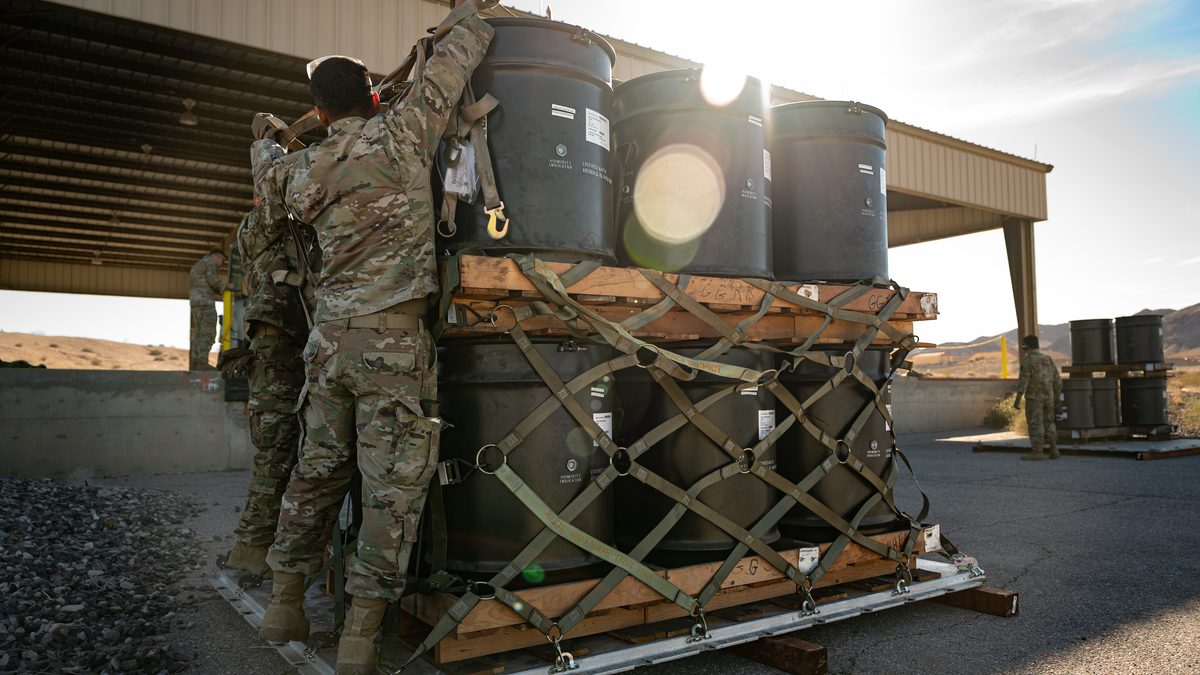
Munitions inspectors of the 57th Munitions Squadron unload and inspect Paveway tail kits at Nellis Air Force Base, Nevada, 16 December 2025. Illustrative of the air-delivered munitions inspection and surveillance activity that “munition readiness” research underwrites; the contract reported here is held at Eglin Air Force Base, Florida. US Air Force photo by Airman 1st Class Jennifer Nesbitt, via DVIDS (public domain). Use does not imply endorsement by the US Department of War or the US Air Force.
USD 20 Million for Munition Readiness: What the Air Force Research Laboratory Actually Bought at Eglin
On 14 August 2026 the Air Force Research Laboratory at Eglin Air Force Base, Florida awarded Leidos Inc. a USD 20 million ceiling indefinite-delivery, indefinite-quantity contract for advanced research for munition readiness, with an ordering period running to 14 August 2031. No funds were obligated at award. The contract buys access to a research vehicle, not munitions.
Technical Summary
The US Department of War daily contract announcement for 14 August 2026 records a single award of interest to the Weapons, Ordnance, Munitions and Explosives (WOME) community. Leidos Inc. of Reston, Virginia received contract FA865126DB003, a USD 20 million ceiling indefinite-delivery, indefinite-quantity (IDIQ) instrument described as providing "a flexible vehicle to rapidly explore, mature, and demonstrate advanced missile and munitions technologies." Work is to be performed at Reston, Virginia and at Eglin Air Force Base, Florida. The ordering period is expected to complete on 14 August 2031. The contracting activity is the Air Force Research Laboratory (AFRL) at Eglin. Critically, the announcement states that no funds are being obligated at time of award.
The award route matters more than the headline figure. The contract was placed off Broad Agency Announcement (BAA) FA8651-22-S-0001, the AFRL Munitions Directorate (AFRL/RW) Air Delivered Effects BAA. That announcement covers Basic Research (Budget Activity 6.1), Applied Research (6.2) and Advanced Technology Development (6.3), and operates as a two-step open solicitation: interested parties submit white papers at any point during the open period, and the contracting officer issues a request for proposal against those the directorate wishes to pursue. AFRL/RW plans and executes research, development and test of conventional munitions and supports the conventional munitions weapons programme offices. In other words, this is a technology maturation instrument sitting upstream of any programme of record, not a procurement of qualified ordnance.
USD 20 million is a ceiling, not a spend. With no funds obligated at award, every dollar on this vehicle still has to be justified task order by task order out to August 2031. ISC assessment of the US Department of War contract announcement, 14 August 2026
Analysis of Effects
The announcement does not define what "munition readiness" covers, and that omission is the single most consequential gap in the record. Within AFRL/RW’s published remit the phrase can reasonably span several distinct technical lines: stockpile surveillance and the ageing behaviour of energetic fills; service life extension and requalification of stored natures; fuze, safe-and-arm and initiation train reliability after long storage; insensitive munitions characterisation against STANAG 4439, whose test protocols, response descriptors and assessment methodology are carried in AOP-39; and producibility of energetic materials where a formulation qualified at laboratory scale has to survive transition to a production line. ISC assesses these as the plausible candidate areas on the basis of the directorate’s stated mission and the BAA’s scope. None of them is named in the award announcement, and no task order has yet been published.
A parallel Air Force effort gives the phrase concrete content. Since July 2024 the Air Force Life Cycle Management Center at Hill Air Force Base has run market research for an Air Delivered Munitions (ADM) Aging and Surveillance (A&S) programme under sources sought FA821324R00AS2, with a 2026 follow-on synopsis (FA821326RB002) seeking engineering services through a competitive IDIQ. Its published scope is unusually explicit for this subject area: mass properties measurement, computed tomography scanning of bombs up to 5,000 lb, non-destructive testing, sectioning and coining of energetic-filled munitions, core extraction of the energetic fill for test, testing of case materials, and digital modelling and simulation validated against full and sub-scale trials. The stated output is a Predictive Age Life Model (PALM) for each munition, validated in turn against ongoing Air Force bomb arena testing. The notice is coded to NAICS 325920 (Explosives Manufacturing) and Product and Service Code H913, and requires a facility able to hold a Net Explosive Weight (NEW) of 25,000 lb and to cut and core an energetic-filled bomb without contaminating the fill. Northrop Grumman Innovation Systems Promontory Division is named in the notice as a known qualified vendor. These are separate contracts under different centres, and ISC draws the connection thematically rather than contractually: ADM A&S shows what a fully specified “readiness” requirement looks like when the Air Force writes one down, which is the yardstick against which the Eglin vehicle’s silence should be read.
Scale is the second thing to read correctly. USD 20 million is a modest ceiling by munitions standards, and the same daily announcement supplies its own yardstick. That cycle also carried a USD 636,110,315 modification (PZ0022) to Boeing’s Apache performance-based logistics contract W58RGZ-24-C-0028, taking that instrument to a cumulative face value of USD 1,128,815,031, and a rotary-wing training award with a combined cumulative face value of USD 10,000,000,000. Both are Army instruments placed through Army Contracting Command at Redstone Arsenal, and both buy sustainment or throughput. A five-year research ordering vehicle of that size is a different kind of object: an instrument for buying speed and optionality rather than capacity, letting the directorate place small, fast technical tasks without re-competing each one. That is a different lever from the industrial-capacity problem visible elsewhere in the US munitions enterprise, where the Army has been publicly short of its 155mm production targets. Inspector General findings reported in July 2026 put actual 155mm output at roughly 36,000 rounds per month as at March 2026 against a National Defense Industrial Strategy implementation target of 100,000 rounds per month by October 2025, with a projected near-term ceiling of about 71,000; a USD 469 million contractor-operated shell body plant at Mesquite, Texas, opened in May 2024 and had not delivered a projectile metal part meeting Army specification. The two problems are related in intent and unrelated in mechanism, and conflating them is the standard reporting error.
Personnel and Safety Considerations
No hazard classification, Net Explosive Quantity (NEQ) or Compatibility Group (CG) applies to the contract itself, because a research ordering vehicle is not a munition. The safety exposure is downstream and conditional. Any task order that reaches live energetics handling, arena testing or air-delivered demonstration at Eglin would sit inside the US explosive safety framework at DESR 6055.09 and the relevant range control and test wing procedures, with hazard classification assigned at the item level under the applicable US and NATO schemes. Readers should note that the award announcement gives no indication that any such activity is yet scheduled, and no assumption should be drawn either way. Where a task order touches insensitive munitions work, the governing NATO instrument is STANAG 4439, with AOP-39 carrying the test protocols, the response descriptors (detonation, partial detonation, explosion, deflagration, burning, no reaction) and the assessment methodology against the six standard threats: fast heating, slow heating, bullet impact, fragment impact, sympathetic reaction and shaped charge jet impact. For UK practitioners the closest analogue in governance terms is Defence Safety Authority regulation DSA 03.OME, which sets the equivalent duty holder framework for ordnance, munitions and explosives activity.
Data Gaps
The following are unresolved on the open-source record as at 16 August 2026, and are recorded as data gaps rather than inferred: (1) no definition of "munition readiness" appears in the award announcement; (2) no task orders have been issued or published, so the actual technical scope is unknown; (3) the split between Budget Activity 6.1, 6.2 and 6.3 funding on this vehicle is not stated; (4) no minimum guarantee value is given; (5) the announcement does not record how many white papers or proposals were considered, which is normal for a BAA route but removes any competitive benchmark; (6) no linkage to a named programme of record is stated; and (7) the announcement does not indicate whether any classified annex or restricted technical area applies.
Key Questions
What did the Air Force Research Laboratory award Leidos in August 2026?
On 14 August 2026 AFRL at Eglin Air Force Base awarded Leidos Inc. contract FA865126DB003, a USD 20 million ceiling indefinite-delivery, indefinite-quantity contract for advanced research for munition readiness. Work runs at Reston, Virginia and Eglin, with an ordering period expected to complete on 14 August 2031. No funds were obligated at award.
Is a USD 20 million ceiling contract significant for munitions?
It is small in absolute terms and meaningful in mechanism. A ceiling means no money has been committed; task orders draw against it. Its value is speed, because it lets the Munitions Directorate place research tasks without a fresh competition each time. It is not an industrial capacity investment and should not be read as one.
What is Broad Agency Announcement FA8651-22-S-0001?
It is the AFRL Munitions Directorate Air Delivered Effects BAA, an open two-step solicitation covering Basic Research, Applied Research and Advanced Technology Development. Companies submit white papers at any time during the open period; the contracting officer then requests proposals from those the directorate elects to pursue. It is a research route, not a production route.
References
Source-evaluated under NATO STANAG 2022 (Reliability A–F / Accuracy 1–6). Tier 1 = government primary source; Tier 2 = quality news / specialist defence media; Tier 3 = authoritative aggregator / encyclopaedia.
- T1US Department of War – Contracts for Aug. 14, 2026, 14 August 2026. (Reliability A / Accuracy 1)
- T1Air Force Research Laboratory – Broad Agency Announcement FA8651-22-S-0001, Air Delivered Effects (Amendment 6), March 2025. (Reliability A / Accuracy 1)
- T2Defense News – Manufacturing woes hamper US 155-mm ammo production, 14 July 2026. (Reliability B / Accuracy 2)
- T2Breaking Defense – Army well short of 155mm ammo production goal, Texas facility in the spotlight, July 2026. (Reliability B / Accuracy 2)
- T1Air Force Life Cycle Management Center, Hill Air Force Base – Air Delivered Munitions (ADM) Aging and Surveillance (A&S) Program, Sources Sought FA821324R00AS2, 17 July 2024. (Reliability A / Accuracy 1)
- T2Stars and Stripes – Bang for Army’s billions of bucks not measuring up in 155 mm shell production, IG says, 14 July 2026. (Reliability B / Accuracy 2)
- T3GlobalSecurity.org – Contracts for Aug. 14, 2026 (mirror of the Department of War announcement), 14 August 2026. (Reliability C / Accuracy 3)
Corrections & updates welcome. If you hold open-source data that refines or corrects any parameter in this article, please contact [email protected] citing the specific claim and your source. Verified corrections will be incorporated and credited in the revision history. AI-assisted technical assessment based on open-source material. Not a formal intelligence product.