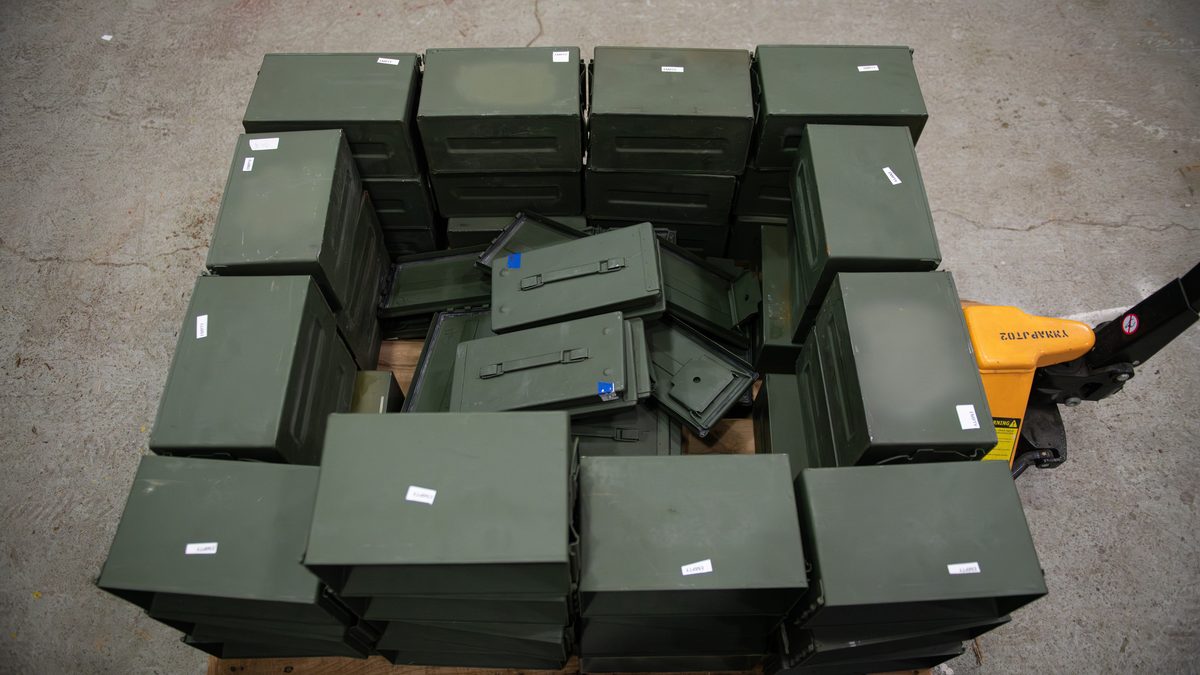
Illustrative: small arms ammunition on a pallet during a roll test at Yokota Air Base, Japan, 13 February 2025. US Air Force photo by David S. Calcote, 374th Airlift Wing. Public domain. Image is illustrative and does not depict the Canadian natures described.
Canada Takes On a Third Rifle Calibre as Federal Wins .300 Blackout Duty and Training Ammunition Award
Federal Ammunition announced on 7 August 2026 that it had won Canadian government contracts for .300 AAC Blackout duty and training ammunition, covering a maximum of 330,000 supersonic 110 grain Tactical Bonded rounds and 530,000 108 grain semi-jacketed frangible training rounds, together with 171,250 reduced-recoil 12 gauge cartridges for the Royal Canadian Mounted Police.
Technical Summary
Federal Ammunition, of Anoka, Minnesota, states that it has been awarded contracts to supply the Canadian Department of National Defence (DND) with .300 AAC Blackout duty and training natures, and the Royal Canadian Mounted Police (RCMP) with 12 gauge shotgun natures. The duty requirement is met by the 110 grain (7.1 g) Tactical Bonded projectile, described in the release as fulfilling a supersonic requirement, to a maximum round count of 330,000. The training requirement is met by a 108 grain (7.0 g) semi-jacketed frangible projectile to a maximum round count of 530,000. The RCMP element covers 51,000 12 gauge one-ounce reduced-recoil rifled slug cartridges and 120,250 12 gauge 00 buckshot reduced-recoil cartridges, on a one-year base period with a single one-year option.
.300 AAC Blackout, also expressed metrically as 7.62 x 35 mm, is a Sporting Arms and Ammunition Manufacturers' Institute (SAAMI) standardised cartridge formed from a shortened 5.56 x 45 mm case necked to accept a 7.82 mm (0.308 in) projectile. Its defining design property is that it functions in an AR-15 or M4 pattern weapon through a barrel change alone: the bolt face, the magazine and the magazine well are unchanged, so a unit already holding STANAG 4179 pattern magazines converts without a new weapon buy. It is not a NATO standardised calibre. There is no interoperability STANAG for it equivalent to STANAG 4172 for 5.56 x 45 mm, so second-line resupply from an allied stock is not available. Small arms ammunition of this class, in its approved packaging configuration, is normally consigned as UN 0012, CARTRIDGES FOR WEAPONS, INERT PROJECTILE, Hazard Division (HD) 1.4, Compatibility Group (CG) S. Neither the classification nor the packaging configuration is stated in the release, and HD and CG are properties of the packaged configuration rather than of the cartridge, so both are recorded here as data gaps.
The award covers a maximum of 860,000 rounds of .300 AAC Blackout across duty and training natures, against a Canadian small arms inventory built on 5.56 x 45 mm and 7.62 x 51 mm. Neither of those is the calibre being bought. ISC assessment, 14 August 2026
Analysis of Effects
The technical interest is not the cartridge, which has been in wide special operations and law enforcement use for over a decade. It is the composition of the buy. The release specifies a supersonic duty round. The whole reason a service adopts .300 AAC Blackout in preference to 5.56 x 45 mm is normally its heavy subsonic loading, typically a projectile of around 190 to 220 grain (12.3 to 14.3 g) driven below the speed of sound, under roughly 1,120 ft/s (341 m/s) so that a suppressor can suppress the muzzle signature without a supersonic crack betraying the firing point. A supersonic-only duty purchase discards that property and buys instead a short-barrel terminal performance and barrier capability. The Tactical Bonded construction, in which the lead core is metallurgically bonded to the jacket, is engineered for weight retention through intermediate barriers such as vehicle glass and light sheet steel. That is a signature barrier-blind close-quarter requirement, not a general infantry requirement. Whether a subsonic nature is being procured separately, or whether the user has deliberately elected against one, is not disclosed.
The training nature carries its own logic. A semi-jacketed frangible projectile uses a compressed or sintered metal core designed to disintegrate on impact with a hard surface. Its purpose is to permit live firing at steel targets and inside close-quarter battle facilities at reduced ricochet and reduced back-splash risk to the firer. The ratio in this award, 530,000 training rounds against 330,000 duty rounds, is roughly 1.6 to 1 and is consistent with a genuine sustained training programme rather than a token allocation. The open-source record initially reads as contradictory. A Public Services and Procurement Canada tender notice for the supply of various .300 AAC Blackout cartridges is published under the RCMP, not DND, while the manufacturer release attributes the .300 AAC Blackout element to DND and the 12 gauge element to the RCMP. The likely explanation is that both organisations hold requirements in this calibre and have done for some time. The RCMP has previously run a standing offer for .300 AAC Blackout barrels in 8.2 inch and 14.5 inch lengths, which is a short-barrel carbine conversion programme rather than an ammunition buy, and indicates an established RCMP holding of the calibre predating this award. On that reading the tender notice and the manufacturer release describe two separate federal requirements rather than one contradictory record.
Personnel and Safety Considerations
For storage and accounting staff the introduction cost of this calibre is low in explosive safety terms and high in inventory terms. Small arms ammunition consigned as HD 1.4 CG S is, by the definition of that division, assessed as presenting no significant hazard beyond the immediate vicinity of the package in the event of a functioning, which is why it attracts the least demanding quantity distance (QD) treatment of any packaged nature and can normally be held in general stores rather than in a licensed magazine. A maximum 860,000 round buy therefore imposes almost no new siting burden. The real cost falls on codification, on the qualification and proof programme for a nature that has no NATO standardisation behind it, on separate ammunition process and inspection instructions, and on the risk of cross-loading in unit ammunition compounds. .300 AAC Blackout will chamber in a 5.56 x 45 mm weapon and will not fire safely; the reverse mistake, a 5.56 x 45 mm round in a .300 AAC Blackout chamber, is the well-documented and more dangerous error. Physical segregation of the two natures at unit level, distinct packaging markings and explicit direction in unit standing orders are the practical mitigations.
Data Gaps
Contract value is not disclosed in the release. Muzzle velocity, barrel length assumption and the chamber pressure specification are not published. The HD and CG of the packaged configuration are not stated. Whether a subsonic .300 AAC Blackout nature is being procured separately is unknown. The weapon system or systems the Canadian requirement is intended to arm, and the unit or units concerned, are not identified. The DND and RCMP attribution difference is most plausibly explained by two parallel federal requirements rather than one record, given the RCMP’s own earlier .300 AAC Blackout barrel standing offer, but ISC has not been able to confirm the split from contract documents. Contract period and option structure for the .300 AAC Blackout element are not stated, although the 12 gauge element is described as one year plus one option year.
Key Questions
What ammunition did Federal win the Canadian contract for?
Federal Ammunition announced contracts covering .300 AAC Blackout duty and training rounds for the Canadian Department of National Defence, up to 330,000 supersonic 110 grain Tactical Bonded and 530,000 108 grain frangible training rounds, plus 171,250 reduced-recoil 12 gauge slug and 00 buckshot cartridges for the Royal Canadian Mounted Police.
Is .300 Blackout a NATO standard calibre?
No. .300 AAC Blackout, or 7.62 x 35 mm, is standardised by the Sporting Arms and Ammunition Manufacturers' Institute, not by NATO. There is no NATO interoperability standard for it equivalent to STANAG 4172 for 5.56 x 45 mm, so a unit firing it cannot draw resupply from allied NATO small arms ammunition stocks.
Why does buying a supersonic .300 Blackout round matter?
The cartridge is usually chosen for its heavy subsonic loading, which suppresses well because the projectile stays below the speed of sound. A supersonic-only duty buy sets that property aside and instead buys short-barrel terminal effect and barrier penetration, which points to a close-quarter protection role rather than a general infantry one.
References
Source-evaluated under NATO STANAG 2022 (Reliability A–F / Accuracy 1–6). Tier 1 = government primary source; Tier 2 = quality news / specialist defence media; Tier 3 = authoritative aggregator / encyclopaedia.
- T1Public Services and Procurement Canada (CanadaBuys) – .300 Blackout Ammunition, tender notice PW-BK-370-27918, accessed 14 August 2026. (Reliability A / Accuracy 1)
- T2The Outdoor Wire – Federal Ammunition Awarded Contracts to Provide Rifle and Shotgun Ammunition to the Canadian Government, 7 August 2026. (Reliability B / Accuracy 2)
- T2The Firearm Blog – Federal Awarded Rifle and Shotgun Ammo Contract for Canadian Government, August 2026. (Reliability B / Accuracy 2)
- T2American Hunter (National Rifle Association) – Federal Ammunition Awarded Rifle and Handgun Ammunition Contracts for Canadian Government, August 2026. (Reliability B / Accuracy 2)
- T1Government of Canada, Defence Investment Agency – Defence Investment Agency awards contract to replace current Canadian Armed Forces assault rifles, 19 March 2026. (Reliability A / Accuracy 1)
- T1Public Services and Procurement Canada (CanadaBuys) – 0.300 AAC Blackout Caliber Barrels, award notice (RCMP standing offer, 8.2 in and 14.5 in), accessed 14 August 2026. (Reliability A / Accuracy 1)
- T2The Defense Post – Canada to Replace Aging C7, C8 Rifles With 65,000+ New Firearms, 24 March 2026. (Reliability B / Accuracy 2)
- T3Wikipedia – .300 AAC Blackout, cartridge dimensional and performance reference, accessed 14 August 2026. (Reliability C / Accuracy 3)
Corrections & updates welcome. If you hold open-source data that refines or corrects any parameter in this article, please contact [email protected] citing the specific claim and your source. Verified corrections will be incorporated and credited in the revision history. AI-assisted technical assessment based on open-source material. Not a formal intelligence product.