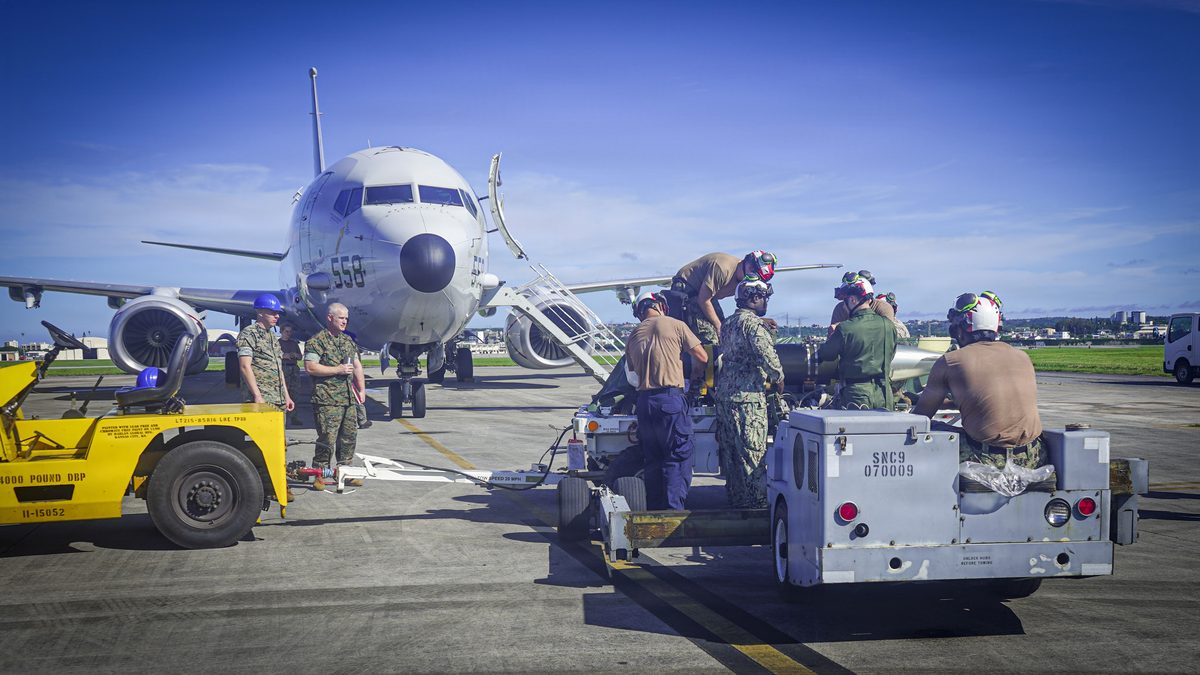
United States Navy Sailors of Patrol and Reconnaissance Squadron 26 prepare to load a Mark 54 lightweight torpedo onto a P-8A Poseidon at Kadena Air Base, Japan, 7 May 2026. Photo: Petty Officer 2nd Class William Bennett IV, U.S. Navy, via DVIDS. Public domain.
Two Increments and a Lithium Boiler: Mk 54 Mod 2 and the NATO 324 mm Inventory Decision
Northrop Grumman took the prime role on the Mk 54 Mod 2 lightweight torpedo on 12 January 2026 under a 233 million US dollar award covering proof of manufacture and qualification. The programme runs as two increments: a new warhead on the legacy Otto Fuel II afterbody, then a stored chemical energy propulsion system. Europe still holds a large Mk 46 fleet and must choose a route before that qualification closes.
Technical Summary
Northrop Grumman announced on 12 January 2026 that it had taken the prime role on the Mk 54 Mod 2 lightweight torpedo, the United States Navy weapon also carried under the Advanced Lightweight Torpedo label. The award, reported at 233 million US dollars, covers the proof of manufacture and qualification phases and the delivery of multiple weapons for qualification testing. Work sits at Plymouth, Minnesota and at the Allegany Ballistics Laboratory, Rocket Center, West Virginia. The company describes its own contribution as an advanced warhead section with new processing, applied to the existing Mod 0 and Mod 1 inventory rather than to a clean sheet design.
The programme divides into two increments, and that division carries more weight than the headline figure. Increment 1 keeps the legacy Otto Fuel II afterbody and buys lethality through the new warhead and signal processing. Increment 2 replaces the propulsion section outright with a Stored Chemical Energy Propulsion System (SCEPS), in which a lithium boiler raises steam to drive a turbine. L3Harris reported the first power plant system test on 1 August 2025 and states that it holds the only SCEPS manufacturing capability in the United States industrial base, at its undersea propulsion facility in Orlando, Florida. Progeny holds guidance and control. Raytheon supplies test sets, test shapes and accessories. Open reporting places operational test of Mod 1 Increment 2 in 2026 and of Mod 2 in 2027.
Neither the technology nor the section-by-section contracting is new. Stored chemical energy propulsion flew in United States service on the Mk 50 torpedo, where sulphur hexafluoride sprayed over solid lithium raised steam through a closed Rankine cycle to drive a pump-jet. The attraction then was depth. Reaction products occupy less volume than the reactants, so the system carries no exhaust back-pressure penalty and its performance holds up as the water gets deeper, which a combustion engine venting against ambient pressure cannot match. Splitting the current award by section, with a warhead house, a propulsion house, a guidance house and a test equipment house each holding their own piece, lets the lethality work proceed on the old afterbody while the new one is still being proven. That lowers schedule risk. It also produces the situation that gives this programme its awkward shape: one designation covering two things that will not arrive together.
Increment 1 is a warhead change on a legacy Otto Fuel II afterbody. Increment 2 is a lithium boiler raising steam for a turbine. A navy that budgets for the first and receives the second has bought a different weapon, with a different storage and handling regime attached. ISC Defence Intelligence assessment, 13 August 2026
The 324 mm Field, Weapon by Weapon
Lightweight torpedo (LWT) is not one market. Six distinct designs share the 324 mm NATO tube standard, and they resolve into three very different industrial propositions. Mk 46, Mk 50 and MU90 figures below come from the open compilations listed in the references. Sting Ray figures follow the comparative baseline set out in the ISC assessment linked later in this article. Orka figures are those published by Roketsan. All of it is published data rather than certified performance, and none of it is trial evidence.
| Weapon | Origin and route | Published parameters | Status |
|---|---|---|---|
| Mk 46 Mod 5 / 5A | United States, in service from 1967. The most numerous LWT ever built and the long-standing NATO baseline. | 230 kg, 2.59 m, 324 mm. PBXN-103 bulk charge of 43.9 kg. Otto Fuel II. Over 40 knots, about 11 km. | Legacy in service |
| Mk 54 Mod 0 / Mod 1 | United States. Mk 50 homing section married to a modified Mk 46 warhead and afterbody. Reached full rate production in 2004. | 324 mm. Mod 1 Increment 1, with revised sonar and computing hardware, fielded 2021. | In service |
| Mk 54 Mod 2 | United States. Northrop Grumman prime from 12 January 2026, 233 million US dollars for proof of manufacture and qualification. | Increment 1: new warhead, legacy Otto Fuel II afterbody. Increment 2: SCEPS lithium boiler afterbody by L3Harris. | In qualification |
| Sting Ray Mod 1 | United Kingdom, in service from 2001. Exported to Norway, Thailand and Romania. | 267 kg, 2.6 m, 12.75 inches (324 mm) on the Royal Navy’s own weapon-system page. Seawater activated magnesium and silver chloride battery. Pump-jet, about 45 knots. | In service |
| Sting Ray Mod 2 | United Kingdom. Refurbishment of existing Mod 1 stock rather than new build. Assessment contract placed with BAE Systems in 2024. | Design not published. Demonstration and initial manufacture is planned to begin in July 2028. | In development |
| MU90 Impact | France and Italy through the EuroTorp consortium. Held by France, Italy, Germany, Denmark, Poland and Greece among others. | 304 kg, 2.85 m, 323.7 mm. PBX shaped charge of 32.7 kg. Electric pump-jet, 29 to over 50 knots, depth over 1,000 m. | In service |
| A244/S | Italy, WASS. The older European 324 mm weapon, still widely held and widely exported. | 324 mm. Electric propulsion with counter-rotating motor. Shaped charge warhead. | Legacy in service |
| Orka | Türkiye, Roketsan with Aselsan. Launched at the end of December 2020 as a national alternative to imported LWTs. | 324 mm. Lithium-ion battery, brushless motor, pump-jet. Over 45 knots, range over 15 km. Insensitive hollow charge warhead. | In development |
What the European Mk 46 Holders Are Actually Doing
Three routes are visible in the open record, and NATO members have taken all three. The first is conversion. Canada is the documented reference case: 425 conversion kits notified by the United States Defense Security Cooperation Agency on 16 May 2019 at 387 million US dollars, with Raytheon as principal contractor, taking Canadian Mk 46 Mod 5A rounds to Mk 54 standard. Modernisation has run since 2022, the first converted round was due in the first quarter of 2026, initial operational capability is set for 2027 and full operational capability for 2030, and the Canadian department states the work keeps the weapons serviceable for a further 25 years. ISC examined that analogue against the British decision in Sting Ray Mod 2 and Britain’s £600m torpedo commitment.
The second route skips conversion and buys complete rounds. Germany was cleared for 64 Mk 54 weapons in 2020 for the P-8A Poseidon. The Netherlands was notified in 2018. Norway, already an operator, was notified on 17 September 2025 for up to 50 Mk 54 Mod 0 all up rounds at an estimated 162.1 million US dollars with RTX Corporation as prime. Buying rounds rather than kits sidesteps the condition lottery of opening a forty year old airframe, and it costs considerably more per weapon.
The third route leaves the American product line. France, Italy, Germany, Denmark, Poland and Greece hold the MU90 Impact, a European design with a 32.7 kg PBX shaped charge and a published depth capability beyond 1,000 m. Türkiye is the sharper case. Open compilations place around 100 Mk 54 weapons in Turkish service alongside a substantial legacy holding, while Roketsan and Aselsan have pushed Orka since December 2020 to the same 324 mm standard, with domestic lithium-ion cells from Aspilsan and a national sonar. The point is not whether Orka outperforms Mk 54. Neither weapon has published comparative trial data. The point is that a NATO member facing submarine activity in two seas judged the supply chain question more pressing than the qualification queue.
Analysis of Effects
The timing argument is the one that decides budgets, and it turns on a detail that no release states plainly. A conversion kit takes a Mk 46 airframe and produces a Mk 54. It does not produce a Mk 54 Mod 2. Mod 2 Increment 1 is a new warhead section, and Increment 2 is a new afterbody, so a nation converting today is buying into the family at Mod 0 or Mod 1 level and inheriting whatever upgrade path the United States Navy later chooses to open. Canada expects initial operational capability in 2027, full operational capability in 2030 and a further 25 years of service life from converted rounds. Mod 2 operational test is reported for 2027. A converted fleet therefore reaches maturity roughly three years after the standard above it enters test, and no located release confirms whether a kit route to Mod 2 will be offered at all.
The second argument is industrial rather than technical. SCEPS has one manufacturing source in the United States industrial base by the manufacturer’s own account. A European navy adopting Increment 2 is accepting a single point of supply for the propulsion section of its primary anti-submarine weapon, under United States export control, for the life of the round. Sting Ray Mod 2 is the alternative model, a refurbishment programme with a non-United States supply chain, and the calibre objection usually raised against it does not survive contact with the primary source. The Royal Navy’s own weapon-system page puts Sting Ray at 12.75 inches, which is 324 mm and the NATO lightweight standard shared with Mk 46 and Mk 54, and records that Mod 1 shares hull components with Mod 0. Several encyclopaedic compilations still carry 330 mm, and that figure should be read as superseded by the service’s own statement. What remains is a timing problem rather than a fit problem. Demonstration and initial manufacture of Sting Ray Mod 2 does not begin until July 2028, later than Mk 54 Mod 2 qualification, so an operator choosing the British route is choosing to wait. The competitive question rests on industrial participation, supply chain sovereignty and schedule. It does not rest on tube bores, and it cannot rest on kill probability figures that neither side has published.
Personnel and Safety Considerations
The energetics change more than the ballistics do, and the change runs in two directions. Mk 46 and Mk 54 Mod 0 and Mod 1 are propelled by Otto Fuel II, a liquid monopropellant based on propylene glycol dinitrate with a long established occupational exposure and spill response regime. A lithium boiler is a different problem. It presents a water reactive alkali metal fire risk and a stored chemical energy hazard rather than a nitrate ester exposure hazard, so the storage licence, transport classification and emergency response plan written for an Otto Fuel II afterbody do not transfer to a SCEPS afterbody. The Mk 50 precedent used sulphur hexafluoride as the oxidiser against solid lithium, and that is the reasonable planning assumption here, but the oxidiser selected for this specific design is not stated in any open release located, so it should be carried as a precedent-based assumption and not as a programme fact. Under DSA 03.OME and AASTP-1 Edition C the operative question for any receiving nation is the hazard division and compatibility group assigned to the new afterbody and to the new warhead section, together with the resulting quantity distance for the storage building. Neither is published. For the legacy baseline the Mk 46 figure is a PBXN-103 bulk charge of 43.9 kg, which is a mass rather than a certified net explosive quantity for licensing purposes.
Data Gaps
Net explosive quantity, fill composition, hazard division and compatibility group for the Mk 54 Mod 2 warhead section are not published, so no quantity distance can be derived. The oxidiser and reactant masses in the SCEPS afterbody are not stated, and the sulphur hexafluoride pairing noted above is an inference from the general literature rather than a programme statement. No initial operational capability date, production quantity or unit price for Mod 2 has been published. No located release states whether Mk 46 conversion kits will be offered to a Mod 2 configuration or will terminate at Mod 0 or Mod 1. National Mk 46 round counts for European holders are not published; the operator list is well attested but the inventory figures behind it are not. Serial production and delivery status for Orka is not confirmed in any government primary source located. Comparative trial data between Mk 54 Mod 2, MU90 Impact and Sting Ray Mod 2 does not exist in open sources, and any performance ranking between them should be treated as marketing rather than evidence. One discrepancy is flagged rather than silently resolved: several open compilations continue to list Sting Ray at 330 mm against the 12.75 inch figure published by the Royal Navy itself. The service statement is preferred here, and any reader planning launcher integration should confirm the bore against current manufacturer documentation rather than against either figure quoted in open sources.
Key Questions
What is the difference between Mk 54 Mod 2 Increment 1 and Increment 2?
Increment 1 keeps the legacy Otto Fuel II afterbody and adds a new Northrop Grumman warhead section with new processing. Increment 2 replaces the afterbody with a Stored Chemical Energy Propulsion System, using a lithium boiler to raise steam that drives a turbine. L3Harris tested the first power plant system on 1 August 2025.
Can a Mk 46 torpedo be upgraded to a Mk 54?
Yes. Conversion kits reuse the Mk 46 airframe and produce a Mk 54. Canada was notified for 425 kits on 16 May 2019 at 387 million US dollars, with modernisation running since 2022 and full capability planned for 2030. No located release confirms that kits will reach the Mod 2 configuration.
Which lightweight torpedoes do NATO navies use besides the Mk 54?
Britain fields Sting Ray, which the Royal Navy states is 12.75 inches, the same 324 mm standard as the Mk 54. France, Italy, Germany, Denmark, Poland and Greece hold the EuroTorp MU90 Impact. The Italian A244/S remains widely held. Türkiye is developing the Roketsan Orka, launched in December 2020 to the same standard.
References
Source-evaluated under NATO STANAG 2022 (Reliability A–F / Accuracy 1–6). Tier 1 = government primary source; Tier 2 = quality news / specialist defence media; Tier 3 = authoritative aggregator / encyclopaedia.
- T1Royal Navy, UK Ministry of Defence – Sting Ray Torpedo weapon-system page (UK Government Web Archive capture), archived 5 August 2011. (Reliability A / Accuracy 1. Service statement of the 12.75 inch diameter and Mod 0 / Mod 1 hull commonality)
- T1Northrop Grumman – Northrop Grumman to Manufacture US Navy’s Advanced Lightweight Torpedo, 12 January 2026. (Reliability A / Accuracy 2)
- T1L3Harris Technologies – L3Harris Successfully Tests New Power Plant System for Advanced Lightweight Torpedo, 1 August 2025. (Reliability A / Accuracy 2)
- T1US Defense Security Cooperation Agency – Canada – MK 54 Lightweight Torpedoes (Transmittal 19-32), 16 May 2019. (Reliability A / Accuracy 1)
- T1US Defense Security Cooperation Agency – Norway – MK 54 MOD 0 Lightweight Torpedoes (Transmittal 25-89), 17 September 2025. (Reliability A / Accuracy 1)
- T2Naval News – Northrop Grumman takes prime role for MK 54 MOD 2 lightweight torpedo, 13 January 2026. (Reliability B / Accuracy 2)
- T2Shephard Media – First Canadian modernised MK 46 Mod 5A torpedo to be delivered in Q1 2026, September 2025. (Reliability B / Accuracy 2)
- T3Defence Turkey – A Look at Major HWTs and LWTs in NATO Countries, Ongoing Torpedo Programs in Türkiye, accessed 13 August 2026. (Reliability C / Accuracy 3. Used for the NATO lightweight torpedo survey and Turkish holdings)
- T3Open encyclopaedic compilation – Mark 46 torpedo, accessed 13 August 2026. (Reliability C / Accuracy 3. Used for the Mk 46 baseline parameters in the comparison table)
- T3Open encyclopaedic compilation – Mark 50 torpedo, accessed 13 August 2026. (Reliability C / Accuracy 3. Used for the stored chemical energy propulsion precedent)
- T3Open encyclopaedic compilation – MU90 Impact, accessed 13 August 2026. (Reliability C / Accuracy 3. Used for the MU90 comparator parameters)
Corrections & updates welcome. If you hold open-source data that refines or corrects any parameter in this article, please contact [email protected] citing the specific claim and your source. Verified corrections will be incorporated and credited in the revision history. AI-assisted technical assessment based on open-source material. Not a formal intelligence product.