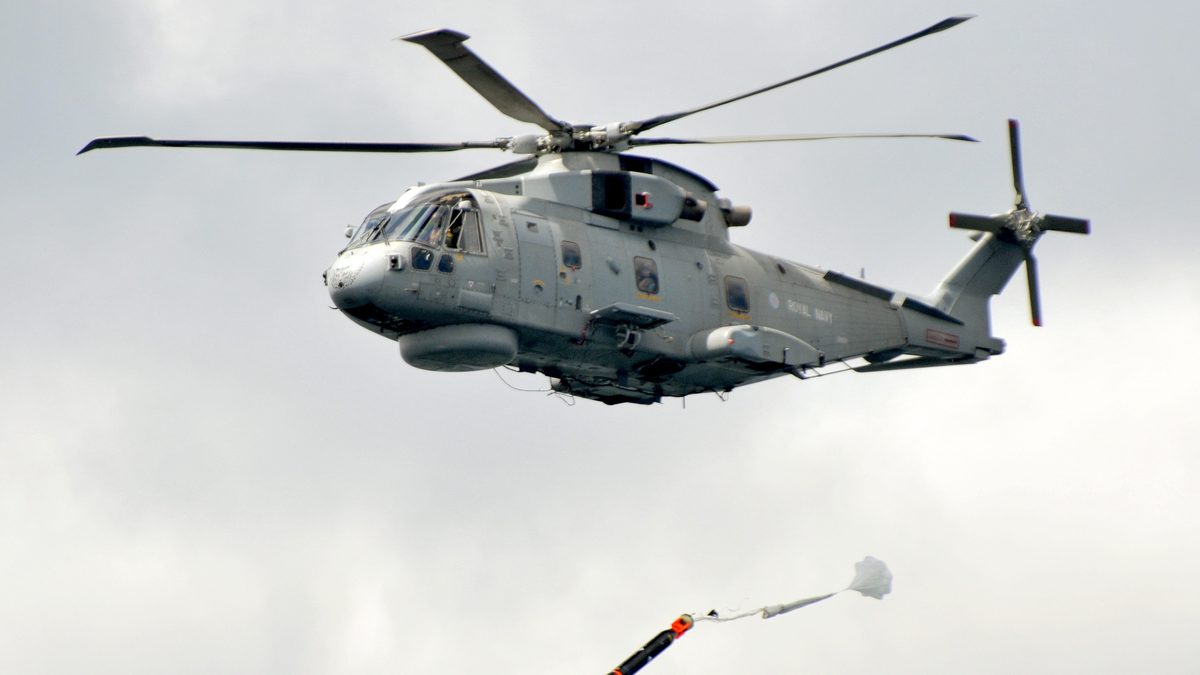
A Royal Navy Merlin of 829 Naval Air Squadron launches a training torpedo off the Cornish coast. Photo: POA(Phot) Paul A’Barrow, UK Ministry of Defence, Crown copyright, Open Government Licence v1.0, via Wikimedia Commons.
Sting Ray Mod 2: What Britain’s £600m Torpedo Commitment Means for NATO’s Ageing Mk 46 Fleet
A Defence Equipment and Support transparency notice published on 22 May 2026 confirms a planned direct award to BAE Surface Ships for the Sting Ray Mid Life Upgrade Demonstration and Initial Manufacture phase, taking the Royal Navy’s lightweight torpedo from Mod 1 to Mod 2. The initial contract runs four years from July 2028 to June 2032, with an option to June 2036, at an estimated £600 million including value added tax. It lands as the United States fields the Mk 54 Mod 2 and as Europe’s large Mk 46 inventory reaches its own decision point, and Sting Ray carries the same 12.75 inch NATO calibre as the Mk 46 it would replace.
Technical Summary
Defence Equipment and Support published a transparency notice on 22 May 2026 setting out a planned direct award to BAE Surface Ships for the Demonstration and Initial Manufacture phase of the Sting Ray Mid Life Upgrade. The work refurbishes existing stocks of the Sting Ray Mod 1 lightweight torpedo to the enhanced Mod 2 design. The initial contract covers four years from July 2028 to June 2032, with an option for a further four years of full manufacture running to approximately June 2036. The wording of that option varies between the procurement pipeline notice and the transparency notice, so the end date should be read as an order of magnitude rather than a fixed point. The estimated value is £600 million including value added tax, an increase on the £500 million ceiling carried in the previous year’s procurement pipeline notice.
The phase follows a £60 million assessment contract placed with BAE Systems in mid 2024, publicised that September, which covered design work, prototype weapons and in-water trials. Two features of the notice matter more than the headline number. The Ministry of Defence justifies the direct award on single-supplier technical grounds, recording that BAE Surface Ships is the current original equipment manufacturer, having acquired the original designer, and that only the original equipment manufacturer holds the technical knowledge and documentation required. The notice adds that any other supplier would have to investigate, recreate and trial the design on legacy equipment already due out of service in 2030.
That out-of-service date is the part worth pinning down. The Torpedo Repair and Maintenance contract announced on 4 August 2026, worth £135 million, sustains the current fleet only to June 2029. The WHITEHEAD2 support arrangement is scheduled to pick up from 2029. Demonstration and Initial Manufacture does not begin until July 2028. Three programmes therefore converge inside a twelve month window, against legacy equipment the department itself says expires in 2030.
This is not a torpedo buy. It is a stockpile being opened, assessed, modified and re-certified round by round, on the department’s own account that only one company can do the work, against legacy equipment it says expires in 2030. ISC Defence Intelligence assessment, 10 August 2026
Comparative baseline, lightweight torpedo class (open sources)
| Sting Ray, calibre | 12.75 inches (324 mm), the NATO lightweight standard shared with Mk 46 and Mk 54, stated by the Royal Navy on its own weapon-system page: “Sting Ray has a diameter of 12.75 inches and a length of around 8.5 feet.” The same page records that Mod 1 shares Mod 0 hull components, so the figure holds across both marks. |
| Sting Ray Mod 1, mass and length | 267 kg, 2.6 m |
| Sting Ray Mod 1, power source | Magnesium and silver chloride battery with seawater electrolyte, activated on water entry. No liquid monopropellant is carried |
| Sting Ray Mod 1, warhead | Directional shaped charge, 45 kg. Mod 0 carried a Torpex fill; Mod 1 introduced an insensitive munition warhead. BAE Systems states this in its own product description, and Grokipedia records the same transition, dating the Mod 1 warhead change to 2004. Net explosive quantity and hazard classification remain unpublished |
| Sting Ray Mod 1, performance | Approximately 45 knots, pump-jet propelled, active and passive acoustic homing |
| Sting Ray, platforms | Merlin and Wildcat helicopters, Type 23 frigates via horizontal launchers. P-8A Poseidon integration confirmed 2023, flight trials from 2026 |
| Sting Ray, export operators | Norway, Thailand, Romania. Norway’s £99 million Norwegian Antisubmarine Torpedo award was the first Mod 1 export |
| Mk 46, status | Most numerous lightweight torpedo in the world and the long-standing NATO standard. Expected to remain with surface combatants into the 2030s |
| Mk 54 Mod 2, status | US Advanced Lightweight Torpedo. Northrop Grumman prime contract of 233 million US dollars announced January 2026 for proof of manufacture and qualification. New propulsion system and warhead. Co-developed with Australia |
Analysis of Effects
The first thing to be clear about is what this programme is not. It is not a new-build torpedo buy. The notice describes refurbishing existing Mod 1 stockpiles to the Mod 2 design, which makes this a through-life munitions programme with a design change attached rather than a production programme. Every weapon in the inventory is stripped, assessed, modified and re-certified. That is a different industrial problem from building new rounds, and a harder one to schedule, because the input condition of each round is only known once it is opened.
Sting Ray is also energetically unlike its heavyweight stablemate, and the distinction gets lost when the two are discussed as one inventory. Spearfish carries a liquid monopropellant. Sting Ray does not. Its power source is a magnesium and silver chloride battery using seawater as the electrolyte, inert on the shelf and energetic only once wetted. The ageing profile of a battery stack in long-term storage is not the ageing profile of a nitrate ester propellant, and the surveillance regime that catches one will not necessarily catch the other. A refurbishment programme touching the whole stockpile is the point at which that distinction becomes a scheduling input rather than a technical footnote.
The warhead question is narrower than it is usually made to appear. The fill is not in doubt: Mod 0 carried Torpex, and Mod 1 introduced an insensitive munition warhead. BAE Systems says so in its own product description, and Grokipedia records the same change, placing it at 2004. What remains unpublished is the quantitative part, which is the part that governs the work: the net explosive quantity, and the hazard division and compatibility group assigned to the round. A refurbishment line is planned around those figures, not around the name of the fill.
The Mk 46 Question
The reason a British lightweight torpedo programme has an audience beyond Britain is the state of the alternative. The Mk 46 is the most numerous lightweight torpedo in the world and has been the NATO standard for decades, held among others by Greece, Italy, the Netherlands, Portugal, Spain and Turkey. It is old, and the navies holding it face the same decision the Royal Navy has just taken for Sting Ray.
The incumbent answer to that decision is American and it is already running. Canada is the clearest documented case: 425 conversion kits requested in 2019 to take its Mk 46 Mod 5A rounds to Mk 54 standard, modernisation under way since 2022, first modernised round due in the first quarter of 2026, initial operational capability in 2027 and full capability by 2030, with the department stating the upgrade keeps the torpedoes in service for a further 25 years. That is the template a European Mk 46 holder is most likely to be shown. It is a conversion, it is proven, and it comes with the US logistics chain attached.
There is no physical barrier on that market. The Royal Navy’s own weapon-system page puts Sting Ray at 12.75 inches, which is 324 mm and the NATO lightweight standard used by Mk 46 and Mk 54, and records that Mod 1 shares hull components with Mod 0, so the figure holds across both marks. A European navy holding Mk 46 can therefore treat Sting Ray Mod 2 as a like-for-like round in the same way it can treat a Mk 54 conversion kit. The competition runs on merit, price, timing and industrial politics, not on tube diameter.
The air-launched path is where the recent movement has been, and it is worth separating from the surface question. A weapon released from a helicopter or a maritime patrol aircraft is a carried store on a rack rather than a round pushed through a fixed bore, so launcher fit does not arise at all. ISC assesses that the British programme’s competitive position rests on two structural facts rather than on performance claims that are not yet public: it is a refurbishment rather than a replacement, which is the same commercial proposition the Mk 54 conversion offers; and it will be in demonstration while Mk 54 Mod 2 is still qualifying. Whether that timing is an advantage depends entirely on delivery, and the demonstration phase does not start until July 2028.
The American Analogue
The closest comparison to Sting Ray Mod 2 is not the Mk 46 at all but the Mk 54 Mod 2, the US Navy’s Advanced Lightweight Torpedo. Northrop Grumman took the prime role in January 2026 under a contract of 233 million US dollars covering integration, proof of manufacture, qualification and delivery of torpedoes for qualification testing. The Mod 2 is a substantial step over the Mod 0 and Mod 1: a new propulsion system, a more capable warhead, and improved target tracking and classification. It is being developed under a cooperative arrangement with Australia and was expected to reach an early operational capability in financial year 2026.
The proof of design phase was split four ways, which tells you something about how the Americans have de-risked it: Northrop Grumman on the warhead section, L3Harris Aerojet Rocketdyne on the stored chemical energy propulsion afterbody, Progeny on guidance and control, and Raytheon on test sets, test shapes, air launch accessories and fleet exercise sections. Britain is taking the opposite approach and placing the whole of Sting Ray Mod 2 with a single supplier, on the stated grounds that only that supplier can do it. Both routes are defensible. They carry different risks, and the British one concentrates them.
The propulsion difference is the sharpest technical contrast between the two programmes. For the Mod 2 Increment 2 the US Navy is moving off the Otto Fuel II external combustion engine to a Stored Chemical Energy Propulsion System, in which a lithium boiler raises steam to drive a turbine. L3Harris, whose Aerojet Rocketdyne subsidiary developed the power plant, completed first power plant testing in August 2025 and holds the only such manufacturing capability in the United States. That buys speed, endurance and countermeasure resistance, and it brings a new thermal and chemical handling regime with it. Britain is doing something quieter: a seawater-activated battery weapon stays a seawater-activated battery weapon, which sidesteps a propulsion transition entirely and keeps the through-life hazard profile the workforce already understands.
The P-8A Lever
The mechanism that could turn a national refurbishment into an export programme already exists. In November 2023 it was confirmed that Sting Ray Mod 1 would be integrated onto the P-8A Poseidon, and that the software update would be made available to all P-8A operators, allowing the aircraft to carry either the Mk 54 or Sting Ray. Flight trials were reported as due to begin in 2026.
That is a more significant commercial fact than any specification sheet. It removes the integration barrier that normally protects an incumbent weapon on a given platform, and it does so on an aircraft with a wide and growing operator base. Norway is the illustrative case, because it already holds both halves: it selected Sting Ray Mod 1 under the Norwegian Antisubmarine Torpedo programme, and it operates the P-8A. ISC assesses that the realistic near-term export population for Sting Ray Mod 2 is the intersection of P-8A operators and navies unwilling to route their entire lightweight torpedo stockpile through a single American supply chain, and that this population is small but not negligible. This is an assessment, not a forecast of sales.
Personnel and Safety Considerations
Refurbishment work concentrates hazards that in-service handling spreads out. Three points bear on the Mod 2 line. First, the seawater-activated battery is inert dry and energetic once wetted, so wash-down, wet recovery and any water ingress during strip-down are live considerations rather than routine steps. Second, a directional shaped charge does not become safe because the rest of the weapon has been rendered inert; standoff, orientation and exclusion arcs apply throughout the process. Third, and specific to a stockpile programme, the rounds arriving on the line will be of varying age and storage history, so the surveillance and proof evidence that supports a hazard classification for one batch does not automatically support it for the next.
None of this is novel. It is, however, the work that a direct award on single-supplier grounds concentrates in one organisation, and the point at which the department’s own argument about irreplaceable technical knowledge stops being a procurement formality and becomes a safety case dependency.
Data Gaps
Four items are not resolvable from open sources. First, the net explosive quantity and hazard classification, meaning hazard division and compatibility group, of the rounds entering refurbishment. The fill itself is not in doubt, Mod 1 carrying an insensitive munition warhead on BAE’s own account, but the quantitative safety data that governs a refurbishment line is unpublished. Second, what the Mod 2 design actually changes. Publicly stated assessment-phase objectives run to increased lethality, reduced cost of ownership, simplified integration and obsolescence resilience, which is a set of aims rather than a specification. Third, the size of the stockpile to be refurbished, without which the £600 million estimate cannot be converted into a cost per round. Fourth, whether Sting Ray Mod 2 is being positioned for export at all, or purely as a national sustainment programme.
Key Questions
What is Sting Ray Mod 2?
Sting Ray Mod 2 is the upgraded standard of the Royal Navy's lightweight anti-submarine torpedo. A Defence Equipment and Support notice of 22 May 2026 signals a direct award to BAE Surface Ships to refurbish existing Mod 1 stocks to the Mod 2 design, estimated at £600 million including value added tax.
How does Sting Ray Mod 2 compare with the US Mk 54 Mod 2?
Both are mid-life upgrades of an in-service lightweight torpedo rather than new weapons. The US Mk 54 Mod 2 Advanced Lightweight Torpedo, with Northrop Grumman as prime from January 2026, adds a new propulsion system and warhead and is co-developed with Australia. Britain has placed its whole programme with a single supplier.
Which navies still operate the Mk 46 torpedo?
The Mk 46 remains the most numerous lightweight torpedo in the world and the long-standing NATO standard, held among others by Greece, Italy, the Netherlands, Portugal, Spain and Turkey. It is expected to serve with surface combatants into the 2030s, with conversion to Mk 54 the established modernisation route.
References
Source-evaluated under NATO STANAG 2022 (Reliability A–F / Accuracy 1–6). Tier 1 = government primary source; Tier 2 = quality news / specialist defence media; Tier 3 = authoritative aggregator / encyclopaedia.
- T1Royal Navy, Ministry of Defence – Sting Ray Torpedo, weapon-systems page, archived by The National Archives 5 August 2011. States the 12.75 inch diameter and that Mod 1 shares Mod 0 hull components. (Reliability A / Accuracy 1)
- T1Defence Equipment and Support, UK Ministry of Defence – Hundreds of UK jobs supported with million-pound contract to secure Royal Navy torpedo weapons, 4 August 2026. (Reliability A / Accuracy 1)
- T2UK Defence Journal – Sting Ray torpedo upgrade moves to demo phase, reporting the Defence Equipment and Support transparency notice of 22 May 2026, accessed 10 August 2026. (Reliability B / Accuracy 2)
- T1Northrop Grumman – Northrop Grumman to Manufacture US Navy’s Advanced Lightweight Torpedo, January 2026. (Reliability A / Accuracy 2)
- T2Naval News – Northrop Grumman takes prime role for MK 54 MOD 2 lightweight torpedo, 13 January 2026. (Reliability B / Accuracy 2)
- T2Shephard Media – First Canadian modernised MK 46 Mod 5A torpedo to be delivered in Q1 2026, accessed 10 August 2026. (Reliability B / Accuracy 2)
- T2Navy Lookout – Upgrading Royal Navy anti-submarine weapons, accessed 10 August 2026, for P-8A integration and Mod 2 context. (Reliability B / Accuracy 2)
- T2Naval News – Sting Ray Mod 1 torpedo poised to start first P-8A flight trials, May 2026. (Reliability B / Accuracy 2)
- T2BAE Systems – Sting Ray Mod 1 Lightweight Torpedo, product page, accessed 10 August 2026. (Reliability B / Accuracy 2)
- T1L3Harris – L3Harris Successfully Tests New Power Plant System for Advanced Lightweight Torpedo, August 2025. (Reliability A / Accuracy 2)
- T3Wikipedia – Mark 46 torpedo, accessed 10 August 2026, for operator list only. (Reliability C / Accuracy 3)
- T3Wikipedia – Sting Ray (torpedo), accessed 10 August 2026. (Reliability C / Accuracy 3)
Corrections & updates welcome. If you hold open-source data that refines or corrects any parameter in this article, please contact [email protected] citing the specific claim and your source. Verified corrections will be incorporated and credited in the revision history. AI-assisted technical assessment based on open-source material. Not a formal intelligence product.