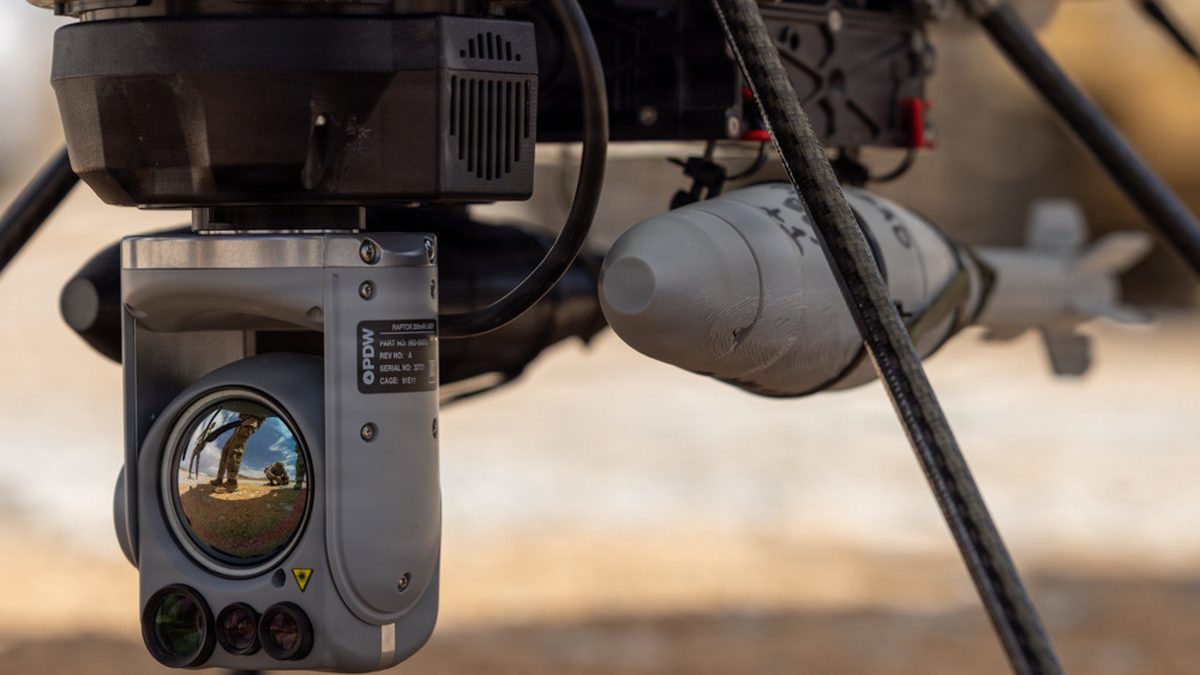
A Picatinny Common Lethality Integration Kit attached to a drone during Project Convergence Capstone 6 at Fort Irwin, California, 20 July 2026. Photo: Pfc. Craig Kong / U.S. Army, via DVIDS. Public domain (17 U.S.C. § 105). The appearance of U.S. Department of Defense visual information does not imply or constitute DoD endorsement.
One Safe and Arm Device, Many Warheads: HEX-ESAD, PLUS and the Picatinny CLIK Standard
The US Army’s DEVCOM Armaments Center said on 6 August 2026 that two of its projects now interlock: the HEX electronic safe and arm device, which identifies the warhead fitted to it and adapts its own arming and firing parameters, and Picatinny Lethal Unmanned Systems, a scalable warhead suite. Both sit inside the Picatinny Common Lethality Integration Kit design standard.
Technical Summary
The US Army Combat Capabilities Development Command (DEVCOM) Armaments Center at Picatinny Arsenal, New Jersey, issued a release on 6 August 2026 describing two of its projects as a matched pair. One is the HEX electronic safe and arm device (HEX-ESAD), built by the Common Armament Guidance and Fusing Technologies team. The other is Picatinny Lethal Unmanned Systems (PLUS), a family of scalable warheads from the Next Generation Warhead Technologies team. Both belong to the Picatinny Common Lethality Integration Kit (CLIK) ecosystem, a design standard for plug-and-play integration of modular lethal payloads on small unmanned aircraft systems (UAS).
The claim is narrower than the headline suggests, and the wording repays care. The Army has not built a new aircraft. It has not built a new munition. It has designed an arming device and a warhead family to a shared interface, so that a change of mission becomes a change of payload rather than a change of airframe. Brandon Cotroneo, an industrial engineer in the Fuze Engineering and Development Branch and the project test lead, is described in the release as having built a device that recognises which warhead is installed and adapts its safety and firing parameters accordingly. Daniel Suarez, a senior research engineer in the Warheads Division, describes the PLUS warheads as optimised against scalability, effectiveness, cost and production figures, and selected to balance high lethality against low production cost, quick manufacturing and low weight.
The release records a successful test at Picatinny Arsenal “in the spring”, which on its own August 2026 dateline means spring 2026, with further testing scheduled. It also states that the Armaments Center is using its own HEX design as “a gold standard” for CLIK-compliant lethality integration, that the CLIK standard is available to industry partners, and that the work runs alongside a Cooperative Research and Development Agreement with the National Armaments Consortium and in step with Project Manager Close Combat Systems, the office that will field the result.
The HEX-ESAD can recognize what warhead is installed and adapt its safety and firing parameters accordingly. It uses a sequential arming process and uses first-person goggle commands to visibly guide users through preparation and firing. DEVCOM Armaments Center release, 6 August 2026, describing the account of Brandon Cotroneo, Fuze Engineering and Development Branch
What HEX-ESAD Has to Do
A safe and arm device is the component that holds an explosive train interrupted until functioning is genuinely intended, and then completes it. In United States practice the governing document is MIL-STD-1316, Fuze Design, Safety Criteria For, currently at Revision F dated 18 August 2017, which superseded Revision E of 10 July 1998. The NATO equivalent is STANAG 4187, Fuzing Systems, Safety Design Requirements, at Edition 4 (2022), with the associated allied ordnance publication AOP-4187.
Four requirements in Revision F set the shape of the problem. Paragraph 4.2.1 requires a fuzing system to include at least two independent safety features, each capable of preventing unintentional arming, with a design that minimises common-cause failure. Paragraph 4.2 requires that the system not initiate the arming sequence except as a consequence of an intentional launch. Paragraph 4.2.2 requires that at least one of those independent safety features depend on sensing an environment after first motion in the launch cycle, or on sensing a post-launch environment. Where the explosive train is not interrupted, paragraph 5.3.4 raises the bar again: two separate and independent safety features with their own environmental sensing and energy interruption, a third safety feature and energy interrupter to validate sequencing and timing, and at least one energy interrupter that operates dynamically so that a static malfunction of the others cannot permit arming. For the initiator itself, paragraph 3.25 defines the maximum no-fire stimulus as the level at which the probability of functioning is 0.005 at a 95 per cent single-sided lower confidence.
The post-launch environmental sensing requirement is where a quadcopter gets awkward. A 155 mm projectile hands a fuze setback of several thousand g, spin, and a clean aerodynamic environment. Those are strong, physically distinct, genuinely independent discriminants, and decades of qualification practice rest on them. A Group 1 rotary-wing UAS hands over almost none of it. There is no gun launch. There is no spin. Release velocity is low and variable. What remains is a thinner menu: pressure or altitude change after release, elapsed time, an acceleration profile during descent, and commands passed down a radio link. The last is the difficult one, because a command channel is not obviously independent of the electronics it commands.
Sequential arming, the term used in the release, is the direct answer to that requirement. The device advances through defined states, and each transition needs its own trigger. Routing those transitions through the operator’s first-person view goggles is the part with no clean precedent in conventional ordnance, because it places a human-machine interface inside the arming chain. Whether the goggle prompt is an indicator of state or an interlock that gates a transition is a material distinction for any safety case. The release does not say which it is.
Warhead recognition is the more consequential idea. A conventional safe and arm device is qualified against one explosive train in one munition, and its safety argument is written for that pairing. A device that reads the warhead fitted to it and reconfigures accordingly turns a single argument into a matrix: every declared combination has to be shown safe, and the recognition mechanism itself becomes safety-critical. A misidentification is not a nuisance fault. It is a wrong arming delay, or a wrong initiation mode, applied to a live explosive train.
The release does not say how the device identifies the warhead. The plausible candidates are a keyed electrical identity line, mechanical keying, a short-range tag, an optical mark, or a software handshake across the interface, and they differ enormously in how they fail. A safety case has to hold the recognition path to the same independence and common-cause rules as the arming features themselves, and show that a failed, absent or spoofed identity cannot resolve to an unsafe state. Leaning on electronic state machines and on authenticating commands across a radio link also pulls firmware integrity, electromagnetic interference and power-glitch behaviour into the safety argument. Mechanical interrupters fail in ways ordnance engineering has argued about for seventy years. This is a different set of arguments.
What the 6 August release publishes, and what it does not
| Fuzing standard named in the release | None. MIL-STD-1316F is the governing US criterion for the class of device described, and the CLIK design standard does not cite it either |
| Arming method | Sequential arming, with first-person view goggle prompts through preparation and firing |
| Safe separation distance | Not published |
| Arming delay | Not published |
| Declared warhead set recognised | Not published |
| PLUS effect families | Personnel and armour named as target sets; specific effect types not published |
| Net explosive quantity, fill, casing | Not published for any variant |
| Hazard division and compatibility group | Not published for the device or any warhead |
| Test event | Successful test at Picatinny Arsenal, season only (“in the spring”); scope not stated |
PLUS Is a Family, Not a Warhead
PLUS is described as a suite, and that word does the analytical work. The release names personnel and armour as target sets. Those sit at opposite ends of terminal-effects design. Defeating personnel in the open is a fragmentation problem, governed by fragment mass and velocity distribution and by casing design. Defeating armour from a Group 1 platform is a penetration problem, and at the mass available it points toward a shaped charge or an explosively formed penetrator, where standoff, liner geometry and initiation point dominate. One warhead does not do both well. A family can.
The mass budget shapes everything else. A Group 1 UAS has a maximum take-off weight of 20 pounds, roughly 9 kg. Once airframe, battery, motors, autopilot, datalink and an electro-optical sensor are accounted for, what is left for an energetic-bearing payload is plausibly in the low single-digit kilograms, and often well below that figure. No net explosive quantity has been published for any PLUS variant, so that range is an estimate from the platform class rather than a reported value. Lethality at that scale is bought through geometry and terminal effect, not through charge weight, which is exactly why a graded family beats a general-purpose warhead.
Cost optimisation carries a cost of its own. Insensitive munitions performance, assessed under STANAG 4439 and AOP-39, is bought through fill selection, casing design and packaging. All three are places a programme under pressure to cut unit cost and shorten manufacture will look for savings. The release does not mention insensitive munitions at all. For a warhead intended to be produced in volume and held in small forward stocks, that is a question a national ordnance safety authority asks early.
Where Picatinny CLIK Came From
This sits alongside, not inside, the Defense Innovation Unit work ISC covered on 2 June 2026, when five winners of the Lethality Prize Challenge were named to design payloads for Group 1 aircraft. That competition went looking for warheads on the open market. Picatinny CLIK is the other half of the same problem: the government-owned interface those warheads have to bolt onto. See Weaponising the Smallest Drone: The Lethality Prize and the Next Phase of Drone Dominance.
| Stage | When | Lead / funding owner |
|---|---|---|
| L-UAS payload set described publicly (AUDIBLE, Shank, Gunslinger); CLIK named | 2 July 2025 | DEVCOM Armaments Center |
| Picatinny CLIK Industry Day, 300+ participants from 70+ companies | 29 July 2025 | JPEO Armaments and Ammunition, Picatinny Arsenal |
| Picatinny CLIK design standard, first public release (Version 2.1, Interim Release) | 17 September 2025 | DEVCOM Armaments Center |
| Sources sought notice for modular munition payloads, citing CLIK and sUPI | 24 February 2026 | Army Contracting Command New Jersey, for PM Close Combat Systems |
| CLIK kit assembled on a PDW C-100 at Project Convergence Capstone 6, Fort Irwin | 20 July 2026 | Sgt Jonathan Simmons, 4th Infantry Division |
| HEX-ESAD and PLUS described as a matched CLIK pair | 6 August 2026 | DEVCOM Armaments Center |
| Stated intent to transition Picatinny CLIK | 2027 | Planned JPEO Armaments and Ammunition |
The design standard itself is public, which is unusual enough to be worth reading directly. It carries Distribution Statement A, approved for public release, and its revision history logs a pre-production release in October 2024 and a working copy in April 2025 before the September 2025 interim version, at which point the document was recast from an interface control document into a design standard. Its stated purpose is to let a soldier “move, mix and match different payloads on different platforms, without requiring a certification for each combination”. It also defines the scaled variant: the small Universal Payload Interface (sUPI), for platforms constrained by payload size, weight and power, aimed at Short Range Reconnaissance and Purpose Built Attritable System aircraft.
That certification sentence is the whole programme, compressed. Per-combination certification is the bottleneck the 6 August release is talking about, not aircraft supply. Removing it means shifting the unit of qualification from the pairing to the interface, which is the move the Picatinny rail made for optics and the move MIL-STD-1760 made for the aircraft-to-store electrical interface. The precedent is good. The difference is that a rail carries a sight, and this one carries an initiated explosive train.
The standard is also honest about its own limits, in a line that deserves more attention than it has had: the safety features CLIK provides are “a component of a payload’s safety functionality but are not exhaustive”. The interface supplies shared discrete lines. It does not supply a safety case. That is precisely the space HEX-ESAD is built to occupy, and it is why the arming device, rather than the mounting kit, is the part of this announcement that carries the regulatory weight.
Analysis of Effects
For the ammunition technician and the fuze engineer, the change that matters here is not lethality. It is configuration control. A conventional munition is a closed article: one body, one fill, one fuze, one hazard classification, one safety case, one set of storage and transport rules. A CLIK-compliant payload is an assembly built close to the point of use from parts that arrived separately, and its properties are a function of which parts were fitted to it.
The consequence lands first on hazard classification. A unit holding one device type and four warhead variants is not holding one natured item. It is holding five, each with its own hazard division and compatibility group, and the safe and arm device is itself an explosive article once an initiator is fitted, since detonator and initiator assemblies classify separately from the warheads they serve. Mixed storage rules then apply inside a small forward holding, which is the difficult end of AASTP-1 Edition C and, for United Kingdom users, of the Defence Safety Authority regime under DSA 03.OME. No hazard division or compatibility group has been published for HEX-ESAD or for any PLUS variant.
The second consequence lands on unexploded ordnance. Cheap payloads produced in volume and delivered by cheap airframes generate a larger absolute number of items that fail to function, even at a respectable reliability figure, because the denominator is far larger than conventional ordnance ever produces. Those items come to rest on ground that infantry then move across.
Personnel and Safety Considerations
The render-safe problem is where modularity bites hardest. An explosive ordnance disposal operator approaching a failed conventional munition works from a strong prior: the item belongs to a known set, its fuzing is documented, and identification narrows the response quickly. A failed CLIK payload offers a weaker prior. The warhead could be any member of a family whose members are not externally distinctive by design, because common mounting is the point of the family. The arming device could sit in any of several sequential states, and that state is held electronically rather than expressed by a visible rotor position.
Two things follow, neither of which the release mentions. Durable external marking that identifies the warhead variant and survives impact. An unambiguous external indication of arming state that does not depend on a powered display or on the operator’s goggles. Both are cheap to specify now and expensive to retrofit across a fielded family.
One plausibility note. The release describes PLUS warheads as able to be equipped to almost any drone in use. Read that as an interface claim, not a ballistic one. Fitting a payload to a rail is not the same as clearing an aircraft to carry it. Centre of gravity, endurance, release dynamics and structural margin are platform-specific, and a common mounting solves none of them.
The Standards Question for European Users
Picatinny CLIK is a United States design standard. There is no NATO standardisation agreement for lethal UAS payload interfaces, and none has been announced. An allied unit adopting a CLIK-compliant payload is adopting a national standard, and its own ordnance safety authority will still want the fuzing safety argument expressed against STANAG 4187 Edition 4 rather than against MIL-STD-1316F. The two documents are closely aligned in intent. They are not the same document, and a safety case written to one is not automatically accepted against the other.
For European programmes the practical question is whether a CLIK payload can enter a national Safety and Environmental Case without full re-qualification. If it can, the interface becomes genuinely transatlantic. If it cannot, CLIK settles into a large national ecosystem that allies buy into one certification at a time, which is the outcome a common standard exists to prevent.
Data Gaps
The following load-bearing parameters are not in the open record. Each is recorded as a gap rather than estimated.
- Net explosive quantity, explosive fill and casing material for every PLUS variant.
- Hazard division and compatibility group for HEX-ESAD and for each PLUS variant.
- Safe separation distance and arming delay for HEX-ESAD, and the environments used to authorise each arming transition.
- Whether the first-person view goggle prompt is a state indicator or a functional interlock.
- The mechanism by which HEX-ESAD identifies the fitted warhead, whether electrical, mechanical, tag-based, optical or a software handshake, and its credible failure modes under a failed, absent or spoofed identity.
- The declared set of device and warhead combinations covered by the qualification argument.
- Reliability and failure-to-function rates for the configurations tested at Picatinny in the spring.
- Whether PLUS variants are assessed against STANAG 4439 and AOP-39 for insensitive munitions.
- The precise date and scope of the Picatinny test the release calls successful, since only the season is given.
Confidence is moderate on programme structure and organisational intent, both of which rest on a primary source. Confidence is low on technical performance, which is not published.
Key Questions
What is the HEX-ESAD?
HEX-ESAD is the HEX electronic safe and arm device, built by the Common Armament Guidance and Fusing Technologies team at the US Army DEVCOM Armaments Center. It holds a drone payload's explosive train interrupted until arming is intended, identifies the warhead fitted to it, and adapts its safety and firing parameters to that warhead.
What does PLUS stand for in the US Army drone programme?
PLUS is Picatinny Lethal Unmanned Systems, a suite of modular warheads from the Next Generation Warhead Technologies team at the DEVCOM Armaments Center. The suite is optimised against scalability, effectiveness, cost and production figures, and the Army names personnel and armour among the target sets it is built to engage.
How does Picatinny CLIK change drone payload certification?
Picatinny CLIK is a design standard for mounting modular lethal payloads on small drones. By fixing the physical, electrical and safety-critical interface, it moves qualification from each drone and payload pairing to the interface itself, which the Army says lets soldiers mix payloads and platforms without certifying every combination.
References
Source-evaluated under NATO STANAG 2022 (Reliability A–F / Accuracy 1–6). Tier 1 = government primary source; Tier 2 = quality news / specialist defence media; Tier 3 = authoritative aggregator / encyclopaedia.
- T1U.S. Army DEVCOM Armaments Center (via DVIDS) – Drone Dominance ‘R’ Us: Suite of tools destroy drone bottlenecks, 6 August 2026. (Reliability A / Accuracy 1)
- T1DEVCOM Armaments Center – Design Standard for Picatinny Common Lethality Integration Kit (CLIK), Version 2.1, Interim Release (Distribution Statement A), 17 September 2025. (Reliability A / Accuracy 1)
- T1U.S. Army – Lethal unmanned aerial systems: Safe, reliable, lethal armaments capability at every echelon, 2 July 2025. (Reliability A / Accuracy 1)
- T1U.S. Army – Picatinny Arsenal hosts Picatinny CLIK Industry Day to advance UAS payload integration, 7 August 2025. (Reliability A / Accuracy 1)
- T1U.S. Department of Defense – MIL-STD-1316F, Fuze Design, Safety Criteria For (superseding MIL-STD-1316E of 10 July 1998), 18 August 2017. (Reliability A / Accuracy 1)
- T1DVIDS imagery record (Staff Sgt. Dane Howard, U.S. Army) – Project Convergence Capstone 6: Sgt Jonathan Simmons, 4th Infantry Division, assembles the PDW C-100 with the Picatinny CLIK, 25 July 2026. (Reliability A / Accuracy 2)
- T2Defence Blog – U.S. Army moves toward plug-and-play drone munition architecture, 26 February 2026. (Reliability B / Accuracy 2)
Corrections & updates welcome. If you hold open-source data that refines or corrects any parameter in this article, please contact [email protected] citing the specific claim and your source. Verified corrections will be incorporated and credited in the revision history. AI-assisted technical assessment based on open-source material. Not a formal intelligence product.