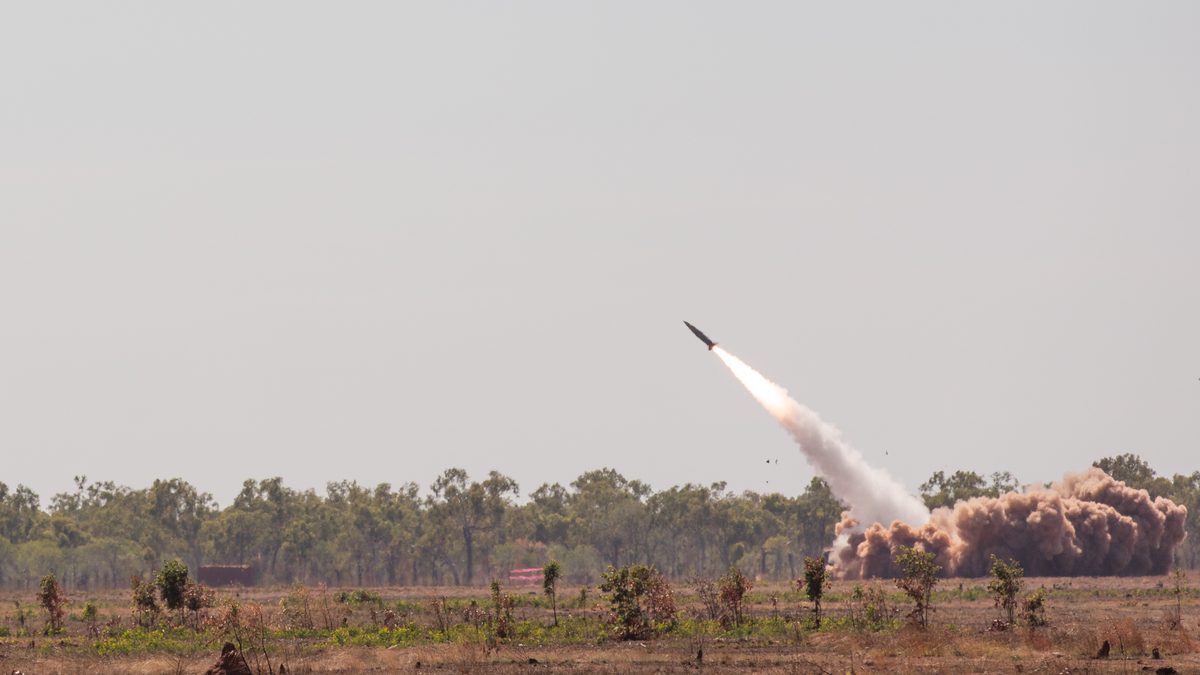
United States Soldiers of 1st Battalion, 3rd Field Artillery Regiment, 17th Field Artillery Brigade launch an Army Tactical Missile System round at Delamere, Northern Territory, Australia, July 2023. Photo: Sgt. 1st Class Andrew Dickson, U.S. Army, via DVIDS. Public domain. Illustrative: the round shown is fired from an M142 HIMARS, not from the M270 launchers in this transfer.
Ten Million Submunitions: Inside the Turkish ATACMS Package Bound for Ukraine
Türkiye is transferring 70 M39 Army Tactical Missile System (ATACMS) missiles, 12 M270 launchers, 2,524 M26 rockets and 47,000 M509A1 203mm projectiles to Ukraine under two United States third-party transfer notifications delivered to Congress on 3 August 2026, with a combined original acquisition value near 283.9 million US dollars. Three of the four natures are cluster munitions. ISC calculates the package carries roughly 10.15 million submunitions.
Technical Summary
The United States Department of State delivered two notifications to Congress on 3 August 2026, entered into the Congressional Record on 6 August, covering a proposed third-party transfer under which Türkiye would sell Ukraine a package of American-origin land fires equipment. The first covers 12 M270 Multiple Launch Rocket System (MLRS) launchers, 2,524 M26 227mm rockets and 47,000 M509A1 203mm projectiles at an original acquisition value of about 255.9 million US dollars. The second covers 70 M39 Army Tactical Missile System (ATACMS) missiles at about 28 million US dollars. The combined figure of roughly 283.9 million US dollars is what most reporting has rounded to 280 million, and the 256 million figure appearing elsewhere is the larger notification counted on its own. Reporting expects movement to begin in late August 2026, which assumes the shorter of the two statutory review windows discussed below. The stated Turkish rationale is inventory reduction to release funding for modernisation and sustainment of systems still in service.
The headline in most reporting is the missile count. The more consequential number is what the package disperses. The M39 is the Block I ATACMS: a 1,670 kg missile of 610mm body diameter, inertially guided by a ring-laser gyro platform, with a maximum range of 165 km and a payload of 950 M74 anti-personnel and anti-materiel (APAM) bomblets in a warhead section of about 560 kg, spread across roughly 33,000 square metres. The M26 is a 306 kg 227mm rocket ranging to 32 km, carrying 644 M77 dual-purpose improved conventional munition (DPICM) grenades over a footprint of about 200 by 100 metres. The M509A1 is the 8 inch (203mm) base-ejection cargo projectile built for the M110 series self-propelled howitzer, carrying 180 M42 series DPICM grenades. Three of the four line items are ordnance, and every one of the three is a cluster munition. The fourth is equipment. The M270 is the launch platform for two of those three natures, the M26 rocket and the M39 missile, while the M509A1 is fired from 203mm howitzers.
Three of the four natures in this package are cluster munitions. On the per-round payloads recorded in open technical references, the transfer moves roughly 10.15 million individual submunitions into a country already carrying one of the largest explosive remnants of war burdens on earth. ISC assessment, 9 August 2026
What the Package Actually Disperses
Multiplying the reported quantities by the per-round submunition loads recorded in open technical references gives the figure that matters for anyone who will have to clear the ground afterwards. The launcher line is included for completeness and carries no payload of its own.
| Nature | Quantity | Submunition | Per round | Submunitions |
|---|---|---|---|---|
| M39 ATACMS (MGM-140A) | 70 | M74 APAM | 950 | 66,500 |
| M26 rocket, 227mm | 2,524 | M77 DPICM | 644 | 1,625,456 |
| M509A1 projectile, 203mm | 47,000 | M42 series DPICM | 180 | 8,460,000 |
| M270 MLRS launcher | 12 | Not applicable | Not applicable | Not applicable |
| Total | 49,594 rounds, plus 12 launchers | 10,151,956 |
ISC calculation. Basis: quantities as reported from the Congressional Record entry; payload counts from published submunition inventories. Confidence: moderate on the totals, high on the per-round loads, which are consistent across independent technical references. The arithmetic is only as good as the reported quantities, and the 2,524 and 47,000 figures come from secondary reporting of the notice rather than from a document ISC has read in full.
Analysis of Effects
For Ukrainian fires planning the M39 is a step backwards in reach and a step forwards in availability. At 165 km it covers roughly half the distance of the M39A1 and M48 rounds delivered from 2024 onward, and it cannot service a point target the way a unitary warhead can. Ukraine has fired the nature before, from a small tranche delivered in the autumn of 2023, so this is a restock rather than the introduction of something new. What it does well is exactly what a depleted force needs: it saturates airfields, assembly areas, logistics nodes and surface-to-air missile sites at a range that still sits outside most Russian divisional artillery. Seventy rounds is not a campaign, but against a stock that open reporting describes as close to exhausted it is a meaningful restocking. The 12 M270 launchers matter as much as the missiles. Tracked, armoured and twice the magazine depth of the wheeled M142 High Mobility Artillery Rocket System, they replace attrition in a launcher fleet that has been a priority Russian target since 2022.
The 47,000 M509A1 projectiles are the least discussed and the most operationally interesting line. Ukraine fields the Soviet 2S7 Pion and 2S7M Malka at 203mm, and has already fired American 8 inch natures from them, with the M106 high-explosive fragmentation projectile confirmed in service use. Bore diameter is common, so the pairing works in principle. Whether a base-ejection cargo projectile designed around the M110 firing table performs to specification from a Pion is a separate question: expulsion charge timing, spin rate at ejection and the resulting grenade arming sequence are all functions of the gun and charge combination the projectile was proofed against. Firing a cargo round outside its proofed envelope tends to degrade pattern uniformity and raise the proportion of grenades that strike at a grazing angle or into soft ground, both of which the impact fuze used by these grenades tolerates poorly. ISC records this as a plausibility concern rather than a defect: it is a testable question that the receiving artillery directorate will answer on a range long before it answers it in the field.
Provenance: a 1995 Sale Comes Back Round
The launcher count is the tell. When the United States notified Congress on 1 December 1995 of a proposed sale of 120 ATACMS to Türkiye, valued at 132 million US dollars, the supporting material recorded that Türkiye already operated twelve M270 launchers. Thirty years later the transfer to Ukraine is 70 missiles and twelve launchers. On the arithmetic alone this looks like the residue of that original tranche moving on, which would make the M39 rounds roughly three decades old. ISC has not seen lot numbers or acceptance dates and treats the identification as a strong inference rather than an established fact.
The 1995 debate is worth reading again for a different reason. Objecting to the sale on the House floor, Representative Christopher Smith told colleagues that each missile "delivers 950 small bombs" and that "[m]any of the munitions fail to detonate." That is a precise description of the round now being notified for onward transfer, entered into the record by the same institution that is being asked to clear its movement.
The Regulatory Picture
The mechanism is retransfer consent. Under the Arms Export Control Act, American-origin defence articles cannot be passed to a third country without United States approval, and proposed retransfers above the statutory value thresholds must be laid before Congress. Absent a joint resolution of disapproval inside the review window, the transfer proceeds by default. The window runs to 15 days for transfers to NATO members and a short list of close partners and to 30 days for everyone else, which places a transfer to Ukraine in the 30 day category and the earliest default authorisation in early September. Reporting has described the window as two weeks. Congress has never successfully blocked a sale by that route, so the practical reading either way is that the window closes and the movement begins.
Cluster munitions law does not bind the principals. Neither Türkiye, Ukraine, the United States nor Russia is a party to the Convention on Cluster Munitions, which now counts 112 States Parties. One named intermediary sits on the other side of that line. Bulgaria is a State Party, and reporting identifies the Bulgarian firm VTIC International among the companies handling the movement alongside the Turkish Mechanical and Chemical Industry Corporation (MKE), the state defence services company ASFAT, ARCA Savunma and the American firms Pansophico and Patriot Defense Group. Article 1 of the Convention prohibits a State Party from assisting, encouraging or inducing anyone to engage in activity the Convention forbids, and transfer is one of those activities. Whether commercial logistics support by a company incorporated in a State Party engages that obligation is a question for Sofia and for the Convention's own compliance machinery. ISC raises it as a live regulatory question, not as a finding of breach, and notes that ISC has not verified the corporate role of any named company beyond the reporting.
There is a domestic American thread as well. United States appropriations law has for years restricted the export of cluster munitions whose submunitions exceed a one per cent unexploded ordnance rate, which is why the 2023 decision to supply DPICM to Ukraine required a waiver. The natures in this package sit well outside that ceiling on every published figure. Whether the one per cent rule reaches a commercial sale between two foreign governments of stock the United States sold decades ago, as opposed to a transfer funded by Washington, is a legal question ISC cannot resolve from open sources and flags for specialist advice.
Personnel and Safety Considerations
The clearance arithmetic is the part of this transfer that will outlive the war. Published failure rates for the grenades in question do not agree, and the disagreement is wide. The United States Department of Defense stated in July 2023 that the DPICM natures it was releasing had a dud rate below 2.35 per cent, while noting that the test data supporting the figure is classified. Human Rights Watch puts M42 and M46 failure at 14 per cent or higher, a figure traceable to a July 2000 United States Army dud-rate study reported by the General Accounting Office, and M74 at 5 to 10 per cent or worse. A Pentagon report to Congress cited 16 per cent for the M77, while acceptance testing recorded by the General Accounting Office in 1993 gave an M77 range of 2 to 23 per cent, the 23 per cent result coming from rockets conditioned to minus 25 degrees Fahrenheit rather than from operational firing, against a 2005 departmental figure of 5 per cent. Applied to 10.15 million submunitions, the Pentagon figure leaves roughly 239,000 unexploded items, the 14 per cent study figure leaves about 1.4 million, and the 23 per cent cold-conditioned outlier would imply about 2.3 million. ISC works to a central band of 1.2 to 1.4 million and states the assumption rather than burying it: the cold-conditioned result is set aside as unrepresentative of operational firing. All of these are estimates from published rates rather than measured outcomes, and the true number will depend on soil, vegetation, snow cover, impact angle and the age of the energetics. Age matters here more than usual. Stock delivered in the late 1990s has had three decades for fuze trains to degrade and for propellant and explosive fills to age, and every one of those mechanisms pushes the functioning rate down and the dud rate up. For the ammunition technicians and explosive ordnance disposal teams who will work this ground, the practical consequence is a very large population of small, sensitised, self-arming items in a fuze state that cannot be assumed safe, distributed across footprints of 200 by 100 metres for the rockets and roughly 33,000 square metres for each missile. Clearance of that class of contamination is measured in decades, and the demining budget that will carry it has not been notified to anybody.
Data Gaps
ISC could not extract the State Department transmittal text from the consolidated daily edition of the Congressional Record for 6 August 2026, so quantities, value and the list of named companies rest on secondary reporting of that document rather than on the primary text. The notified sums are original acquisition values, which is a statutory accounting figure and not the commercial price Ukraine is paying. That price is not published. Lot numbers, manufacture dates and acceptance dates for the M39 missiles are not published, so the inference that they are the 1995 tranche remains an inference. Hazard division and compatibility group for the specific lots are not in open sources and cannot be assumed from the nature alone, since national classification schedules differ. Net explosive quantity per round is not published for any of the three cluster natures. Whether the M509A1 has been proofed for the 2S7 Pion charge system is unknown, as is the storage condition and the propellant ageing state of the rocket motors. Finally, ISC has not independently verified the role of any of the six named companies.
Key Questions
What is Türkiye selling Ukraine in the August 2026 ATACMS deal?
Türkiye is transferring 70 M39 ATACMS missiles, 12 M270 launchers, 2,524 M26 227mm rockets and 47,000 M509A1 203mm projectiles. The US State Department sent two retransfer notifications to Congress on 3 August 2026, entered into the Congressional Record on 6 August, with a combined original acquisition value near 283.9 million US dollars. Deliveries are expected from late August.
How far can the M39 ATACMS reach and what warhead does it carry?
The M39 is the Block I ATACMS. It ranges to about 165 km, roughly half the reach of the M39A1 and M48 rounds Ukraine received in 2024, and it is not a unitary weapon. Each missile disperses 950 M74 anti-personnel and anti-materiel bomblets over some 33,000 square metres.
Why does this transfer matter for explosive ordnance disposal in Ukraine?
Three of the four natures are cluster munitions carrying roughly 10.15 million submunitions in total. Published failure rates for the M42 series and M77 grenades run from the Pentagon figure of under 2.35 per cent to at least 14 per cent in a US Army study. That range implies between 239,000 and 1.4 million items of unexploded ordnance.
References
Source-evaluated under NATO STANAG 2022 (Reliability A–F / Accuracy 1–6). Tier 1 = government primary source; Tier 2 = quality news / specialist defence media; Tier 3 = authoritative aggregator / encyclopaedia.
- T1United States Congressional Record – Congressional Record, Vol. 172, No. 129 (daily edition), carrying the two State Department retransfer notifications, 6 August 2026. (Reliability A / Accuracy 3, transmittal text not recoverable from the consolidated daily edition)
- T2Türkiye Today – Türkiye seeks US approval to transfer MLRS, ATACMS missiles to Ukraine (split notification values and dates), 8 August 2026. (Reliability B / Accuracy 2)
- T2The Kyiv Independent – Ukraine buys 70 ATACMS missiles, other US weapons from Turkey in major defense package, 8 August 2026. (Reliability B / Accuracy 2)
- T2Militarnyi – Ukraine to Receive 70 M39 ATACMS Missiles and 12 M270 MLRS Launchers from Turkey, 8 August 2026. (Reliability B / Accuracy 2)
- T2Kyiv Post – Ukraine Buys 70 ATACMS Missiles From Turkey (munition designations and quantities), 9 August 2026. (Reliability B / Accuracy 2)
- T1United States General Accounting Office – Operation Desert Storm: Casualties Caused by Improper Handling of Unexploded U.S. Submunitions, GAO/NSIAD-93-212 (M77 acceptance-test dud rates), August 1993. (Reliability A / Accuracy 1)
- T1United States General Accounting Office – Military Operations: Information on U.S. Use of Land Mines in the Persian Gulf War, GAO-02-1003 (July 2000 Army dud-rate study, M42 and M46), September 2002. (Reliability A / Accuracy 1)
- T3Human Rights Watch – US Cluster Munition Transfers Raise Humanitarian Concerns (Pentagon 2.35 per cent claim; M42, M46 and M74 failure rates), 4 April 2024. (Reliability B / Accuracy 2)
- T3Human Rights Watch – Cluster Munition Questions and Answers: The M26 Rocket (submunition load, footprint, functioning conditions), 18 August 2006. (Reliability B / Accuracy 2)
- T3Human Rights Watch – A Global Overview of Explosive Submunitions (M509A1, M26 and ATACMS payload counts), May 2002. (Reliability B / Accuracy 1)
- T3Directory of U.S. Military Rockets and Missiles – MGM-140 ATACMS (M39 physical and performance parameters), accessed 9 August 2026. (Reliability C / Accuracy 2)
- T3Directory of U.S. Military Rockets and Missiles – MLRS Rockets M26, M30 and M31 (M26 physical and performance parameters), accessed 9 August 2026. (Reliability C / Accuracy 2)
- T2Militarnyi – Ukrainian 2S7 Pion shoots with American 203mm rounds, June 2023. (Reliability B / Accuracy 2)
- T1Convention on Cluster Munitions – States Parties and Signatories (membership status and totals), accessed 9 August 2026. (Reliability A / Accuracy 1)
- T3United States Congressional Record – Proceedings on the proposed sale of 120 ATACMS to Turkey (GlobalSecurity.org transcript), December 1995. (Reliability C / Accuracy 2)
Corrections & updates welcome. If you hold open-source data that refines or corrects any parameter in this article, please contact [email protected] citing the specific claim and your source. Verified corrections will be incorporated and credited in the revision history. AI-assisted technical assessment based on open-source material. Not a formal intelligence product.