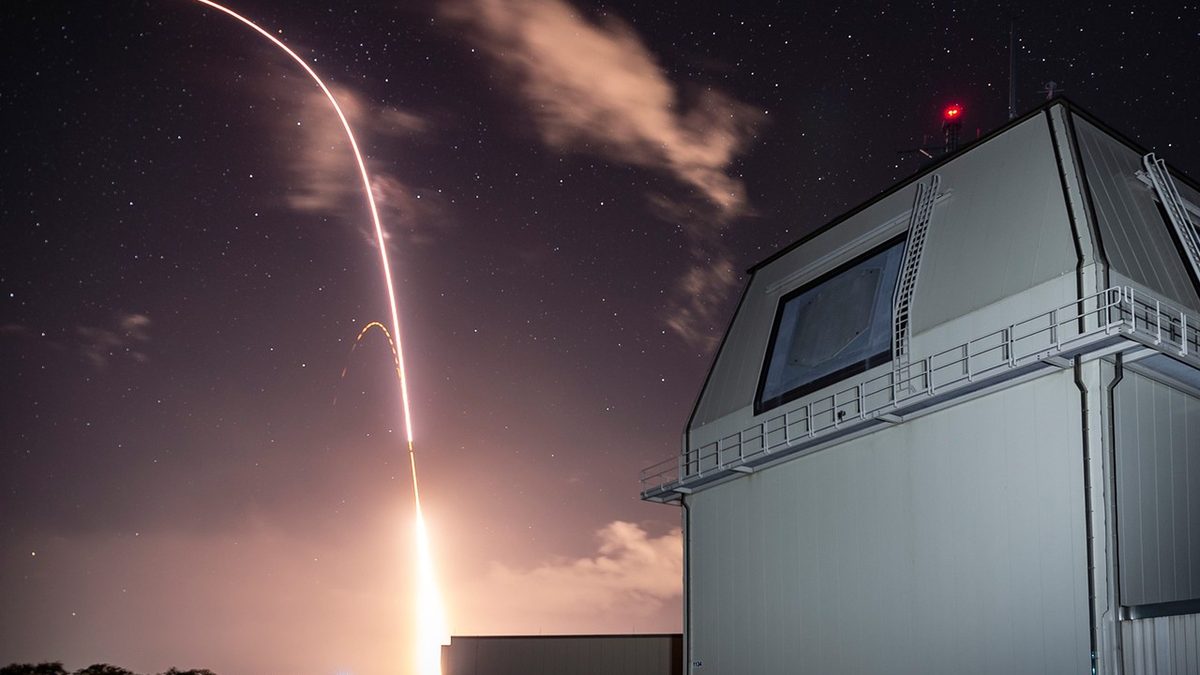
A Standard Missile 3 Block IIA launches from the Aegis Ashore Missile Defense Test Complex, Pacific Missile Range Facility, Kauai, Hawaii, 10 December 2018. Photo: U.S. Army, public domain, via Wikimedia Commons.
Raytheon Takes $745 Million to Build SM-3 Block IIA All-Up Rounds for the United States and Japan
On 7 August 2026 the Missile Defense Agency awarded Raytheon a noncompetitive, undefinitized contract, HQ0851-26-C-E002, with a base value of $745,387,095 to manufacture and assemble Standard Missile 3 Block IIA all-up rounds for the United States and for Japan Ministry of Defense Foreign Military Sales requirements. Work runs at Tucson, Arizona and Huntsville, Alabama to 28 February 2031.
Technical Summary
The Missile Defense Agency (MDA), Huntsville, Alabama, is the contracting activity for a new contract, HQ0851-26-C-E002, placed with Raytheon at Tucson, Arizona. The announced base value is $745,387,095. Two funding lines were obligated at award: $275,613,909 of fiscal 2026 procurement money and $277,688,036 of Japan Ministry of Defense (JMOD) Foreign Military Sales (FMS) case funds. That is $553,301,945 committed on day one, or 74.2 per cent of the announced base value. Work is split between Tucson and Huntsville with an estimated completion date of 28 February 2031. The award is recorded as both noncompetitive and undefinitized, which are two separate conditions and each carries its own consequence.
The deliverable is described as all-up rounds (AUR). In ordnance accounting an all-up round is the complete, certified missile as it is handed to the user, canisterised and ready to load into the Mark 41 Vertical Launching System (VLS) without further assembly. It is a single accountable item of ordnance rather than a set of components. For the SM-3 family the energetic content of that item is dominated by solid rocket motors rather than by a warhead. The round is a three-stage missile carrying a kinetic warhead of the Lightweight Exo-Atmospheric Projectile (LEAP) type. The kill mechanism is hit-to-kill impact energy, so there is no high-explosive fill and no fragmentation sleeve in the terminal stage. The motor set must be read variant by variant. Block IA and IB share the first two stages of the SM-2 Block IV, a Mk 72 booster and a Mk 104 dual-thrust rocket motor, with a Mk 136 third-stage rocket motor above them, and they carry a 21-inch booster below a 13.5-inch body. Block IIA is not that missile. It retains the Mk 72 booster but adopts a uniform 21-inch (0.54 m) body along its whole length, and Japan took primary responsibility for developing the new nosecone and the second and third stage motors. The wider body buys propellant: CSIS records burnout speed rising from about 3.0 km/s for Block IA and IB to about 4.5 km/s for Block IIA, and range from about 700 km to about 2,500 km, with a larger kill vehicle carrying more divert fuel. The Missile Defense Agency credits the Block IIA seeker with more than double the sensitivity and more than three times the divert capability of Block IB.
That variant is the one which, on 10 December 2018, intercepted an intermediate-range ballistic missile target during Flight Test Integrated-03 (FTI-03) at the Pacific Missile Range Facility, Kauai. The target was air-launched from a U.S. Air Force C-17 in the broad ocean area and the interceptor was fired from the Aegis Ashore Missile Defense Test Complex. FTI-03 was an operational test of Engage On Remote, in which the firing unit shoots on track data passed from another sensor rather than its own, which is the tactic that makes a small number of high-value rounds cover a large area.
$553,301,945 was obligated at award against an announced base value of $745,387,095. Roughly three-quarters of the money is committed before the government and the contractor have agreed a price for what it buys. ISC analysis of Department of War contract announcement, 7 August 2026
Analysis of Effects
An undefinitized contract action (UCA) lets work start before terms, specification and price are settled. It is a schedule instrument, and it is used when the government judges that waiting for a negotiated price costs more than the pricing risk of not having one. Defense Federal Acquisition Regulation Supplement (DFARS) Subpart 217.74 constrains that risk. DFARS 217.7404-3 requires definitization by the earlier of two events: 180 days after the contractor submits a qualifying proposal, or the point at which funds under the action exceed 50 per cent of the not-to-exceed price. The announcement gives a base value but does not state a not-to-exceed price, so the two figures cannot be assumed identical and the 50 per cent trigger cannot be tested from open sources. What can be said is that MDA has front-loaded an unusually large obligation, which is the behaviour of a programme office buying production slots rather than one exploring a requirement.
The funding split is the more interesting number. Japan is putting in $277,688,036 against the United States contribution of $275,613,909, so the partner nation is carrying slightly more than half of the money obligated at award. Block IIA has been a co-development since the programme began, and this award reads less like a classical FMS sale bolted onto a domestic buy and more like two customers loading one production line together. That matters for throughput. Solid rocket motor capacity and the specialist workforce that pours, cures and certifies it are the binding constraint across almost every Western interceptor programme, and a shared line amortises that constraint across two national stockpiles. The timing sits against reporting on 5 and 6 August 2026 that United States long-range and interceptor inventories were heavily drawn down during the war with Iran, with claims that a large share of the Terminal High Altitude Area Defense (THAAD) interceptor stock had been expended. ISC has not independently verified those consumption figures.
Personnel and Safety Considerations
For storage and transport staff the practical point is that an SM-3 Block IIA all-up round is handled as one certified item, not as a warhead plus a motor. Its hazard profile is set by three solid propellant charges and by the ordnance devices that serve them, including initiators, stage-separation charges and any flight termination provision, rather than by a high-explosive payload. Fuzing safety criteria for those devices fall under MIL-STD-1316, and hazard assessment and insensitive munitions response are addressed by MIL-STD-2105E, with United States explosives safety siting under DESR 6055.09 Edition 1 Change 2 and NATO siting under AASTP-1 Edition D, Version 1 (4 November 2025). The specific hazard division (HD) and compatibility group (CG) assigned to the canisterised Block IIA round, and its net explosive quantity (NEQ) expressed in kilograms of trinitrotoluene equivalent, are not published in open sources. Practitioners should take those from the national munitions data sheet for the packaging configuration actually held, and not infer them from the SM-2 or SM-6 families.
Data Gaps
Six gaps constrain this assessment. First, the not-to-exceed price is not stated, so the DFARS 217.7404-3 definitization trigger cannot be tested. Second, no round quantity is given, so no unit cost can be derived and any per-round figure circulating from this announcement is arithmetic on an unknown denominator. Third, the split of rounds between the United States and Japan is not stated, and the near-equal funding split does not oblige an equal quantity split. Fourth, the HD and CG assignment and NEQ for the all-up round in its shipping and stowage configuration are not in open sources. Fifth, no insensitive munitions assessment result for Block IIA is public. Sixth, the announcement does not say whether this contract replaces, supplements or runs alongside earlier Block IIA production lots, so the total programme quantity on order is unclear. A prior Missile Defense Agency contract, HQ0851-24-C-0001, carries the same scope description, manufacture and assembly of SM-3 Block IIA all-up rounds; whether the new award adds to it, succeeds it, or runs in parallel is not stated in either announcement, and ISC does not assume.
Key Questions
What is an all-up round and why does it matter here?
An all-up round is the complete, certified missile delivered ready to load, canisterised for the Mark 41 Vertical Launching System with no further assembly by the user. It is accounted for as one item of ordnance. For SM-3 Block IIA that item carries three solid rocket motors and a non-explosive hit-to-kill warhead, so its handling hazard comes from propulsion rather than from a high-explosive payload.
Why did the Missile Defense Agency award this without competition or a settled price?
Raytheon is the SM-3 Block IIA producer, which explains the noncompetitive route. The undefinitized action lets manufacture begin before price is agreed. MDA obligated $553,301,945 at award, about 74.2 per cent of the $745,387,095 base value, which indicates the agency is buying production capacity now and negotiating afterwards under DFARS Subpart 217.74.
How much of this contract is Japan paying for?
Japan Ministry of Defense Foreign Military Sales funds account for $277,688,036 of the $553,301,945 obligated at award, marginally more than the $275,613,909 of United States fiscal 2026 procurement money. SM-3 Block IIA has been a United States and Japan co-development, so this is two customers funding one production line rather than a standalone export sale.
References
Source-evaluated under NATO STANAG 2022 (Reliability A–F / Accuracy 1–6). Tier 1 = government primary source; Tier 2 = quality news / specialist defence media; Tier 3 = authoritative aggregator / encyclopaedia.
- T1U.S. Department of War – Contracts for Aug. 7, 2026, 7 August 2026. (Reliability A / Accuracy 1)
- T1Electronic Code of Federal Regulations – 48 CFR Subpart 217.74, Undefinitized Contract Actions (DFARS), current as at 9 August 2026. (Reliability A / Accuracy 1)
- T2Center for Strategic and International Studies, Missile Threat – Standard Missile-3 (SM-3) system profile, accessed 9 August 2026. (Reliability B / Accuracy 2)
- T1U.S. Navy / Missile Defense Agency – SM-3 Block IIA launched from Aegis Ashore successfully intercepts intermediate range ballistic missile target during operational test (FTI-03), 10 December 2018. (Reliability A / Accuracy 1)
- T2CNN – Live coverage: reporting on United States munitions and interceptor stockpiles, 6 August 2026. (Reliability B / Accuracy 2)
- T3Wikimedia Commons – SM-3 Block IIA launched from the Aegis Ashore Missile Defense Test Complex, Hawaii (U.S. Army, public domain), 10 December 2018. (Reliability C / Accuracy 3)
Corrections & updates welcome. If you hold open-source data that refines or corrects any parameter in this article, please contact [email protected] citing the specific claim and your source. Verified corrections will be incorporated and credited in the revision history. AI-assisted technical assessment based on open-source material. Not a formal intelligence product.